July 23, 2026
When Scale Meets Structure: The Industrial Logic Behind Vedanta's Defining Year
Few moments in the lifecycle of a diversified natural resources company carry as much strategic weight as the simultaneous achievement of peak financial performance and a fundamental restructuring of corporate architecture. The aluminium industry, in particular, operates on long investment cycles where smelter expansions, refinery ramp-ups and backward integration initiatives can take years to translate into earnings. When those investments converge with commodity price tailwinds at precisely the moment a company is preparing to separate its businesses into independently listed entities, the financial outcomes can be extraordinary.
That is precisely the context shaping an analysis of Vedanta FY26 results and demerger, a story that extends well beyond headline profit figures into questions of competitive positioning, capital efficiency, and what it means for aluminium to command half of a conglomerate's earnings before a structural separation designed to unlock its standalone value.
When big ASX news breaks, our subscribers know first
FY26 Financial Performance: Reading Beyond the Record Numbers
The headline figures from Vedanta's full-year FY26 results are, by any measure, historically significant. However, understanding why they matter requires looking at the architecture of those numbers rather than simply their magnitude.
| Financial Metric | FY25 Result | FY26 Result | YoY Change |
|---|---|---|---|
| Revenue | ₹1,50,725 crore (USD 15.82B) | ₹1,74,075 crore (USD 18.27B) | +15% |
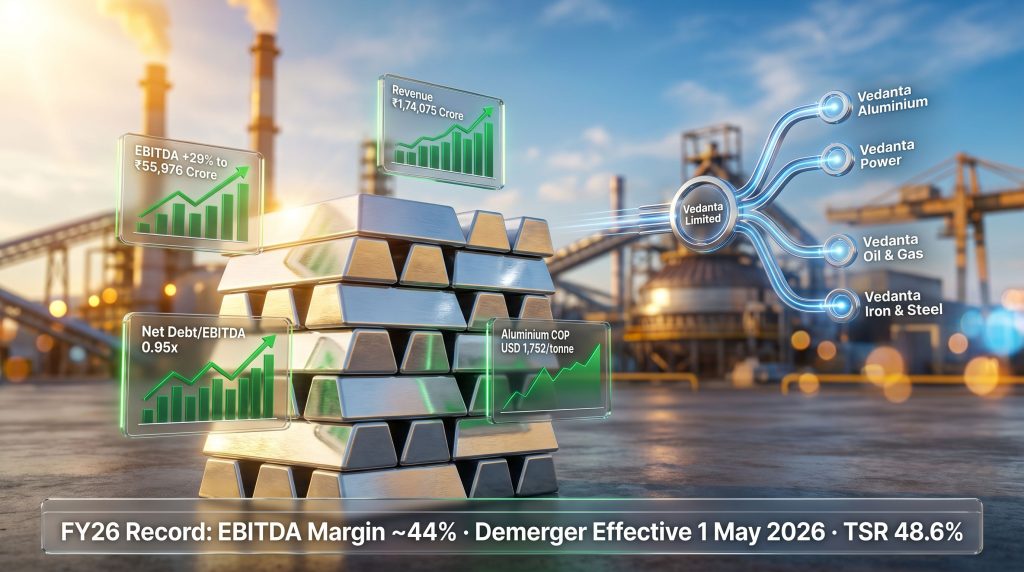
| EBITDA | ₹43,541 crore (USD 5.19B) | ₹55,976 crore (USD 5.87B) | +29% |
| Profit After Tax | ₹20,535 crore (USD 2.45B) | ₹25,096 crore (USD 2.63B) | +22% |
| Net Debt/EBITDA | 1.22x | 0.95x | Improved |
| Free Cash Flow (Pre-Capex) | – | ₹26,013 crore (USD 2.73B) | – |
The EBITDA margin expanding to approximately 39% for the full year reflects not merely commodity price luck but a deliberate strategy of cost compression executed alongside capacity expansion. When a producer simultaneously lowers its cost per unit and benefits from rising realised prices, the margin amplification is multiplicative rather than additive.
EBITDA margin for Q4 FY26 reached approximately 44%, representing an improvement of 915 basis points year-on-year and reflecting the strongest single-quarter profitability Vedanta has recorded.
What is less commonly understood is the significance of the net debt-to-EBITDA ratio falling to 0.95x, the best leverage position across the preceding 14 quarters. In commodity-linked businesses, leverage ratios below 1.0x are not merely a balance sheet metric but a strategic signal: they indicate a company has sufficient cash generation capacity to self-fund growth capex without dilutive equity raises or debt accumulation during the next capital cycle. Furthermore, the commodity price impact on margins during this period was meaningfully amplified by commodity price impact on profitability across the broader sector.
Q4 FY26: Dissecting the Quarter That Redefined Vedanta's Earnings Trajectory
The fourth quarter alone deserves detailed examination, as its results set a new performance benchmark and provided a high-exit-rate momentum heading into the demerger period.
| Metric | Q3 FY26 | Q4 FY25 | Q4 FY26 | QoQ Change | YoY Change |
|---|---|---|---|---|---|
| Revenue | ₹45,899 crore | ₹39,789 crore | ₹51,524 crore | +12.3% | +29% |
| EBITDA | ₹15,171 crore | ₹11,618 crore | ₹18,447 crore | +21.6% | +59% |
| PAT | ₹7,807 crore | ₹4,960 crore | ₹9,352 crore | +19.8% | +89% |
| EBITDA Margin | – | ~35% | ~44% | – | +915 bps |
Four distinct forces combined to produce Q4's exceptional profitability:
- LME aluminium price appreciation and meaningfully improved realised premiums across primary metal sales
- Higher production volumes concentrated in the aluminium and energy segments, reflecting completed commissioning phases
- Foreign exchange tailwinds amplifying USD-denominated commodity revenues when converted to Indian rupees
- Sustained cost discipline that lowered per-unit production expenses even as output volumes increased
The 89% year-on-year PAT growth in Q4 is particularly noteworthy from an operational leverage perspective. It illustrates how a largely fixed-cost smelting and refining infrastructure generates disproportionate profit growth when revenue increases, a characteristic that becomes especially valuable when volumes are simultaneously expanding.
Vedanta Aluminium's Operational Architecture: Why the Cost Story Matters Most
The Significance of USD 1,752 Per Tonne
Vedanta Aluminium's cost of production reaching USD 1,752 per tonne in FY26, the lowest in five years, is not simply an efficiency metric. In global aluminium markets, cost positioning determines which producers survive commodity price downturns and which ones thrive during upswings. The global cost curve for primary aluminium production typically ranges from approximately USD 1,400 per tonne at the most efficient smelters to well above USD 2,500 per tonne for high-cost producers in energy-constrained regions.
At USD 1,752 per tonne, Vedanta Aluminium sits in the lower quartile of the global cost curve, a position achieved through:
- Backward integration into alumina: The Lanjigarh refinery's 2.9 million tonne annual output reducing reliance on third-party alumina procurement, which typically represents 30–35% of total aluminium production costs
- Captive power generation: Integrated power capacity eliminating exposure to grid electricity pricing, the single largest variable cost in aluminium smelting globally
- Operational scale: Larger facilities distribute fixed overhead costs across greater output volumes, compressing per-unit costs
- Bauxite supply chain integration: Reducing exposure to bauxite spot market pricing volatility
In addition, this approach to production sustainability mirrors broader industry efforts to align cost reduction with long-term environmental responsibility.
Production Records and Expansion Milestones
Annual aluminium output reached approximately 2.46 million tonnes in FY26, a 1% year-on-year improvement achieved primarily through operational efficiency rather than new greenfield capacity. This distinction matters: efficiency-driven volume gains carry lower capital intensity and higher incremental margin than greenfield additions.
The more significant production story was at the Lanjigarh alumina refinery, where output surged 48% year-on-year, reaching a record annual level with an exit run-rate of 4 MTPA following the commissioning of the 5 MTPA expansion phase. In refinery economics, achieving a high run-rate exit velocity heading into the next financial year is strategically important because it establishes the production baseline from which further aluminium metal output growth is possible.
Capital expenditure across aluminium growth projects for FY26 totalled ₹14,918 crore (USD 1.57 billion), deployed across three primary workstreams:
- Lanjigarh Train II expansion: Phased commissioning contributing to the 5 MTPA capacity milestone, with the refinery now positioned among India's largest alumina production facilities
- BALCO smelter upgrade: Capacity elevated to 1 MTPA by Q3 FY26, placing BALCO within the select group of smelters globally that exceed the million-tonne threshold
- Jharsuguda downstream aluminium park: Expansion progressing through Q2 FY26, with the longer-term target of reaching 6 MTPA smelter capacity establishing Jharsuguda as one of the world's largest single-location aluminium complexes
ESG as a Competitive Variable, Not Just a Reporting Obligation
Vedanta Aluminium's ranking second globally in the S&P Corporate Sustainability Assessment for the third consecutive year carries practical commercial implications that extend beyond reputational value. Institutional investors operating under ESG mandates increasingly apply sustainability screening to emerging market industrial companies, and a top-two global ranking in the aluminium sector creates direct access to capital pools that would otherwise remain closed.
The Jharsuguda facility's recognition as Indian Manufacturer of the Year by Frost & Sullivan further reinforces operational credibility at the facility level, relevant context for offtake agreements, project financing, and supply chain partnerships with sustainability-conscious downstream customers. This trajectory is broadly consistent with the performance of top aluminium companies globally that are integrating ESG outcomes into core business strategy.
Oil & Gas and Power: The Supporting Cast With Strategic Depth
Cairn Oil & Gas: Stability With Exploratory Upside
While aluminium dominated the earnings narrative, the Oil & Gas segment through Cairn maintained average gross operated production of 87.2 kboepd across FY26, providing consistent hydrocarbon revenue against a backdrop of global energy market volatility.
The more strategically significant development was the gas discovery at the Ambe Block on India's West Coast, estimated to add approximately 13 million barrels of oil equivalent in reserves and resources. In upstream oil and gas valuation, reserve additions are typically assessed on a present-value basis against discovery and development costs. A 13 mmboe addition at Indian West Coast development economics could represent meaningful net asset value accretion for what will become an independently listed entity post-demerger.
Cairn's debut participation in the S&P Corporate Sustainability Assessment, emerging as the highest-scoring Indian company in the Oil & Gas Upstream and Integrated category, signals a deliberate effort to build ESG credentials ahead of its independent listing.
Power Segment: Long-Term Revenue Visibility
The commissioning of approximately 1.3 GW of new power capacity during FY26, combined with the securing of a five-year, 500 MW power purchase agreement for the Meenakshi and Athena projects, establishes predictable long-term cash flows for what will become Vedanta Power as a standalone entity.
The TSPL plant availability rate of 83% across the year reflects the consistent operational performance that underpins power purchase agreement compliance, a critical metric for utility-scale power generators whose revenue depends on contracted availability guarantees.
An often-overlooked strategic dynamic is the relationship between the power and aluminium segments. Aluminium smelting is one of the most energy-intensive industrial processes globally, consuming approximately 14–15 megawatt-hours per tonne of aluminium produced. Vedanta's integrated power capacity effectively functions as a cost hedge for its smelting operations, with the power segment's economics directly supporting the aluminium segment's COP competitiveness.
Balance Sheet Fortification: Entering the Demerger From a Position of Strength
Debt Reduction and Liquidity Metrics
| Balance Sheet Metric | Position |
|---|---|
| Net Debt | ₹53,254 crore (USD 5.59B) |
| Gross Debt | ₹81,740 crore |
| Cash and Equivalents | ₹28,485 crore (USD 2.99B, +38% YoY) |
| Net Debt/EBITDA | 0.95x (14-quarter best) |
| Free Cash Flow (Pre-Capex) | ₹26,013 crore (USD 2.73B) |
The 38% year-on-year increase in cash and cash equivalents to ₹28,485 crore is a particularly important pre-demerger metric. When a conglomerate separates into independent entities, each business unit requires sufficient standalone liquidity to service its own obligations and fund initial capital requirements without the support of cross-entity cash pooling arrangements.
Both CRISIL and ICRA reaffirmed Vedanta's credit rating at AA/Watch with Developing Implications, a designation that acknowledges the structural complexity of the demerger process while maintaining investment-grade recognition for the group's standalone credit quality.
Shareholder Returns and Market Re-Rating
Vedanta distributed a total dividend of ₹34 per share during FY26, including ₹11 per share in Q4, representing a meaningful yield component for shareholders during the transition year. The company's total shareholder return of 48.6% across FY26, more than double the Nifty Metal Index performance, reflects the market's progressive recognition of the demerger value-unlock thesis.
Brokerage price targets shifted dramatically over the period, moving from a range of ₹470–550 in mid-to-late 2025 to ₹780–965 by early 2026. This re-rating trajectory is consistent with markets pricing in a sum-of-the-parts valuation premium as the demerger completion date approached, with aluminium's approximately 50% EBITDA contribution positioning Vedanta Aluminium as the flagship asset driving the group's revised valuation multiples.
Vedanta's CFO characterised the period as a defining point for the company, noting the delivery of record financial performance across revenue, EBITDA and profit after tax for both the quarter and the full year, alongside clear positioning for the next growth phase following the demerger taking effect on 1 May 2026.
The next major ASX story will hit our subscribers first
Understanding the Five-Entity Demerger: Structure, Rationale and Mechanics
Why Break Up a Conglomerate at Peak Earnings?
The timing of Vedanta's demerger during a record financial year is counterintuitive at first glance but strategically deliberate. Conglomerate discount theory in corporate finance suggests that diversified industrial groups typically trade at a discount to the sum of their individual parts, primarily because investors in different sectors apply different valuation multiples to different business types.
A commodity metals producer and an upstream oil and gas company, for instance, attract entirely different investor bases with distinct risk tolerances, capital allocation frameworks, and return expectations. Separating them allows each to attract sector-specialist capital at multiples appropriate to their individual growth and cash flow profiles. This mirrors the Alcoa aluminium joint venture approach of creating focused structures to maximise investor clarity and valuation efficiency.
The Five Listed Entities Post-Demerger
| Entity | Core Business | Status |
|---|---|---|
| Vedanta Limited (Existing) | Zinc, Silver and residual operations | Continues as listed entity |
| Vedanta Aluminium | Primary aluminium, alumina, bauxite | New listed entity |
| Vedanta Power | Thermal and renewable power generation | New listed entity |
| Vedanta Oil & Gas | Upstream oil and gas (Cairn) | New listed entity |
| Vedanta Iron & Steel | Iron ore and steel operations | New listed entity |
Share Allocation Mechanics: A Step-by-Step Breakdown
For existing Vedanta Limited shareholders, understanding the demerger entitlement structure is critical for portfolio management decisions:
- The record date was established as 1 May 2026, the date on which share ownership was assessed for demerger entitlements
- As 1 May 2026 was a market holiday, shares traded on an ex-demerger basis from 30 April 2026
- Every eligible shareholder on the record date receives one share each in all four newly created entities for every Vedanta Limited share held
- New shares are credited directly to shareholders' existing demat accounts without requiring additional action
- The four new entities are expected to commence separate trading on Indian stock exchanges, with a possible June 2026 debut subject to exchange listing process completion
Under Vedanta's demerger scheme effective 1 May 2026, every eligible shareholder receives one share each in Vedanta Aluminium, Vedanta Power, Vedanta Oil & Gas, and Vedanta Iron & Steel for every Vedanta Limited share held on the record date.
What Vedanta Aluminium Looks Like as a Standalone Business
As an independently listed entity, Vedanta Aluminium brings a compelling standalone investment case built on several structural advantages that are often obscured within conglomerate reporting:
- A USD 1,752 per tonne cost of production positioning it in the lower quartile of the global cost curve, providing margin protection across commodity price cycles
- 2.46 million tonnes of annual output generating a large, diversified revenue base with established customer relationships
- An active expansion pipeline targeting 5 MTPA alumina from Lanjigarh, 6 MTPA smelting capacity from Jharsuguda, and 1 MTPA from BALCO, providing a clear production growth roadmap
- Second-ranked global ESG credentials in the S&P Corporate Sustainability Assessment facilitating institutional investor access
- Captive power integration providing structural cost advantages versus peers relying on grid electricity
FY27 Outlook: Macro Tailwinds, Capacity Pipeline and Demerger Value Unlock
Segment-Specific Growth Priorities
Vedanta's operational priorities entering FY27 span three major workstreams:
- Aluminium: Continued ramp-up of Lanjigarh toward the full 5 MTPA alumina capacity; downstream expansion at Jharsuguda targeting the 6 MTPA smelter scale milestone; BALCO stabilising operations at 1 MTPA
- Oil & Gas: Development of the Ambe Block gas discovery; production optimisation supported by the Asian Energy Services integrated services contract valued at ₹865 crore
- Power: Long-term revenue visibility underpinned by the 500 MW PPA; additional capacity commissioning aligned with smelting operation requirements
Global Aluminium Market Dynamics Supporting the Outlook
Several macro factors are providing tailwinds for aluminium pricing and demand that extend beyond any single producer's operational decisions. Furthermore, the global steel outlook provides a useful parallel lens through which to assess how broader metals markets are responding to infrastructure and energy transition demand.
- Geopolitical supply disruptions: Production curtailments linked to Middle East conflict tensions, including concerns around Gulf-region smelter operations such as Qatalum in Qatar, have contributed to LME price elevation by creating uncertainty around global primary aluminium supply
- India's infrastructure spending cycle: Government-driven infrastructure programmes and energy transition investments sustaining domestic aluminium demand growth, with India's per-capita aluminium consumption still significantly below developed market benchmarks, implying structural demand growth runway
- Energy transition demand: Aluminium's critical role in electric vehicle lightweighting, renewable energy infrastructure (solar frames, wind turbines) and high-voltage power transmission providing secular demand tailwinds independent of near-term economic cycles
According to Vedanta's record FY26 earnings reporting, the demerger is being positioned as the beginning of a new growth phase rather than merely a corporate restructuring exercise, with each entity expected to pursue independent capital market strategies suited to its specific sector dynamics.
Disclaimer: All financial forecasts, analyst price targets, and market outlook statements referenced in this article reflect publicly available information and analyst estimates as of the reporting period. They do not constitute investment advice. Past financial performance and commodity price trends are not reliable indicators of future results. Readers should conduct independent research and consult qualified financial advisers before making any investment decisions.
Frequently Asked Questions: Vedanta FY26 Results and Demerger
What was Vedanta's total revenue in FY26?
Vedanta's consolidated revenue for FY26 reached ₹1,74,075 crore (approximately USD 18.27 billion), representing a 15% increase over the prior year.
When did the Vedanta demerger become effective?
The demerger became effective on 1 May 2026, with the ex-date falling on 30 April 2026 due to the market holiday.
How many new companies will Vedanta create through the demerger?
The demerger creates four new independently listed entities alongside the continuing Vedanta Limited, resulting in a total of five listed companies.
What is Vedanta Aluminium's cost of production?
Vedanta Aluminium reported a cost of production of USD 1,752 per tonne in FY26, the lowest recorded in five years and placing it in the lower quartile of the global aluminium cost curve.
What was Vedanta's net debt-to-EBITDA ratio at the end of FY26?
Net debt-to-EBITDA improved to 0.95x as of 31 March 2026, the strongest leverage ratio achieved across the preceding 14 quarters.
What dividend did Vedanta pay in FY26?
Vedanta distributed a total dividend of ₹34 per share during FY26, including ₹11 per share in the fourth quarter.
When will the demerged Vedanta entities list on stock exchanges?
Media reports have indicated a possible listing in June 2026, though the precise timing remains subject to the completion of exchange listing procedures.
Key Takeaways: Vedanta FY26 and Demerger Summary
| Theme | Key Data Point |
|---|---|
| Revenue Growth | +15% YoY to ₹1,74,075 crore |
| EBITDA Growth | +29% YoY to ₹55,976 crore |
| PAT Growth | +22% YoY to ₹25,096 crore |
| Q4 PAT YoY Growth | +89% to ₹9,352 crore |
| Aluminium COP | USD 1,752/tonne (5-year low) |
| Aluminium Production | ~2.46 million tonnes |
| Lanjigarh Output Growth | +48% YoY to 2.9 million tonnes alumina |
| Net Debt/EBITDA | 0.95x (14-quarter best) |
| Demerger Effective Date | 1 May 2026 |
| New Listed Entities | 4 (plus continuing Vedanta Ltd) |
| Total Shareholder Return | 48.6% in FY26 |
| Growth Capex FY26 | ₹14,918 crore (USD 1.57B) |
The convergence of record earnings, meaningful balance sheet improvement, and a transformative demerger structure makes the Vedanta FY26 results and demerger one of the most consequential corporate events in India's metals and mining sector in over a decade. As each of the five entities begins its independent journey, the aluminium business in particular enters the market with a rare combination of scale, cost competitiveness, expansion momentum, and ESG credentials that position it as one of the more compelling standalone industrial listings in the Asia-Pacific metals space.
Want to Catch the Next Major Metals Discovery Before the Market Does?
Discovery Alert's proprietary Discovery IQ model instantly scans ASX announcements to identify significant mineral discoveries — turning complex commodities data into clear, actionable opportunities the moment they're made public. Explore why major mineral discoveries have historically delivered extraordinary returns, and begin your 14-day free trial at Discovery Alert to position yourself ahead of the market.