
May 15, 2026
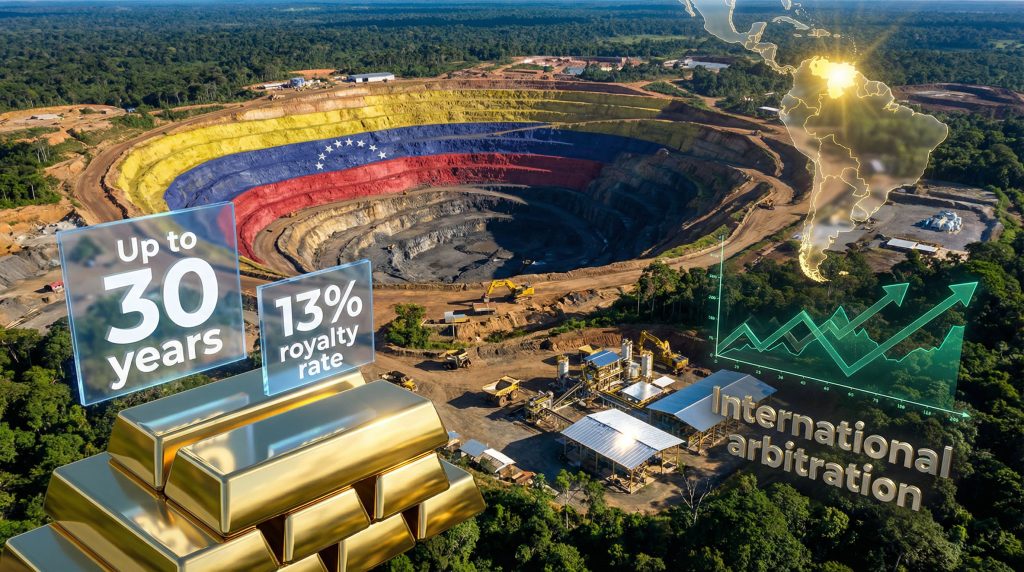
Venezuela's mining sector underwent a comprehensive legislative overhaul in April 2026, representing the most substantial policy shift since the nationalisation waves of the early 2000s. The Venezuela mining law investment framework fundamentally restructures how international capital can participate in the country's extractive industries, moving from state-controlled operations toward a hybrid model that permits foreign ownership while maintaining government oversight of strategic resources. This regulatory transformation creates unprecedented opportunities for international investors seeking exposure to one of South America's most mineral-rich territories.
Understanding Venezuela's Revolutionary Mining Framework Transformation
Venezuela's new mining legislation eliminates previous restrictions that effectively barred international mining companies from establishing operations. Under the updated framework, foreign entities can now secure mining concessions directly, participate in joint ventures with Venezuelan partners, and access dispute resolution mechanisms that bypass the domestic court system entirely. Furthermore, the US Policy Change PDVSA has created additional pathways for international engagement.
The new framework establishes key legislative changes that include concession periods extended to 30 years with renewal options and international arbitration mechanisms for dispute resolution. Additionally, transparent royalty structures replace ad-hoc arrangements, while foreign ownership permissions now extend across all mineral categories. Consequently, streamlined permitting processes for qualified investors have become available, addressing longstanding concerns about mining permitting insights.
The timing of these reforms coincides with broader economic pressures facing Venezuela, including the need to diversify revenue streams beyond petroleum exports. Mining industry specialists note that this legislative shift represents a pragmatic acknowledgment that state-led extraction models have proven insufficient for developing the country's substantial mineral endowments.
Comparative Analysis of Regional Mining Investment Frameworks
Venezuela's new mining law positions the country within competitive parameters relative to other Latin American jurisdictions. The 30-year concession periods with renewal options align with industry standards across the region, while the introduction of international arbitration addresses longstanding concerns among international investors about judicial independence.
Regional Mining Framework Comparison:
| Country | Concession Duration | Royalty Range | Arbitration Access |
|---|---|---|---|
| Venezuela (2026) | 30 years + renewals | Up to 13% | International |
| Chile | 30 years | 5-14% sliding | Limited |
| Peru | Indefinite | 1-12% sliding | International |
| Colombia | 30 years | 4-10% | Bilateral treaties |
| Brazil | Variable | 1.5-4% | Case-by-case |
The royalty structure established under Venezuela's new framework incorporates both production-based payments and operational taxes. This approach creates a dual revenue stream for the government while providing cost predictability for operators. However, this differs from pure sliding-scale models used elsewhere in the region, where royalty rates fluctuate based on commodity prices or production volumes.
When big ASX news breaks, our subscribers know first
International Arbitration Mechanisms and Sovereign Risk Mitigation
The introduction of international arbitration represents perhaps the most significant risk mitigation factor for potential Venezuela mining law investment opportunities. This mechanism allows companies to resolve disputes through established international forums rather than relying solely on Venezuelan domestic courts. Furthermore, it addresses concerns about judicial independence that have deterred investment for over two decades.
Historical context illuminates why this provision carries particular weight in Venezuela's case. The country has faced numerous high-profile disputes with international mining companies, including cases involving companies that had established significant operations before nationalisation policies took effect. These precedents created substantial sovereign risk premiums that effectively priced Venezuelan opportunities out of most institutional investment portfolios.
"The arbitration clause fundamentally transforms the risk-return equation for international mining investments in Venezuela, potentially reducing political risk premiums that have historically made projects uneconomical despite favourable geology."
International arbitration mechanisms typically operate through established frameworks such as the International Centre for Settlement of Investment Disputes (ICSID) or the London Court of International Arbitration (LCIA). These forums provide neutral venues for resolving commercial disputes, with decisions that are generally enforceable across multiple jurisdictions.
For Venezuela mining law investment strategies, the arbitration provision creates several practical advantages including predictable dispute resolution timelines compared to domestic court systems and internationally trained arbitrators with mining industry expertise. Additionally, enforceable awards across multiple jurisdictions reduce political interference in commercial disputes whilst providing precedent-based decision making that ensures greater certainty.
Financial Structure Analysis: Royalties, Taxes, and Investment Returns
Venezuela's new mining legislation establishes a comprehensive financial framework that combines production royalties with operational taxes. This creates a dual-stream revenue model for government receipts while providing cost transparency for operators. The royalty structure caps payments at 13% of gross production value, while additional operational taxes can reach 6% for primary mining activities.
This financial architecture differs significantly from previous arrangements, which often involved ad-hoc negotiations between operators and government officials. The standardised approach provides greater predictability for financial modelling, which is a critical factor for securing project financing in international capital markets.
Venezuela Mining Investment Financial Framework:
| Revenue Component | Maximum Rate | Application Basis | Payment Frequency |
|---|---|---|---|
| Production Royalty | 13% | Gross production value | Monthly |
| Operational Tax | 6% | Primary mining activities | Quarterly |
| Concession Fees | Variable | Per hectare basis | Annual |
| Export Duties | To be determined | FOB value | Per shipment |
The gross production value basis for royalty calculations provides transparency compared to net revenue models. However, this approach also means that royalty obligations persist regardless of operational profitability, requiring robust financial planning for projects in development phases or during commodity price downturns.
Cash Flow Modelling Considerations
Investment analysis for Venezuela mining law investment opportunities must account for several unique factors that distinguish these projects from operations in more established mining jurisdictions. Currency controls, while recently relaxed, continue to influence fund repatriation strategies. Additionally, the requirement for gold sales to proceed through the Central Bank of Venezuela creates specific liquidity considerations for precious metals operations.
Working capital requirements may exceed typical mining operations due to infrastructure limitations and supply chain complexities. Companies planning Venezuela mining law investment strategies should model additional inventory requirements and extended payment cycles for local suppliers. Furthermore, potential costs for developing supporting infrastructure that might be available in more established mining regions must be considered.
Strategic Mineral Resources and Geological Potential
Venezuela possesses substantial mineral endowments beyond its well-known petroleum reserves, with geological surveys indicating significant potential across multiple commodity categories. The Orinoco Mining Arc, covering approximately 111,000 square kilometres in the southern region, contains documented reserves of gold, diamonds, iron ore, bauxite, and various strategic minerals essential for modern technology applications.
Gold represents the most immediately attractive opportunity under the new legislative framework, with estimated reserves exceeding 15,000 tonnes concentrated primarily in Bolivar and Amazonas states. These deposits include both alluvial and hard-rock formations, offering opportunities for different extraction technologies and investment scales.
Primary Mineral Resources in Venezuela:
- Gold: Estimated 15,000+ tonnes in proven and probable reserves
- Iron Ore: Substantial deposits in the Guiana Shield region
- Bauxite: Large lateritic deposits suitable for aluminium production
- Diamonds: Alluvial and kimberlite formations in southern regions
- Rare Earth Elements: Preliminary surveys indicate potential deposits
- Coltan: Strategic mineral deposits relevant to technology applications
The geological diversity creates opportunities for both large-scale industrial operations and smaller-scale specialised extraction projects. However, much of Venezuela's mineral potential remains underexplored due to limited investment in modern geological surveys and exploration technologies over the past two decades.
Infrastructure Requirements and Development Challenges
Venezuela mining law investment opportunities face significant infrastructure constraints that must be factored into project economics and development timelines. Remote mineral deposits often lack adequate transportation networks, reliable power generation, and modern telecommunications systems essential for contemporary mining operations.
Critical Infrastructure Development Needs:
- Transportation Networks: Road and rail connections to remote mining areas
- Power Generation: Reliable electricity supply for processing operations
- Water Management: Treatment facilities and sustainable supply systems
- Telecommunications: Digital connectivity for monitoring and safety systems
- Port Facilities: Export infrastructure for international mineral sales
- Social Infrastructure: Housing, healthcare, and education facilities for workforce
These infrastructure requirements represent both challenges and opportunities for investors. Companies with expertise in remote area development may find competitive advantages, while the infrastructure needs create potential for public-private partnerships that could reduce individual project risk exposure.
US Sanctions Evolution and Compliance Considerations
Recent modifications to US Treasury sanctions have created new pathways for mineral-related transactions involving Venezuela, coinciding with the country's legislative reforms. The Office of Foreign Assets Control (OFAC) published updated licensing guidance in March 2026 that specifically addresses mineral transactions under defined conditions.
These licensing modifications permit certain transactions related to Venezuelan mineral exports, including gold operations, provided they meet specific compliance requirements and involve authorised entities. However, the sanctions framework remains complex and requires careful legal analysis for any potential Venezuela mining law investment strategy. Consequently, understanding these regulatory changes becomes crucial for international investors.
OFAC Compliance Requirements for Venezuela Mining Investment:
- Enhanced due diligence on all Venezuelan counterparties
- Real-time transaction monitoring and reporting obligations
- Legal structure optimisation to ensure sanctions compliance
- Regular compliance audits and documentation maintenance
- Coordination with legal counsel specialising in sanctions law
The evolving sanctions landscape creates both opportunities and risks for international investors. While recent modifications have opened specific pathways for mineral sector engagement, the regulatory framework remains subject to geopolitical developments that could affect compliance requirements or licensing availability. Moreover, the executive order on permits has influenced the broader regulatory environment.
Legal Structure Optimisation for Sanctions Compliance
Successful Venezuela mining law investment strategies require sophisticated legal structures that navigate sanctions requirements while optimising operational efficiency and tax considerations. Many investors utilise offshore holding companies domiciled in jurisdictions with clear sanctions compliance frameworks and established mining law precedents.
These structures typically involve multiple layers of legal entities, with operational companies incorporated in jurisdictions that provide both sanctions clarity and investment protection. Insurance coverage through specialised political risk providers can further mitigate sanctions-related risks whilst providing protection against policy changes.
Investment Models and Partnership Structures
The new Venezuelan mining legislation permits various partnership arrangements that can optimise risk distribution while providing access to local expertise and government relationship management. Joint venture structures have emerged as particularly attractive for international investors seeking to establish operations under the updated regulatory framework.
Viable Investment Approaches:
- Direct Foreign Investment: Wholly-owned subsidiaries for maximum control
- Joint Ventures: Risk-sharing partnerships with Venezuelan entities
- Management Contracts: Technical expertise provision without equity exposure
- Infrastructure Development: Mining-adjacent services and logistics focus
- Technology Transfer: Equipment and expertise provision arrangements
Joint ventures offer several advantages in the Venezuelan context, including local regulatory knowledge and established government relationships. Additionally, they provide shared infrastructure costs. However, these arrangements require careful structuring to ensure decision-making authority alignment and equitable profit distribution mechanisms.
Due Diligence Framework for Venezuela Mining Investment
Comprehensive due diligence for Venezuela mining law investment opportunities requires enhanced scrutiny across multiple dimensions given the country's complex regulatory history and ongoing economic challenges. Technical, legal, financial, and political risk assessments must be more thorough than typical emerging market mining investments. Furthermore, legal dispute resolution mechanisms must be carefully evaluated.
Enhanced Due Diligence Components:
- Geological Assessment: Independent reserve verification and exploration potential
- Legal Title Review: Concession validity and potential conflicting claims
- Environmental Compliance: Current and historical environmental liabilities
- Security Evaluation: Regional security conditions and operational safety
- Political Risk Analysis: Scenario planning for various political outcomes
- Sanctions Compliance: Comprehensive legal review of OFAC requirements
The technical due diligence process should include independent geological assessments by internationally recognised consulting firms. This is particularly important given limited recent exploration activity in many Venezuelan mineral provinces. Environmental assessments require particular attention due to potential legacy contamination issues and current regulatory enforcement capabilities.
The next major ASX story will hit our subscribers first
Market Entry Timing and Strategic Considerations
The timing of market entry for Venezuela mining law investment opportunities presents a classic first-mover advantage versus risk management dilemma. Early entrants may secure premium concessions and establish crucial government relationships, while later entrants can benefit from observing initial implementation experiences and regulatory clarifications.
Current market conditions suggest a bifurcated approach may be optimal, with initial investments focused on lower-risk opportunities. These provide market intelligence and relationship development, followed by larger commitments as the regulatory environment demonstrates stability and effectiveness. Additionally, understanding broader mining industry trends can inform strategic decision-making.
Phased Investment Strategy Benefits:
- Risk Mitigation: Graduated exposure allows learning and adjustment
- Relationship Building: Early presence facilitates government and partner relationships
- Market Intelligence: Direct experience informs larger investment decisions
- Optionality Preservation: Maintains ability to scale up successful operations
- Capital Efficiency: Avoids large commitments during uncertainty periods
The new mining law's implementation timeline creates natural entry points for different investor categories. Exploration companies may find immediate opportunities, while larger industrial operators might prefer waiting for infrastructure development and regulatory precedent establishment.
Long-term Scenario Planning for Venezuela Mining Investment
Investment success in Venezuela's mining sector requires robust scenario planning that accounts for various political, economic, and regulatory outcomes over typical 15-30 year project lifecycles. The country's complex geopolitical position necessitates planning for multiple potential futures rather than single-point forecasts.
Optimistic Scenario Assumptions:
- Continued political stability and economic liberalisation
- Infrastructure development through public-private partnerships
- Further sanctions relief enabling full international integration
- Successful implementation of mining law without major modifications
- Regional economic integration creating export opportunities
Conservative Scenario Planning:
- Periodic political instability affecting regulatory consistency
- Limited infrastructure development constraining operational efficiency
- Continued sanctions restrictions limiting market access options
- Regulatory modifications requiring operational adjustments
- Regional economic challenges affecting commodity demand
Successful Venezuela mining law investment strategies incorporate flexibility mechanisms that allow operational adjustments based on changing conditions. These protect core investment interests through legal structures and insurance arrangements.
Environmental and Social Governance Implementation
Modern mining investments increasingly require robust Environmental, Social, and Governance (ESG) frameworks that meet international institutional investor standards. Venezuela's new mining law addresses some environmental requirements but may require supplementation to satisfy contemporary ESG compliance expectations.
The legislation includes provisions for environmental impact assessments and community engagement requirements, though implementation protocols remain under development. International investors should anticipate implementing ESG standards that exceed local requirements to maintain access to global capital markets and institutional investor mandates.
ESG Implementation Priorities:
- Environmental Management: Water treatment, waste management, and biodiversity protection
- Community Engagement: Local hiring, skills development, and benefit-sharing programmes
- Safety Standards: International safety protocols and incident reporting systems
- Governance Transparency: Regular reporting and stakeholder communication
- Human Rights Compliance: Labour standards and community rights protection
Companies pursuing Venezuela mining law investment opportunities should develop ESG implementation plans that anticipate future regulatory developments. These investments in responsible mining practices can provide competitive advantages whilst reducing operational and reputational risks.
International Perspective and Market Response
According to Reuters, the Venezuelan legislature's approval of this comprehensive mining law reflects a strategic shift towards attracting foreign investment in the mining sector. Furthermore, Le Monde reported that the sweeping legislative changes represent one of the most significant economic reforms in Venezuela's recent history.
The integration of ESG considerations into Venezuela mining law investment strategies represents both a compliance requirement and a strategic opportunity. This approach allows companies to differentiate operations in a crowded global mining marketplace while contributing to sustainable development in host communities.
Investment Disclaimer: This analysis is for educational purposes only and does not constitute investment advice. Venezuela mining law investment involves substantial risks including political, regulatory, and operational uncertainties. Prospective investors should conduct comprehensive due diligence and consult qualified legal and financial advisors before making investment decisions.
Ready to Capitalise on Emerging Mining Opportunities?
Discovery Alert's proprietary Discovery IQ model delivers real-time alerts on significant ASX mineral discoveries, helping investors identify actionable opportunities before they become mainstream news. Whether you're tracking emerging markets or established mining jurisdictions, staying ahead of major discoveries across all commodity sectors can provide the competitive edge needed for informed investment decisions. Start your 14-day free trial at Discovery Alert today and discover why timing is everything in mineral exploration investing.