June 8, 2026
The Structural Paradox at the Heart of Global Oil Markets
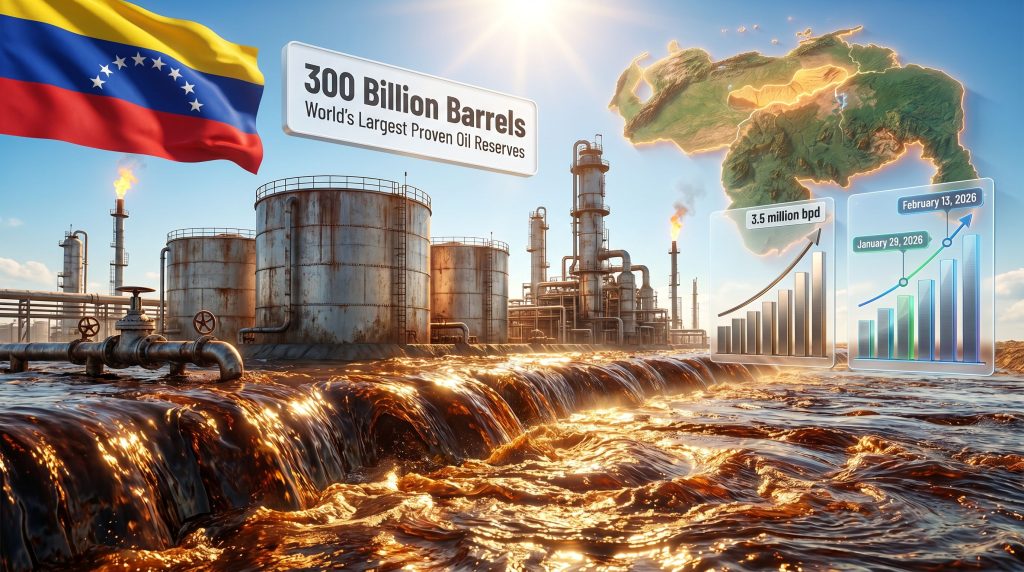
Few anomalies in global energy are as striking as the inverse relationship between resource endowment and productive output. Across the history of petroleum development, the nations holding the largest proven reserves have generally commanded the greatest production volumes. Venezuela breaks this pattern entirely. Sitting atop more than 300 billion barrels of proven crude reserves, the largest national endowment on the planet, the country produces only a fraction of what its geology can theoretically support. Understanding how that paradox formed, and whether Venezuela's newly enacted hydrocarbons framework can resolve it, matters well beyond Caracas.
At its late-1990s peak, Venezuela's oil sector delivered approximately 3.5 million barrels per day (bpd) to global markets. Today, production operates at a deeply depressed fraction of that figure, the result of two decades of institutional erosion, capital flight, and geopolitical isolation. The country's reopening to foreign investment, materialising through a reformed legal framework circulated in draft form during May 2026, represents one of the more consequential developments in Venezuela oil regulations to attract foreign investment in years.
When big ASX news breaks, our subscribers know first
Venezuela Oil Regulations to Attract Foreign Investment: The Legislative Architecture
A Timeline of Rapid Regulatory Change
The pace at which Venezuela's regulatory framework has evolved since early 2026 is notable. The sequence of milestones below illustrates how quickly the country moved from political transition to the production of investable legal infrastructure.
| Milestone | Date | Significance |
|---|---|---|
| Hydrocarbons Law Reform, Second Reading | January 29, 2026 | National Assembly approval; structural overhaul of oil governance |
| OFAC General License No. 49 Issued | February 13, 2026 | Expanded authorised U.S. energy activity in Venezuela |
| PDVSA Contract Model Circulated | Early May 2026 | Commercial templates distributed to interested energy companies |
| 63-Page Draft Regulations Released | May 2026 | Detailed technical, operational, fiscal, and control provisions |
| 1943 Oil Law and 1969 Regulations Abrogated | Concurrent with new law | Dismantling of statutory framework spanning more than 80 years |
The political precondition for all of this was the transition from the Maduro administration to a government led by Delcy Rodriguez following U.S.-facilitated leadership changes. That shift unlocked the diplomatic alignment necessary for regulatory reform to proceed. The Venezuela-PDVSA policy shift played a defining role in creating this opening. Critically, the U.S. Treasury's sanctions relief programme is structured across three distinct phases: stabilisation, economic recovery, and political transition. Each phase progressively expands the legal space available for foreign energy companies to re-engage with Venezuelan assets.
OFAC General License No. 49, issued on February 13, 2026, formalised the expansion of authorised U.S. oil-and-gas activity in Venezuela, explicitly permitting new investments and new joint venture formations. The issuance of this licence was not incidental to the regulatory reform process. It was a structural signal that U.S. sanctions architecture was being reconfigured in parallel with Venezuela's domestic legal changes.
The regulatory reforms emerging from Caracas and the sanctions adjustments emanating from Washington are not independent events. They form a coordinated legal corridor, and investors who evaluate one without the other are missing the most important variable in the risk equation.
What the 63-Page Draft Actually Contains
The draft regulations cover four primary operational dimensions:
- Technical provisions covering upstream operational standards, including mandatory enhanced and secondary recovery requirements applicable across all projects
- Operational provisions defining rules for activities previously exclusive to PDVSA, now opened to private operators, specifically oil refining, crude upgrading, and commercial trading
- Fiscal provisions establishing the financial terms for private company participation, including cost recovery structures and revenue-sharing arrangements
- Control provisions governing state oversight, data reversion rights, monitoring obligations, and enforcement mechanisms
Several of the concepts introduced in the draft are described by energy specialists as genuinely novel within Venezuela's historical regulatory tradition. These include:
- Domestic utilisation requirements mandating that a defined portion of output serves the country's internal energy needs before export
- Unitisation provisions enabling coordinated development of reservoirs that straddle multiple licence boundaries
- Mandatory data reversion requiring that all subsurface and operational data collected by private operators becomes state property
- Greenhouse gas monitoring obligations embedded as a formal compliance requirement rather than a voluntary disclosure
- Mandatory enhanced and secondary recovery apparently required across every project, not selectively applied at operator discretion
That last provision deserves particular attention. In most international upstream frameworks, enhanced oil recovery and secondary recovery techniques such as water flooding, gas injection, or chemical flooding are choices that operators make based on reservoir economics. Making them a baseline legal requirement across all projects significantly raises the capital entry threshold and will materially influence which companies are technically and financially qualified to participate.
The New Contract Model: From Joint Ventures to Productive Participation
How the Structure Has Changed
Venezuela's legacy framework required foreign participation to occur through majority-state-owned joint ventures, a model that concentrated commercial and operational risk within PDVSA's institutional structure. The reformed framework replaces this with what are termed contratos de participación productiva, or productive participation contracts. The distinction is substantive, not merely terminological. According to Reuters, however, while the reform encourages immediate investment, analysts believe it still needs to go deeper to fully unlock the sector's potential.
| Dimension | Legacy Framework | Reformed Framework |
|---|---|---|
| Primary structure | Majority-state-owned joint ventures | Productive participation contracts |
| National Assembly approval | Required for JV arrangements | Streamlined under new contractual model |
| Private company role | Minority partner in state-led JV | Contractor assuming management, cost, and operational risk |
| Hydrocarbon ownership | State-retained | State-retained (unchanged) |
| Sector access for private firms | Restricted to upstream | Expanded to refining, upgrading, and trading |
| Gas sector flexibility | Historically more open | Continues under reformed framework |
Under this structure, private companies domiciled in Venezuela assume full management responsibility and bear both operational costs and project-level financial risk. What does not change is the Venezuelan state's ownership of hydrocarbons in the ground. Resource sovereignty remains non-negotiable and is explicitly preserved across the entire reform architecture.
The downstream extension of private participation rights is arguably as significant as the upstream restructuring. Oil refining, crude upgrading, and trading were historically exclusive PDVSA functions. Opening these activities to private operators transforms the integrated economics of participation, reducing dependence on PDVSA as a commercial intermediary and eliminating one of the most persistent sources of payment delays and contractual friction experienced by foreign partners under the old framework.
For operators managing Venezuela's heavy Orinoco Belt crude, the upgrading provision is particularly consequential. Extra-heavy crude from the Orinoco typically carries an API gravity of 8 to 16 degrees, making it largely incompatible with standard refinery configurations without prior upgrading to a synthetic crude or diluted blend. Private access to upgrading operations removes a structural bottleneck that previously forced operators into dependence on PDVSA-controlled infrastructure.
Benchmarking Venezuela's Opening Against Comparable Emerging Oil Jurisdictions
How Does This Reform Measure Up?
Venezuela's liberalisation effort is not without historical precedent, but its scale and the quality of the underlying resource base set it apart from most comparable transitions. Furthermore, broader geopolitical trade tensions are adding additional complexity to how international investors assess frontier market re-entry strategies.
| Country | Reform Trigger | Private Access Model | State Ownership Retained? | Timeline to Meaningful FDI |
|---|---|---|---|---|
| Venezuela (2026) | Political transition and sanctions relief | Productive participation contracts | Yes | TBD, regulations still in draft form |
| Iraq (post-2003) | Regime change and reconstruction | Technical service contracts | Yes | 5 to 8 years to meaningful scale |
| Libya (post-2011) | Civil conflict resolution | Exploration and production sharing | Yes | Fragmented, ongoing instability |
| Myanmar (pre-2021) | Gradual liberalisation | Production sharing contracts | Partial | Reversed entirely by 2021 coup |
| Angola (2018 reforms) | Leadership transition | Open licensing rounds | Partial | 3 to 5 years to attract major IOCs |
A critical differentiator in Venezuela's case is that investors are not being asked to take exploration risk. The resource is proven, quantified, and already commercially characterised through decades of prior development work. The investment thesis is built on development and production economics, not on the geological uncertainty that typically defines frontier market entry. This simplifies the due diligence framework while concentrating all residual risk on operational execution and political continuity.
Iraq's post-2003 experience is instructive. Despite enormous reserve volumes and strong IOC interest, the journey from legislative reform to scaled production took the better part of a decade. Venezuela faces analogous infrastructure rehabilitation challenges, though with the additional complexity of a U.S. sanctions overhang that Iraq never had to navigate.
The ESG Dimension: Sustainability Provisions and Their Real-World Credibility
Embedded Obligations and Their Limits
The inclusion of greenhouse gas monitoring and reporting as a mandatory compliance obligation is a structural departure from Venezuela's historically thin environmental governance record in the oil sector. On paper, it aligns the framework with the ESG disclosure standards that major institutional investors and international oil companies operating under European or North American mandates are required to meet.
In practice, the gap between regulatory text and regulatory enforcement is where environmental provisions typically lose their substance. Environmental advocates have raised concerns that accelerated foreign investment in the Orinoco Belt and surrounding ecosystems could deepen ecological harm unless monitoring provisions are backed by independent verification, transparent reporting mechanisms, and enforceable financial penalties for non-compliance.
Embedding GHG monitoring requirements in the draft regulations may serve a dual function: providing a genuine environmental baseline, but also offering IOCs operating under internal ESG governance frameworks a regulatory hook that supports board-level justification for re-engagement with a historically controversial jurisdiction.
The cynical reading of the ESG provisions is that they are partly performative, designed to lower the reputational barrier for large international operators rather than to impose substantive environmental constraints. The more charitable reading is that even imperfect regulatory language creates a compliance infrastructure that can be strengthened over time. The truth likely contains elements of both.
Core Risk Factors That No Regulatory Text Can Resolve
Structural Vulnerabilities Persisting Into the New Framework
Venezuela's regulatory reform addresses the legal architecture of investment. It does not resolve the physical, institutional, and geopolitical vulnerabilities that accumulated during the isolation years. Investors evaluating Venezuela exposure need to model these risks as independent variables. Consequently, understanding the broader context of sanctions and oil trading dynamics elsewhere provides a useful comparative lens for assessing residual compliance risk.
Infrastructure Degradation
Upstream and downstream infrastructure across Venezuela has suffered from chronic underinvestment compounded by sanctions-era operational restrictions. Incoming operators face not only the capital burden of new project development but also the cost of rehabilitating existing production facilities, pipelines, water injection systems, and processing plants. Rehabilitation costs in some mature Venezuelan fields may rival greenfield development economics.
PDVSA's Institutional Capacity
PDVSA's ability to function as a technically and commercially credible counterparty is a central risk that cannot be legislated away. The company carries substantial legacy debt, has lost a significant portion of its experienced technical workforce through emigration, and operates under institutional governance that has been severely degraded over the past two decades. For incoming operators, counterparty risk with PDVSA is not a peripheral concern but a core project variable.
Regulatory Uncertainty During Transition
The regulations remain in draft form as of May 2026. Final fiscal terms, enforcement mechanisms, and dispute resolution provisions have not yet been confirmed. Venezuela's information and oil ministries declined to respond to requests for comment when contacted, a posture that reflects the opacity still characterising official communication channels.
Geopolitical Reversibility
Perhaps the most significant risk embedded in the entire framework is its dependency on the continuation of the current U.S.-Venezuela diplomatic alignment. The legal space that has been opened for foreign participation is a function of OFAC licence architecture and bilateral political relationships, both of which can shift rapidly. In addition, the geopolitical oil price drivers at play globally mean that external shocks could further complicate the investment calculus.
Investors must price geopolitical reversibility not as a tail risk but as a core scenario in their Venezuela exposure models. The Myanmar experience, where a fully developed legal framework for foreign investment was rendered inoperative within weeks of a political disruption, provides a sobering reference point.
The next major ASX story will hit our subscribers first
The Three-Phase Programme and Optimal Investment Timing
Positioning Strategy Across the Sanctions Relief Trajectory
The structure of the U.S. sanctions relief programme creates a specific temporal logic for investment positioning. Understanding which phase of the programme is active at any given moment directly determines what categories of activity are legally permissible and what financing structures are available. Furthermore, shifts in oil market geopolitics continue to influence how quickly capital flows into emerging energy jurisdictions.
| Phase | Primary Focus | Implication for Foreign Investors |
|---|---|---|
| Phase 1: Stabilisation | Political and institutional stabilisation | Regulatory framework development; early-mover contract positioning |
| Phase 2: Economic Recovery | Sanctions relief and financial system reintegration | Project financing becomes accessible; FDI inflows begin in earnest |
| Phase 3: Political Transition | Long-term governance normalisation | Full investment cycle viable; large-scale IOC re-entry becomes feasible |
Companies that engage during Phase 1, while regulatory uncertainty is highest, position themselves to negotiate more favourable contract terms before competitive pressure intensifies. However, the risk of regulatory reversal or political disruption is also concentrated in this phase. For most institutional investors with governance constraints on political risk exposure, the transition between Phase 1 and Phase 2 represents the more rational entry window: enough legal clarity to structure financing, but still early enough in the competitive cycle to capture commercial advantage.
Frequently Asked Questions: Venezuela's New Oil Investment Framework
What is Venezuela's new hydrocarbons law?
Venezuela's reformed Organic Law on Hydrocarbons was approved by the National Assembly on January 29, 2026, following a second reading. It replaces statutory structures dating back to 1943 and 1969 and creates a new contractual architecture for private sector participation in oil and gas.
Can foreign companies own Venezuelan oil reserves?
No. State ownership of hydrocarbons in the ground is preserved as a non-negotiable principle across the entire reform. Private companies operate as contractors, assuming management responsibility and financial risk without acquiring ownership rights over the resource.
What is a contrato de participación productiva?
It is the new contractual model introduced under the reformed law. Private companies domiciled in Venezuela contract with state entities to manage upstream oil and gas projects. The contractor bears financial risk and operational responsibility while the state retains resource sovereignty.
Are U.S. sanctions on Venezuela fully lifted?
No. Sanctions are being progressively relaxed under a structured three-phase programme. OFAC General License No. 49, issued in February 2026, expanded authorised U.S. energy activity but the sanctions architecture remains partially in place, with further relief contingent on political and diplomatic developments.
What does mandatory enhanced recovery mean for operators?
The draft regulations reportedly require enhanced and secondary recovery techniques to be implemented across all projects, not selectively at operator discretion. This represents a significant capital and technical obligation that will materially affect project economics and the criteria used to select qualified operators.
Which sectors beyond upstream are now open to private companies?
The new framework extends private participation rights to oil refining, crude upgrading, and oil trading, all of which were previously exclusive PDVSA functions. Venezuela oil regulations to attract foreign investment are specifically designed to make these sectors commercially accessible under the new productive participation contract model.
This article is intended for informational purposes only and does not constitute financial or investment advice. Venezuela's regulatory framework remains in draft form as of the date of publication, and all provisions are subject to revision before formal enactment. Investors should conduct independent due diligence and seek qualified legal and financial counsel before making any investment decisions related to Venezuelan energy assets. Geopolitical and regulatory risks associated with Venezuela remain elevated.
Want to Stay Ahead of Major Resource Discoveries Before the Broader Market Reacts?
While Venezuela's evolving hydrocarbons framework reshapes global energy investment thinking, Discovery Alert's proprietary Discovery IQ model is scanning ASX announcements in real time, delivering instant alerts on significant mineral discoveries across more than 30 commodities and turning complex data into actionable opportunities — explore historic discoveries and their returns, then begin your 14-day free trial to position yourself ahead of the market.