July 13, 2026
The Hidden Architecture of Venezuela's Oil Opening: Why Regulatory Design Determines Everything
Resource-rich nations attempting to reverse decades of capital flight rarely fail because of geology. They fail because of governance. When a country sits atop the world's largest proven crude reserves yet struggles to sustain output above 1.2 million barrels per day, the explanation lies not in what is underground but in the legal and institutional structures that determine who can access it, on what terms, and with what protections. Venezuela oil regulations are, consequently, a case study in exactly this dynamic.
Understanding what Venezuela's hydrocarbons law reform actually changes — and what it deliberately leaves unchanged — requires moving past headline announcements and examining the mechanical design of the framework being constructed.
When big ASX news breaks, our subscribers know first
Why the State-Monopoly Model Collapsed Under Its Own Weight
For roughly two decades, Venezuela's energy sector operated on the premise that PDVSA could function simultaneously as a commercial operator, a social spending vehicle, and a geopolitical instrument of the state. That triple mandate proved structurally incompatible with sustaining a technically demanding upstream industry.
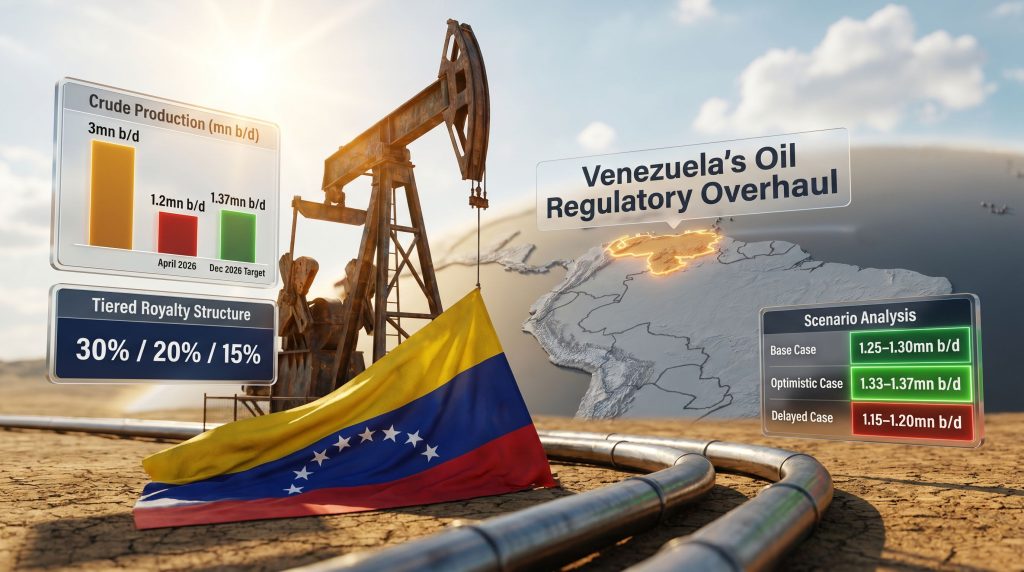
Peak production exceeded 3 million barrels per day in the late 1990s. By April 2026, output had fallen to approximately 1.2 million b/d, a collapse driven by chronic underinvestment, the departure of international technical expertise, sanctions pressure, and an institutional framework that provided no legal pathway for private capital to independently market crude or enforce dispute outcomes through international mechanisms.
The fundamental flaw was concentration of risk. With PDVSA as the mandatory intermediary for all commercial activity, every operational failure, every sanctions action, and every fiscal decision cascaded directly into production capacity. There was no redundancy in the system because the regulatory architecture had deliberately excluded it. For further context, the history of the Venezuelan oil industry illustrates how deeply embedded these structural challenges have become over successive decades.
What Venezuela's Reformed Hydrocarbons Law Actually Introduces
The legislation passed by Venezuela's national assembly earlier in 2026 represents a structural departure from the prior model in several specific respects:
- A tiered royalty structure establishes a standard rate of 30%, with reductions to 20% or 15% available for projects that cannot achieve commercial viability at the baseline rate
- Private companies operating through joint ventures with PDVSA now hold a legal right to directly market their proportional share of crude production, bypassing the prior requirement for state-intermediated sales
- The framework formally authorises private operating contracts and asset leasing arrangements, creating new entry mechanisms for international operators
- Investor dispute-resolution protections have been incorporated, with the hydrocarbons minister confirming that new contracts will include international arbitration provisions
- Ministerial authority over licensing approvals and sector governance has been expanded
Furthermore, Venezuela's new oil law specifically enables private companies to market crude independently, which represents a defining structural shift from the prior model.
Critical framing: This reform is best understood as controlled liberalisation rather than privatisation. The state retains structural primacy through mandatory PDVSA joint venture requirements, but commercial pathways for private and foreign capital have been selectively opened for the first time in the sector's recent history.
How Venezuela's Framework Compares to Regional Hydrocarbon Regimes
Placing Venezuela's reformed model in regional context reveals both how far the country has moved and how much institutional distance remains to close.
| Regulatory Dimension | Venezuela (Reformed) | Brazil (ANP Model) | Colombia | Mexico (Post-2013 Reform) |
|---|---|---|---|---|
| Royalty Rate | 15–30% (tiered) | 10–40% (variable) | 8–25% | 7.5–65% (sliding scale) |
| Private Marketing Rights | Yes (new) | Yes | Yes | Partial |
| International Arbitration | Confirmed (ministerial) | Yes | Yes | Limited |
| State JV Requirement | Mandatory (PDVSA) | Optional | Optional | PEMEX-linked |
| Contract Standardisation | Pending publication | Established | Established | Established |
Venezuela's tiered royalty range now overlaps with regional norms, and the introduction of private marketing rights closes a gap that had made the country structurally unattractive relative to Colombia and Brazil. However, the mandatory PDVSA joint venture requirement and the absence of published, standardised contract templates continue to differentiate Venezuela's framework unfavourably from more mature regional models.
A detail worth noting for investors: Brazil's ANP model and Colombia's framework both benefit from decades of implementing regulation tested through actual contract cycles. Venezuela is beginning that process from scratch, which introduces execution risk that royalty rate comparisons alone cannot capture.
The Three Unresolved Gaps Blocking Capital Commitment
Venezuela oil regulations as currently constituted leave three substantive questions unanswered, each of which creates a distinct category of investor risk.
1. Royalty Rate Qualification Criteria
The reduced royalty thresholds of 20% and 15% exist in the legislation, but no published methodology determines which projects qualify. The critical question is whether eligibility will be determined through a formula-based assessment tied to production costs and oil price benchmarks, or through ministerial discretion applied project by project.
Discretionary qualification creates negotiating asymmetry and the risk of inconsistent treatment across different joint venture structures. Without published criteria, project economics modelled at reduced royalty rates carry a qualification assumption that has no legal foundation yet.
2. International Arbitration Enforceability Architecture
Ministerial assurances have confirmed arbitration inclusion in new contracts. However, the underlying legislation does not explicitly exclude a domestic dispute resolution pathway. This creates legal ambiguity over which mechanism takes precedence when a dispute arises.
Venezuela's historical compliance record with international arbitration awards adds a sovereign risk premium that contractual language alone cannot eliminate. Investors should distinguish between the inclusion of arbitration clauses and the enforceability of arbitration outcomes, which depend on treaty frameworks and judicial independence that exist outside the hydrocarbons law itself.
3. Gazette Publication and Implementing Regulations
Multiple draft regulatory versions have circulated among market participants without formal gazette publication. As of late May 2026, Venezuela's hydrocarbons minister indicated that publication was imminent, but no confirmed gazette date had been established.
This matters because in Venezuela's legal system, implementing regulations only become legally enforceable upon official gazette publication. Until that occurs, the reform's provisions remain aspirational commitments rather than binding legal architecture.
Investor Warning: Capital commitment decisions timed to the reform's legislative passage rather than its gazette publication carry the risk of committing to a framework that has not yet achieved legal operationality. Due diligence timelines should explicitly account for this publication dependency.
The U.S. Sanctions Layer: How Washington's Framework Intersects With Caracas's Reforms
Venezuela oil regulations cannot be assessed in isolation from the U.S. sanctions environment, which operates as a parallel legal layer affecting which counterparties, transaction structures, and financial institutions can participate in any investment activity. The broader U.S. policy on PDVSA has evolved considerably in recent months, adding further complexity for international operators evaluating entry strategies.
Several significant developments have reshaped this landscape in 2026:
- A January 2026 executive action from the White House specifically addressed the management and safeguarding of Venezuelan oil revenues, signalling active U.S. engagement in how export proceeds are controlled
- OFAC subsequently lifted most restrictions on financial dealings with Venezuela's central bank, government institutions, and broader financial sector entities, improving transaction settlement access for international operators
- Certain U.S. companies have been granted authority to buy, sell, transport, store, and refine Venezuelan crude under specific licence conditions, though not all production-related sanctions have been removed
- The removal of former president Nicolás Maduro in January 2026 and the U.S. recognition of interim president Delcy Rodriguez's government has materially altered the bilateral diplomatic environment
| Sanctions Variable | Impact on Regulatory Reform Effectiveness |
|---|---|
| OFAC licensing requirements | Foreign investors must verify licence eligibility before engaging with PDVSA joint ventures |
| Revenue safeguarding measures | Controls on how export proceeds are received and repatriated remain active |
| Financial institution restrictions (partially lifted) | Improves banking access for transaction settlement |
| Production sanctions (partially retained) | Limits the universe of eligible foreign capital partners |
In addition, Trump administration policy shifts in the broader energy and resources sector have introduced parallel regulatory pressures that affect how U.S.-linked investors approach sovereign risk environments like Venezuela.
Venezuela's hydrocarbons minister Paula Henao's appearance at an American Association of Petroleum Geologists conference near Houston in May 2026 represents the first in-person ministerial engagement in the United States in at least a decade. The visit signals a deliberate diplomatic repositioning that runs parallel to the domestic regulatory reform agenda and reflects the changed bilateral relationship following the political transition in Caracas.
The next major ASX story will hit our subscribers first
Production Targets, Infrastructure Reality, and the Gap Between Them
Venezuela's government has set a production target of 1.37 million b/d by December 2026, against a reported output of approximately 1.2 million b/d in April 2026. The incremental gap of roughly 170,000 b/d sounds modest but requires meaningful capital deployment and operational restoration across assets that have experienced years of deferred maintenance.
Scenario Analysis: Production Outcomes Under Different Regulatory Timelines
| Scenario | Regulatory Publication Timeline | Production Outcome (Dec 2026) | Investment Confidence Level |
|---|---|---|---|
| Base Case | Gazette publication within 30–60 days | 1.25–1.30mn b/d | Moderate |
| Optimistic Case | Publication within 2 weeks, contract templates released simultaneously | 1.33–1.37mn b/d | High |
| Delayed Case | Regulations delayed beyond 90 days | 1.15–1.20mn b/d | Low |
The optimistic case depends not only on speed of gazette publication but on the simultaneous release of standardised contract templates that allow joint venture negotiations to advance without requiring bespoke legal structures for each transaction.
A lesser-known constraint in Venezuela's upstream recovery is the degradation of artificial lift infrastructure across Orinoco Belt heavy oil operations, where replacement parts procurement has been disrupted for years. Even with regulatory clarity, physical production gains in this region require lead times that compress the December 2026 target into a very narrow execution window.
The PDVSA-Citgo Dimension: Sovereign Debt as a Reform Constraint
A factor that does not appear in the hydrocarbons law text but directly shapes the reform's investability is PDVSA's financial condition. Venezuela's government announced plans in May 2026 to restructure all sovereign debt and PDVSA obligations, a liability pool that analysts estimate could reach up to $160 billion.
The ongoing U.S. court proceedings over Citgo add further complexity. Venezuela's legal team has argued that comparable U.S. independent refiner valuations — which have appreciated significantly partly due to the disruption of Iranian oil flows through the Strait of Hormuz — support a Citgo valuation of $15.1 billion, contrasting sharply with the $5.9 billion bid from Amber Energy that a U.S. district court selected as the auction winner.
Citgo itself reported a $157 million profit in Q1 2026, reversing a $82 million loss in Q1 2025, driven substantially by elevated fuel prices linked to supply chain disruptions in the Strait of Hormuz.
Analytical Note: A state oil company carrying tens of billions in legacy debt cannot function as a credible joint venture partner at the scale Venezuela's production targets require. The hydrocarbons reform's long-term effectiveness is therefore structurally dependent on parallel progress in PDVSA's fiscal rehabilitation, which involves a separate legal process with its own timeline and uncertainty.
A Regulatory Due Diligence Framework for Venezuela Entry
For investors seriously evaluating participation in Venezuela's reformed upstream market, a structured due diligence sequence is essential given the layered legal complexity. Understanding the broader geopolitical risk landscape is equally critical, as regional instability and sovereign risk factors can materially alter investment timelines and outcomes.
- Confirm Gazette Publication Status before any capital commitment. Verify that implementing regulations have been formally published and that the gazette version matches the draft versions that have circulated among market participants.
- Model All Three Royalty Scenarios. Do not assume reduced rate eligibility. Build project economics at 30%, 20%, and 15% royalty rates and establish the return threshold at which the project remains viable at the standard rate alone.
- Assess the Dispute Resolution Architecture in Executed Contracts. Confirm binding international arbitration language and evaluate the legal relationship between arbitration and the retained domestic dispute pathway. Review Venezuela's historical compliance with arbitration awards as a separate risk dimension.
- Map OFAC Compliance Requirements for Your Specific Transaction Structure. Determine whether a specific OFAC licence applies, identify which financial institutions can legally facilitate settlement, and model revenue repatriation controls in your cash flow projections.
- Stress-Test Against PDVSA Debt Restructuring Outcomes. Assess how different restructuring scenarios affect PDVSA's capacity to fulfil joint venture obligations, including co-investment commitments and operational contributions.
Furthermore, the U.S. trade and tariff landscape remains a dynamic variable for any cross-border energy transaction, and investors should incorporate tariff risk modelling into their broader due diligence process. The evolving permitting reform framework in the United States also signals shifting standards that may influence how international investors benchmark regulatory quality when evaluating emerging market entry.
Frequently Asked Questions: Venezuela Oil Regulations
What is the current royalty rate under Venezuela's reformed hydrocarbons law?
The standard rate is 30%, with tiered reductions to 20% or 15% available for projects unable to achieve commercial viability at the baseline rate. Qualification criteria have not yet been formally published.
Has Venezuela confirmed international arbitration in new oil contracts?
The hydrocarbons minister confirmed arbitration inclusion in new contracts at the Houston conference in May 2026. However, the legislation retains a domestic dispute resolution pathway alongside international arbitration, creating some ambiguity over precedence in contested situations.
When will Venezuela's oil regulations take effect?
Gazette publication was described as imminent by the hydrocarbons minister as of late May 2026, but no confirmed publication date had been announced. The regulations become legally enforceable only upon formal gazette publication.
Can U.S. companies invest in Venezuela's oil sector?
OFAC has lifted most restrictions on financial dealings with Venezuelan government institutions. However, specific licence requirements may still apply depending on transaction structure and counterparties. U.S. companies must conduct OFAC compliance analysis before engaging in any activity involving PDVSA joint ventures.
What is Venezuela's crude production target for 2026?
The government has set a target of 1.37 million b/d by December 2026, compared to approximately 1.2 million b/d reported for April 2026.
The Strategic Outlook: Controlled Liberalisation in a High-Complexity Environment
Venezuela oil regulations mark a genuine ideological pivot. The architecture of tiered royalties, direct marketing rights for private partners, and arbitration protections mirrors the investor-attraction frameworks that other resource-dependent economies have deployed when seeking international capital inflows. The design intent is clear and coherent.
What separates intent from outcome in Venezuela's case is the density of concurrent variables: gazette publication timing, PDVSA debt restructuring progress, OFAC licensing architecture, Citgo ownership resolution, and the political continuity of a transitional government. Each variable operates on its own timeline and introduces uncertainty that compounds across the investment decision.
The reform creates a credible legal foundation for re-engagement. It does not yet constitute a complete, operationally ready investment framework. The distance between those two states is the defining variable for any investor assessing entry timing into Venezuela's upstream sector.
This article is intended for informational purposes only and does not constitute investment advice. Venezuela's regulatory and geopolitical environment involves material uncertainty. Readers should conduct independent legal, financial, and compliance due diligence before making any investment decisions. All production figures, financial data, and regulatory details referenced are based on publicly available information as of May 2026. Ongoing developments in Venezuela's sanctions environment and legal proceedings may alter the investment landscape materially.
Want to Track the Next Major Resource Discovery Before the Market Does?
While Venezuela's complex regulatory landscape unfolds across the coming months, Discovery Alert's proprietary Discovery IQ model delivers real-time alerts on significant ASX mineral discoveries — instantly translating complex resource data into actionable investment insights for both short-term traders and long-term investors. Explore historic discoveries and their extraordinary returns to understand what early positioning in a major find can mean, and begin your 14-day free trial today to secure a market-leading edge.