August 10, 2026
The Structural Logic of Petro-State Reform: Why Resource Monopolies Eventually Break
Across the modern history of resource nationalism, the arc tends to follow a predictable trajectory. A state seizes control of its hydrocarbon wealth, centralises revenue, and initially delivers growth. Over time, institutional decay sets in, political capture erodes technical competence, and production capacity deteriorates. The nation finds itself sitting atop an enormous resource endowment that it can no longer efficiently extract. At that point, the question is no longer whether to open the market, but how, and on what terms.
Venezuela oil regulations expand private sector role — this is precisely the reform logic playing out in the country's 2026 petroleum overhaul, arriving after decades of compounding mismanagement have reduced one of the world's most hydrocarbon-rich nations to a fraction of its former output potential. Understanding what these regulations actually change, and what they leave unresolved, requires moving beyond the policy announcement itself to examine the underlying geology, fiscal architecture, and geopolitical scaffolding that will determine whether this reform delivers genuine investment recovery.
When big ASX news breaks, our subscribers know first
Eighty-Three Years Between Frameworks: The Weight of Regulatory Inertia
Venezuela's previous comprehensive petroleum regulatory framework dated to 1943, a period when global oil demand was measured in millions rather than hundreds of millions of barrels per day, and when the geopolitical calculus of resource sovereignty looked entirely different. The fact that this framework governed the world's largest proven oil reserves for over eight decades — through nationalisations, boom cycles, political upheaval, and institutional collapse — is itself an extraordinary indicator of regulatory stagnation.
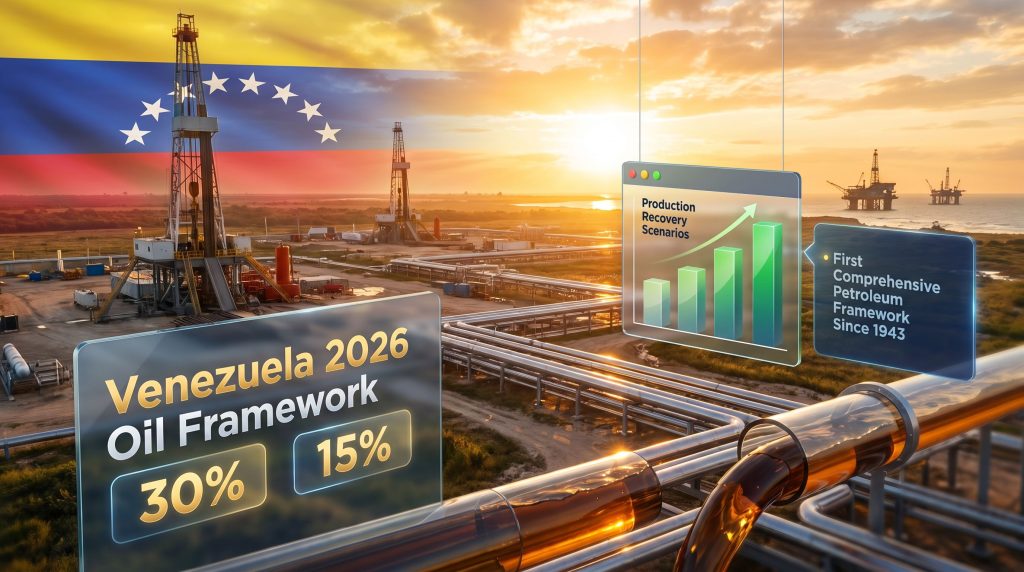
The 2026 framework, spanning 29 pages in the Official Gazette, does not tinker at the margins. It restructures the foundational rules governing who can operate across the entire petroleum value chain, from upstream extraction through midstream processing, refining, and final distribution. Crucially, the regulations make no direct reference to Petróleos de Venezuela SA (PDVSA), the state oil company that once defined the country's energy identity. This omission is deliberate and analytically significant: it signals an institutional transition rather than a surface-level policy adjustment.
What Venezuela's New Oil Regulations Actually Change
The core function of the 2026 framework is to formally authorise private sector participation across activities that were previously reserved for PDVSA, either exclusively or through heavily constrained joint venture structures. The scope of this authorisation is comprehensive, and furthermore, it reflects a deliberate strategic pivot by the interim administration.
Key Structural Changes at a Glance
| Regulatory Element | Previous Framework | 2026 Framework |
|---|---|---|
| Upstream production control | State monopoly via PDVSA | Open to private operators and joint ventures |
| Refining and distribution | PDVSA-exclusive | Private sector permitted |
| Standard royalty rate | Case-by-case negotiation | 30% standard rate |
| Reduced royalty (marginal fields) | Not formalised | 15% for economically unviable assets |
| Dispute resolution | Venezuelan courts only | Independent international arbitration |
| Direct crude marketing | State-controlled | Private JV partners permitted with price benchmarking |
| Resource ownership | State | State (unchanged) |
One structural mechanism deserves particular attention: Productive Participation Contracts (CPP). Under this arrangement:
- Private companies may lease PDVSA assets under defined contractual terms
- Full operational management transfers to the private entity
- Commercial risk and capital expenditure obligations sit entirely with the private operator
- PDVSA retains nominal asset ownership while ceding day-to-day authority
This structure allows the Venezuelan state to preserve constitutional resource sovereignty while effectively outsourcing operational competence to entities capable of delivering it. It is not dissimilar to the technical service contract models deployed in Iraq after 2003, though Venezuela's CPP structure allocates more management autonomy to the private partner. For further context on Venezuela's infrastructure crisis, the physical state of these assets adds a further layer of complexity to any CPP arrangement.
The Arbitration Clause: A Material De-Risking Event
The introduction of independent international arbitration removes one of the most significant deterrents to foreign direct investment in the Venezuelan energy sector. Requiring multinational energy companies to resolve commercial disputes within a domestic judicial system perceived as politically influenced was widely cited by legal and financial analysts as a primary barrier to capital commitment. This single regulatory change materially alters the risk calculus for prospective entrants.
For international energy companies carrying institutional memory of asset seizures and unilateral contract renegotiations under the Chávez and Maduro governments, contractual enforceability is not an abstract legal concern. It is the foundational condition for investment committee approval. Legal analysts at Hogan Lovells have noted that this opening represents a structurally significant shift in Venezuela's approach to private sector engagement.
The Fiscal Architecture: Tiered Royalties and Asset-Class Strategy
The 2026 regulations introduce a structured royalty framework designed to calibrate fiscal burden against investment risk. This tiered approach reflects a sophisticated understanding of Venezuela's diverse reserve composition.
| Asset Type | Risk Profile | Applicable Royalty Rate | Strategic Rationale |
|---|---|---|---|
| Conventional brownfield | Lower | 30% | Established production base |
| Marginal fields | High | 15% (reducible) | Incentivise stranded asset development |
| Ultra-heavy oil deposits | Very high | 15% (reducible) | Orinoco Belt revival strategy |
| Offshore operations | High | Variable (risk-adjusted) | Capital-intensive frontier exploration |
The geological rationale behind this structure is important and often underappreciated by non-technical observers. Venezuela's reserve base is not homogeneous. The Orinoco Heavy Oil Belt, which contains the largest share of the country's proven reserves, produces extra-heavy crude with API gravity typically below 10 degrees, requiring upgrading facilities to convert it into marketable synthetic crude before it can be refined conventionally.
This upgrading process is capital-intensive, technically complex, and economically sensitive to oil price trends. Without a meaningfully reduced royalty burden, the internal rate of return on Orinoco Belt development is unlikely to clear the hurdle rates that international majors apply to frontier-category investments.
A separate government resolution published alongside the main regulations establishes specific tax and royalty rules for:
- Oil upgrading facilities
- Conventional refining operations
- Industrialisation and downstream marketing
- Specialised oilfield services companies
This parallel resolution reflects an attempt to create a coherent fiscal architecture across the full value chain, rather than applying upstream royalty logic to fundamentally different downstream activities.
Infrastructure Deterioration: The Variable That Fiscal Terms Cannot Fix
Attractive royalty rates address the revenue-sharing equation. They do not, however, address the physical condition of the assets private operators would be acquiring management of. This distinction is critical to any realistic investment analysis.
PDVSA's operational trajectory over the past decade has been one of sustained deterioration. Venezuela's crude production capacity declined sharply from peak levels exceeding 3 million barrels per day in the late 1990s to levels that have at times fallen below 400,000 barrels per day in recent years, though output has partially recovered under private operator management since 2022. Refinery utilisation rates collapsed in parallel, driven by deferred maintenance, technical staff emigration, and chronic underfunding of operational budgets.
Samantha Gross, Director of Energy Security at the Brookings Institution, has made the observation that Venezuela's refineries will require substantial capital investment to restore functional operating capacity after prolonged neglect, and that the fundamental question facing prospective investors is whether expected long-term returns are sufficient to justify the scale of upfront rehabilitation spending required. This framing captures the core investment dilemma precisely: fiscal incentives lower the revenue-sharing burden, but they do not reduce the capital commitment required to make deteriorated infrastructure productive again.
The infrastructure rehabilitation challenge is particularly acute in refining. Venezuela's refinery network, once capable of processing domestic heavy crude into export-grade products, has been operating at severely reduced utilisation for years. Restoring this capacity to commercially viable levels is a multi-billion dollar undertaking that royalty rate reductions alone cannot finance.
Geopolitical Architecture: Sanctions, the Interim Administration, and Reform Sequencing
The 2026 petroleum regulations cannot be understood in isolation from the political transition that produced them. The underlying oil law reform was enacted on January 29, 2026, at the commencement of a US-backed interim administration led by Acting President Delcy Rodríguez. Implementing regulations were published in the Official Gazette and accelerated in July 2026, with the timing reflecting deliberate coordination between the political transition agenda and foreign investment attraction objectives.
The US policy shift on PDVSA has been central to the reform sequence, as the unwinding of US sanctions against Venezuela is a prerequisite condition for meaningful capital re-entry by major international operators. Without sanctions relief, the universe of eligible investors is constrained to entities not subject to US jurisdiction, consequently limiting both the quantity and quality of available capital.
Adding urgency to the reform timeline, catastrophic seismic events in mid-2026 compounded Venezuela's existing infrastructure challenges, creating additional political momentum for accelerating regulatory publication and signalling commitment to an international investment community that had grown accustomed to policy ambiguity from Caracas. In addition, the broader dynamics of sanctions and oil trading across global markets provide a useful comparative lens for understanding how sanctions relief shapes investor behaviour in similar contexts.
The next major ASX story will hit our subscribers first
Which Private Operators Are Best Positioned?
Chevron's position in Venezuela is structurally advantaged relative to any new entrant. Having assumed managerial control over joint venture production operations from 2022 onward, Chevron possesses current operational knowledge of asset conditions, workforce relationships, and regulatory interactions that would take a new entrant years to replicate. The 2026 framework formalises and expands the type of arrangement Chevron already operates under, rather than creating an entirely new paradigm for existing operators.
For companies evaluating entry, the framework offers three primary structural options:
| Entry Structure | Capital Commitment | Control Level | Risk Exposure | Best Suited For |
|---|---|---|---|---|
| Joint Venture with PDVSA | Shared | Shared management | Moderate | Established majors with existing relationships |
| Productive Participation Contract (CPP) | Full private | Full management control | High | Operators seeking operational autonomy |
| Oilfield Services Contracts | Project-based | Operational scope only | Lower | Specialised service companies |
One commercially meaningful provision that may be underappreciated in early analysis is the direct crude marketing right extended to private joint venture partners. Under the new framework, private JV participants may sell their crude allocation directly to international buyers, provided they can demonstrate price superiority over state-controlled sales channels. This provision removes PDVSA as a mandatory commercial intermediary, which has historically introduced pricing opacity, payment delays, and compliance complexity into international trading relationships.
S&P Global's analysis of Venezuela's new oil law underscores that this direct marketing provision is among the most commercially consequential elements of the reform for prospective international partners.
Remaining Barriers: Political Legitimacy and Historical Trust Deficits
The legal framework is meaningfully stronger than anything Venezuela has offered international investors in decades. However, legal frameworks operate within political realities, and Venezuela's political reality remains genuinely uncertain.
The interim administration's democratic legitimacy is contested, and international investors must price the possibility of future political discontinuity into their return models. A change in political control that repudiates current contractual arrangements would not be without precedent in Venezuelan history, and the arbitration provisions, while valuable, cannot fully eliminate sovereign risk from the investment equation.
Comparing Venezuela's opening to peer emerging market liberalisations provides useful context:
| Country | Reform Period | Private Sector Opening | Outcome |
|---|---|---|---|
| Iraq | Post-2003 | Technical service contracts, then licensing rounds | Partial recovery; ongoing instability constraints |
| Libya | Post-2011 | Disrupted by civil conflict | Inconsistent; production remains volatile |
| Angola | 1990s to 2000s | PSA-based liberalisation | Successful; became major sub-Saharan producer |
| Myanmar | 2010s | PSC framework opened | Reversed following 2021 military coup |
Angola's experience represents the optimistic scenario: consistent institutional follow-through transformed a framework reform into durable production growth. Myanmar's experience, however, represents the cautionary scenario: even well-structured frameworks cannot survive fundamental political discontinuity.
Three Production Recovery Scenarios
Scenario 1: Accelerated Recovery
Sanctions relief is fully implemented within 12 to 18 months. Multiple international majors enter through CPP and JV structures. Private capital funds refinery rehabilitation in parallel with upstream development. Production climbs meaningfully within a 3 to 5 year horizon.
Scenario 2: Gradual Reentry (Base Case)
Selective operator participation concentrates in upstream brownfield assets where rehabilitation costs are lower. Downstream investment lags due to return-on-investment uncertainty. Modest production gains materialise over a 5 to 7 year horizon, while a persistent political risk premium continues to constrain capital allocation.
Scenario 3: Stalled Reform
Political discontinuity undermines regulatory credibility before investment commitments mature. Infrastructure deterioration continues to outpace new capital inflows. Venezuela's production potential remains structurally constrained despite the formal existence of a more permissive regulatory framework. Understanding the broader crude oil market dynamics will be essential in determining which scenario ultimately plays out.
Frequently Asked Questions: Venezuela's 2026 Oil Privatisation
What does the 2026 regulation framework actually authorise?
The 29-page framework published in the Official Gazette formally permits private companies to operate across the full petroleum value chain, including upstream extraction, refining, industrialisation, marketing, and distribution. It introduces tiered royalty rates, independent international arbitration, and direct crude marketing rights for private joint venture partners. This is a defining example of how Venezuela oil regulations expand private sector role across the entire industry.
Does Venezuela still own its oil reserves?
Yes. Hydrocarbon resource ownership remains constitutionally vested in the Venezuelan state. The reform changes who manages and operates assets, not who owns the underlying reserves.
What royalty rates apply?
A standard 30% royalty applies to conventional operations. This can be reduced to 15% for projects involving marginal fields or ultra-heavy oil deposits where the standard rate would render development economically unviable.
Can disputes be resolved outside Venezuelan courts?
Yes. The new framework establishes independent international arbitration as the mechanism for commercial dispute resolution, replacing the previous requirement for domestic court adjudication.
When did the regulations take effect?
The underlying oil law reform was enacted on January 29, 2026. Implementing regulations were published in the Official Gazette and accelerated in July 2026 to support investment attraction objectives under the interim administration.
Key Takeaways
- Venezuela's 2026 regulations represent the country's first comprehensive petroleum framework since 1943, covering the entire value chain from wellhead to retail distribution
- A tiered royalty structure (30% standard; 15% for marginal and ultra-heavy assets) is designed to unlock stranded reserve development across Venezuela's diverse geological base
- Independent international arbitration replaces domestic court dependency, materially lowering the perceived political risk of contractual investment
- Private JV partners gain direct crude marketing rights, removing PDVSA as a mandatory commercial intermediary
- Refinery rehabilitation costs represent the most significant near-term barrier to downstream investment recovery, a challenge that fiscal incentives alone cannot resolve
- The reform is directly linked to the transition to an interim administration and the ongoing unwinding of US sanctions
- Resource ownership remains with the Venezuelan state — the reform changes operational control, not reserve title
- Historical peer comparisons suggest outcomes range from Angola-style success to Myanmar-style reversal, with political continuity being the decisive variable
Disclaimer: This article contains forward-looking scenarios and investment-related analysis for informational purposes only. It does not constitute financial or investment advice. Readers should conduct independent due diligence before making any investment decisions related to Venezuelan energy assets or companies operating in the sector.
Want to Identify the Next Major Resource Discovery Before the Market Moves?
Discovery Alert's proprietary Discovery IQ model delivers real-time alerts on significant ASX mineral discoveries, transforming complex resource data into clear, actionable investment insights for both new and seasoned investors — explore historic discovery returns to understand the scale of opportunity, then begin your 14-day free trial at Discovery Alert to position yourself ahead of the market.