
August 3, 2026
The End of an Era: How Venezuela's Hydrocarbons Law Reform Reshapes Global Oil Investment
For most of the past century, the global oil industry operated under a relatively stable set of assumptions about sovereign resource control. Nationalisation waves of the 1970s locked in state monopoly structures across Latin America, the Middle East, and Africa, creating frameworks that persisted long after the economic logic that justified them had eroded. Venezuela ends PDVSA monopoly in 2026, representing something far more consequential than a policy adjustment: it is the structural dismantling of a 50-year state monopoly framework, with cascading implications for global oil supply chains, Latin American energy governance, and investor risk calculus.
When big ASX news breaks, our subscribers know first
Why Five Decades of State Control Reached a Breaking Point
Venezuela's nationalisation created Petróleos de Venezuela S.A. (PDVSA) as the sole institutional vehicle through which the country's vast hydrocarbon wealth would be managed. At its height in the late 1990s, Venezuela produced roughly 3.2 million barrels of oil per day, making it one of the most significant exporters to the United States and a foundational OPEC member with real pricing influence. Understanding OPEC's market influence helps contextualise how significant Venezuela's role once was within global supply structures.
The collapse that followed was structural rather than cyclical. Successive policy decisions, combined with internationally imposed sanctions, stripped PDVSA of the technical workforce, capital reinvestment capacity, and operational discipline required to maintain a complex, mature reservoir system. Venezuela's production fell to levels that many analysts considered irreversible under the existing governance model.
The 1990s apertura petrolera, or oil opening, attempted a partial correction by inviting international operators into specific project structures. However, PDVSA retained operational primacy, and the 2007 decree that mandated a minimum 60% state equity stake in all joint ventures effectively reversed even those limited gains. Foreign operators who had built technical positions in Venezuelan fields faced a stark choice: accept minority status in state-controlled entities or exit. Many chose the latter, accelerating the capital flight that undermined production recovery.
Chevron's limited operational continuation from 2022 onward under US sanctions waivers offered a preview of how international operators might re-engage with Venezuela under modified conditions, but it remained an isolated exception rather than a systemic solution. Furthermore, the broader relationship between sanctions and oil trading demonstrates how geopolitical restrictions consistently reshape the commercial landscape for energy producers operating under international pressure.
What the New Hydrocarbons Law Actually Changes
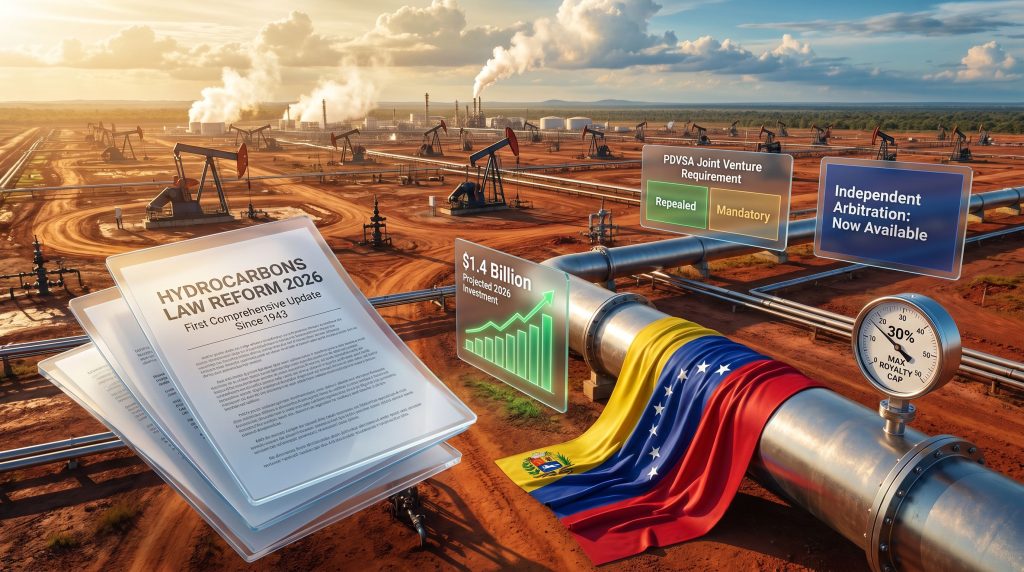
A 29-Page Document That Closes an 83-Year Regulatory Gap
When Acting President Delcy Rodríguez signed the Regulation of the Hydrocarbons Law on July 9, 2026, the publication in the Official Gazette marked the first comprehensive regulatory overhaul of Venezuela's oil sector since 1943. That 83-year gap is not simply a bureaucratic footnote; it reflects how deeply the nationalised model had become self-reinforcing, resistant to the kind of technical modernisation that hydrocarbon governance requires.
The 29-page implementing regulation operationalises the sweeping legislative reform passed unanimously by Venezuela's National Assembly on January 29, 2026. Unanimous passage is analytically significant in this context: it signals a degree of political consensus around economic liberalisation that transcends factional positioning and reduces the near-term risk of legislative reversal.
One of the most striking features of the new framework is what it does not contain. The implementing regulation makes no reference to PDVSA whatsoever. For investors and analysts accustomed to a Venezuelan oil sector where PDVSA's institutional fingerprint appeared in every legal instrument, this absence functions as a deliberate signal of systemic displacement rather than marginal reform.
Full Value Chain Access for Private Operators
The practical scope of what private operators can now undertake independently in Venezuela is extensive. Under the previous framework, each of these activities carried mandatory state partnership requirements:
- Exploration and appraisal of new hydrocarbon acreage
- Extraction and primary production at the wellhead
- Transportation through pipeline and terminal infrastructure
- Storage at onshore and offshore facilities
- Refining of crude into finished petroleum products
- Marketing and distribution of refined products domestically
- Direct international commercialisation, including independent pricing and export contracting
The repeal of the 2007 mandatory joint venture decree means private operators, both domestic and foreign, can now pursue any or all of these activities following submission and approval of a business plan. They operate, in the regulation's framing, entirely at their own expense, account, and risk. This is a foundational shift in operational sovereignty that separates the 2026 reform from every previous iteration of Venezuelan oil policy.
Fiscal Architecture Designed to Attract Capital to Complex Assets
The new fiscal framework introduces risk-adjusted royalty rates calibrated to the technical and environmental complexity of different asset categories. This approach reflects a sophisticated understanding that Venezuela's hydrocarbon resource base is not uniform: it ranges from relatively straightforward conventional fields to heavily contaminated zones requiring remediation investment, to offshore deepwater assets with high capital intensity.
| Asset / Activity Type | Fiscal Treatment Under New Framework |
|---|---|
| High-risk contaminated zone fields | Lower royalty rates reflecting remediation costs |
| Offshore operations | Differentiated tax profile for capital intensity |
| Standard onshore production | Standard royalty regime |
| Maximum royalty cap (all categories) | 30% |
| Rate adjustment authority | Ministry of Hydrocarbons retains discretionary power |
The 30% maximum royalty cap is competitively positioned relative to many Latin American hydrocarbon jurisdictions. More importantly, the Ministry of Hydrocarbons retains discretionary authority to set lower rates for individual projects based on risk profile assessments. This creates room for negotiated fiscal terms on the most technically challenging assets, which is precisely where Venezuela requires the greatest capital mobilisation.
Arbitration Access as a Critical Investor Protection
Independent arbitration for contractual disputes is now explicitly permitted under the new framework. This change removes one of the most frequently cited deterrents to foreign investment in Venezuelan hydrocarbons: the requirement to resolve commercial disputes through Venezuelan domestic courts, which carried significant sovereign risk exposure. Aligning Venezuela's dispute resolution mechanisms with international investment treaty standards is a prerequisite for serious institutional capital engagement, regardless of the attractiveness of asset-level economics.
Comparing Venezuela's Three Regulatory Eras
| Policy Dimension | Post-1975 Nationalisation | 1990s Apertura | 2026 Reform |
|---|---|---|---|
| Private exploration rights | None | Limited | Full, independent |
| PDVSA joint venture requirement | Mandatory | Required for primary activities | Repealed |
| Downstream private access | Prohibited | Restricted | Fully permitted |
| Direct international sales | State-exclusive | State-exclusive | Private operators permitted |
| Dispute resolution | Venezuelan courts only | Venezuelan courts only | Independent arbitration available |
| Royalty flexibility | Fixed | Limited | Risk-adjusted, capped at 30% |
| Regulatory framework | 1943 law | Partial amendments | First comprehensive update since 1943 |
The critical distinction between the 2026 reform and the 1990s apertura is not merely one of degree but of institutional architecture. The 1990s opening preserved PDVSA's operational primacy and limited private participation to defined project categories. The 2026 framework systematically displaces state operational control across the entire value chain, permitting vertically integrated private investment structures that were previously structurally impossible.
Who Benefits First: The Commercial Calculus of Early Entry
Oilfield Services Companies as First-Mover Beneficiaries
In any major hydrocarbon liberalisation cycle, oilfield services companies typically capture early-mover advantages before upstream exploration capital makes fully committed entry decisions. Venezuela's 2026 opening follows this pattern. SLB signed a long-term framework agreement with PDVSA in June 2026, covering exploration and production services, digital oilfield enablement, and workforce development programmes.
The agreement was explicitly structured to leverage the broader commercial opening, positioning SLB to benefit from infrastructure reconstruction and technical capacity rebuilding regardless of which upstream operators ultimately take equity positions. Consequently, oilfield services entry carries lower political and sanctions risk than direct equity production stakes, while still capturing significant upside from increased activity levels.
The US-Venezuela Diplomatic Dimension
The regulatory framework did not emerge in a geopolitical vacuum. The Venezuela PDVSA policy shift driven by Washington's engagement reflects a calculated alignment between US energy supply diversification interests and Caracas's urgent need for capital and sanctions relief. National Energy Dominance Council Director Jarrod Agen maintained active communications with Venezuelan leadership regarding the legal conditions necessary for foreign company participation.
Critical context for investors: US sanctions on Venezuela remain in place as of mid-2026. The domestic Venezuelan legal framework creates necessary but not sufficient conditions for broad international operator re-entry. Companies with US nexus must navigate their own independent sanctions compliance analysis, entirely separately from what Venezuelan domestic law now permits.
The interim government projects approximately $1.4 billion in investment for 2026 as a direct result of the new regulatory environment. Infrastructure reconstruction represents the primary near-term capital deployment priority, given that PDVSA's production and transportation assets have suffered significant deterioration from years of underinvestment.
PEMEX's Deer Park Refinery receiving Venezuelan crude in early 2026 provides an early, concrete indicator of re-emerging trade flows and the practical possibility of Venezuela re-integrating into regional and global oil supply chains.
Risk Assessment: What Could Prevent the Reform From Delivering
Structural Risks Investors Cannot Ignore
The 2026 reform resolves many of the legal deterrents to foreign investment in Venezuelan hydrocarbons, but it does not eliminate the underlying structural risks that have frustrated previous recovery attempts:
- Constitutional resource ownership is unchanged. Oil and gas reserves remain the property of the Venezuelan state. The reform separates operational and commercial rights from subsurface ownership, but this constitutional layer remains a sovereign risk floor.
- Regulatory continuity risk. The framework was enacted by an acting president under a transitional political configuration. Future administrations retain the legislative capacity to modify or reverse these provisions, as occurred after the 1990s apertura.
- Sanctions complexity. International operators, particularly those with US regulatory exposure, must conduct independent legal analysis of their ability to participate. Venezuelan domestic law cannot override US Treasury enforcement jurisdiction.
- PDVSA's institutional degradation. The state company has lost significant portions of its experienced technical workforce over the past decade. Even in joint venture structures where private operators hold management rights, PDVSA's institutional capacity constraints create execution risk.
- Infrastructure deficit. Production infrastructure requires substantial rehabilitation investment before output recovery becomes meaningful. This front-loads capital requirements and extends the timeline to cash flow generation.
Scenario Analysis: Four Pathways for Venezuela's Oil Sector
| Scenario | Key Condition | Investment Implication |
|---|---|---|
| Full sanctions relief + regulatory stability | US-Venezuela diplomatic normalisation | High capital inflow; major international oil company re-entry |
| Partial sanctions relief + regulatory continuity | Phased diplomatic engagement | Oilfield services and mid-tier operator entry |
| Sanctions maintained + reform reversal | Political instability or US policy shift | Capital withdrawal; framework rollback |
| Sanctions maintained + reform sustained | Venezuelan unilateral liberalisation | Compliance-constrained operators only; limited capital |
In addition, monitoring the broader oil market trade risks that stem from shifting diplomatic alignments remains essential for investors assessing Venezuelan exposure within a volatile geopolitical climate.
The next major ASX story will hit our subscribers first
Venezuela's Reform in a Latin American Context
A Counterpoint to Regional Energy Nationalism
Venezuela's structural pivot arrives at a moment when Latin American energy policy is deeply divided between resource nationalism and capital attraction imperatives. Mexico's continued emphasis on PEMEX's institutional role represents one end of this spectrum; Venezuela's 2026 framework, which formally sees Venezuela end PDVSA monopoly, represents the other.
This divergence is not coincidental: it reflects the different fiscal positions, production trajectories, and geopolitical alignments of the two countries. Venezuela holds some of the world's largest proven heavy crude reserves, concentrated primarily in the Orinoco Belt. Private sector access to these assets carries multi-decade supply chain implications for global heavy crude markets, refinery feedstock planning, and Latin American energy trade patterns.
The downstream integration opportunity that the 2026 reform creates, encompassing private refining and distribution rights, enables vertically integrated investment structures that could attract a different and more committed class of long-term capital than upstream-only concession models. For a broader perspective, the crude oil market overview illustrates how Venezuela's re-entry could meaningfully shift global supply dynamics over the coming years.
The reform's success or failure will be closely watched by other hydrocarbon-rich states in the region weighing whether liberalised fiscal and operational terms can unlock capital more effectively than state-centric models. In that sense, Venezuela has positioned itself as an unintentional policy experiment with implications extending well beyond its own borders.
Frequently Asked Questions: Venezuela's PDVSA Reform
What exactly changed about PDVSA's role?
PDVSA's operational monopoly across the hydrocarbon value chain has been formally dismantled. Private companies can now independently manage exploration, production, refining, and commercialisation. The new implementing regulation contains no reference to PDVSA, marking a departure from every previous Venezuelan oil policy instrument.
Does Venezuela still own its oil and gas reserves?
Yes. Constitutional state ownership of subsurface hydrocarbon resources is unchanged. The reform decouples operational and commercial management rights from ownership, allowing private operators to generate returns without Venezuela relinquishing title to the resource base.
Can foreign companies operate in Venezuela without a PDVSA partnership?
Yes, for the first time since the 1975-1976 nationalisation period. The mandatory joint venture requirement that previously required a minimum 60% state equity stake has been repealed. Foreign operators can explore, produce, refine, and export independently following business plan approval by the Ministry of Hydrocarbons.
What is the maximum royalty rate under the new framework?
The maximum royalty rate is capped at 30% across all asset categories. The Ministry of Hydrocarbons holds discretionary authority to set lower rates for projects with elevated risk profiles, including contaminated zone fields and offshore operations.
How do US sanctions affect practical investment decisions?
US sanctions on Venezuela remained in place as of mid-2026. The Venezuelan domestic legal framework establishes the conditions for participation, but operators with US regulatory exposure must conduct independent sanctions compliance analysis. The domestic legal reform does not provide any protection from US Treasury enforcement jurisdiction.
When were Venezuela's last comprehensive oil regulations issued before 2026?
The previous comprehensive regulatory framework for Venezuela's hydrocarbons sector dated to 1943. The July 9, 2026 publication of the implementing regulation represents the first complete overhaul in 83 years.
Key Takeaways at a Glance
- 83-year regulatory gap closed: First comprehensive oil regulations since 1943, published July 9, 2026
- PDVSA monopoly formally ended: New implementing framework contains no reference to the state company
- Full value chain access: Private operators can independently engage in exploration, production, refining, marketing, and distribution
- 30% royalty cap: Risk-adjusted fiscal terms designed to attract capital to technically complex and environmentally challenged assets
- Independent arbitration: Investor protection mechanism now available for contractual disputes, replacing exclusive domestic court jurisdiction
- $1.4 billion projected 2026 investment: Government target anchoring the reform's economic rationale
- SLB first-mover: Long-term framework agreement signed June 2026 positions oilfield services sector as the earliest commercial beneficiary
- Sanctions overhang remains: US sanctions compliance is an independent obligation for international operators regardless of Venezuelan domestic law
This article contains forward-looking analysis and scenario projections based on publicly available information as of mid-2026. Readers should conduct independent due diligence before making any investment decisions. The regulatory and geopolitical environment described is subject to change. Nothing in this article constitutes financial or legal advice.
Want to Stay Ahead of the Next Major Resource Discovery?
Discovery Alert's proprietary Discovery IQ model delivers real-time alerts on significant ASX mineral discoveries, transforming complex resource data into actionable investment insights — explore the historic returns major discoveries have generated and begin your 14-day free trial to position yourself ahead of the broader market.