August 3, 2026
The Hidden Architecture of Energy Security: How Underground Oil Storage Actually Works
Most people understand that countries stockpile oil for emergencies. Far fewer understand how that stockpiling actually functions at a technical level, why the geology of a coastline matters as much as the politics of a budget, or why a national oil company building storage tanks represents something far more strategically significant than it might first appear. Before examining what ONGC oil storage for strategic reserves means for India's position in global energy markets, it is worth understanding the mechanical and geological foundations that make strategic petroleum reserves function in the first place.
Underground rock cavern storage is not simply a cheaper version of above-ground steel tanks. Hard rock formations, particularly granitic geology like that found along India's southern Karnataka coastline, create a naturally sealed environment where crude oil can be held for years without significant quality degradation or evaporation loss. The rock itself acts as a containment vessel, with hydrostatic water pressure in the surrounding geology preventing crude from migrating outward. This is why the Mangaluru and Padur sites were selected for India's existing network, and why the same region is being targeted for expansion.
When big ASX news breaks, our subscribers know first
India's Import Exposure: Understanding the Scale of Structural Vulnerability
India ranks as the world's third-largest crude oil consumer and importer, with import dependency exceeding 85% of domestic demand. That single figure carries enormous strategic weight. Unlike economies that have diversified domestic production or substantial reserve buffers, India's energy system is structurally exposed to supply shocks occurring thousands of kilometres from its borders.
The exposure is not abstract. India's primary crude supply routes transit through the Strait of Hormuz, a maritime chokepoint through which roughly 20% of global oil trade passes daily. Any disruption to that corridor, whether driven by military conflict, sanctions enforcement, or shipping insurance failures, would create an immediate and severe supply gap for Indian refineries. Post-2022, India's dramatic increase in discounted Russian crude imports addressed one cost problem whilst quietly introducing another: supply chain concentration risk tied to the evolving sanctions landscape and the reliability of non-traditional shipping routes.
Furthermore, there is the OPEC+ production strategy dimension to consider. Coordinated production management by cartel members has repeatedly tightened global crude availability at moments when import-dependent economies are least positioned to absorb price increases. For India, each OPEC+ cut translates directly into higher import bills and increased pressure on the current account deficit.
Decoding the 74-Day Figure: What India's Reserve Cover Actually Represents
India currently holds crude oil and petroleum product inventories sufficient to cover approximately 74 days of net crude import requirements. This figure is cited frequently in policy discussions, but its composition is rarely examined carefully, and the distinction matters enormously for understanding India's true emergency buffer.
The 74-day cover is a composite metric. It blends strategic cavern storage managed by ISPRL, commercial refinery tank inventories, offshore holding facilities, and the volumetric fill of India's approximately 35,000-kilometre pipeline network. It is not a measure of dedicated emergency reserves alone.
This is a critical distinction when benchmarking against international standards. Member nations of the International Energy Agency are obligated to maintain a minimum of 90 days of net import cover in dedicated emergency reserves, not composite figures that include commercial stocks. India holds observer status with the IEA rather than full membership, but the gap between India's composite 74-day figure and IEA-equivalent dedicated reserve standards is the central policy problem that the current expansion programme is designed to address.
A genuine strategic reserve, in the IEA sense, must be accessible to government authorities independent of commercial operator decisions. Refinery tanks and pipeline fill cannot be drawn down by government decree the way dedicated cavern stocks can. This operational distinction is what makes the ONGC Mangaluru facility and the planned Chandikhol and Padur projects strategically significant beyond their raw volume numbers.
ONGC Oil Storage for Strategic Reserves: The Mangaluru Facility in Detail
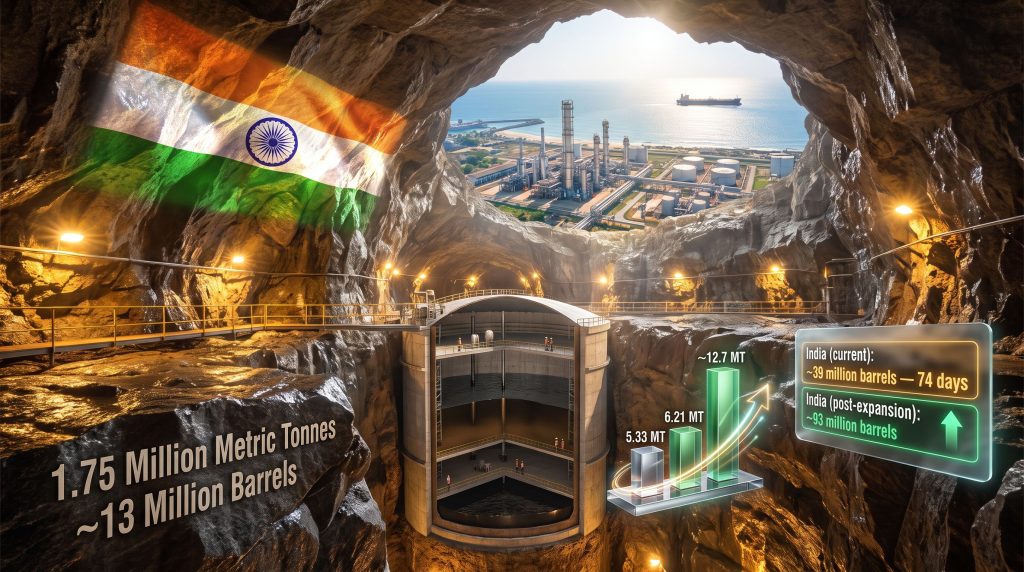
Oil and Natural Gas Corporation's decision to develop a 1.75 million metric tonne storage facility at Mangaluru, equivalent to approximately 13 million barrels, represents a structural expansion of India's energy security infrastructure. Half of that capacity, approximately 875,000 tonnes or 6.5 million barrels, will be formally earmarked for India's strategic petroleum reserve purposes. The remaining capacity is designated for potential commercial utilisation, pending government approvals.
The location is not coincidental. ONGC's subsidiary Mangalore Refinery and Petrochemicals Ltd (MRPL) operates a 300,000 barrels-per-day refinery at the same site, creating direct pipeline integration between the new storage caverns and an operating refinery intake. In a supply disruption scenario, crude released from strategic storage can flow immediately into refinery processing without requiring additional logistics coordination. This operational integration is a significant advantage over standalone storage facilities that require separate transportation arrangements.
It is also worth noting that the existing 1.5 million tonne Mangaluru SPR facility has already seen half of its capacity leased to MRPL on a commercial basis, demonstrating that the hybrid commercial-strategic model is operationally proven at this location rather than theoretical.
The 50/50 Allocation Model: A Replicable Policy Template
The bifurcated capacity allocation at the new ONGC facility reflects an evolution in Indian SPR policy thinking. Rather than treating strategic storage as a purely budgetary cost centre, the 50/50 model allows commercial lease revenue from the non-strategic tranche to partially offset facility development and operating costs. This is not a novel concept globally. South Korea and Japan have long operated hybrid models where private energy companies participate in strategic reserve infrastructure under contractual arrangements that preserve government emergency access rights.
The commercial tranche creates an important secondary benefit: it attracts foreign national oil companies and trading houses that value access to Indian storage capacity for inventory management purposes. Their presence introduces market intelligence, operational benchmarking, and foreign exchange flows that purely government-operated facilities cannot generate.
India's Existing SPR Network: The Foundation Being Built Upon
Before examining the expansion pipeline, understanding the current infrastructure baseline is essential.
| Facility Location | State | Capacity (Million Tonnes) | Status |
|---|---|---|---|
| Visakhapatnam (Vizag) | Andhra Pradesh | ~1.33 MT | Operational |
| Mangaluru | Karnataka | ~1.50 MT | Operational + Expansion Planned |
| Padur | Karnataka | ~2.50 MT | Operational + New Facility Planned |
| Total Existing (ISPRL) | ~5.33 MT |
All three facilities use the underground rock cavern technology described earlier. The Indian Strategic Petroleum Reserves Ltd (ISPRL), a government-owned special purpose vehicle, manages operations across all locations. The institutional structure is important: ISPRL sits outside the normal commercial operating framework of public sector oil companies, with a specific mandate to maintain strategic buffer capacity rather than optimise commercial returns.
Phase-II Expansion: Chandikhol and New Padur Projects
The Mangaluru ONGC facility is one piece of a substantially larger expansion programme. Two additional projects are planned under India's Phase-II SPR buildout.
| Project | Location | State | Planned Capacity | Estimated Cost | Development Model |
|---|---|---|---|---|---|
| Chandikhol SPR | Chandikhol | Odisha | ~4.0 million tonnes | ₹90 billion (~USD 944 million) | Public-private partnership |
| New Padur Facility | Padur | Karnataka | ~2.5 million tonnes | Not yet disclosed | Private collaboration |
The Chandikhol project deserves particular attention. At approximately 4 million tonnes, it would become the single largest SPR facility in India upon completion, nearly matching the entire existing three-site ISPRL network in isolation. ISPRL has already completed land acquisition for Chandikhol, a milestone that removes one of the most common delay risks for greenfield infrastructure projects in India: land title disputes and rehabilitation requirements.
The estimated cost of approximately ₹90 billion (USD 944 million) for Chandikhol alone signals the capital intensity of underground cavern construction. This is, consequently, the primary driver behind India's pivot toward public-private participation frameworks for Phase-II development. The fiscal math of fully government-funded SPR expansion at this scale is challenging within existing budget envelopes.
Projected Post-Expansion Capacity Scenario
Combining existing infrastructure with planned developments produces a dramatically different strategic reserve picture:
- Existing ISPRL network: approximately 5.33 million tonnes
- ONGC Mangaluru extension (strategic tranche only): approximately 0.875 million tonnes
- Chandikhol new facility: approximately 4.0 million tonnes
- New Padur facility: approximately 2.5 million tonnes
- Estimated total strategic storage post-expansion: approximately 12.7 million tonnes, or roughly 93 million barrels
Note: These figures represent announced project capacities and should be treated as planning targets rather than confirmed outcomes. Project timelines and final capacities may vary.
The next major ASX story will hit our subscribers first
Regional Benchmarking: Where India Stands Against Asian Peers
India's expansion ambitions become clearer when mapped against the SPR positions of regional competitors and energy security peers. In addition, understanding oil's global importance helps contextualise why these reserve gaps carry such strategic significance.
| Country | Estimated SPR Capacity | Days of Import Cover | Development Model |
|---|---|---|---|
| China | 500+ million barrels (est.) | 90+ days (est.) | State-owned, ongoing expansion |
| Japan | 300+ million barrels (est.) | 150+ days | Government and private industry |
| South Korea | ~96 million barrels | ~100 days | Government-managed |
| India (current) | ~39 million barrels (5.33 MT) | 74 days (composite) | Government ISPRL and expanding PPP |
| India (post-expansion est.) | ~93 million barrels | Projected improvement | Government and private participation |
Note: All figures are approximate, sourced from publicly available estimates. Methodology differences across countries make direct comparisons indicative rather than precise.
China's aggressive SPR expansion to an estimated 500+ million barrels is frequently cited in Indian policy circles as a benchmark that reframes domestic targets upward. The gap between India's current position and Chinese reserve levels is not simply a number: it represents a meaningful asymmetry in economic resilience during supply shocks affecting both countries simultaneously.
The Public-Private Participation Risk Framework
Bringing private capital into strategic energy infrastructure introduces efficiencies but also creates governance tensions that deserve analytical scrutiny. Furthermore, oil market disruption risks make robust governance frameworks even more critical as India scales its PPP model.
The core risks in India's evolving PPP model for SPR development include:
- Emergency access risk: Government override rights during declared supply crises must be contractually unambiguous. Ambiguity in emergency drawdown clauses creates legal exposure at exactly the moment decisive action is required.
- Commercial conflict of interest: A private operator holding leased capacity for a foreign national oil company may face competing obligations when government authorities seek to draw down that same storage for domestic emergency use.
- Stock level transparency: Government-operated facilities produce auditable strategic stock figures. Private operator involvement can reduce public visibility into actual reserve levels, complicating independent verification.
- Counterparty durability: Long-duration infrastructure agreements with private entities carry counterparty risk over 20-to-30-year facility lifespans that purely government structures do not.
India's SPR governance framework must evolve in parallel with its capacity expansion. Robust contractual protections, independent auditing mechanisms, and clear emergency drawdown protocols are non-negotiable safeguards as the PPP model scales up across Phase-II developments.
How Emergency Drawdowns Actually Work: A Technical Walkthrough
Understanding the operational mechanics of strategic reserve releases provides important context for evaluating the practical value of expanded storage capacity.
- Trigger authorisation: A declared national emergency or formally assessed supply disruption initiates a government drawdown decision through the Ministry of Petroleum and Natural Gas.
- ISPRL operational coordination: ISPRL coordinates with downstream refineries and pipeline operators to schedule crude release volumes and timing.
- Cavern to pipeline transfer: Crude is pumped from underground caverns through dedicated connecting pipelines to refinery intake points or coastal export terminals.
- Refinery processing integration: Released volumes enter the refinery processing queue, substituting for disrupted import volumes without requiring separate procurement.
- Mandatory replenishment: Post-drawdown policy frameworks require restocking within defined timeframes, typically through opportunistic purchasing during periods of lower global prices.
The proximity of the ONGC Mangaluru facility to MRPL's refinery compresses steps two through four of this sequence significantly, which is a genuine operational advantage over facilities located at greater distance from refining capacity. Monitoring crude oil price trends during the replenishment phase is therefore essential to maximising cost efficiency for India's treasury.
FAQ: ONGC Oil Storage for Strategic Reserves
What is the total capacity of ONGC's new Mangaluru storage facility?
The new facility will have a total storage capacity of 1.75 million metric tonnes, equivalent to approximately 13 million barrels of crude oil. India's ONGC board approved this plan as part of the broader national energy security strategy.
How much of ONGC's new storage will be used for strategic reserves?
Half of the 1.75 million tonne capacity, approximately 875,000 tonnes or 6.5 million barrels, will be designated for India's strategic petroleum reserve purposes. The remaining half is earmarked for potential commercial utilisation subject to government approvals.
Who manages India's strategic petroleum reserves?
India's strategic petroleum reserves are managed by Indian Strategic Petroleum Reserves Ltd (ISPRL), a government-owned special purpose vehicle operating the existing three-site network across Visakhapatnam, Mangaluru, and Padur.
What is the cost of the Chandikhol project?
The Chandikhol SPR project in Odisha carries an estimated cost of approximately ₹90 billion, equivalent to roughly USD 944 million.
Can private companies use India's SPR storage capacity?
Yes. Indian regulations permit commercial leasing of a defined portion of existing SPR storage to private and foreign entities, subject to government approval and preservation of emergency access rights.
What does India's 74-day figure actually cover?
The 74-day figure is a composite metric combining strategic cavern stocks, commercial refinery tank inventories, offshore holdings, and pipeline system volumes across India's approximately 35,000-kilometre pipeline network. It is not a measure of dedicated emergency reserves alone.
Key Takeaways for Energy Policy and Investment Analysis
- ONGC oil storage for strategic reserves represents a structural evolution in how India finances and operates its emergency buffer infrastructure, shifting from pure public ownership toward a hybrid commercial-strategic model.
- The 50/50 allocation template at Mangaluru is likely to become the standard framework for future ONGC-developed SPR facilities, creating a replicable model that balances national security objectives with asset monetisation.
- Post-Phase-II completion, India's dedicated strategic crude storage capacity could approach 93 million barrels, materially narrowing the gap with IEA-equivalent reserve standards even if formal IEA membership remains a longer-term aspiration.
- The USD 944 million Chandikhol project signals that underground cavern SPR construction is a billion-dollar infrastructure category, with genuine barriers to entry that favour well-capitalised participants.
- Governance framework development must keep pace with physical capacity expansion. The PPP model introduces risk dimensions that purely government-operated networks do not carry. Tracking WTI and Brent futures will remain a key indicator for assessing the macroeconomic environment surrounding India's ongoing reserve buildout.
Disclaimer: This article contains forward-looking capacity projections and cost estimates based on publicly announced planning figures. Actual project outcomes, timelines, and costs may differ materially. Nothing in this article constitutes financial or investment advice. Readers should conduct independent due diligence before drawing conclusions for investment or policy purposes.
Want to Stay Ahead of the Next Major Resource Discovery?
Discovery Alert's proprietary Discovery IQ model scans ASX announcements in real time, delivering actionable alerts on significant mineral discoveries directly to subscribers — explore historic examples of exceptional returns that major finds have generated, and begin your 14-day free trial at Discovery Alert to position yourself ahead of the broader market.