August 7, 2026
Venezuela's complex sanctions regime has fundamentally reshaped petroleum industry dynamics, creating lasting disruptions that extend far beyond immediate political objectives. The Venezuela sanctions impact on oil industry demonstrates how economic restrictions generate cascading effects that transform global energy markets permanently. Understanding these mechanisms requires examining multiple layers of disruption that unfold across different timeframes and affect various stakeholders differently.
When sanctions target major oil-producing nations, they create cascading effects that extend far beyond immediate production impacts. These restrictions operate through sophisticated mechanisms that sever commercial relationships, disrupt technological transfers, and fundamentally alter global supply chain configurations. The resulting market transformations often persist long after political situations stabilise, creating permanent shifts in energy trade patterns and strategic alliances.
Understanding the Dual-Track Impact Framework
Economic sanctions against oil-producing nations generate disruption through two distinct yet interconnected pathways that reshape industry operations across multiple timeframes. These mechanisms create layered challenges that affect different aspects of petroleum operations with varying degrees of reversibility.
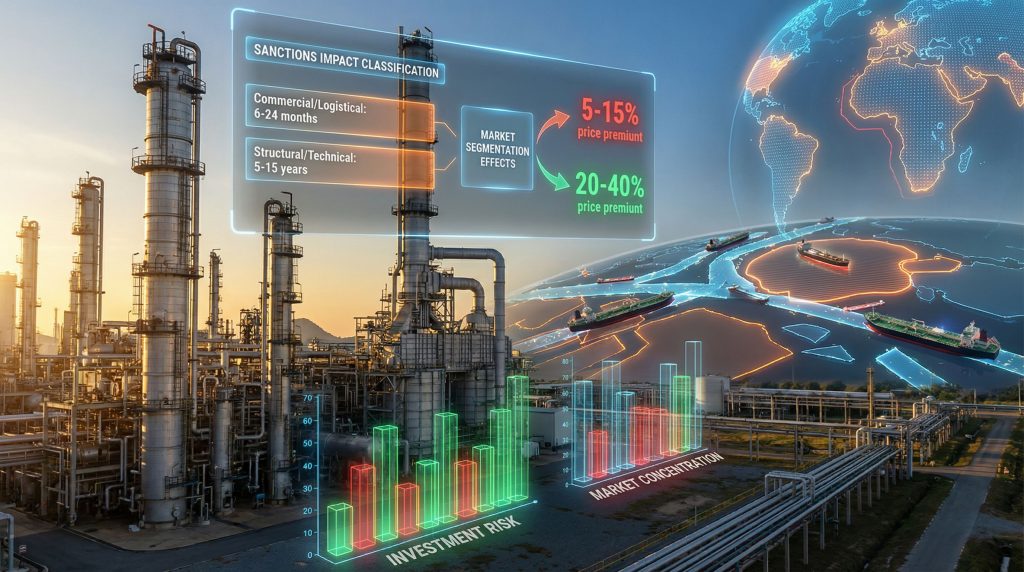
Table: Sanctions Impact Classification
| Impact Type | Timeline | Primary Drivers | Reversibility |
|---|---|---|---|
| Commercial/Logistical | 6-24 months | Payment restrictions, shipping constraints | High |
| Structural/Technical | 5-15 years | Infrastructure decay, workforce exodus | Low |
The first layer involves immediate commercial and logistical disruptions that sever established business relationships overnight. When sanctions target petroleum sectors, they eliminate payment channels, withdraw insurance coverage, and fragment shipping networks into compliant and non-compliant segments. These disruptions create immediate production shut-ins not because wells cannot produce, but because crude cannot reach markets profitably.
Heavy oil operations become particularly vulnerable during sanctions periods, as they require specialised diluents, upgrading facilities, and dedicated refinery configurations. Furthermore, the Venezuela sanctions impact on oil industry demonstrates how these commercial disruptions can eliminate entire market segments instantaneously, leaving technically viable production stranded without commercial pathways.
Beneath commercial disruptions lies a deeper structural transformation that unfolds over years rather than months. Sanctions typically coincide with or accelerate the departure of international operators who maintain complex technical systems. Without continuous investment in maintenance, upgrading, and workforce development, production capacity erodes even when wells remain technically viable.
This degradation follows predictable patterns: first, production efficiency declines as maintenance schedules slip; then, equipment failures cascade through interconnected systems; finally, entire production complexes become uneconomical to operate. The Venezuela case study illustrates this progression, where production declined significantly between 2007 and 2019 due to structural factors before sanctions accelerated the decline further.
The Commercial Disruption Layer
When economic restrictions target oil sectors, they immediately sever commercial relationships that required decades to establish. Payment channels close overnight as financial institutions withdraw services to avoid secondary sanctions exposure. Insurance providers cancel coverage for operations in restricted territories, while shipping networks fragment into risk-compliant and risk-accepting segments.
These disruptions create immediate production shut-ins not because wells cannot produce, but because crude cannot reach markets profitably. Heavy oil operations face particularly severe challenges, as they require specialised diluents, upgrading facilities, and dedicated refinery configurations that become inaccessible under sanctions regimes.
Venezuela's Orinoco Belt exemplifies this vulnerability, ranking among the most technically demanding heavy oil regions globally. The region's crude typically ranges 6-12° API gravity (versus 30-40° for light crude) and requires 1:3 to 1:4 diluent ratios by volume for pipeline transport. When sanctions blocked diluent imports and severed relationships with U.S. refiners who represented Venezuela's largest customer base, technically viable production became commercially stranded.
Critical Commercial Disruption Mechanisms:
- Payment Channel Severance: Restrictions eliminate access to dollar-denominated transactions and Western financial systems
- Shipping and Insurance Complications: Vessel interdictions and insurance cost escalation create route uncertainty
- Diluent Supply Restriction: Heavy crude requires specialised additives that become unavailable through normal supply chains
- Refinery Access Loss: Dedicated processing facilities optimised for specific crude grades become inaccessible
The speed and severity of commercial disruptions explain why barrels can be "shut in for commercial reasons" rather than geological constraints. Wells remain technically capable of producing, but operational shutdowns result from commercial severing rather than physical limitations. This distinction proves crucial for understanding recovery dynamics, as commercial disruptions can reverse more rapidly than infrastructure degradation.
The Infrastructure Degradation Spiral
Beneath commercial disruptions lies a more insidious transformation that unfolds over years rather than months. Sanctions frequently coincide with organisational disruptions that accelerate the departure of international operators responsible for maintaining complex technical systems.
The Venezuelan experience demonstrates this pattern clearly. Following 2007 expropriations, the state oil company PDVSA inherited assets but not operational capabilities. The subsequent decade witnessed what experts characterise as internal organisational collapse marked by political purges, management failures, technical staff exodus, and critical infrastructure deterioration.
This degradation follows predictable engineering patterns. Without proper maintenance cycles, centrifugal pumps (primary equipment for heavy oil operations) experience accelerated bearing and seal failures. Oil-gas-water separators require inspection and cleaning every 90 days to prevent corrosion-induced failures. Pipeline systems operating with heavy crude need regular cleaning operations to maintain flow rates.
Critical Infrastructure Categories and Degradation Patterns:
Primary Extraction Equipment:
- Centrifugal pumps require monthly maintenance cycles and bearing replacements at 6-12 month intervals
- Wellheads and gathering systems suffer accelerated corrosion without cathodic protection
- Replacement lead times extend to 3-6 months under normal conditions, longer during sanctions
Processing Facilities:
- Multi-billion-dollar upgrader units require continuous catalyst replacement and process optimisation
- Storage tank systems need internal inspections and corrosion monitoring
- Separator vessels require replacement at 7-10 year intervals under normal operations
Transportation Networks:
- Heavy crude pipelines operate at reduced velocities and require specialised maintenance
- Loading terminals need continuous upkeep to prevent line ruptures affecting export capacity
- Port facilities require regular dredging and infrastructure maintenance
Support Systems:
- Power generation systems using associated gas require specialised maintenance
- Water treatment facilities handle produced water volumes often exceeding 5-10 barrels per barrel of oil
- Waste management systems require continuous operation to maintain environmental compliance
The compound effect emerges when commercial sanctions overlay existing infrastructure degradation. Furthermore, oil production decline factors accelerated after January 2019 when direct sanctions eliminated commercial pathways while infrastructure was already compromised. Expert analysis indicates this layered disruption explains why sanctions relief alone cannot restore full production capacity quickly.
Recovery projections suggest a decade or more would be required to restore pre-disruption production levels, even under optimal political conditions. This timeline reflects the complexity of rebuilding not just physical infrastructure, but also organisational capabilities, workforce expertise, and operational systems that took decades to develop initially.
When big ASX news breaks, our subscribers know first
Determining Recovery Speed When Sanctions Are Modified
Recovery trajectories following sanctions modification depend heavily on operational continuity maintained during restriction periods. Companies that preserve legal presence, even under constrained conditions, retain institutional knowledge, stakeholder relationships, and technical capabilities that prove invaluable when restrictions ease.
The Asset Continuity Advantage
Operational continuity models demonstrate significant variation in recovery potential. The "Maintained Presence Model" exemplified by Chevron's Venezuelan operations shows how continuous engagement preserves competitive advantages. Chevron maintained joint ventures, kept personnel on the ground, and preserved operational knowledge despite sanctions constraints.
This continuity translates to immediate scaling advantages when restrictions ease. Unlike competitors requiring complete re-establishment of operations, companies with maintained presence can activate existing relationships and technical systems rapidly. Expert assessments suggest Chevron could scale operations faster than any other Western operator because it never fully lost its operational foothold.
Conversely, the "Complete Exit Model" demonstrates recovery challenges facing operators who withdrew entirely. ConocoPhillips, forced to exit Venezuelan operations in 2007, illustrates how complete disengagement creates multi-year re-entry requirements. Despite winning an $8.7 billion arbitration award plus interest for seized investments, the company faces fundamental rebuilding challenges.
Case Study Framework: Operational Continuity Models
- Maintained Presence Model: Operators retain skeleton crews, preserve joint ventures, maintain equipment readiness
- Complete Exit Model: Full withdrawal requiring complete re-establishment of operations and relationships
- Shadow Operations Model: Informal networks maintaining minimal technical oversight through third-party arrangements
Infrastructure Readiness Assessment
Recovery scenarios must account for the physical state of production assets during sanctions periods. Wells shut-in for commercial reasons can restart relatively quickly if infrastructure remains intact. However, facilities that suffered years of deferred maintenance require extensive rehabilitation before meaningful production increases become possible.
The technical complexity of heavy oil operations compounds these challenges. Orinoco Belt operations require advanced reservoir management, sophisticated pressure maintenance schemes, and integrated extraction-upgrading-logistics systems operating as coordinated units. When operators departed, they removed not just capital investment but also project management systems calibrated for specific technical challenges.
Critical Infrastructure Categories for Recovery Assessment:
- Primary extraction equipment (pumps, wellheads, gathering systems)
- Processing facilities (separators, upgraders, storage tanks)
- Transportation networks (pipelines, loading terminals, shipping facilities)
- Support systems (power generation, water treatment, waste management)
Each category requires specialised assessment to determine rehabilitation requirements versus replacement needs. Standard engineering metrics indicate pump efficiency losses of 2-5% annually without proper maintenance, while separator vessel degradation typically requires replacement at 7-10 year intervals under normal operating conditions.
Recovery speed also depends on workforce availability and technical expertise retention. Heavy oil operations require specialised knowledge for reservoir management, materials handling of corrosive crude, and complex upgrading processes. When experienced personnel emigrate during extended sanctions periods, rebuilding technical capabilities becomes a multi-year undertaking independent of infrastructure rehabilitation.
How Sanctions Reshape Global Oil Trade Patterns
Economic restrictions create bifurcated markets where compliant and non-compliant buyers operate under fundamentally different risk profiles. This fragmentation generates persistent price premiums for alternative suppliers while creating new trading relationships that often outlast the original sanctions periods.
Market Fragmentation and Premium Structures
Sanctions create market segmentation effects that persist beyond immediate restriction periods. When major producers face limitations, global supply chains reorganise around alternative sources, creating lasting shifts in energy trade patterns that reflect new risk tolerances and commercial relationships. Moreover, oil price rally impacts become amplified during such market disruptions.
Table: Market Segmentation Effects
| Market Segment | Risk Profile | Price Premium | Buyer Characteristics |
|---|---|---|---|
| Compliant Buyers | Low | Baseline | Major refiners, public companies |
| Risk-Tolerant Buyers | Medium | 5-15% discount | Independent traders, smaller refiners |
| Shadow Market | High | 20-40% discount | State entities, specialised networks |
These price differentials reflect risk premiums associated with sanctions exposure, insurance costs, and operational complexity. Compliant buyers typically pay market prices for alternative supplies, while risk-tolerant purchasers can access discounted crude at the cost of increased legal and operational risks.
Shadow markets develop sophisticated mechanisms for sanctions circumvention, including ship-to-ship transfers, document falsification, and payment system alternatives. These networks often involve state entities from non-aligned countries and specialised trading operations designed specifically for high-risk transactions.
Supply Chain Reconfiguration
When sanctions remove major producers from global markets, refineries modify their crude slates, shipping routes change permanently, and new trading relationships emerge. These adaptations create structural shifts that persist even after sanctions modification, as companies invest in alternative supply arrangements and develop new commercial relationships.
The Venezuela sanctions impact on oil industry illustrates how U.S. Gulf Coast refineries, previously optimised for Venezuelan heavy crude processing, were forced to source from alternative heavy producers including Mexico, Canada, and Middle Eastern suppliers. This transition required technical modifications to accommodate different sulfur content and viscosity profiles.
Refineries invested in new supplier relationships, modified processing configurations, and developed alternative logistics arrangements. When sanctions ease, these companies may choose to maintain diversified supply sources rather than returning to previous concentration levels, permanently altering global trade flows.
Technology Transfer Implications
Economic restrictions frequently include technology export controls that limit access to advanced extraction techniques, digital monitoring systems, and efficiency improvements. These technological restrictions compound production challenges and widen performance gaps with international operators.
Restricted countries often respond by developing domestic technological capabilities or sourcing alternatives from non-aligned suppliers. This can lead to the formation of alternative technology ecosystems that challenge Western technological dominance in specific sectors.
Over time, technology restrictions can accelerate innovation in both sanctioned countries (seeking self-sufficiency) and sanctioning countries (developing competitive advantages). These technological developments create long-term competitive dynamics that extend beyond the original sanctions framework.
The Role of Geopolitical Alliances in Sanctions Effectiveness
Sanctions effectiveness depends critically on participation by major oil consumers and financial centres. Unilateral measures by individual countries, regardless of their economic size, create arbitrage opportunities that can undermine intended economic pressure and generate alternative alliance structures.
The Coalition Coherence Factor
Modern sanctions architecture requires broad international cooperation to achieve maximum effectiveness. When major economies coordinate restrictions, they can severely limit targeted countries' access to global markets. However, non-participating countries can capture significant economic benefits by maintaining trade relationships. Additionally, Saudi exploration licenses demonstrate how other major producers can benefit from reduced competition.
Alliance Architecture Analysis:
- Primary Sanctions Bloc: Countries imposing direct restrictions on targeted entities
- Secondary Compliance Zone: Nations following restrictions to avoid secondary sanctions exposure
- Non-Aligned Markets: Countries maintaining normal trade relationships despite international pressure
- Active Circumvention Networks: States deliberately facilitating sanctions evasion for strategic benefit
The effectiveness of sanctions depends on the relative economic size and market access of each group. When major economies coordinate restrictions, they can create severe market access limitations. However, large non-aligned economies can provide alternative markets that significantly reduce sanctions impact.
Financial System Leverage
Modern oil trade relies heavily on dollar-denominated transactions and Western financial institutions for international payments. Sanctions that restrict access to these systems create immediate operational challenges that extend far beyond the targeted country's borders.
Financial sanctions can be particularly effective because they leverage the central role of Western banking systems in global trade. Even countries not directly targeted may comply with restrictions to maintain access to Western financial systems, amplifying sanctions impact through secondary effects.
However, sustained financial sanctions also incentivise the development of alternative payment systems and currency arrangements. Over time, this can reduce the effectiveness of financial leverage as alternative systems mature and gain adoption among non-aligned countries.
How Sanctions Influence Long-Term Investment Decisions
International oil companies incorporate sanctions risk into long-term investment decisions through sophisticated risk assessment frameworks that extend far beyond current political situations. Even potential future sanctions can deter investment in politically volatile regions, creating lasting impacts on capital allocation patterns.
Risk Premium Calculation Models
Investment decisions in potentially volatile regions require complex risk modelling that accounts for various scenarios including sanctions escalation, political instability, and asset expropriation. These assessments influence capital allocation decisions that shape global energy development patterns over decades.
Investment Decision Matrix Components:
- Political Risk Assessment: Probability calculations for future sanctions or restrictions
- Asset Recovery Scenarios: Evaluation of ability to maintain or recover investments under various political outcomes
- Alternative Opportunity Costs: Comparative returns available in more stable jurisdictions
- Portfolio Diversification: Geographic and political risk distribution across company asset bases
Companies typically apply significant risk premiums to investments in politically unstable regions, requiring higher projected returns to justify capital deployment. These premiums reflect not just current political risks but also potential future sanctions or instability that could affect long-term project viability.
Technology Development Incentives
Sanctions create divergent incentives for technological innovation in both targeted countries seeking self-sufficiency and sanctioning countries developing competitive advantages. These technological developments often persist beyond the original sanctions framework, creating lasting competitive dynamics.
Restricted countries may accelerate domestic research and development programmes to reduce dependence on Western technology. They may also develop stronger technological cooperation with non-aligned countries, creating alternative innovation networks that compete with Western technological leadership.
Sanctioning countries may invest more heavily in technologies that provide strategic advantages or reduce dependence on potentially unstable suppliers. This can accelerate development of alternative energy sources, improved efficiency technologies, or enhanced domestic production capabilities.
Unintended Consequences for Global Energy Security
Economic sanctions can generate significant unintended effects on global energy security, including market concentration increases, alternative partnership formation, and potential reductions in safety and environmental standards. These consequences often extend far beyond the intended scope of restrictions.
Market Concentration Effects
When sanctions remove major producers from global markets, remaining suppliers gain increased market power and pricing leverage. This concentration can lead to higher prices and greater supply volatility, particularly during geopolitical crises or supply disruptions.
The removal of significant production capacity from global markets reduces spare capacity available to respond to supply shocks. This can increase price volatility and reduce the global energy system's resilience to future disruptions from natural disasters, technical failures, or political instability.
Market concentration also creates opportunities for remaining suppliers to coordinate production policies or pricing strategies that may not align with broader global economic interests. Consequently, US economic tariffs and related policies may interact with these dynamics to sustain higher energy costs that affect economic growth in consuming countries.
Alternative Partnership Formation
Sanctions often drive targeted countries to develop stronger relationships with non-sanctioning nations, creating new geopolitical alignments that can challenge existing international economic structures. These partnerships frequently extend beyond energy trade to include broader economic and strategic cooperation.
Strategic Partnership Categories:
- Resource-for-Infrastructure Deals: Long-term commodity agreements financing development projects in exchange for resource access
- Technology Transfer Arrangements: Knowledge sharing agreements designed to reduce dependence on sanctioning countries
- Financial System Alternatives: Development of non-dollar trading mechanisms and payment systems for international commerce
These partnerships often create lasting changes in global economic relationships that persist beyond the original sanctions period. Countries that develop alternative trading relationships may maintain these arrangements even after restrictions ease, permanently altering global economic integration patterns.
Environmental and Safety Standards
Economic restrictions can indirectly affect environmental and safety standards in targeted petroleum sectors through reduced access to advanced monitoring technology and international best practices. This may lead to higher accident risks and environmental damage that affects both local and global interests.
Sanctions may also limit access to cleaner production technologies or environmental remediation equipment, potentially increasing the environmental impact of continuing operations. These effects can persist long after sanctions end if environmental damage becomes entrenched or cleanup becomes more expensive over time.
The departure of international operators often coincides with reduced adherence to global environmental and safety standards, as local operators may lack the expertise or resources to maintain international best practices without external support.
The next major ASX story will hit our subscribers first
Evaluating Sanctions-Related Investment Opportunities
Investment opportunities in sanctions-affected oil sectors require specialised due diligence that extends far beyond traditional financial and technical analysis. Successful strategies must account for legal compliance requirements, asset condition variations, and complex political risk factors.
Due Diligence Framework for Sanctions-Affected Assets
Investment evaluation in restricted territories requires enhanced due diligence procedures that address legal, technical, and political risk factors simultaneously. Traditional investment analysis must be supplemented with specialised expertise in sanctions law, political risk assessment, and technical asset evaluation under stressed conditions.
Enhanced Due Diligence Components:
- Legal Compliance Verification: Ensuring all proposed activities comply with applicable sanctions regimes and avoiding inadvertent violations
- Asset Condition Assessment: Evaluating infrastructure degradation during sanctions periods and rehabilitation requirements
- Political Risk Analysis: Assessing probability of sanctions modification, escalation, or political instability affecting operations
- Market Access Evaluation: Understanding available export routes, buyer networks, and commercial pathways under various scenarios
Legal compliance requires ongoing monitoring as sanctions regimes frequently change with evolving political situations. Investment structures must be designed to adapt to changing legal requirements without compromising operational viability or triggering inadvertent violations.
Asset condition assessment requires specialised expertise in evaluating equipment and infrastructure that may have suffered extended periods of deferred maintenance. Standard engineering assessments must account for accelerated degradation under stressed operating conditions and limited maintenance resources.
Timeline-Based Investment Strategies
Different investment horizons require fundamentally different approaches to sanctions-affected opportunities, reflecting varying risk tolerances and expected return requirements across time periods.
Short-Term (1-3 years): Focus on assets with minimal rehabilitation requirements and clear legal pathways for rapid development. These opportunities typically involve infrastructure that remained operational during sanctions periods and can restart quickly when restrictions ease.
Medium-Term (3-7 years): Target undervalued assets with strong geological fundamentals requiring moderate investment for restoration. These opportunities balance higher potential returns with manageable technical and political risks over intermediate timeframes.
Long-Term (7+ years): Consider strategic positions in high-quality resources trading at significant discounts due to political uncertainty. These investments require patient capital and high risk tolerance but may offer exceptional returns if political situations stabilise. Moreover, tariffs and investment impacts must be considered alongside traditional sanctions analysis.
Regulatory Compliance Infrastructure
Successful investment in sanctions-affected regions requires robust compliance systems capable of adapting to changing regulatory environments while maintaining operational efficiency. These systems must monitor multiple jurisdictions simultaneously and respond rapidly to regulatory changes.
Compliance infrastructure must include legal monitoring systems, operational control mechanisms, and financial safeguards designed to prevent inadvertent violations while maximising operational flexibility under permissible activities.
Companies operating in these environments typically maintain dedicated compliance personnel with specialised expertise in sanctions law, political risk assessment, and regulatory change management. These capabilities represent significant overhead costs that must be factored into investment returns calculations.
What Does Recovery Look Like in Practice?
Actual recovery patterns in sanctions-affected regions demonstrate the complexity of restoration timelines. According to analysis by the Council on Foreign Relations, increasing Venezuela's oil output will require "several years and billions of dollars" even under optimal conditions.
Recovery scenarios typically unfold through distinct phases: immediate commercial pathway restoration, followed by infrastructure rehabilitation, and finally full operational capacity restoration. Each phase requires different types of investment and faces unique technical challenges.
The Venezuela sanctions impact on oil industry illustrates how even partial sanctions relief creates complex operational challenges. When certain restrictions were eased, companies faced difficulties determining which activities were permissible while maintaining compliance with remaining restrictions.
Economic Implications for Global Markets
The broader economic implications extend beyond petroleum markets into global trade patterns and financial systems. According to research from Wood Mackenzie, regime change scenarios could fundamentally alter oil production dynamics and crude markets over the medium term.
These changes affect not only direct participants but also global energy security, price stability, and international economic relationships that took decades to develop. The interconnected nature of modern energy markets means that disruptions in one region create ripple effects across global supply chains and trading relationships.
Disclaimer: This analysis is provided for educational purposes only and should not be considered as investment advice. Sanctions regimes change frequently based on political developments, and all investment decisions should be made only after consulting qualified legal and financial professionals familiar with current regulatory requirements.
Looking to Capitalise on Mining Discovery Announcements?
Discovery Alert's proprietary Discovery IQ model delivers real-time alerts on significant ASX mineral discoveries, instantly empowering subscribers to identify actionable opportunities ahead of the broader market. Begin your 30-day free trial today and secure your market-leading advantage whilst global energy disruptions continue reshaping commodity markets.