July 23, 2026
When Sanctions Architecture Becomes a Trading Blueprint
Few corners of global commodities markets illustrate the relationship between regulatory design and market structure as vividly as the Venezuelan crude trade. For years, layers of U.S. Treasury sanctions effectively transformed Venezuela's oil exports into a highly restricted, high-margin niche accessible only to those with the legal clearance and logistical muscle to operate within it. That architecture created an extraordinary commercial opportunity for a handful of trading houses, but it also planted the seeds of its own disruption. As licensing access broadens and PDVSA reasserts its preference for direct commercial relationships, refiners buying Venezuelan crude directly from PDVSA is now reshaping how Venezuelan crude moves through global refining networks.
Understanding what is happening today requires appreciating how that architecture was built in the first place.
When big ASX news breaks, our subscribers know first
How Commodity Trading Houses Captured Venezuela's Oil Export Market
Following significant political developments inside Venezuela in early 2026, the us policy shift on PDVSA facilitated an arrangement for managing and marketing the country's crude production. The U.S. Department of the Treasury issued exclusive, long-term special licenses to two global trading houses, Vitol and Trafigura, granting them the legal framework to purchase and market Venezuelan crude until June 2027. All other international firms remained legally locked out of the trade during this window.
The scale of the opportunity this created was enormous. Vitol and Trafigura collectively moved more than 100 million barrels of crude within a six-month period, capturing reseller margins on volumes that no competing buyer could legally access.
Their dominance was not purely regulatory, however. The operational infrastructure these commodity trading giants brought to the arrangement was genuinely formidable:
- Large, deployable tanker fleets capable of handling Venezuelan crude's logistical complexity
- Floating storage facilities in strategic locations, including Malaysia, used to break bulk cargoes and reroute volumes flexibly
- Financial capacity to absorb significant storage and freight costs in a volatile market environment
- Established PDVSA relationships and pre-existing familiarity with Venezuelan terminal operations
- Proven ability to rapidly redirect heavy sour grades to alternative destinations when supply chains shifted
That last capability became especially valuable when geopolitical conflict disrupted Middle Eastern supply chains. Vitol and Trafigura diverted heavy Venezuelan grades, including Merey 16, to major Asian refining hubs across India, South Korea, and Malaysia, often at competitive discounts relative to alternative heavy sour suppliers whose supply chains faced greater disruption risk.
The trading house monopoly over Venezuelan crude was not born purely from market competition. It was structurally engineered through a narrow licensing regime that temporarily excluded all other buyers from legal participation, creating artificial scarcity of access rather than scarcity of supply.
Understanding Merey 16: The Crude Grade at the Centre of This Trade
What Makes Venezuelan Heavy Crude Commercially Distinctive
Merey 16 is a heavy sour crude produced primarily in Venezuela's Orinoco Oil Belt, one of the largest accumulations of extra-heavy crude in the world. Its characteristics define both its commercial appeal and its processing requirements:
- API gravity of approximately 16 degrees, classifying it as a heavy crude requiring significant upgrading
- High sulfur content, making it a sour grade that requires desulfurization during refining
- Typically priced at a material discount to lighter benchmarks such as WTI and Brent
- Ideally suited for refineries equipped with coking units and hydrocracking capacity
The Orinoco Belt itself holds an estimated 300 billion barrels of oil in place, though the vast majority requires thermal or blending techniques to achieve the viscosity needed for pipeline transportation. Diluents, typically light naphtha or condensate, must be mixed with extra-heavy Orinoco crude before it can flow through export infrastructure, adding complexity and cost to Venezuela's production chain.
This geological reality has a less commonly appreciated implication: the supply of diluents into Venezuela is not merely a commercial input but a strategic lever. Companies like Repsol and Eni, which have supplied gas and diluents to the Venezuelan domestic market, have accumulated substantial receivables in exchange, and are now converting those debt entitlements into direct crude liftings. This barter-adjacent dynamic is reshaping how European majors access Venezuelan barrels in a way that extends well beyond simple purchasing relationships.
Why Refiners Are Now Buying Venezuelan Crude Directly from PDVSA
PDVSA's Commercial Strategy: Eliminating the Reseller Premium
PDVSA's motivation for restoring direct supply relationships is straightforward from a fiscal perspective. Every barrel sold through a trading house intermediary involves a reseller margin that reduces PDVSA's realised price. By moving back toward its pre-2019 model of direct contracts with refiners and joint-venture partners, PDVSA captures more revenue per barrel — a critical optimisation for a state oil company operating under sustained fiscal pressure and constrained budgets.
For refiners, the economics are equally compelling. The comparison below illustrates why the trend toward direct purchasing is accelerating:
| Factor | Buying Through Traders | Buying Directly from PDVSA |
|---|---|---|
| Price Premium Paid | Reseller margin embedded | No intermediary margin |
| Supply Certainty | Subject to trader allocation | Direct contract allocation |
| Cargo Scheduling | Trader-controlled | Refiner-negotiated terms |
| Regulatory Exposure | Trader holds licence risk | Refiner operates under own licence |
| PDVSA Relationship | Indirect and mediated | Direct, potentially long-term |
How Licensing Expansion Dissolved the Trading Duopoly
The structural barrier protecting Vitol and Trafigura's market position was always time-limited and dependent on licensing exclusivity. As the U.S. Treasury's sanctions framework evolved to permit additional companies to obtain their own Office of Foreign Assets Control (OFAC) authorisations, the legal moat surrounding the trading house position began to erode.
Each new licence issued to a refiner or integrated oil major transfers market access directly from intermediaries to end-users. This is not a gradual erosion of trading house influence. It is a categorical transfer of commercial rights that fundamentally changes who captures margin in the Venezuelan crude supply chain.
Which Companies Are Now Buying Venezuelan Crude Directly from PDVSA
Phillips 66: Ending a Seven-Year Commercial Absence
Phillips 66 resumed direct spot cargo purchases from PDVSA in May 2026, ending a trading relationship that had been severed for seven years. By July 2026, the company had received three direct cargo allocations of Merey 16, all suited to its U.S. Gulf Coast refinery configuration, which includes coking units specifically designed to process high-sulfur, high-viscosity feedstocks.
For a complex Gulf Coast refiner, direct access to Merey 16 at PDVSA-realised prices — without a trader reseller margin layered on top — meaningfully widens crack spreads. Furthermore, at a time when competing heavy sour supplies from the Persian Gulf face Hormuz-related disruption risk, Venezuelan heavy crude has become a strategically valuable alternative feedstock.
Reliance Industries: Scale Purchasing from the World's Largest Refining Complex
India's Reliance Industries began direct Venezuelan crude purchases in May 2026, reducing its dependency on intermediary-sourced volumes. In April 2026, Reliance loaded a 2-million-barrel cargo of heavy Venezuelan crude directly from PDVSA, operating under terms governed by U.S. Treasury oversight.
Reliance's Jamnagar refinery complex in Gujarat is among the largest and most complex refining installations in the world, with the configuration to process ultra-heavy crudes at industrial scale. Direct PDVSA relationships allow Jamnagar to optimise feedstock economics while reducing supply concentration risk from Persian Gulf corridors that are experiencing escalating disruption.
Repsol and Eni: Debt-to-Crude Conversion as a European Strategy
Spain's Repsol began loading Merey 16 directly at Venezuela's Jose terminal in July 2026. Italy's Eni received its own direct cargo allocation bound for European refining operations. Both companies are using direct crude liftings to offset billions in receivables accumulated from supplying Venezuela's domestic market with gas and diluents over prior years.
This approach represents a less commonly understood dimension of the Venezuelan trade: the receivables-to-barrels conversion mechanism. Rather than waiting for cash settlement of outstanding debts, Repsol and Eni are effectively being repaid in crude — a model that aligns PDVSA's interests in preserving strategic relationships with the commercial interests of European suppliers seeking return on capital deployed in Venezuela.
Both companies jointly operate the Cardón IV gas project and are pursuing expanded domestic gas supply agreements, with longer-horizon ambitions that include LNG export development from Venezuelan production.
Chevron: Beyond Purchasing Into Upstream Integration
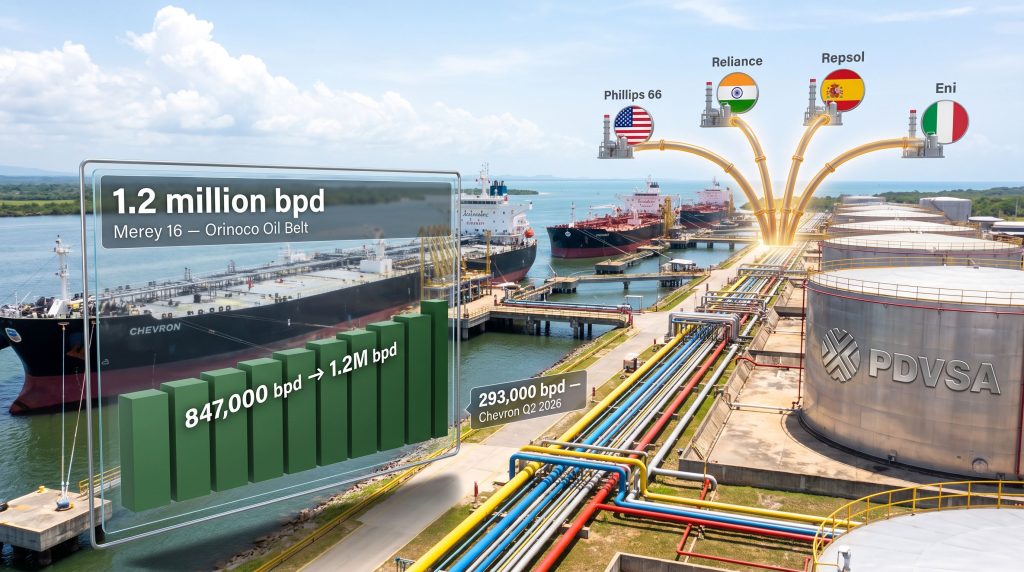
Chevron's Venezuelan position has moved well beyond direct crude purchasing into upstream integration. The company's exports averaged 293,000 barrels per day in Q2 2026, up from 223,000 bpd earlier in the year. This volume expansion coincided with Chevron finalising an asset swap with PDVSA that raised its stake in the Petroindependencia joint venture to 49% and secured development rights across new Orinoco Oil Belt acreage.
Bloomberg analysis estimated that maximising Venezuelan production and export capabilities could contribute up to $700 million annually to Chevron's operating cash flow. At current trajectories, Chevron's integrated upstream-to-refinery position in Venezuela allows it to capture margin across multiple points in the value chain simultaneously — a structural advantage that pure purchasing relationships cannot replicate.
Venezuela's total oil and fuel exports climbed from 847,000 bpd in 2025 to over 1.2 million bpd by mid-2026, with year-end targets of 1.37 million bpd. Valero Energy and Thailand's Tipco Asphalt are expected to enter direct purchasing relationships in the near term, according to trade sources cited by Reuters.
Operational Constraints Limiting Venezuela's Production Recovery
The Infrastructure Gap Between Ambition and Reality
Despite the commercial momentum generated by direct supply agreements and expanding JV activity, Venezuela's upstream sector is contending with severe structural deficits that cap production growth:
- A critical shortage of functional oilfield services companies capable of operating in Venezuela
- Limited availability of drilling equipment and workover rigs
- Workforce attrition following years of economic deterioration and emigration
- Ageing pipeline and processing infrastructure requiring sustained capital expenditure
- Diluent supply constraints that restrict Orinoco Belt production volumes
| Metric | Current Status (Mid-2026) | Year-End Target | 2028 Technical Ceiling |
|---|---|---|---|
| Total Oil and Fuel Exports | ~1.2 million bpd | ~1.37 million bpd | +17% above mid-2026 levels |
| 2025 Baseline Exports | 847,000 bpd | N/A | N/A |
| Chevron JV Output (Q2 2026) | 293,000 bpd | Expanding | Services-constrained |
Rystad Energy estimates that a 17% crude production increase is technically achievable by 2028, but operational realities — including equipment scarcity and limited drilling capacity — are dictating actual recovery pace. The gap between Venezuela's theoretical production ceiling and its day-to-day operational reality is the central risk that any refiner building a long-term supply strategy around PDVSA volumes must account for.
Refiners entering direct supply agreements with PDVSA must factor in Venezuela's structural production variability. Unlike contracts with stable national oil companies or international operators, PDVSA supply commitments carry elevated execution risk tied to infrastructure reliability, workforce capacity, and geopolitical developments that can shift rapidly.
The next major ASX story will hit our subscribers first
How the Disintermediation Trend Is Reshaping Global Crude Trade Flows
The Compressing Role of Commodity Trading Houses
The erosion of Vitol and Trafigura's dominant position in Venezuelan crude represents a structural compression of intermediary margins in one of the most lucrative sanctioned-market trades of the past decade. As more refiners secure direct access, the volume flowing through trading house principals shrinks, reducing their ability to arbitrage price differentials, manage floating storage positions profitably, and capture freight optimisation gains.
Consequently, trading houses are likely to pivot toward providing logistics, risk management, blending services, and spot cargo facilitation rather than acting as principal buyers and resellers. This repositioning from principal trader to service provider is a meaningful downgrade in margin capture, even if it preserves some commercial relevance.
Three Scenarios for How the Market Structure Could Evolve
Scenario 1: Accelerated Disintermediation
Further licensing expansion and Venezuelan production growth allow refiners to handle the majority of crude under bilateral direct contracts, reducing trading house involvement to residual spot cargoes and logistical facilitation.
Scenario 2: Hybrid Market Bifurcation
A more probable near-term outcome sees established refiners with direct licences managing base-load volumes under term contracts, while trading houses continue handling spot cargo management, distressed volumes, and destinations lacking direct PDVSA commercial relationships.
Scenario 3: Production Constraint Reversal
If Venezuela's oilfield services bottleneck worsens, or if geopolitical conditions deteriorate, production growth stalls. Reduced total export volumes could limit the scale of direct allocations, potentially restoring trading house relevance as flexible volume managers with the logistical infrastructure to handle complex, variable supply.
Long-Term Implications for Heavy Crude Markets Globally
Venezuela holds the world's largest proven oil reserves, the vast majority of which are heavy and extra-heavy grades requiring complex refinery configurations to process economically. The restoration of refiners buying Venezuelan crude directly from PDVSA at scale carries implications for competing heavy sour suppliers including Canada's Western Canadian Select, Mexico's Maya blend, and Iraq's Basra Heavy.
Furthermore, oil price movements and the broader trade war impact on oil add another layer of complexity to how these direct supply strategies will play out over time. In addition, OPEC market influence remains a critical variable, as production quota decisions directly shape the competitive landscape for Venezuelan heavy grades competing against Gulf member output.
Refiners that secure durable direct supply relationships with PDVSA now may establish a structural feedstock cost advantage that persists well beyond the current period of market transition. In a global refining environment where heavy crude discounts to light benchmarks fluctuate significantly with Middle Eastern supply conditions, having locked-in direct access to Venezuelan barrels at PDVSA-realised prices could prove to be a material competitive differentiator over the medium term.
Disclaimer: This article is for informational purposes only and does not constitute investment advice. Forecasts, production targets, and cash flow estimates referenced herein reflect analyst projections and are subject to material uncertainty. Readers should conduct their own due diligence before making investment or commercial decisions.
Want to Identify the Next Major Resource Discovery Before the Market Does?
Discovery Alert's proprietary Discovery IQ model delivers real-time alerts on significant ASX mineral discoveries, transforming complex resource data into actionable investment insights — explore historic discoveries and their returns to understand the potential, then start your 14-day free trial at Discovery Alert to position yourself ahead of the broader market.