
August 5, 2026
When Infrastructure Fails to Keep Pace With Production: The Economics of the Permian Natural Gas Glut
There is a peculiar paradox at the heart of American energy markets. At the same moment that European nations scramble for gas supplies and Asian LNG buyers compete aggressively for every available cargo, one of the world's most prolific hydrocarbon basins has been producing natural gas it cannot sell at any positive price. The Permian natural gas glut is not a story about weak demand or oversupplied global markets. It is a story about infrastructure, and what happens when the pipes simply cannot keep up with the wells.
Understanding this dynamic requires stepping back from commodity pricing headlines and examining the underlying geology and economics that make the Permian Basin structurally different from virtually every other major gas-producing region in the world. Furthermore, US natural gas prices have added another layer of complexity to how regional bottlenecks are perceived nationally.
When big ASX news breaks, our subscribers know first
The Geology Behind the Price Problem
The Permian Basin, stretching across West Texas and southeastern New Mexico, is primarily an oil-producing system. The reservoir formations targeted by operators, particularly the Wolfcamp and Bone Spring intervals of the Delaware and Midland sub-basins, are liquid-rich plays where crude oil is the economic prize.
Natural gas found in these formations exists in two states: as free gas in the reservoir and as gas dissolved within the crude oil under pressure. When oil is lifted to the surface, pressure drops, and dissolved gas separates from the liquid. This is called associated gas or casinghead gas, and it emerges whether the operator wants it or not.
Unlike a conventional dry gas well, where a producer can throttle output in response to falling prices, an oil well in the Permian cannot selectively produce its crude without simultaneously producing the gas that comes with it. The ratio of gas to oil produced, measured as the gas-to-oil ratio (GOR), has been rising across many Permian formations as reservoir pressure depletes over time, meaning the gas burden per barrel of crude is actually increasing across the basin's maturing well inventory.
This geological reality creates a pricing dynamic that is unlike almost any other commodity market. Gas supply in the Permian is largely unresponsive to gas price signals because the decision to produce is driven entirely by crude economics.
What Negative Prices Actually Mean in Practice
For most commodities, a price of zero represents the floor. For Permian natural gas at the Waha Hub, the regional benchmark near Midland, Texas, zero is not a floor at all.
When pipeline takeaway capacity is fully subscribed and no additional gas can be moved out of the basin, local buyers gain enormous leverage. Producers who cannot flare their gas within regulatory limits, and cannot store it, face a binary choice: pay someone to take it, or shut in the oil well entirely. For most operators, paying to dispose of gas is far preferable to forfeiting crude oil revenue. According to Natural Gas Intelligence, storage availability has become increasingly critical as Waha buckles under these very pressures.
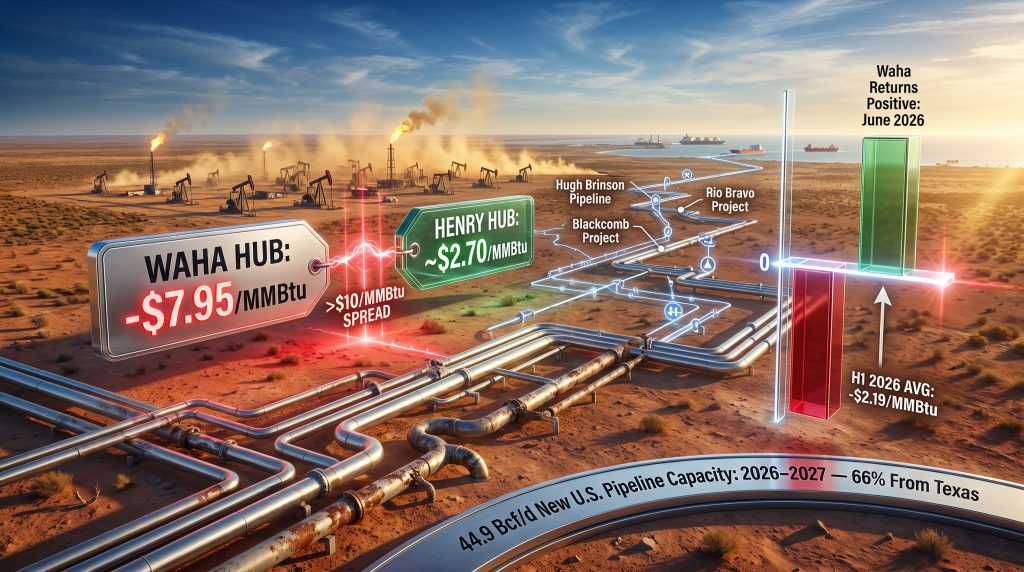
The result is a market where the price reflects disposal cost rather than energy value. During the first half of 2026, the Waha Hub averaged -$2.19/MMBtu, with a record low of -$7.95/MMBtu recorded at the end of April. Simultaneously, the national Henry Hub benchmark held at approximately $2.70/MMBtu, producing a price differential of more than $10/MMBtu between the same molecule of gas depending solely on whether it could be moved east.
| Metric | Value |
|---|---|
| Waha Hub H1 2026 Average | -$2.19/MMBtu |
| Waha Hub Record Low (Late April 2026) | -$7.95/MMBtu |
| Henry Hub Benchmark (Same Period) | ~$2.70/MMBtu |
| Peak Waha-to-Henry Hub Differential | >$10/MMBtu |
| Period of Negative Waha Pricing | Most of H1 2026 |
A differential exceeding $10/MMBtu between Waha and Henry Hub represents one of the most extreme basis dislocations recorded in U.S. natural gas market history, and it occurred not because demand collapsed nationally, but because West Texas ran out of pipe.
The Three Operational Responses to Negative Gas Pricing
When prices turn negative, Permian producers face a narrow and unattractive menu of options:
- Pay counterparties to accept gas – Entering negative-priced contracts where the producer bears a disposal cost rather than earning revenue. This is operationally simple but economically painful, particularly for smaller operators with thinner margins.
- Flare at the wellhead – Combusting gas at the surface is regulated by the Texas Railroad Commission, which sets volume limits and conditions under which flaring permits are granted. Prolonged negative pricing cycles drive elevated flaring activity across the basin, creating both emissions concerns and regulatory scrutiny.
- Curtail or shut in production – Temporarily reducing or halting well output eliminates the gas disposal problem but also sacrifices crude oil revenue, which typically defeats the economic purpose of the decision.
A lesser-known fourth option, increasingly relevant in newer developments, involves on-site gas monetisation through power generation or compressed natural gas conversion. Some operators have begun deploying modular gas turbines at the wellsite to consume associated gas for electricity generation, either for internal use or sale to grid operators. This approach, while still niche, reduces flaring exposure and partially offsets the economic penalty of stranded gas.
The Pipeline Buildout: What Is Coming and When
The structural solution to the Permian natural gas glut is additional pipeline takeaway capacity, and that buildout is now underway. The critical question is not whether capacity will arrive, but whether it will arrive fast enough to stay ahead of production growth.
According to the U.S. Energy Information Administration, pipeline developers plan to commission 44.9 Bcf/d of new gas pipeline capacity across the United States during 2026 and 2027 combined. Of that total, more than 66%, or approximately 29.7 Bcf/d, originates in Texas, reflecting the outsized role that Permian debottlenecking plays in the national infrastructure buildout.
The three largest Texas pipeline projects expected to enter service by the end of 2026 are:
| Pipeline Project | Operator | Destination Markets | Full Capacity Timeline |
|---|---|---|---|
| Hugh Brinson Pipeline | Energy Transfer | East Texas, Katy Hub, Gulf Coast LNG, power, storage | March 2027 |
| Rio Bravo Pipeline | TBD | Gulf Coast markets | End of 2026 (target) |
| Blackcomb Pipeline | TBD | Gulf Coast markets | End of 2026 (target) |
The Hugh Brinson Pipeline is particularly significant because of its destination mix. By connecting Permian and Midland Basin gas eastward to the Katy Hub and Gulf Coast demand centres, it opens pathways to LNG export terminals, industrial consumers, and power generation markets, according to analysis from East Daley Analytics. This is a meaningfully broader demand base than purely regional Texas consumers.
The GCX (Gulf Coast Express) expansion has also contributed to early price relief, having come online ahead of the Hugh Brinson ramp-up.
The June 2026 Inflection: Prices Return to Positive Territory
Following the commissioning of the GCX expansion and the initial service commencement of the Hugh Brinson Pipeline, Waha Hub pricing moved into positive territory during June 2026 and held above zero for more than a month. This represents the first sustained period of positive Waha pricing after an extended stretch of deeply negative values.
Industry commentary noted that producers who had previously curtailed volumes, either through shut-ins or flaring, began restoring output as new pipeline capacity absorbed previously stranded gas. This behaviour reflects the inherent pent-up supply dynamic of the Permian: when takeaway opens, molecules that had been held back, at considerable economic cost, return to the market rapidly.
However, the recovery carries important caveats. The Hugh Brinson Pipeline is operational but has not yet reached its full design capacity, with complete ramp-up not expected until March 2027. Analysts and producers alike emphasise that the current price stabilisation represents early-stage infrastructure relief, not a structural resolution of the underlying mismatch between gas production growth and transportation capacity.
The next major ASX story will hit our subscribers first
Industry Expectations: What Producers Are Saying
The Federal Reserve Bank of Dallas Energy Survey, published in June 2026, polled executives at exploration and production companies focused primarily on the Permian Basin. The results reveal a wide spectrum of expectations about when the takeaway constraint will be fully resolved.
| Timeline Expectation | Share of Respondents |
|---|---|
| Q1 2027 (most frequently selected) | ~25% |
| Sometime in 2027 (broader consensus) | Majority |
| 2028 or later | >10% |
| Never | ~7% |
The survey finding that approximately 7% of respondents selected "never" is particularly striking. It suggests that a meaningful segment of Permian operators has concluded that the structural mismatch between associated gas production and takeaway capacity is a permanent feature of operating in the basin, not a temporary problem awaiting an infrastructure fix.
This pessimism may reflect an understanding that pipeline buildouts tend to incentivise additional drilling, which in turn generates more associated gas, effectively resetting the congestion problem at a higher production level. It is an infrastructure arms race with no guaranteed finish line. As reported by OilPrice.com, producers have in some cases been paying buyers to haul gas away, underscoring just how extreme this dynamic has become.
The Geopolitical Wildcard: How Hormuz Risk Reconnects to Waha Pricing
One of the less obvious dimensions of the Permian natural gas glut is its sensitivity to geopolitical events thousands of miles away. The feedback mechanism works as follows:
- Geopolitical escalation, such as disruption to Strait of Hormuz shipping lanes, tightens global crude supply
- Rising oil prices follow in response to tightening supply conditions
- Elevated crude prices incentivise Permian operators to accelerate drilling programmes
- More oil wells produce more associated gas
- New pipeline capacity, still in its ramp-up phase, becomes congested again
- Waha Hub prices fall back toward or below zero
This transmission mechanism from Middle East conflict to West Texas gas prices is not theoretical. With the Hugh Brinson Pipeline not reaching full capacity until March 2027, there is a window of vulnerability through the remainder of 2026 during which any significant acceleration in Permian drilling could overwhelm the incremental capacity additions and reignite the basis dislocation. The global oil market influence exerted by major producers adds yet another variable to an already complex equation.
The irony is stark: the same geopolitical pressures that would drive crude oil revenues higher for Permian producers could simultaneously push their associated gas revenues back below zero, partially offsetting the crude windfall at the wellsite level.
Furthermore, crude oil price pressures stemming from trade tensions and geopolitical uncertainty continue to shape how aggressively operators approach their Permian drilling schedules, adding unpredictability to the gas glut equation.
The LNG Connection: Long-Term Demand Outlook for Permian Gas
Beyond the near-term bottleneck dynamics, the structural long-term outlook for Permian gas is considerably more positive, provided infrastructure keeps pace with production. The LNG supply outlook plays a pivotal role in determining how quickly stranded Permian molecules find their way to premium global markets.
Gulf Coast LNG export terminals represent a transformative demand outlet. Unlike regional power plants or industrial consumers with relatively fixed demand, LNG export facilities link Permian molecules to global gas markets where prices have been substantially higher. The Waha-to-Henry Hub basis differential problem is effectively a disconnect between stranded regional supply and accessible global demand.
As pipeline corridors connecting Waha to the Gulf Coast expand, the relevant demand market for Permian gas shifts from West Texas consumers to international LNG buyers in Europe, Asia, and beyond. This shift has profound implications for long-run Waha pricing, as the floor for regional gas prices becomes increasingly anchored to global LNG netback economics rather than purely local supply-demand balances.
| Factor | Waha Hub (Permian) | Henry Hub (National) |
|---|---|---|
| Price Driver | Local pipeline capacity | National supply/demand balance |
| H1 2026 Average | -$2.19/MMBtu | ~$2.70/MMBtu |
| Basis Volatility | Extremely high | Moderate |
| Primary Risk | Pipeline congestion | Demand seasonality |
| Long-Term Demand Catalyst | Gulf Coast LNG export access | Continued LNG export growth |
Frequently Asked Questions
Why do Permian producers keep drilling when gas prices are negative?
The decision to drill in the Permian is driven by crude oil economics, not gas. Because associated gas is an unavoidable byproduct of oil production, operators continue drilling as long as crude revenues justify the well economics. Negative gas prices reduce overall well returns but rarely make a high-quality Permian oil well uneconomic on their own.
What is the Waha Hub and how does it differ from Henry Hub?
The Waha Hub is the primary trading and pricing point for Permian Basin natural gas in West Texas. It reflects the local balance between production volumes and available pipeline capacity. Henry Hub, located in Louisiana, is the national benchmark and reflects broader U.S. supply and demand. The spread between the two benchmarks is known as the basis differential and signals the degree of regional infrastructure stress.
Could new pipelines permanently solve the glut?
New capacity provides meaningful relief but does not guarantee a permanent resolution. If oil prices remain elevated and drilling accelerates materially, associated gas production could grow faster than new pipeline capacity ramps up. The Dallas Fed survey data, showing that roughly 7% of Permian executives expect bottlenecks to never be fully resolved, reflects this cyclical risk.
How does flaring relate to the gas glut?
Flaring is the controlled combustion of gas at the wellhead when no other disposal option is viable or economic. It is regulated by the Texas Railroad Commission under specific permit conditions. During periods of sustained negative pricing, flaring activity across the Permian tends to increase as operators exhaust other options.
This article is intended for informational purposes only and does not constitute financial, investment, or legal advice. Commodity price forecasts, survey data, and infrastructure timelines referenced herein are subject to change. Readers should conduct independent research before making any investment or operational decisions related to energy markets.
Want to Stay Ahead of Major ASX Mineral Discoveries Before the Market Moves?
Whilst the Permian gas glut illustrates how infrastructure bottlenecks can create dramatic pricing dislocations, savvy investors know that identifying transformative resource discoveries early is where the real opportunity lies — Discovery Alert's proprietary Discovery IQ model delivers real-time alerts on significant ASX mineral discoveries, turning complex data across 30+ commodities into clear, actionable insights. Explore historic examples of exceptional discovery returns and begin your 14-day free trial today to position yourself ahead of the broader market.