
August 3, 2026
The Hidden Cost of Dilution: Why Mining Width Determines Gold Mine Viability
In underground gold mining, the difference between profit and loss often comes down to a single variable that never makes headlines: dilution. When miners extract ore from a narrow vein, every extra centimetre of surrounding waste rock that enters the ore stream reduces the grade delivered to the processing plant. At scale, this effect can render a genuinely high-grade deposit economically marginal. Understanding this dynamic is essential context for appreciating why the Vertex Minerals Reward gold mine longhole stope blast, completed in August 2026, represents far more than an operational update.
The challenge of mining narrow, high-grade veins without sacrificing grade through excessive dilution has occupied mining engineers for decades. Conventional airleg methods, while versatile and relatively low-cost to initiate, are notoriously difficult to control at precise widths in complex geological settings. The result is that miners frequently overbreak, pulling in wall rock that dilutes the ore and reduces the head grade feeding the mill. For high-grade narrow-vein deposits, this tradeoff can be devastating.
When big ASX news breaks, our subscribers know first
What Longhole Open Stoping Actually Achieves in Narrow-Vein Operations
The Mechanics of Grade Control Underground
Longhole open stoping is a bulk underground mining method in which parallel rings of drill holes are blasted in sequence, with broken ore falling into an open void below. The critical distinction from airleg or hand-held drilling methods lies in the drilling precision achievable with mechanised rigs. Purpose-built longhole drill rigs can hold tighter collar-to-toe tolerances across longer drill intervals, which directly translates into better control of the stope boundary and, therefore, less unintended dilution from the surrounding host rock.
In conventional airleg stoping, miners work within the stope void itself, drilling short holes with handheld pneumatic equipment. This places workers in close proximity to unsupported ground and limits the planning horizon for each blast. Longhole stoping removes operators from the active stope cavity, improving safety while simultaneously enabling more systematic and geometrically consistent extraction.
Why 1.2 Metres Is a Technically Significant Number
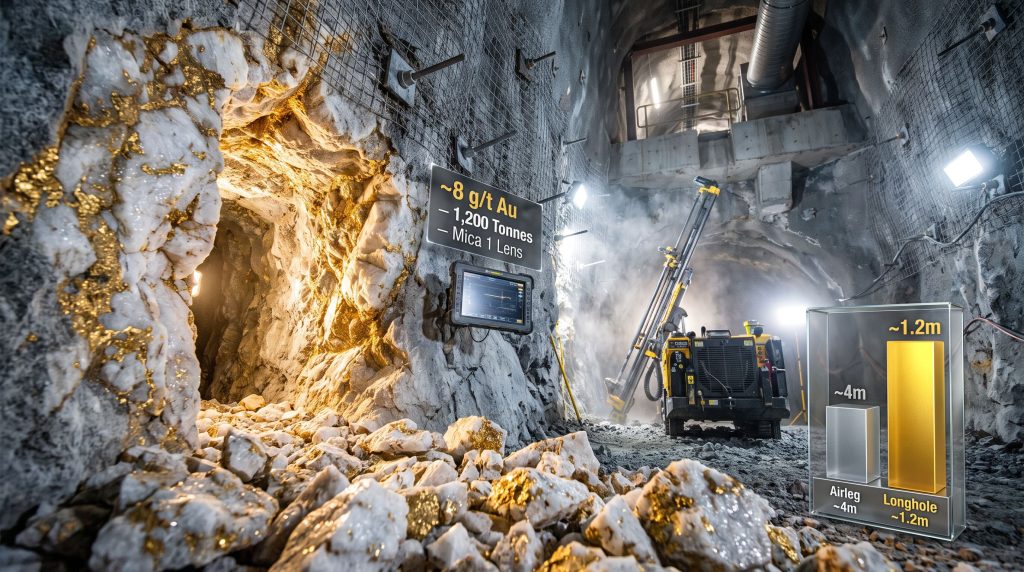
The stope at the Reward mine's Mica 1 lens has been designed to a mining width of approximately 1.2 metres. In the context of mechanised longhole stoping, this figure is exceptional. Most mechanised longhole applications are designed for stope widths of 2 metres or more, where the geometry allows standard production drill rigs to operate within their designed parameters. Applying longhole methodology at 1.2 metres requires careful adaptation of drill rig configuration, blast design, and ground support sequencing.
According to information released by Vertex Minerals, this stope is believed to be among the narrowest mechanised longhole stopes mined in Australia to date. This is not simply a record for its own sake. Narrower mechanised stopes mean that the extracted material more closely approximates the true vein geometry, delivering a higher proportion of actual ore relative to diluting waste material. Furthermore, when interpreting drill results from narrow-vein systems, the distinction between true and apparent widths becomes critical to any meaningful grade assessment.
The Reward Gold Mine: Understanding the Geological Setting
The Mica 1 Lens and Its Mining Implications
The Reward gold mine is located in New South Wales, Australia. The primary target in the current trial is the Mica 1 lens, a narrow, high-grade gold-bearing structure whose geometry demands precision extraction to realise its full economic potential. Narrow-vein gold deposits of this type are characterised by sharp contacts between the mineralised zone and the surrounding host rock. When mining widths exceed the true vein thickness, grade falls rapidly as diluting material enters the ore stream.
The table below illustrates why the shift from historical airleg methods to the current longhole trial is so consequential:
| Parameter | Historical Airleg Approach | Trial Longhole Stope |
|---|---|---|
| Mining Width | ~4 m (highly dilutive) | ~1.2 m |
| Expected Diluted Head Grade | Significantly lower | ~8 g/t Au |
| Stope Volume | Variable | ~1,200 tonnes |
| Method Classification | Conventional airleg | Mechanised longhole open stoping |
Previous mining at a 4-metre width had proven highly dilutive, meaning that a large proportion of the material processed through the plant was waste rock rather than gold-bearing ore. At an expected diluted head grade of approximately 8 g/t gold from the 1,200-tonne trial stope, the longhole approach delivers a substantially higher-grade feed to the gravity processing plant, even after accounting for the inevitable dilution inherent in any bulk mining method. In addition, understanding true widths vs apparent widths is essential when evaluating whether any reported intercept reflects the genuine geometry of the ore body.
A Mine Restarting from Difficult Ground Conditions
One detail that places the technical achievement in sharper relief is the condition of the underground workings prior to the current programme. The historic decline network at the Reward mine had been inundated with water for approximately 14 years before dewatering commenced. Once the workings were accessible, the ground was found to be in poor condition, requiring substantial remediation before safe mechanised operations could proceed.
The rehabilitation programme was extensive:
- Loose material was stripped from backs (the roof of underground workings) across affected areas
- Rock bolts and mesh were installed throughout the rehabilitated zones
- Cable anchors were grouted into the surrounding rock in areas where additional support was required
- Approximately 350 metres of hanging wall cable bolt installation was completed ahead of the first production firing
- Around 680 metres of production drilling was carried out to prepare the stope
This level of ground preparation reflects both the severity of the historical inundation damage and the operational team's commitment to safe work practices before advancing to production activities. Vertex Minerals' Reward gold mine provides further background on the mine's history and current development strategy.
How the Trial Stope Was Designed and Executed
From Decline Development to First Production Firing
The path to the Vertex Minerals Reward gold mine longhole stope blast followed a structured sequence of underground development and engineering work spanning approximately six months of detailed geological and engineering planning. The process can be understood in stages:
- Decline development was advanced to reach the base of Decline 3
- Comprehensive ground rehabilitation was completed across affected areas
- An 8-metre airleg slot rise was developed to create the initial void for the longhole rings to blast into
- Production drilling of longhole rings was completed, totalling approximately 680 metres
- Explosive charging and the first production firing were carried out
- Initial ore screening confirmed high-grade quartz with visible gold
- Bogging and transport of broken ore to the processing plant commenced
The slot rise is a critical element of any longhole stope. Without a free face for the blast to break towards, the explosive energy has nowhere to direct the fragmented rock. The 8-metre slot rise established this void, allowing the subsequent longhole rings to fire efficiently and produce well-fragmented ore suitable for mechanical loading.
The Modified Jumbo: An Interim Solution with Real Value
An often-overlooked technical detail in this operation is that the trial stope's 680 metres of production drilling was completed using a modified jumbo drill rig rather than a purpose-built longhole production rig. Jumbo drills are designed primarily for development headings and lack the same angular drilling capability and hole straightness tolerances of dedicated longhole rigs. Using a modified jumbo for longhole rings is technically demanding and requires careful drill setup and operator discipline to maintain acceptable hole deviation across the ring geometry.
The fact that the trial returned visible gold and is expected to deliver approximately 8 g/t Au despite being drilled with less-than-optimal equipment underscores the underlying quality of the Mica 1 lens and the capability of the underground team. Moreover, when reviewing gold drilling results from operations of this kind, the grade consistency achieved with interim equipment is a meaningful indicator of deposit robustness.
What a Dedicated Longhole Rig Changes for the Reward Operation
The Resemin Muki: Specifications and Strategic Role
The next significant equipment milestone for the Reward mine is the commissioning of a Resemin Muki longhole production drill rig, with construction scheduled for September 2026. The Muki is a purpose-built narrow-vein longhole drill designed for exactly the kind of constrained mining geometry found at the Reward mine. Its key advantages over a modified jumbo in this application include:
- Superior hole accuracy across longer drill intervals
- Optimised geometry for narrow stope widths
- Reduced collar-to-toe deviation, improving blast fragmentation and dilution control
- Higher drilling productivity enabling faster stope turnaround
The table below summarises the equipment transition timeline:
| Equipment | Current Status | Expected Deployment |
|---|---|---|
| Modified Jumbo Drill Rig | Interim solution, currently in use | Being phased out post-Muki arrival |
| Resemin Muki Longhole Rig | Under construction | Construction set for September 2026 |
| Commissioning at Reward | Pending shipment to Australia | Post-construction delivery, late 2026 |
Once commissioned, the Muki rig is expected to improve the consistency and accuracy of production drilling across the Reward underground mine, enabling a more systematic rollout of longhole stoping to additional levels as the mine develops below Decline 3.
Safety Improvements Enabled by Mechanised Mining
Removing Workers from the Active Stope Environment
One dimension of the longhole transition that deserves explicit attention is the safety improvement it enables. In conventional airleg stoping, miners work within the active stope void, drilling short holes in close proximity to the stope walls and back. This exposes them to risks from ground falls, poor visibility, and blast fume management in constrained spaces.
Mechanised longhole stoping fundamentally changes this exposure profile. The production driller operates from a mechanised platform at a designated drill drive, remote from the active stope cavity. The stope void itself remains unoccupied during all drilling and blasting activities. This means that ground instability events within the stope, which are common in post-blast environments, do not place workers at risk.
The ground support protocols established during the rehabilitation programme at Reward now form the baseline safety standards for ongoing operations, representing an institutional knowledge gain that persists beyond the trial stope itself.
The next major ASX story will hit our subscribers first
Proof of Concept: What the First Blast Results Mean for the Wider Rollout
Reading the Initial Ore Screening Results
The initial ore screening from the first production firing returned high-grade quartz with visible gold, consistent with the expected characteristics of the Mica 1 lens. In underground gold mining, the presence of visible gold in freshly blasted ore is a qualitative indicator of exceptional grade concentration. Most economic gold deposits do not contain gold visible to the naked eye, as the metal is typically disseminated at the micron scale within sulphide minerals or quartz. Visible gold indicates that gold concentration is sufficiently high to produce macroscopic grains, which typically corresponds to exceptionally high assay values.
The 1,200-tonne trial stope, mined at approximately 1.2 metres width, is expected to deliver a diluted head grade of around 8 g/t gold to the processing plant, representing a substantial improvement over grades achievable through the previously used wider airleg method at the Reward mine.
From Trial Stope to Full Mechanised Production
The strategic importance of this trial extends well beyond the 1,200 tonnes of ore it produces. Vertex Minerals has described the exercise as a proof of concept for full mechanised longhole open stoping across the Reward mine as new levels are established below Decline 3. The data generated from this trial, covering productivity rates, drilling accuracy, blast fragmentation, dilution outcomes, and ore handling performance, will inform the engineering parameters for the wider rollout.
The transition from airleg to mechanised longhole stoping as additional levels are developed represents a progressive improvement in both unit costs and ore grade delivered to the processing plant. Each new level developed below Decline 3 using longhole methodology should deliver higher head grades than equivalent airleg production would achieve, compounding the economic benefit over time. Consequently, decisions about cut-off grade economics will become increasingly important as the mine scales its extraction programme and seeks to optimise material flow to the processing plant.
Forward Milestones: What to Watch at the Reward Mine
The following table outlines the key milestones tracking the Reward mine's mechanisation programme:
| Milestone | Status | Timeframe |
|---|---|---|
| First longhole stope blast, Mica 1 lens | Completed | August 2026 |
| Initial ore screening, visible gold confirmed | Completed | August 2026 |
| Resemin Muki rig construction | In progress | September 2026 |
| Muki rig shipment to Australia | Pending | Post-September 2026 |
| Commissioning of Muki rig at Reward | Planned | Late 2026 |
| Full mechanised longhole stoping rollout | Progressive | As new levels are established below Decline 3 |
As the operation matures and additional data from the trial stope is incorporated into mine planning, a definitive feasibility study framework will ultimately be required to confirm the economics of full-scale mechanised production across the deposit. Furthermore, the latest ore production update released by Vertex Minerals provides additional operational context for investors monitoring the mine's progress.
Frequently Asked Questions: Vertex Minerals Reward Gold Mine Longhole Stoping
What is a longhole open stope in underground gold mining?
A longhole open stope is a mechanised underground mining method where parallel rings of drill holes are blasted in sequence into an open void. Broken ore falls to the bottom of the stope and is mechanically loaded and transported. It differs from hand-held methods by using purpose-built drill rigs that deliver greater hole accuracy and remove workers from the active stope environment.
Why is 1.2 metres considered an exceptionally narrow mechanised stope width?
Most mechanised longhole applications target stope widths of 2 metres or more to accommodate standard equipment geometry and maintain acceptable drill hole deviation. Designing and executing a mechanised longhole stope at 1.2 metres requires significant adaptation of drill setup, blast geometry, and ground support and is considered at the technical frontier of this mining method in the Australian context.
What grade of gold is expected from the Reward mine trial stope?
The 1,200-tonne trial stope at the Mica 1 lens is expected to deliver a diluted head grade of approximately 8 g/t gold to the processing plant.
What caused delays in reaching the first stope at Decline 3?
The primary cause of delays was the condition of the ground encountered in the declines and stope areas. The workings had been submerged for approximately 14 years before dewatering, leaving the rock mass in deteriorated condition requiring substantial rehabilitation before mechanised operations could safely proceed.
What is the Resemin Muki drill rig?
The Resemin Muki is a purpose-built narrow-vein longhole production drill rig designed for constrained underground environments. Its construction is scheduled for September 2026, after which it will be shipped to Australia and commissioned at the Vertex Minerals Reward gold mine longhole stope blast programme to support mechanised longhole production drilling.
How does longhole stoping reduce dilution compared to airleg mining?
By maintaining tighter control of the stope boundary through mechanised drilling, longhole stoping extracts material closer to the true vein geometry. Historical airleg mining at the Reward mine required a width of approximately 4 metres, far exceeding the natural vein width and introducing large volumes of diluting waste rock. The longhole trial operates at approximately 1.2 metres, dramatically improving the ratio of ore to waste in the extracted material.
What does bottom-up mining sequence mean in underground mine planning?
A bottom-up mining sequence means that the lowest accessible level is extracted first, with subsequent levels mined progressively upward. This approach allows broken ore to be gravity-fed downward and prevents mining-induced subsidence from affecting workings at lower elevations that have not yet been extracted.
Disclaimer: This article contains forward-looking statements and projections based on information disclosed by Vertex Minerals. Actual results, grades, and timelines may differ materially from those anticipated. This article does not constitute financial or investment advice. Readers should conduct their own due diligence before making any investment decisions.
Want to Stay Ahead of the Next Significant ASX Mineral Discovery?
Discovery Alert's proprietary Discovery IQ model scans ASX announcements in real time, delivering instant notifications on high-potential mineral discoveries — from narrow-vein gold operations like the Reward mine to transformative finds across 30+ commodities — so subscribers can act before the broader market reacts. Explore historic discoveries and their returns to see what early positioning can mean, then begin your 14-day free trial at Discovery Alert to secure your market-leading edge.