July 10, 2026
The Geopolitics of Heavy Rare Earth Supply and Why Offtake Agreements Are the New Battleground
The global scramble to secure heavy rare earth elements outside of China is no longer a future-oriented policy exercise. It is happening right now, at the procurement desk level, inside the supply chain divisions of some of the world's largest industrial manufacturers. Victory Metals heavy rare earth concentrate offtake partners are emerging as a critical focal point in this race, as the structural dependency that Western nations built up over decades of relying on Chinese rare earth processing capacity is being stress-tested in real time.
Companies that can deliver verified, non-Chinese heavy rare earth concentrate are finding themselves at the centre of an increasingly urgent commercial conversation. Furthermore, understanding the broader context of rare earth supply chains helps illustrate just how significant this shift has become.
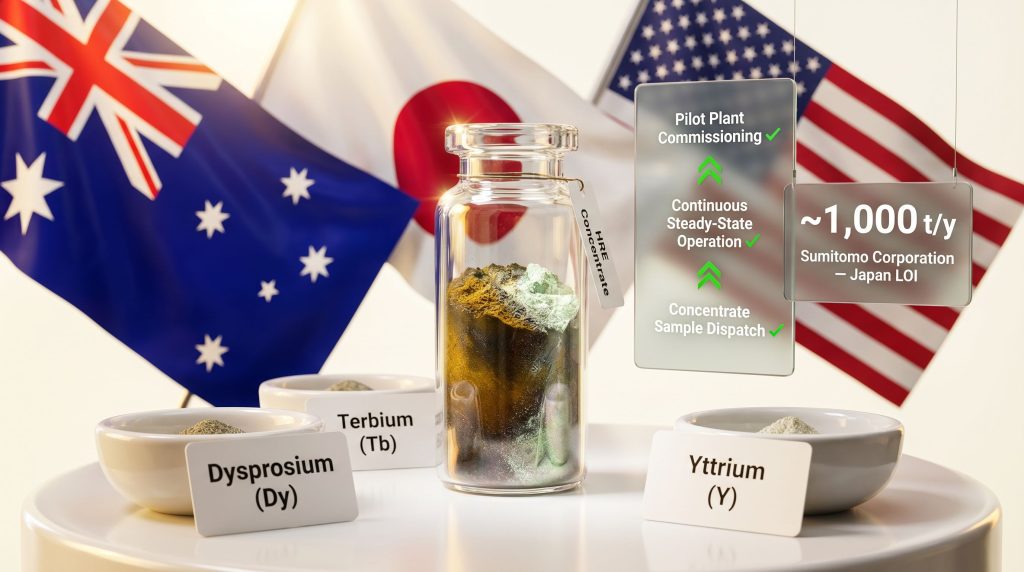
Victory Metals' active programme of dispatching heavy rare earth concentrate to potential offtake partners across Australia, Japan, and the United States is a direct reflection of this dynamic. Understanding what this programme actually means, technically, commercially, and strategically, requires unpacking several layers of context that go well beyond a simple project update.
When big ASX news breaks, our subscribers know first
Why the Heavy Rare Earth Supply Problem Is Structurally Different From Light Rare Earths
Most public discussion of rare earth supply chains conflates light and heavy rare earths, but these are fundamentally different markets with different geological sources, processing pathways, and strategic profiles.
Light rare earth elements such as neodymium and praseodymium are found in relatively abundant deposits globally, including in Australia, Canada, and parts of Africa. Heavy rare earth elements, by contrast, are geologically rarer and are predominantly sourced from ionic adsorption clay deposits concentrated in southern China's Jiangxi Province and neighbouring regions. This geological concentration is the root cause of China's dominant position in heavy rare earth supply, a position that cannot be replicated quickly regardless of how much capital flows into alternative projects.
The three heavy rare earth elements anchoring Victory Metals' concentrate, dysprosium, terbium, and yttrium, each carry distinct strategic weight:
| Element | Primary Use Case | Supply Risk Level |
|---|---|---|
| Dysprosium (Dy) | High-temperature NdFeB permanent magnets for EV motors and wind turbines | Extreme |
| Terbium (Tb) | Magnet coercivity enhancement, next-generation magnet formulations | Extreme |
| Yttrium (Y) | Phosphors, advanced ceramics, fuel cells, medical imaging systems | High |
China controls an estimated 85 to 90 percent of global heavy rare earth refining capacity. Moreover, China's export restrictions targeting rare earth processing intermediates have transformed what was previously described as a theoretical supply chain risk into an active and demonstrated vulnerability. Western industrial buyers who were previously comfortable with long supply chains through Chinese processors are now under pressure from their own governments and customers to qualify alternative sources.
The qualification of new non-Chinese heavy rare earth supply sources has shifted from a long-range strategic planning item to an immediate procurement priority for downstream manufacturers operating in Japan, the United States, and Australia.
How the Flotation Pilot Plant Changes Victory Metals' Commercial Position
The Technical Logic of an Ambient-Temperature Flotation Flowsheet
Victory Metals operates a purpose-built flotation pilot plant in Perth, Western Australia. What distinguishes this facility from many competing rare earth processing approaches is its ambient-temperature operating design. Most rare earth processing routes involve hydrometallurgical circuits that require elevated temperatures and complex reagent systems, both of which drive up capital intensity and operating cost.
Flotation at ambient temperature offers several commercially meaningful advantages:
- Lower energy intensity relative to thermally driven processing routes, reducing operating expenditure per tonne of concentrate produced
- Simplified reagent circuits, which reduces both procurement complexity and the environmental management burden associated with aggressive chemical processing
- Faster optimisation cycles, because the flowsheet's relative simplicity allows rapid testing of process modifications without extensive shutdown and restart protocols
- Scalability, as the pilot-scale flowsheet can be modelled directly into pre-feasibility study engineering inputs with higher confidence than theoretical design assumptions
The plant has moved beyond commissioning into what the company describes as consistent, reliable continuous steady-state operation. This distinction matters enormously in the context of offtake discussions. A plant that has achieved commissioning has demonstrated that it can produce product. A plant operating in continuous steady-state has demonstrated that it can produce product reliably and reproducibly, which is an entirely different commercial threshold.
What Continuous Operation Signals to Downstream Processors
Industrial offtake partners, particularly those embedded in Japanese and American manufacturing supply chains, approach new concentrate sources with a structured qualification process. They are not evaluating a concept. They are evaluating whether a specific material, produced by a specific process, can be reliably integrated into their existing processing circuits.
Continuous pilot-scale operation provides three critical data points that prospective partners require:
- Process stability confirmation that the flowsheet performs consistently across extended production runs, not just in optimised batch conditions
- Grade predictability across multiple production cycles, demonstrating that the heavy rare earth content and distribution are reproducible rather than variable
- Scalability modelling inputs that allow engineering teams to project commercial-scale performance with confidence
Victory Metals has also engaged Curtin University as a research collaborator in the pilot plant development process. This is a technical research partnership, not a commercial arrangement, but it adds a layer of independent academic scrutiny to the flowsheet's design and performance that strengthens the company's technical credibility with sophisticated industrial partners. For further context, Victory Metals' heavy rare earth strategy outlines the full scope of their concentrate and processing approach.
Mapping Victory Metals' Heavy Rare Earth Concentrate Offtake Partner Landscape
Sumitomo Corporation: The Commercial Anchor
The most advanced relationship in Victory Metals' offtake programme involves Sumitomo Corporation, one of Japan's largest diversified trading conglomerates with deep positions across metals, energy, and industrial materials supply chains.
| Parameter | Detail |
|---|---|
| Partner | Sumitomo Corporation |
| Agreement Type | Non-binding Letter of Intent (upgraded from 2024 MoU) |
| Target Volume | Up to 30% of annual mixed rare earth carbonate production |
| Indicative Annual Volume | Approximately 1,000 tonnes |
| Target Commercial Commencement | 2027 (pilot plant scale sales) |
The progression from a Memorandum of Understanding in 2024 to a Letter of Intent is not merely procedural. It reflects Sumitomo's internal assessment that Victory Metals has met the technical credibility thresholds required to escalate toward commercial commitment. The timing of this upgrade, following the transition to continuous steady-state pilot plant operation, is not coincidental.
Japan's industrial dependence on dysprosium and terbium is acute. Its permanent magnet sector, which supplies components for electric vehicle motors and wind turbine generators across Asian and global supply chains, consumes meaningful volumes of both elements. Japan has no domestic heavy rare earth production and has historically relied on Chinese-origin material through its trading house networks. Consequently, the Sumitomo partnership with Victory Metals is structurally aligned with Japan's national critical mineral diversification objectives, even if the commercial terms are driven by procurement economics rather than policy directives.
Australia and the United States: Independent Qualification in Progress
For prospective offtake partners in both Australia and the United States, Victory Metals has dispatched physical concentrate samples for independent examination. No binding agreements or publicly named partners have been confirmed in either jurisdiction at this stage.
| Jurisdiction | Stage | Current Activity |
|---|---|---|
| Australia | Pre-qualification | Concentrate samples dispatched, independent examination underway |
| United States | Pre-qualification | Concentrate samples dispatched, independent examination underway |
| Japan | LOI (non-binding) | Sumitomo; commercial framework established |
Independent product examination is a standard and necessary step in qualifying new supply sources for rare earth processing facilities. Prospective partners conduct their own analytical testing across three critical parameters:
- Concentrate grade, measured as total rare earth oxide content per unit of material
- Heavy rare earth distribution, specifically the relative proportions of dysprosium, terbium, yttrium, and other heavy rare earth elements within the total rare earth oxide fraction
- Impurity profile, with particular focus on radiological elements such as thorium and uranium, as well as silica and phosphorus, all of which impose additional processing costs and regulatory compliance obligations on downstream facilities
The low impurity profile of Victory Metals' concentrate is cited as a key commercial attribute. This is not a minor technical footnote. Processing facilities in Japan and the United States operate under stringent radiological and environmental regulations. A concentrate with elevated thorium or uranium content creates licensing complexity, waste management obligations, and potential operational restrictions that downstream processors price heavily into their purchasing decisions. Clean feedstock commands a premium in these markets.
The Offtake-to-Financing Pathway: Why These Agreements Matter Beyond Revenue
How Offtake Structures De-Risk Project Financing for Junior Developers
For a junior mining and processing company, the strategic value of an offtake agreement extends well beyond the revenue it represents. In the project financing ecosystem, particularly for critical mineral projects seeking debt or equity funding, offtake agreements serve as a foundational revenue assumption that underpins the entire financial model. The surging critical minerals demand globally only amplifies this dynamic.
The qualification pathway from pilot production to binding offtake follows a clear sequential logic:
| Stage | Activity | Commercial Outcome |
|---|---|---|
| 1 | Pilot plant achieves continuous operation | Technical credibility established |
| 2 | Concentrate samples dispatched | Physical product in partner hands |
| 3 | Independent examination by partners | Grade, distribution, and impurity verified |
| 4 | LOI or MoU executed | Commercial intent formalised |
| 5 | PFS completed with offtake inputs | Project economics validated |
| 6 | Binding offtake negotiated | Revenue-generating agreement executed |
| 7 | Project financing secured | Capital raised against contracted revenue |
Victory Metals heavy rare earth concentrate offtake partners are being qualified across stages two through five simultaneously, which is a deliberate acceleration strategy. Running a definitive feasibility study development in parallel with offtake qualification, rather than sequentially, compresses the timeline to project financing by ensuring that commercial and technical workstreams converge rather than waiting on each other.
The Multi-Jurisdictional Diversification Logic
Qualifying potential offtake partners across three separate jurisdictions simultaneously is also a sound commercial negotiating strategy. It creates competitive tension in eventual pricing discussions, prevents any single buyer from assuming they are the only viable commercial pathway for the project, and provides resilience if one partner's internal procurement timelines shift.
Multi-jurisdictional exposure also aligns Victory Metals' supply positioning with three of the most active critical mineral procurement frameworks operating globally. The United States Inflation Reduction Act, Japan's Economic Security Promotion Act, and Australia's Critical Minerals Strategy each create structural incentives for downstream manufacturers to source material from allied nations. However, while these policy frameworks do not constitute project-specific support for Victory Metals, they do create the commercial environment in which the company's offtake discussions are taking place.
Australia's Geological Advantage in the Western Heavy Rare Earth Race
Why Western Australia Is Emerging as a Preferred HREE Source Region
Australia's geological endowment in heavy rare earth mineralisation, particularly across Western Australia, positions it as one of the few non-Chinese jurisdictions capable of supplying meaningful concentrate volumes. Ionic adsorption clay deposits similar in character to those in southern China have been identified across parts of northern and central Western Australia, providing a geological basis for the country's emerging role in the broader critical minerals race.
Beyond geology, several structural factors make Australian-sourced heavy rare earth material attractive to allied-nation industrial buyers:
- Proximity to Asian processing hubs reduces logistics cost and supply chain complexity relative to Atlantic Basin sources
- Established and transparent mining regulation reduces project execution risk for downstream partners investing in qualification programmes
- Strong bilateral trade and security relationships with Japan and the United States elevate the geopolitical value of Australian-origin supply
- The Five Eyes intelligence partnership and AUKUS defence arrangements further reinforce Australia's strategic partner status in critical mineral procurement discussions among allied defence and industrial procurement agencies
The next major ASX story will hit our subscribers first
Key Milestones for Investors to Monitor
Investors tracking Victory Metals' progress should focus on the transition points between commercial stages rather than any single announcement. The escalation from non-binding LOI to binding offtake, and the emergence of named partners in Australia and the United States, represent the next material de-risking events in the company's development trajectory.
The sequential development pathway from current activities to Final Investment Decision can be mapped as follows:
- Pilot plant continuous steady-state operation confirmed (completed)
- Concentrate samples dispatched to Australia, Japan, and US (completed)
- Independent qualification by prospective partners (in progress)
- PFS completion with offtake-informed revenue assumptions (upcoming)
- Binding offtake agreement negotiations
- Project debt and equity financing
- Final Investment Decision
Each step in this progression reduces a specific category of project risk, whether technical, commercial, or financial, and collectively moves Victory Metals along the spectrum from exploration-stage concept to construction-ready project. Furthermore, recent coverage of Victory Metals' dispatch to global offtake partners underscores just how rapidly this commercial pathway is advancing.
Victory Metals Offtake Programme: Summary Snapshot
| Dimension | Current Position |
|---|---|
| Pilot Plant Status | Continuous steady-state operation |
| Concentrate Dispatch | Australia, Japan, United States |
| Lead Offtake Partner | Sumitomo Corporation (Japan) |
| Agreement Level with Sumitomo | Non-binding LOI (upgraded from 2024 MoU) |
| Indicative Sumitomo Volume | ~1,000 t/y (up to 30% of annual MREC output) |
| Target Pilot Sales Commencement | 2027 |
| Key HREE Elements | Dysprosium, Terbium, Yttrium |
| Processing Technology | Ambient-temperature flotation flowsheet |
| Academic Partnership | Curtin University (technical research collaboration) |
| PFS Status | Advancing in parallel with offtake discussions |
Victory Metals heavy rare earth concentrate offtake partners spanning three jurisdictions represent a structured and deliberate approach to de-risking one of the most strategically important junior critical mineral projects currently in development outside of China. The convergence of technical progress, commercial qualification, and policy tailwinds creates a rare alignment of circumstances that positions this programme as a meaningful development in Western heavy rare earth supply chain construction.
This article is intended for informational purposes only and does not constitute financial advice. Statements regarding future timelines, offtake outcomes, and project development milestones involve inherent uncertainty and should not be relied upon as guarantees of future performance. Investors should conduct their own due diligence and seek independent financial advice before making investment decisions.
Want to Track the Next Major Critical Mineral Discovery Before the Market Does?
Discovery Alert's proprietary Discovery IQ model scans ASX announcements in real time, instantly identifying significant mineral discoveries across rare earths and over 30 other commodities — turning complex data into actionable investment insights for both short-term traders and long-term investors. Explore historic discoveries and their returns, then begin your 14-day free trial at Discovery Alert to position yourself ahead of the broader market.