Viking Mines Ltd
- ASX Code: VKA
- Market Cap: $22,613,789
Viking Mines Strikes Visible Scheelite in First Linka Drilling in 40 Years
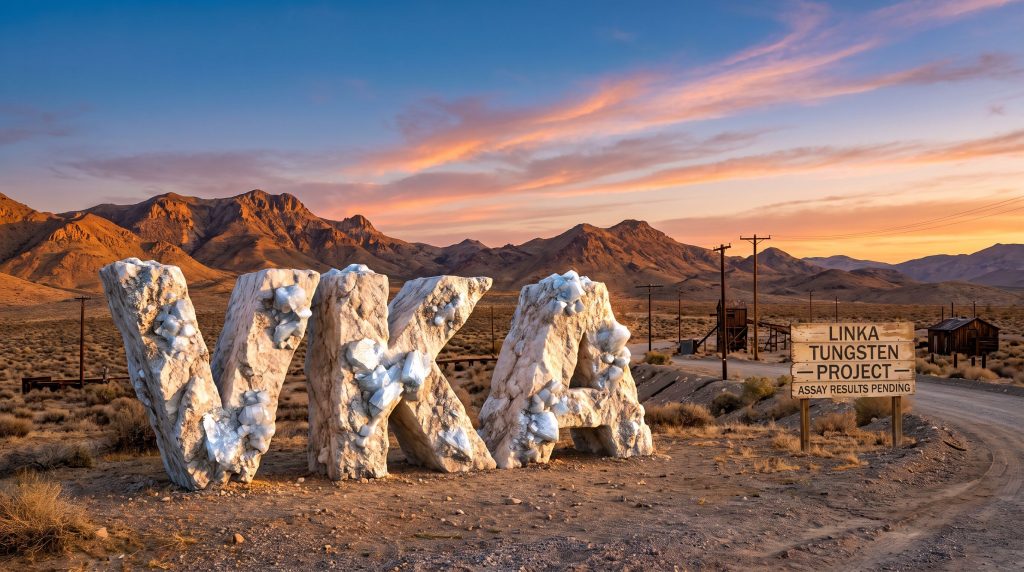
Viking Mines Limited (ASX: VKA) has reported multiple zones of visible scheelite in the first three holes from its maiden reverse circulation drilling programme at the Linka Tungsten Project in Nevada, with mineralisation logged from as shallow as 3m downhole. According to the ASX announcement, all three reported holes intersected scheelite hosted in tactite, also known as skarn, providing early support for the company's geological model ahead of laboratory assays.
The update matters because it marks the first drilling at Linka in more than 40 years, and because the project already carries historical production, existing site infrastructure, and prior metallurgical results using conventional processing methods. Assays are now expected in approximately 4 to 6 weeks, which will be the next key test of whether visual mineralisation translates into commercially meaningful tungsten grades.
"Being on the ground at Linka observing our maiden RC drilling programme with the chip trays lighting up under the UV lamp hole after hole, as predicted by our 3D geological model, is as good as it gets prior to assays," said Julian Woodcock, Managing Director and CEO of Viking Mines.
When big ASX news breaks, our subscribers know first
What Did the First Linka Drill Holes Report?
In the drilling update, Viking said company geologists identified scheelite visually in RC drill chips using its fluorescence under shortwave ultraviolet light at 254nm, a standard field identification method for this tungsten-bearing mineral.
The first three reported holes were LKRC0002, LKRC0003 and LKRC0004. Each returned multiple mineralised intervals, with the strongest visual responses concentrated in specific sections of the holes.
| Hole ID | Visible scheelite summary | Horizon from | Key stronger zone |
|---|---|---|---|
| LKRC0002 | 12m continuous | 40m | 2m from 50m to 52m |
| LKRC0003 | 13m combined over 19m | 9m | 2m from 20m to 22m |
| LKRC0004 | 11m combined over 21m | 3m | 4m from 14m to 18m |
The company stated that visual abundance across these intervals was estimated at 0.1% to 3.0% scheelite. It also included a caution that visual estimates are not a substitute for laboratory analysis and provide no reliable information on final grade, impurities, or other factors relevant to valuation.
That caution is important. For investors, the significance of this update is not that grades have been confirmed, but that multiple holes encountered the target mineral in predicted positions, suggesting the geological model may be working as intended.
Why Does Scheelite Matter in Tungsten Projects?
Scheelite, chemically CaWO₄, is one of the main natural ore minerals of tungsten and is described by Viking as the most important for downstream tungsten production. The company noted that scheelite contains about 80.5% WO₃, or tungsten trioxide, which is the standard measure used to report tungsten grades.
For non-specialist investors, furthermore, several points make scheelite particularly relevant:
- It is a recognised tungsten source used in commercial mining.
- It can be identified quickly in the field using UV light because it fluoresces.
- It is commonly found in skarn deposits, which are a known geological setting for tungsten mineralisation.
- It has a conventional processing route, with projects often using gravity and flotation methods.
This matters because the style of mineralisation can affect both exploration efficiency and future development options. A mineral that is easy to recognise during drilling may help geologists refine hole placement more quickly.
Key Tungsten Terms Explained
For investors following tungsten exploration, a few technical terms in the report are worth translating into plain language.
Scheelite: A calcium tungstate mineral and a major natural source of tungsten.
WO₃: Tungsten trioxide, the standard unit used to express tungsten grade.
Skarn or tactite: A rock formed when hot mineral-rich fluids from an intrusion react with limestone or similar rocks. This setting is often associated with tungsten mineralisation.
RC drilling: Short for reverse circulation drilling. This is a drilling method that brings rock chips to surface using compressed air. It is widely used in early-stage exploration because it is relatively fast and cost-effective.
NSR royalty: Short for net smelter return. This is a royalty paid as a share of revenue from minerals sold, usually to a previous owner.
Understanding these terms helps frame why the Linka results are being watched closely. The report is not simply describing visible minerals in chips. It is describing a specific tungsten deposit style with historical mining precedent and known treatment methods.
What Might the Drilling Indicate About the Linka System?
Although true widths are not yet known, the announced intervals point to a mineralised system that appears broad in places and relatively shallow in the areas tested so far.
Hole LKRC0004 is particularly notable because visible scheelite starts from 3m downhole, while LKRC0002 returned a 12m continuous interval from 40m. In practical terms, shallow mineralisation can be important because, if supported by assays and continuity, it may be easier to access in any future mining scenario.
The drill orientations also matter. According to the appendix, Viking used different hole directions and dips, including a vertical hole and angled holes:
| Hole ID | End of hole | Azimuth | Dip |
|---|---|---|---|
| LKRC0002 | 61m | 065° | -70° |
| LKRC0003 | 31m | 315° | -50° |
| LKRC0004 | 25m | 000° | -90° |
This variation can help geologists understand the orientation of the mineralised zones. However, the company also stated in its JORC tables that the relationship between drill angle and mineralisation is not yet well understood, and that some intervals may include length bias.
That is a standard early-stage exploration issue and one reason assays alone will not be the full story. Geometry and continuity will also need to be refined through further drilling.
Linka's Historical Production and Project Backdrop
The Linka Tungsten Project is located in Lander and Pershing counties, Nevada, and includes the historically producing Linka, Conquest and Hillside mines. According to the ASX announcement, these operations produced approximately 65,000 tonnes at 0.5% WO₃ through a 360 tonne-per-day mill until 1956.
The company said operations ceased in response to the tungsten price at the time rather than because of geological depletion. That distinction is relevant for market interpretation, because it suggests the historical shutdown was linked to economics rather than an exhausted orebody.
In addition, the project includes brownfields advantages identified in the announcement, including:
- A 150ft shaft, equivalent to about 46m
- Historic pits and underground workings
- An on-site run-of-mine pad
- A historical tailings dam
- Approximately 8.5km² of consolidated mining claims
- Sealed highway access within 7km
- Grid power within 4km
Viking also said digitisation of 72 historical drillholes totalling 2,908m has extended the known mineralised trend to 1.6km within an interpreted ~7km intrusive contact that remains largely untested.
For investors, that mix of historical production and existing infrastructure can matter because it may provide a more informed starting point than a greenfields exploration project. It does not remove development risk, but it can improve the amount of geological and operational context available at an early stage.
Metallurgy, Acquisition Terms and the Broader Tungsten Context
Before the current assay results are available, Linka already carries some useful technical reference points from prior work cited in the announcement. These include:
- Surface sampling up to 14.7% WO₃
- Metallurgical testwork producing a 56.9% WO₃ concentrate
- Reported concentrate recovery of 76.0%
- Processing using conventional gravity and flotation
Those figures do not confirm future plant performance, but they suggest the project has already shown compatibility with standard tungsten processing approaches.
On ownership, Viking said it signed a binding term sheet in December 2025 to acquire a 100% interest in the project. The consideration totals US$2.88 million over a staged 7-year period. BLK Group retains a 2% NSR royalty, with Viking holding the right to buy back 1% for US$2 million.
The broader tungsten market backdrop also provides context. The company noted that tungsten is designated a critical mineral, and referenced the US REEShore Act requirement for Chinese-free tungsten in US military supply chains from December 2026. This is relevant as a market setting factor, though it should be read as sector context rather than project-specific support.
What Should Investors Watch Next?
According to the drilling update, the immediate next steps are clear and near-dated. The company is currently:
- Completing its maiden RC drilling programme at Linka
- Preparing and dispatching samples to ALS Laboratories in Reno, Nevada
- Continuing metallurgical testwork for ore sorting and flotation
- Planning to report drilling progress and assay results as they are received and validated
The expected timeline is straightforward:
| Milestone | Status / timing |
|---|---|
| Sample dispatch to ALS Reno | In preparation |
| First assay results | Approximately 4 to 6 weeks |
| Maiden RC programme completion | Ongoing |
| Metallurgical testwork updates | Ongoing |
The first assays are likely to be the main near-term catalyst. They will determine whether the visible scheelite intervals correspond to grades that justify follow-up drilling and possible resource definition work.
The next major ASX story will hit our subscribers first
Why Does This Linka Drilling Update Matter?
This ASX update does not yet provide assay grades, resource estimates or economic studies. What it does provide, however, is early geological confirmation that all three reported holes encountered visible tungsten-bearing scheelite, including shallow intervals and a 12m continuous section in one hole.
For investors, the report adds weight to several parts of the Linka thesis:
- The 3D geological model appears to have predicted mineralisation locations effectively in the first holes
- The mineralisation reported so far is shallow in places
- The project has a historical production record
- Existing infrastructure and prior metallurgical work provide additional context
- The next key data point, laboratory assays, is expected within weeks rather than months
That combination means the current update is best viewed as an encouraging early exploration signal rather than a definitive valuation event. The conversion of visual observations into assay grades will ultimately determine whether the initial drilling at Linka marks the start of a broader tungsten growth story for Viking Mines.
Ready to Catch the Next Major Mineral Discovery Before the Market Does?
Discovery Alert's proprietary Discovery IQ model scans ASX announcements in real time, instantly alerting subscribers to significant mineral discoveries like emerging tungsten plays — translating complex geological data into clear, actionable opportunities. Explore how major discoveries have historically delivered exceptional returns on Discovery Alert's dedicated discoveries page, and start your 14-day free trial today to position yourself ahead of the broader market.