
June 24, 2026
The Developer-to-Producer Gap: Why Most Silver Projects Stall Before Construction
The history of silver mining is littered with technically sound projects that never made it past the feasibility study stage. Capital markets dry up, permitting timelines extend beyond investor patience, or the operational leadership required to execute a complex underground build simply isn't assembled in time. The transition from a completed feasibility study to a formal construction decision represents one of the most statistically challenging thresholds in the entire mining project lifecycle, with a significant proportion of projects failing to cross it within any reasonable timeframe after their studies are published. Understanding exactly where a given project sits within this transition, and what specific variables have already been resolved versus what remains outstanding, is arguably the most important analytical exercise an investor can perform when evaluating a development-stage silver company.
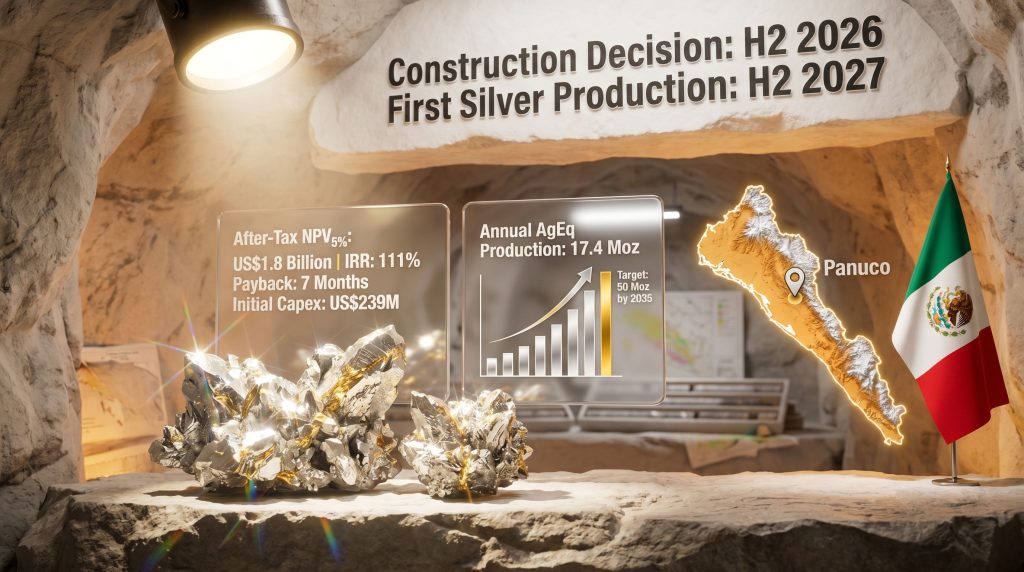
Vizsla Silver Panuco development readiness has advanced to a point that distinguishes it sharply from the broader universe of silver developers. The project has a completed November 2025 Feasibility Study, a fully permitted test mine, a US$300 million project finance facility, a cash position exceeding US$450 million as of year-end 2025, a newly secured government-backed working capital facility, and three senior operational appointments made in the span of four days in May 2026. The single remaining regulatory gating item before a formal construction decision is MIA permit approval, with the construction decision itself targeted for the second half of 2026 and first silver production targeted for the second half of 2027.
This article examines each of these elements systematically, with a focus on what they mean for execution risk, project economics, and the district-scale exploration upside that extends the investment case well beyond the initial feasibility study mine life.
When big ASX news breaks, our subscribers know first
What "Construction Readiness" Actually Means for a Silver Developer
The Stages Most Silver Projects Never Complete
The mining project development pathway moves through a defined sequence: grassroots exploration, resource definition drilling, preliminary economic assessment, pre-feasibility study, definitive feasibility study, detailed engineering, construction decision, and production. Each stage requires progressively greater capital commitments, technical rigour, and regulatory compliance, which is precisely why attrition rates are so high at each transition point.
The gap between feasibility study completion and construction decision is particularly treacherous for three compounding reasons. First, definitive feasibility studies are expensive to produce and often leave companies with depleted treasury positions, creating a financing requirement precisely when investors are scrutinising execution capability most closely. Second, the permitting challenges required before construction can begin, particularly environmental impact assessments, operate on regulatory timelines that are largely outside the company's control. Third, the operational leadership profiles required to execute a construction program are substantially different from those needed to advance a project through exploration and resource definition, meaning companies frequently need to restructure their teams at exactly the point when continuity matters most.
Three variables determine whether a project successfully crosses the feasibility-to-construction threshold:
-
Capital availability: Not merely the existence of a financing term sheet, but confirmed, drawn-down-ready facilities that cover both initial capital expenditure and working capital requirements through first production.
-
Permit status: Progress toward final environmental approvals, with demonstrated regulatory track record in the relevant jurisdiction.
-
Operational leadership: Experienced personnel in place who have previously executed comparable construction and production transitions, not merely committed to joining once construction is sanctioned.
Where Panuco Sits on the Development Spectrum in Mid-2026
The following table maps Panuco's current status across each major development milestone:
| Development Milestone | Status (Mid-2026) |
|---|---|
| Feasibility Study | Completed November 2025 |
| Test Mine Permit | Fully permitted |
| Project Finance Facility | US$300 million secured |
| Cash Position | >US$450 million (end 2025) |
| FIFOMI Working Capital Facility | MXN$173 million (~US$10 million) secured |
| Detailed Engineering | In progress |
| MIA Environmental Permit | Pending approval |
| Construction Decision | Targeted H2 2026 |
| First Silver Production | Targeted H2 2027 |
Among the three critical variables, two have been substantially resolved. Capital availability is addressed by the combination of the US$300 million project finance facility, the company's cash position, and the FIFOMI working capital facility, which together cover both construction capital and operational liquidity through first production. Operational leadership has been directly addressed by the three senior appointments in May 2026. Permit status remains the primary outstanding variable, with the MIA process representing the final regulatory hurdle before construction can formally commence.
How Strong Are Panuco's Feasibility Study Economics?
Breaking Down the November 2025 Feasibility Study Numbers
The economics outlined in Vizsla Silver's November 2025 Feasibility Study place Panuco in a category occupied by very few silver development projects globally. At base case assumptions of US$35.50 per ounce silver and US$3,100 per ounce gold, the project delivers metrics that compress investor risk exposure to an unusually short timeframe while simultaneously generating exceptional long-term value.
The key financial parameters from the study are as follows:
- Annual silver equivalent production: 17.4 million ounces
- Initial mine life: 9.4 years
- Initial capital expenditure: US$239 million
- After-tax NPV at 5% discount rate: US$1.8 billion
- Internal rate of return: 111%
- Payback period: 7 months
These numbers reflect the structural advantages of a high-grade epithermal vein system. Unlike bulk-tonnage silver deposits that require enormous throughput volumes and correspondingly large capital bases to generate acceptable returns, epithermal vein systems like Panuco deliver concentrated metal content within narrower ore zones, which reduces both mining costs per tonne and the capital intensity of the processing infrastructure required.
Why a 7-Month Payback and 111% IRR Matter for Risk Assessment
A 7-month payback period is not merely a headline metric. It fundamentally compresses the window during which commodity price volatility can materially impair the project's return profile. In practical terms, it means that at base case production rates, the project recovers its entire initial capital expenditure before the end of its first year of operation. This dramatically reduces the sensitivity of total project returns to silver price movements in years two through nine of the mine life, because the capital at risk has already been recovered.
An IRR of 111% signals capital efficiency that substantially exceeds the cost of capital under virtually any financing scenario. Where most silver development projects must demonstrate viability against a financing cost structure that assumes 15–20% equity return requirements, a project generating an 111% IRR retains compelling economics even after significant financing costs, construction contingencies, and moderate commodity price downside.
The primary risk variable for a project with this economic profile is not silver prices. It is construction execution. Cost overruns and schedule delays represent the most direct mechanism by which a high-IRR project can have its economics materially degraded, and this is precisely why the appointment of Dave D'Antonio as Senior Vice President of Technical Services carries direct financial significance.
How Panuco's Economics Compare to the Silver Development Peer Group
The following table contextualises Panuco's feasibility study metrics against typical ranges observed across the silver development project universe:
| Metric | Panuco (Nov 2025 FS) | Typical Silver Developer Range |
|---|---|---|
| After-Tax NPV5% | US$1.8 billion | US$200M – US$800M |
| IRR | 111% | 15% – 40% |
| Payback Period | 7 months | 3 – 7 years |
| Initial Capex | US$239 million | US$150M – US$600M |
| Annual AgEq Production | 17.4 Moz | 5 – 20 Moz |
The IRR differential is the most striking feature of this comparison. While a 15–40% IRR range is considered commercially viable for silver development projects, an 111% IRR reflects a deposit quality and mine design configuration that sits at the top of the global silver development pipeline. The relatively contained initial capex of US$239 million, combined with the project's high-grade nature, drives this outcome by maximising metal value extracted per dollar of capital invested.
Investors should note that feasibility study economics represent modelled projections based on stated assumptions. Actual project performance will depend on construction execution, operational efficiency, commodity price outcomes, and factors that cannot be fully anticipated at the study stage. This article does not constitute financial advice.
How Vizsla Silver Is Financing the Panuco Build
The Layered Capital Structure
Financing risk, alongside permitting and execution risk, is one of the three variables that most commonly prevent development-stage silver projects from advancing to construction. Vizsla Silver has addressed this variable through a layered capital structure combining three distinct components:
-
US$300 million project finance facility: The primary construction capital source, sized to cover the US$239 million initial capex outlined in the feasibility study with meaningful contingency capacity.
-
Cash position exceeding US$450 million: As reported at year-end 2025, this treasury position provides substantial additional liquidity that supplements the project finance facility and covers ongoing operating and development expenditures while the construction financing is deployed.
-
MXN$173 million FIFOMI working capital facility: Secured by Minera Canam, Vizsla Silver's Mexican subsidiary, this facility provides dedicated operational liquidity specifically for working capital requirements during the project's development and early production phases.
The company has stated that this combined capital structure positions it as fully funded through first silver production, removing financing risk from the near-term critical path for the first time in the project's development history.
What FIFOMI Is and Why Its Participation Signals More Than Just Liquidity
FIFOMI, or Fideicomiso de Fomento Minero, is a Mexican government-backed financial institution established with a mandate to support the responsible development and growth of Mexico's mining sector. Its lending activities are directed toward mining projects that demonstrate economic significance to Mexico's industrial and employment base, and its participation in a project's financing structure carries a form of institutional validation that extends beyond the financial terms of the facility itself.
The key terms of the FIFOMI facility secured by Minera Canam are:
-
Facility size: MXN$173 million (approximately US$10 million)
-
Term: 5 years
-
Interest rate: TIIE funding rate plus a margin of 4.6681%
-
Repayment structure: Quarterly interest and principal payments, with a 2-year grace period on principal
-
Use of proceeds: Operating and working capital expenditures related to the Panuco Project
The TIIE rate, Mexico's interbank equilibrium interest rate, serves as the floating benchmark for the facility's interest cost, meaning the all-in rate will fluctuate with Mexican monetary policy conditions over the 5-year term.
The participation of a Mexican government-backed financial institution in the Panuco financing structure communicates institutional confidence in the project's economic contribution to Sinaloa and the broader Mexican mining sector. Investors evaluating jurisdictional risk should weigh this signal alongside Mexico's broader regulatory environment.
From a jurisdictional risk perspective, the FIFOMI facility provides a meaningful positive signal. The institution's decision to extend credit to Minera Canam reflects an assessment by a knowledgeable domestic actor that the project is viable, constructive for the local economy, and consistent with Mexico's mining sector policy objectives. This does not eliminate jurisdictional risk, but it meaningfully reduces the uncertainty premium that international investors typically assign to silver development projects in emerging market mining jurisdictions.
The MIA Permit: The Final Gating Item Before Construction
What Mexico's Environmental Impact Assessment Process Entails
The Manifestación de Impacto Ambiental, commonly referred to as the MIA, is Mexico's comprehensive environmental impact assessment process administered by the Secretaría de Medio Ambiente y Recursos Naturales (SEMARNAT). It represents the final major regulatory approval required before construction of a new mine can formally commence, and it covers a broad range of environmental and social considerations including impacts on water resources, biodiversity, land use, community wellbeing, and waste management.
For advanced mining projects with existing operational permits, such as Panuco's fully permitted test mine, the MIA process benefits from a substantial pre-existing body of environmental baseline data and demonstrated community engagement history. The test mine operations have established Vizsla Silver's regulatory track record in Sinaloa, which is a meaningful mitigating factor for MIA processing timelines.
What Follows MIA Approval on the Path to Construction
Once the MIA permit is received, the pathway to a formal construction decision involves several concurrent processes:
-
Detailed engineering completion review: Confirmation that engineering specifications are sufficient to support contractor procurement and construction scheduling.
-
Financing confirmation: Final drawdown authorisation from the project finance facility, contingent on all conditions precedent being satisfied including permit receipt.
-
Board approval: Formal construction decision by Vizsla Silver's board of directors, representing the company's definitive commitment to project execution.
-
Contractor appointment and mobilisation: Engagement of major construction contractors for underground development, processing plant construction, and infrastructure works.
The timeline from MIA receipt to first silver production, targeting the second half of 2027, implies an approximately 12-month construction and commissioning period from a second-half 2026 construction decision, which is consistent with the scale of the initial capital program and the mine design outlined in the feasibility study.
How New Senior Appointments Directly De-Risk the Panuco Build
Why Leadership Appointments at This Stage Are an Execution Signal, Not a PR Event
The developer-to-producer transition is historically where feasibility study economics diverge most dramatically from actual project outcomes. Personnel gaps in technical services and exploration leadership are among the most frequently cited contributors to construction cost overruns and schedule delays in the mining industry. The fact that Vizsla Silver made three senior technical appointments within a four-day window in May 2026, specifically timed to the pre-construction decision phase, reflects a deliberate sequencing strategy designed to address execution risk before the capital commitment is made rather than after.
SVP of Technical Services: The Construction Execution Role
Dave D'Antonio has been appointed to the newly created role of Senior Vice President of Technical Services, a position covering mine production, processing, and infrastructure operations across the full scope of the Panuco development. His appointment is particularly significant because it fills a role created specifically for the construction and production phase, signalling that the company has identified technical services leadership as a material risk variable that required dedicated senior-level attention.
D'Antonio brings over 18 years of international mining experience. His most recent role was at K92 Mining's Kainantu Mine in Papua New Guinea, where he led a multidisciplinary technical services team of more than 100 professionals. Preceding that, he contributed to the transition from open-pit to underground operations at OceanaGold's Didipio Mine in the Philippines, specifically the conversion to a 1.6 million tonne per annum long-hole stoping operation. This is the same underground mining method planned for Panuco, making his experience directly applicable to the technical challenges the project will face during construction and early production.
Long-hole stoping is an underground mining technique particularly well-suited to steeply dipping, high-grade vein deposits like those at Panuco. It involves drilling parallel holes in a pattern within the ore zone, charging them with explosives, and blasting large volumes of ore in a single operation. The method delivers high productivity and relatively low operating costs in the right geological setting, but it demands precise geotechnical assessment and careful ground support design to manage dilution and maintain stope stability. D'Antonio's prior experience executing this transition at Didipio provides a directly relevant technical reference point for Panuco's planned mining configuration.
VP of Exploration: Latin American Discovery Track Record
Guillermo Hernandez joins as Vice President of Exploration, bringing 20 years of international experience across Latin America and Asia in mineral exploration, resource estimation, and mine development. His credentials are particularly relevant for Panuco given the district's early-stage exploration potential.
Key prior roles in Hernandez's career include:
-
Outcrop Silver and Gold (Santa Ana, Colombia): Led technical and strategic exploration, delivering the company's maiden NI 43-101 Mineral Resource at the Santa Ana project.
-
Lundin Gold's Fruta del Norte (Ecuador): Contributed to resource conversion programs that added 1.2 million ounces of gold in new resources at one of the highest-grade gold mines in the world.
-
Luca Mining Corp (Mexico): Contributed to the Campo Morado Mine restart and the development of the Tahuehueto Mine.
Hernandez holds a Bachelor of Science in Geological Engineering and a Master of Science in Geochemistry from the Universidad Nacional Autonoma de Mexico, is a Certified Professional Geologist, and is an NI 43-101 Qualified Person. His combination of high-grade Latin American system expertise and documented track record of delivering maiden resources makes him directly suited to advancing Panuco's underexplored district, where only 28% of known vein targets have been drill-tested.
Chief Geologist Promotion: Preserving Four Years of Deposit Knowledge
Jesus Velador's elevation from Vice President of Exploration to Chief Geologist addresses a risk that is frequently underestimated in development-stage mining: the loss of institutional geological knowledge during the transition from exploration to production. Velador holds a doctorate in epithermal deposits and previously served as Director of Exploration for First Majestic Silver, giving him direct experience with the mineralisation style that characterises Panuco's high-grade silver-gold veins.
Epithermal deposits are formed by hydrothermal fluids circulating at relatively shallow depths in volcanic settings, typically producing high-grade, structurally controlled vein systems that can be geometrically complex at the deposit scale. The ability to accurately model these systems, predict grade distribution within veins, and identify structural controls on mineralisation is critical for maintaining the resource model integrity that underpins the feasibility study economics. By creating a dedicated Chief Geologist role and elevating someone with Velador's specific technical background and four years of project-level experience at Panuco, Vizsla Silver is directly protecting the geological knowledge base that forms the foundation of its US$1.8 billion NPV projection.
The next major ASX story will hit our subscribers first
District-Scale Exploration Upside Beyond the 9.4-Year Mine Life
The Full Extent of the Panuco District
The 9.4-year mine life outlined in the November 2025 Feasibility Study represents the resource base that has been sufficiently defined to meet the confidence thresholds required for feasibility-level planning. It does not represent the full mineralisation potential of the Panuco district. The land package has quadrupled in size since 2024, and current geological mapping has documented approximately 88.5 kilometres of cumulative vein strike across the property.
Two statistics from Vizsla Silver's May 2026 disclosures illustrate the scale of remaining exploration potential:
-
Less than 70% of the Panuco property has been fully geologically mapped.
-
Only 28% of known vein targets have been drill-tested.
With more than 70% of the property still to be comprehensively mapped and approximately 72% of identified vein targets unexplored at the drill level, the 9.4-year feasibility study mine life should be understood as a floor-case resource scenario, not a ceiling. The district-scale upside is the mechanism by which Panuco's mine life can be materially extended beyond current modelled parameters.
Furthermore, when interpreting drill results across a district of this scale, the relationship between surface-visible vein outcrops and deeper structural controls becomes a key determinant of how aggressively a company can prioritise its drill targeting. The geophysical survey program currently underway at Panuco is designed precisely to address this question across the broader property.
The Long-Term Production Target and What It Requires
Vizsla Silver's stated long-term production objective is 50 million ounces of silver equivalent annually by 2035. The current feasibility study outlines 17.4 million ounces of silver equivalent per year, meaning the 2035 target requires approximately a threefold increase in annual production throughput. Achieving this would require multiple phases of mine expansion, additional resource definition drilling across the broader district, potentially parallel processing capacity, and ongoing exploration success in areas that have not yet been drill-tested.
The VP of Exploration and Chief Geologist appointments are structurally connected to this long-term objective. Hernandez's experience delivering maiden resources in high-grade Latin American systems and Velador's deep knowledge of Panuco's epithermal vein architecture together provide the geological leadership infrastructure required to systematically test the remaining 72% of known vein targets and advance new discoveries toward resource definition.
In addition, the broader backdrop of silver supply deficits provides important context for why a project with Panuco's scale and grade profile carries particular strategic relevance in the current market environment. Projects capable of delivering meaningful production growth into a structurally undersupplied market command a different premium than those operating in conditions of excess supply.
The Planned Geophysical Survey Program
Concurrent with the leadership changes and financing developments, Vizsla Silver is progressing a district-scale geophysical survey program incorporating electromagnetic and magnetic surveys designed to define the structural controls on mineralisation and identify new mineralised zones within the broader Panuco property. In epithermal vein districts, geophysical methods play a critical role in extending exploration reach beyond surface-visible vein outcrops by detecting the deeper structural features, including faults, intrusive contacts, and alteration halos, that control where high-grade mineralisation is most likely to occur. These surveys integrate with geological mapping to produce prioritised drill target lists that direct future drilling programs toward the highest-probability discovery areas.
Key Risks Investors Should Monitor
Execution Risk: Construction Delivery Against Feasibility Parameters
The most material near-term risk for Vizsla Silver is the translation of feasibility study economics into actual construction outcomes. An initial capital estimate of US$239 million carries inherent uncertainty, and construction cost inflation, contractor availability constraints, or unforeseen underground conditions can all drive capex above the study estimate. Given the high IRR of 111% and the short 7-month payback, the project retains compelling economics even with moderate cost escalation. However, investors should monitor detailed engineering completion, contractor appointment timelines, and any project updates that indicate movement in the capital cost estimate as key early indicators of execution performance.
Permit Timeline Risk: The MIA as Critical Path
MIA approval represents the primary variable that determines whether the H2 2026 construction decision timeline is achievable. Environmental assessment processes in Mexico follow regulatory procedures that involve technical review periods, consultation requirements, and administrative approvals that can extend beyond initial estimates. Vizsla Silver's existing regulatory track record in Sinaloa, demonstrated through successful test mine permitting, provides a positive precedent, but the MIA covers a broader scope than the test mine permit and operates on its own administrative timeline.
Silver Price Sensitivity and By-Product Revenue
The feasibility study base case assumes US$35.50 per ounce silver. A meaningful sustained decline in silver prices below this assumption would reduce project NPV and extend the payback period, though the high-IRR nature of the project provides a wider margin of viability compared to lower-returning silver development peers. Furthermore, silver's dual demand as both a precious and industrial metal means price dynamics are influenced by a broader set of macroeconomic variables than gold alone. Panuco's gold by-product contribution provides meaningful revenue diversification at a FS base case of US$3,100 per ounce gold, partially insulating the project's cash flow profile from silver-specific price weakness.
Jurisdictional Considerations in Mexico
Mexico has undergone notable regulatory evolution in its mining sector in recent years, with modifications to concession frameworks and environmental policy creating a more complex operating environment for mining companies. FIFOMI's participation as a lender to Minera Canam provides a positive institutional signal regarding Panuco's standing within Mexico's mining policy context, but investors should maintain awareness of broader regulatory developments that could affect permitting timelines or operating conditions for the project.
Frequently Asked Questions: Vizsla Silver and Panuco
What is the Panuco project?
A high-grade silver-gold epithermal vein district located in Sinaloa, Mexico, currently at advanced development stage with a completed November 2025 Feasibility Study and first silver production targeted for the second half of 2027.
Has a construction decision been made?
As of mid-2026, no formal construction decision has been made. The company targets a decision in the second half of 2026, contingent on MIA permit approval and completion of detailed engineering review. Vizsla Silver's 2026 outlook outlines the key milestones expected to drive this decision.
How is the construction being funded?
Through a combination of a US$300 million project finance facility, a cash position exceeding US$450 million as of year-end 2025, and a MXN$173 million working capital facility with FIFOMI. The company states it is fully funded through first production.
What are the key feasibility study economics?
After-tax NPV5% of US$1.8 billion, IRR of 111%, 7-month payback, US$239 million initial capex, and 17.4 million ounces of silver equivalent annual production over a 9.4-year mine life.
What is the long-term production target?
50 million ounces of silver equivalent annually by 2035, requiring multi-phase district development substantially beyond the initial feasibility study mine life.
Key Takeaways: Assessing Panuco's Development Readiness
Vizsla Silver Panuco development readiness, assessed across each of the critical variables outlined in this analysis, reflects a project that has systematically resolved the variables most commonly responsible for developer-to-producer transition failures.
-
Financial position: Fully funded through first production via a layered capital structure combining a US$300 million project finance facility, over US$450 million cash, and a government-backed working capital facility from FIFOMI.
-
Project economics: Among the strongest in the global silver development space, with a US$1.8 billion after-tax NPV5%, 111% IRR, and 7-month payback at feasibility study base case assumptions.
-
Remaining gating item: MIA permit approval is the primary outstanding regulatory requirement before a formal construction decision can be made, targeted for the second half of 2026.
-
Leadership build-out: Three senior technical appointments in May 2026 directly address construction execution risk and exploration continuity, the two variables most likely to determine whether feasibility study economics translate into actual investor returns.
-
Exploration optionality: Less than 70% of the property has been geologically mapped and only 28% of known vein targets have been drill-tested, representing district-scale upside that extends the investment case well beyond the 9.4-year feasibility mine life.
-
Timeline: Construction decision targeted for the second half of 2026, with first silver production targeted for the second half of 2027.
Consequently, the overall picture of Vizsla Silver Panuco development readiness is one of a project that has addressed financing, leadership, and operational sequencing ahead of its formal construction commitment — a sequencing pattern that distinguishes it from the majority of silver developers at a comparable stage in the project lifecycle.
This article is for informational purposes only and does not constitute financial or investment advice. All forward-looking statements regarding production timelines, project economics, and development milestones are subject to material risks and uncertainties. Investors should conduct their own due diligence before making investment decisions. Further information on Vizsla Silver's Panuco project is available at cruxinvestor.com.
Want to Identify the Next Major Silver Discovery Before the Market Does?
Discovery Alert's proprietary Discovery IQ model delivers real-time alerts on significant ASX mineral discoveries, transforming complex geological data into actionable investment insights for both short-term traders and long-term investors — explore Discovery Alert's discoveries page to understand how historic mineral discoveries have generated substantial market returns, and begin your 14-day free trial today to position yourself ahead of the broader market.