August 12, 2026
Understanding Voluntary Administration in Australia's Mining Sector
The Australian mining landscape has witnessed significant structural transformation over recent decades, with traditional coal operations increasingly facing complex financial and regulatory pressures. Within this evolving framework, tahmoor coal mine administration represents a critical mechanism through which financially distressed mining companies navigate insolvency proceedings while maintaining operational continuity where possible.
When big ASX news breaks, our subscribers know first
Legal Framework for Mining Company Insolvency
Australia's Corporations Act 2001 establishes comprehensive provisions governing voluntary administration processes, with specific applications to resource sector operations. When mining companies enter administration, external administrators assume control of business operations, implementing structured approaches to creditor protection and asset preservation.
The regulatory framework recognises the unique challenges facing mining operations, where substantial capital investments, ongoing environmental obligations, and complex lease arrangements require specialised administrative approaches. Furthermore, external administrators must navigate intricate relationships between:
- Primary secured creditors holding charges over mining equipment and infrastructure
- Government agencies maintaining regulatory oversight during financial distress
- Environmental bond holders ensuring rehabilitation obligations remain secured
- Employee entitlement funds protecting workforce interests during uncertainty
Mining company insolvency proceedings differ significantly from standard commercial administrations due to the regulatory complexity surrounding resource extraction operations. Consequently, administrators must maintain compliance with mining lease conditions, environmental management plans, and safety protocols even while pursuing financial restructuring or asset disposal strategies.
Distinction Between Operational Shutdown and Financial Restructuring
The tahmoor coal mine administration exemplifies the critical distinction between temporary financial restructuring and permanent operational closure. During administration periods, mining operations may continue under external oversight, with administrators evaluating whether sustainable business models can be developed through debt restructuring, operational efficiency improvements, or alternative ownership arrangements.
Administrative processes focus on asset preservation and creditor protection, rather than immediate mine closure. This approach recognises the substantial value embedded in mining infrastructure, established supply chains, and regulatory approvals that may be difficult to replicate if operations cease entirely.
Safety and environmental obligations remain paramount during administration, with external administrators inheriting full responsibility for:
- Work Health and Safety Act compliance across all operational areas
- Environmental protection measures including water management and air quality monitoring
- Heritage site protection in accordance with established management protocols
- Community consultation requirements under existing stakeholder agreements
How Do Mining Regulations Handle Financial Distress?
NSW Resources Regulator's Role During Administration
The NSW Resources Regulator maintains comprehensive oversight responsibilities throughout voluntary administration proceedings, ensuring that financial distress does not compromise operational safety standards or environmental protection measures. However, regulatory frameworks recognise that administrative processes cannot suspend fundamental compliance obligations.
During the tahmoor coal mine administration, regulatory agencies continue monitoring critical operational parameters including:
- Subsidence management systems ensuring structural integrity of underground workings
- Gas monitoring protocols maintaining workplace safety in potentially hazardous environments
- Water treatment operations preventing contamination of surrounding water sources
- Rehabilitation bond adequacy securing long-term environmental restoration funding
In addition, the regulator's enforcement powers remain fully operational during administration, with external administrators facing potential prosecution for compliance failures. This regulatory approach ensures that financial restructuring processes cannot compromise public safety or environmental protection standards.
Multi-Agency Coordination Framework
Mining administration triggers coordinated responses across multiple government agencies, each maintaining distinct regulatory responsibilities. For instance, the Environmental Protection Authority continues environmental compliance monitoring, while local planning authorities ensure land use obligations are maintained throughout restructuring processes.
Federal environmental legislation adds additional complexity, with Environment Protection and Biodiversity Conservation Act requirements potentially triggering Commonwealth intervention if administration processes threaten significant environmental values or endangered species habitats.
Heritage protection agencies maintain oversight of cultural and historical site management, ensuring that financial distress does not compromise obligations to Traditional Owners or heritage conservation requirements established through mining approval processes.
What Triggers Voluntary Administration in Coal Mining?
Financial Performance Indicators
Coal mining operations face multifaceted financial pressures that can precipitate voluntary administration, with market volatility, operational cost escalation, and regulatory compliance expenses creating cumulative stress on cash flow sustainability. These industry evolution trends reflect broader transformation across the resource sector.
Key financial indicators that may trigger administration include:
- Debt service coverage ratios falling below sustainable thresholds
- Working capital deficiencies preventing normal operational funding
- Market price volatility undermining revenue predictability
- Capital expenditure backlogs creating safety or compliance risks
The global coal market dynamics significantly influence individual mine viability, with international price movements, shipping costs, and currency fluctuations creating revenue uncertainty that can strain highly leveraged operations.
Regulatory Compliance Cost Pressures
Environmental and safety compliance costs represent substantial ongoing expenses that continue regardless of market conditions or operational profitability. These regulatory requirements often escalate over time as environmental standards become more stringent and monitoring requirements expand.
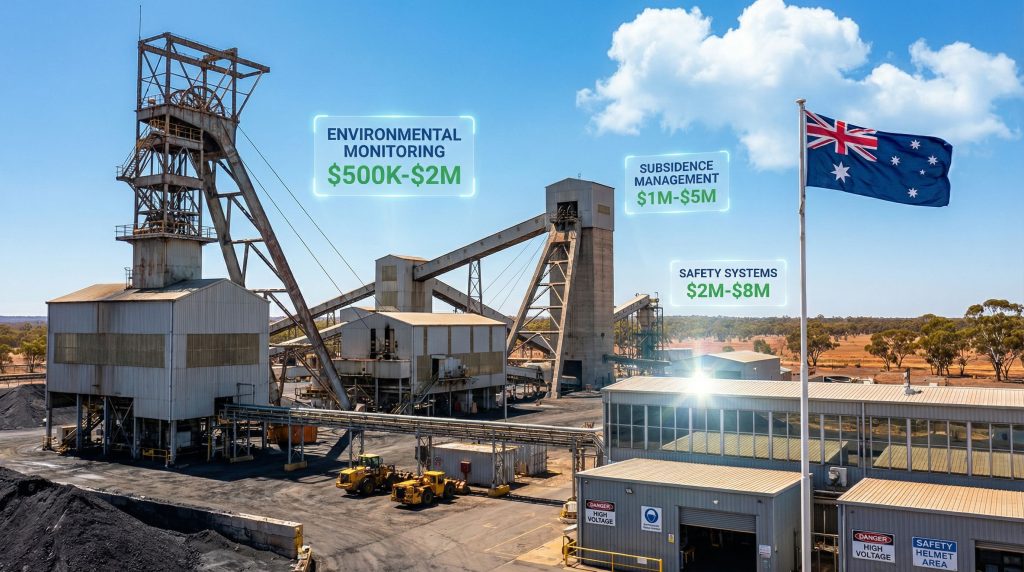
| Compliance Category | Annual Cost Range | Escalation Factors |
|---|---|---|
| Environmental Monitoring | $800K-$2.5M | Water quality standards, air emissions tracking |
| Subsidence Management | $1.5M-$6M | Geological complexity, infrastructure proximity |
| Safety Systems Maintenance | $2.5M-$10M | Equipment modernization, training requirements |
| Heritage Site Management | $300K-$1.5M | Archaeological discoveries, cultural protocols |
Subsidence monitoring and mitigation costs represent particularly significant expenses for underground coal operations, with longwall mining techniques requiring comprehensive structural monitoring of surface infrastructure, residential properties, and natural watercourses.
How Does Administration Affect Mining Lease Obligations?
Lease Condition Continuity Requirements
Mining lease obligations persist throughout voluntary administration, with external administrators inheriting full responsibility for lease compliance including rental payments, exploration commitments, and environmental management plan implementation.
The NSW mining lease framework requires continuous compliance with production targets, rehabilitation milestones, and community consultation requirements. Administration does not provide automatic relief from these obligations, potentially creating additional financial pressure on restructuring efforts. Moreover, industry consolidation trends suggest that struggling operations may find limited acquisition interest during these challenging market conditions.
Environmental bonds and rehabilitation guarantees remain fully enforceable during administration, with government agencies maintaining the authority to call upon securities if compliance standards are not maintained or if mine closure appears imminent.
Regulator Powers During Financial Distress
Mining regulators possess extensive enforcement powers that remain active throughout administration proceedings, including the authority to suspend operations, appoint alternative operators, or initiate bond forfeiture processes if compliance standards are compromised.
Lease suspension mechanisms provide regulators with tools to address non-compliance while potentially preserving the underlying mining rights for future operators. This regulatory approach recognises that temporary financial distress should not necessarily result in permanent loss of resource access rights.
Asset transfer approval processes become particularly relevant during administration, as potential purchasers must demonstrate technical competence, financial capacity, and regulatory compliance capability before acquiring distressed mining operations.
The next major ASX story will hit our subscribers first
What Are the Policy Implications for Coal Phase-Out?
Accelerated Transition Timeline Impacts
Market-driven coal mine closures through voluntary administration may accelerate energy transition timelines beyond government policy projections, potentially creating grid stability challenges or energy security concerns if alternative supply sources are not adequately developed.
The tahmoor coal mine administration represents one example of how financial market forces may drive energy sector transformation independently of formal policy mechanisms, requiring adaptive government responses to manage transition impacts on regional communities and energy systems. This aligns with broader investment red flags that institutional investors increasingly recognise within traditional energy sectors.
Just transition programs designed to support coal-dependent communities may require activation earlier than anticipated if multiple operations enter administration simultaneously, placing pressure on retraining resources and alternative economic development initiatives.
Energy Security Considerations
Unexpected coal mine closures through administration can create short-term energy supply disruptions, particularly where operations supply specialised coal grades required for specific industrial processes or power generation facilities.
Grid stability maintenance during transition periods requires careful coordination between energy market operators and mining regulators to ensure adequate notice of potential supply disruptions and development of alternative sourcing arrangements.
Strategic energy security planning must account for the possibility that market-driven mine closures may occur more rapidly than policy-driven phase-out schedules, requiring flexible response mechanisms to maintain energy system reliability.
How Do International Ownership Structures Complicate Administration?
Cross-Border Asset Management
International ownership structures introduce complex jurisdictional challenges during voluntary administration, particularly where overseas parent companies control critical financing arrangements, technical expertise, or market access rights.
The Foreign Investment Review Board may become involved in administration processes if asset transfers or ownership restructuring involves foreign investors, potentially extending timeline requirements and adding regulatory complexity to restructuring efforts.
Cross-border creditor coordination becomes particularly challenging when international banks, equipment suppliers, or joint venture partners hold competing claims over mining assets, requiring sophisticated legal frameworks to resolve conflicting jurisdictional requirements.
Regulatory Jurisdiction Challenges
Sovereign risk considerations may influence administration outcomes where overseas parent companies face political or economic pressures in home jurisdictions, potentially affecting their willingness or capacity to provide ongoing financial support for Australian operations.
International arbitration provisions in joint venture agreements or financing arrangements may create additional complexity for administrators seeking to restructure operations or negotiate with creditors across multiple legal systems. As one administrator noted regarding Tahmoor's challenges, the complex ownership structures can significantly complicate resolution pathways.
What Recovery Pathways Exist for Distressed Coal Assets?
Restructuring Options Under Administration
Voluntary administration provides several potential recovery pathways for distressed coal mining operations, ranging from financial restructuring with existing ownership to complete asset divestiture to alternative operators.
Debt-to-equity conversion mechanisms may allow creditors to assume ownership stakes in exchange for debt forgiveness, potentially providing necessary capital for operational continuation while reducing financing costs. However, companies facing administration often struggle with capital raising strategies due to investor confidence issues.
Key restructuring strategies include:
- Operational efficiency improvements through technology upgrades or process optimisation
- Asset rationalisation focusing resources on highest-return mining areas
- Market diversification developing alternative product grades or customer relationships
- Cost structure optimisation renegotiating supplier contracts and employment arrangements
Alternative Ownership Models
Employee buyout structures have emerged as viable alternatives for some distressed mining operations, particularly where workforce expertise and local community support can sustain operations through challenging market conditions.
Community ownership models, while less common in coal mining, may provide pathways for maintaining local employment while transitioning operations toward alternative land uses or economic activities aligned with regional development objectives.
Government acquisition represents a potential backstop option where strategic energy security concerns or regional economic impacts justify public sector intervention, though such approaches remain politically sensitive given broader energy transition policies.
How Does This Impact Regional Development Policy?
Economic Diversification Imperatives
Coal mine administration events highlight the urgent need for economic diversification in resource-dependent regions, where single-industry employment patterns create vulnerability to market volatility and energy transition pressures.
Regional development strategies must account for the possibility that coal operations may cease earlier than anticipated, requiring accelerated implementation of alternative industry development programs and infrastructure repurposing initiatives.
Skills transition support mechanisms become critical during administration periods, as specialised mining expertise may be transferable to renewable energy projects, advanced manufacturing, or other emerging industries with appropriate retraining support.
Social Licence and Community Relations
Community consultation requirements continue throughout administration processes, with external administrators inheriting established stakeholder engagement obligations and community benefit sharing arrangements.
Social impact mitigation measures may require enhanced funding during administration as communities face uncertainty about long-term employment prospects and economic sustainability, potentially triggering additional support requirements from government agencies. Recent examples, such as the project halt example of other mining operations, demonstrate how quickly regional communities can be affected by such decisions.
Local employment priority policies established through original mining approvals remain enforceable during administration, ensuring that any continuing operations maintain commitments to regional workforce development and training opportunities.
What Lessons Does This Provide for Energy Policy?
Market Mechanism Effectiveness
The tahmoor coal mine administration demonstrates how market forces can drive energy transition outcomes independently of formal policy mechanisms, suggesting that carbon pricing and renewable energy subsidies may be creating stronger transformation pressures than initially projected.
Price signal transmission through energy markets appears increasingly effective at identifying uneconomic coal operations, potentially accelerating closure timelines beyond government planning assumptions and requiring adaptive policy responses.
Renewable energy substitution rates may exceed policy projections if coal mine closures create supply constraints that accelerate clean energy deployment to maintain grid reliability and energy security.
Regulatory Framework Adaptability
Current regulatory frameworks demonstrate reasonable adaptability to handle mining administration processes, though coordination mechanisms between agencies could be strengthened to improve response efficiency and reduce administrative burden on external administrators.
Cross-sector policy coordination improvements may be necessary as energy transition accelerates, requiring better integration between mining regulation, energy market governance, and regional development policy frameworks.
International best practice adoption in mining administration procedures could enhance Australia's capacity to manage complex cross-border ownership structures and multi-jurisdictional creditor arrangements in future cases.
Frequently Asked Questions
What happens to environmental obligations during administration?
Environmental obligations remain fully enforceable throughout voluntary administration, with external administrators inheriting complete responsibility for compliance with environmental management plans, monitoring requirements, and rehabilitation activities. Government agencies maintain all enforcement powers and can pursue bond forfeiture if standards are not maintained.
Can coal mines restart after voluntary administration?
Yes, coal mines can successfully emerge from administration through various restructuring mechanisms including debt reorganisation, new ownership arrangements, or operational efficiency improvements. However, restart success depends on market conditions, regulatory compliance capacity, and access to adequate financing for ongoing operations.
How long does the administration process typically take?
Voluntary administration periods typically extend three to six months initially, with possible extensions for complex cases involving multiple creditors or regulatory issues. Mining operations may face longer timeframes due to environmental compliance requirements and the need to maintain safety standards throughout the process.
What role do creditors play in determining mine futures?
Creditors vote on proposed restructuring plans or liquidation options, with secured creditors holding significant influence over asset disposal decisions. However, mining-specific regulations may limit creditor options where environmental obligations or safety requirements must be maintained regardless of commercial preferences. As detailed reports on the Tahmoor situation highlight, complex creditor arrangements can significantly influence administration outcomes.
This analysis is provided for educational purposes and should not be considered as financial or legal advice. Energy transition policies and mining regulations are subject to ongoing change, and specific circumstances may vary significantly between different operations and jurisdictions.
Looking to Capitalise on Mining Sector Opportunities?
Discovery Alert's proprietary Discovery IQ model delivers real-time alerts on significant ASX mineral discoveries, transforming complex market data into actionable investment insights that help subscribers identify opportunities ahead of the broader market. Explore how major mineral discoveries have historically generated substantial returns and begin your 14-day free trial today to gain a competitive market advantage.