
June 25, 2026
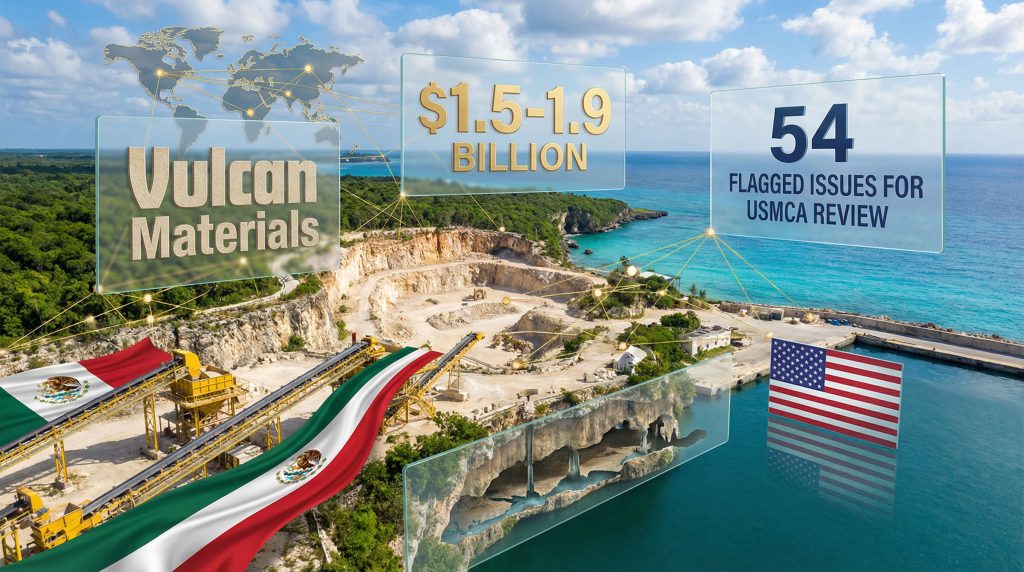
The ongoing Vulcan Materials Dispute represents a critical test of international investment protection mechanisms as environmental sovereignty assertions increasingly challenge established property rights frameworks. This complex arbitration under the United States-Mexico-Canada Agreement highlights how modern trade disputes reflect broader tensions between legitimate regulatory authority and foreign investor protections, with implications extending throughout North America's extractive industries.
Understanding USMCA Arbitration Framework
The United States-Mexico-Canada Agreement (USMCA) Chapter 14 investment protections represent a sophisticated evolution from the North American Free Trade Agreement's investor-state dispute settlement mechanisms. Unlike NAFTA's Chapter 11 framework, the current system incorporates enhanced procedural safeguards while maintaining core protections against discriminatory treatment and expropriation.
Key USMCA Chapter 14 Statistics:
• Agreement entered force July 1, 2020
• Replaces NAFTA's 26-year-old investment protection structure
• Maintains International Centre for Settlement of Investment Disputes (ICSID) arbitration procedures
• Establishes enhanced environmental and regulatory sovereignty protections
The Vulcan Materials Dispute timeline illustrates the framework's complexity. Vulcan commenced operations at Punta Venado, Quintana Roo in 1986, launching USMCA arbitration proceedings in 2018 after port concessions were revoked. Furthermore, operations were suspended entirely in May 2022 under the López Obrador administration. The company claims $1.5-1.9 billion in damages for alleged indirect expropriation.
Indirect Expropriation Standards Under International Law
International arbitration jurisprudence establishes distinct analytical frameworks for evaluating regulatory takings. The three-pronged test examines: (1) economic impact of governmental action, (2) degree of interference with investor expectations, and (3) character of the government action itself.
Precedent cases demonstrate the complexity of these determinations. In Metalclad Corporation v. United Mexican States, environmental designation preventing hazardous waste facility operations constituted indirect expropriation, resulting in a $16.7 million award plus costs in August 2000. Similarly, Tecnicas Medioambientales Tecmed S.A. v. Mexico produced a $5.1 million award in May 2003 for environmental regulations restricting hazardous waste operations.
Conversely, S.D. Myers v. Canada established that non-discriminatory environmental regulations typically fall outside expropriation standards. Additionally, Lauder v. Czech Republic demonstrated that regulatory denials preserving potential investment value may breach fair treatment obligations without constituting full expropriation.
ICSID Arbitration Process Mechanics
The ICSID Convention framework governs the Vulcan Materials Dispute through established procedural mechanisms. Arbitration panels, selected jointly by disputing parties, conduct proceedings involving written pleadings, evidence submission, and formal hearings. Typical complex investment disputes span 3-5 years from claim submission through final award.
Critical procedural elements include:
• Written memorial and counter-memorial submissions
• Document production and expert witness testimony
• Oral hearings before three-arbitrator panels
• Provisional measures applications for interim relief
• Final awards with enforcement mechanisms under the ICSID Convention
When big ASX news breaks, our subscribers know first
Precedent-Setting Environmental vs. Investment Claims Balance
Environmental protection laws increasingly intersect with foreign investment rights as nations assert greater regulatory sovereignty over natural resources. The Vulcan Materials Dispute crystallises this tension through Mexico's protected natural area designation versus the company's claimed property rights.
Mexico's Environmental Designation Authority
Mexico's environmental ministry, SEMARNAT, operates under the General Law of Ecological Balance and Environmental Protection (LGEEPA), providing statutory authority for protected natural area designations. Presidential decree power enables rapid environmental zone declarations, though due process requirements remain subject to international arbitration review.
Mexican President Claudia Sheinbaum articulated the government's position: "There was overexploitation beyond the environmental impact that was granted to the mine, so the protected natural area was decreed because it is a jungle zone that must be protected." The administration maintains that regulatory restrictions rather than formal expropriation occurred.
Ongoing negotiations focus on alternative arrangements. Sheinbaum indicated talks between Vulcan, the Environment Ministry, Economy Ministry, and Quintana Roo's governor explore potential agreements. "What does the agreement consist of? The protected natural area can no longer be exploited. There are some other mines in other locations and SEMARNAT would have to analyse whether their exploitation is feasible."
Legal Standards for Regulatory Takings Compensation
International investment law distinguishes between legitimate regulatory authority and compensable takings through established analytical frameworks. Economic impact analysis examines whether measures substantially eliminate investment value. Meanwhile, legitimate expectations assessment evaluates investor reliance on regulatory stability at investment commencement.
Proportionality review balances regulatory objectives against impairment degree. Environmental protection typically receives deference under international law. However, procedural requirements and compensation obligations remain contested areas, particularly as tariffs impact investment markets in broader economic contexts.
| Comparative Case Analysis | Outcome | Award Amount | Key Finding |
|---|---|---|---|
| Metalclad v. Mexico | Investor Victory | $16.7 million | Environmental designation = expropriation |
| Tecmed v. Mexico | Investor Victory | $5.1 million | Regulatory restriction = taking |
| S.D. Myers v. Canada | Government Victory | Case dismissed | Non-discriminatory regulation protected |
| Azinian v. Mexico | Government Victory | Case dismissed | Legitimate governmental authority |
Geological and Environmental Complexity Factors
The Yucatan Peninsula's karst topography creates unique environmental protection challenges. Extensive cenote systems and underground water networks provide ecological rationale for limestone extraction restrictions. However, technical details regarding specific cave system protection remain limited in public documentation.
Underground limestone extraction impacts subsurface hydrology through multiple pathways:
• Aquifer disruption affecting regional water supplies
• Cave system destabilisation threatening ecological integrity
• Coastal erosion acceleration through reduced limestone buffering
• Marine ecosystem impacts from increased sedimentation
Congressional Legislative Response Mechanisms
The Defense of American Property Abroad Act of 2026 (HR 7084) represents unprecedented Congressional intervention in bilateral investment disputes. The legislation, sponsored by Rep. August Pfluger (R-TX), authorises presidential port access denial for vessels utilising expropriated infrastructure in free trade agreement partner countries.
Legislative Timeline and Bipartisan Support Structure
HR 7084 Congressional Progress:
• January 2026: House Committee on Transportation and Infrastructure clearance
• March 2026: Full House passage with bipartisan support
• Current Status: Senate consideration pending
The legislation emerged after four years of exhausted diplomatic options, according to Pfluger. Thirty-five Republican lawmakers signed a March 2025 letter to President Trump urging administration action. This demonstrates sustained Congressional concern over the dispute, particularly in light of US legislative trade measures affecting various sectors.
Representative Pfluger characterised the measure as surgical intervention: "This legislation is fundamental because it guarantees that enforceable consequences exist for such actions. It sends a clear message to any foreign government that the United States will not tolerate this behaviour and that we will defend our economic interests."
Constitutional Framework for Trade Authority
Congressional trade authority derives from Article I, Section 8 of the Constitution, granting explicit power to regulate Commerce with foreign Nations. The legislation leverages established statutory frameworks:
• Ports and Waterways Safety Act (33 U.S.C. § 1221) provides port restriction authority
• Maritime Commerce and Security Act (46 U.S.C. Chapter 531) establishes vessel documentation controls
• Trade Act of 1974 (19 U.S.C. § 2101) enables presidential trade remedies
Port denial represents an infrastructure-based sanction targeting trade partners' shipping access to U.S. facilities. This indirect economic pressure mechanism avoids direct trade restrictions while creating substantial commercial consequences.
Historical Precedents for Legislative Trade Intervention
Congressional precedent exists for legislatively-mandated trade restrictions. The Comprehensive Iran Sanctions, Accountability, and Divestment Act of 2010 directed presidential implementation of targeted penalties including port restrictions. Similarly, Cuba embargo legislation evolved from presidential executive orders into Congressional codification through the Cuban Democracy Act.
In addition, this follows broader patterns where US tariffs and inflation concerns have shaped legislative responses to international trade disputes.
"The Defense of American Property Abroad Act establishes a new paradigm for Congressional intervention in investment disputes, shifting from diplomatic resolution toward legislatively-mandated economic consequences."
Mexican Government Response to Legislative Pressure
Mexican President Claudia Sheinbaum disputed the legislation's applicability: "It would have no impact because there was no expropriation. It clearly states that it applies in the case of expropriations." Mexico maintains that environmental restrictions constitute legitimate regulatory authority rather than compensable property seizure.
Despite legislative pressure, Sheinbaum indicated ongoing negotiation willingness: "We have had talks with the company Vulcan, particularly the Environment Ministry, the Economy Ministry, and the governor of Quintana Roo, to see if an agreement can be reached."
USMCA Renegotiation Context and Strategic Implications
Former Mexican Economy Minister Ildefonso Guajardo, NAFTA's chief negotiator, emphasised the case's significance for USMCA review: "I think the Calica issue is going to be very important, especially if the treaty review has to resort to legislative ratification in Washington. Many American legislators are very angry with Mexico over the way the Calica issue has been resolved."
Risk Assessment for Future Investment Flows
The Vulcan Materials Dispute creates precedential risk for extractive industry investments across Mexico. Mining sector operators face enhanced regulatory uncertainty regarding environmental designation authority and compensation obligations. Furthermore, this uncertainty is compounded by broader challenges in critical minerals and energy sectors affecting strategic supply chains.
Investment Risk Factors:
• Presidential decree power enabling rapid operational restrictions
• Environmental designation authority lacking clear procedural safeguards
• Compensation standards remaining unclear under Mexican law
• ICSID arbitration timelines extending 3-5 years minimum
Insurance and hedging strategies for regulatory risk become essential for future extractive investments. Political risk insurance markets increasingly price Mexican regulatory uncertainty into premium calculations.
Alternative Resolution Pathway Analysis
Negotiated settlement options under discussion include alternative site allocation outside protected zones and compensation mechanisms for existing infrastructure. Joint environmental restoration projects could provide face-saving resolution for both parties.
Diplomatic mediation effectiveness depends on bilateral trade commission intervention capabilities and timeline pressures from USMCA review processes. Executive branch authority remains limited without Congressional support for enforcement mechanisms.
ICSID arbitration timeline projections suggest resolution unlikely before 2028-2029, creating extended uncertainty for broader Mexico-US investment relationships.
Environmental Sovereignty vs. International Investment Balance
The Vulcan Materials Dispute reflects broader global tensions between national environmental authority and international investment protection standards. Climate considerations increasingly influence trade agreement structures, requiring enhanced due process requirements for regulatory changes. In addition, these tensions are amplified by broader concerns about the global market impact of tariffs across various sectors.
Emerging Compensation Standards for Environmental Designations
International arbitration increasingly recognises environmental protection as legitimate governmental authority while maintaining procedural requirements for affected investors. Enhanced environmental compliance requirements create new categories of regulatory risk requiring specialised assessment frameworks.
Mining sector investment faces particular scrutiny under evolving environmental standards:
• Ecological impact assessment requirements expanding in scope
• Indigenous rights considerations affecting resource extraction permits
• Climate change implications influencing regulatory approval processes
• Biodiversity protection mandates restricting operational flexibility
Integration of Climate Considerations in Trade Agreements
Future trade agreement structures must balance investment protection with environmental sovereignty assertions. The USMCA review process provides opportunity for enhanced integration of climate and environmental considerations into investment protection frameworks.
Proposed modifications include:
• Enhanced due process requirements for environmental designations affecting foreign investments
• Compensation standards for legitimate regulatory takings
• Alternative site allocation mechanisms for affected operations
• Joint environmental restoration project requirements
The next major ASX story will hit our subscribers first
Resolution Timeline and Outcome Probability Assessment
ICSID arbitration proceedings typically require 3-5 years for complex investment disputes, suggesting resolution unlikely before 2028-2029. Evidence submission and hearing schedules remain subject to arbitral panel discretion. Moreover, enforcement mechanisms for potential awards depend on ICSID Convention procedures.
Congressional Legislative Timeline Analysis
HR 7084 Senate consideration faces uncertain prospects given bipartisan trade policy complexities. Amendment possibilities during upper chamber review could modify port access provisions or expand application to other dispute categories.
Presidential signing likelihood appears high given executive branch support for investment protection measures. Implementation timeline would require coordination between Commerce, Transportation, and Homeland Security departments.
What Are the Prospects for Negotiated Settlement?
Incentive structures favour resolution through alternative site allocation and partial compensation mechanisms. Mexico faces USMCA renegotiation pressure, while Vulcan confronts extended arbitration costs and operational uncertainty.
Third-party mediation opportunities through bilateral trade commission processes remain underutilised. Economic pressures from Congressional legislation create additional settlement incentives for Mexico.
Recent developments suggest both parties recognise the benefits of compromise. Mexico has prepared to defend its position against what it considers inappropriate pressure, while Vulcan has rejected Mexico's actions as unlawful expropriation.
Long-Term Implications for North American Trade
The Vulcan Materials Dispute ultimately represents a fundamental recalibration of environmental sovereignty and international investment protection that will influence trade agreement structures and extractive industry investment patterns for decades. Resolution mechanisms developed through this case will establish precedents affecting billions in cross-border investment flows across North America.
Disclaimer: This analysis involves forecasting and speculation regarding ongoing legal proceedings and international arbitration. Actual outcomes may differ materially from projections presented. Investment and trade policy decisions should incorporate comprehensive risk assessment and professional legal counsel.
The outcome of this dispute will likely shape future interactions between environmental policy and international investment law throughout the USMCA region. Consequently, both governments and investors must carefully monitor developments as this precedent-setting case unfolds through arbitration and potential legislative action.
What's Next for North American Mining Investment Opportunities?
Discovery Alert's proprietary Discovery IQ model continuously monitors evolving regulatory landscapes affecting extractive industries, providing immediate alerts when significant ASX mineral discoveries emerge amid changing international investment conditions. Begin your 14-day free trial today to position yourself ahead of the market as trade disputes and environmental considerations reshape global mining opportunities.