July 22, 2026
The Hidden Bottleneck Threatening the Global Energy Transition
Across every major decarbonisation roadmap, the conversation centres on technology costs, capital deployment, and policy ambition. Rarely does water appear as a frontline variable. Yet in basin after basin, from the copper belts of South America to the platinum fields of southern Africa, water risk and the energy transition are quietly reshaping what is and is not possible. The constraint is not approaching on the horizon. For a significant portion of the global mining and metals sector, it has already arrived.
When big ASX news breaks, our subscribers know first
Why Water Scarcity Is a Structural Problem, Not an Operational Footnote
Reframing the Challenge Beyond Technology and Capital
Most analyses of clean energy scale-up focus on two bottlenecks: whether the right technologies exist and whether sufficient capital can be mobilised. A third constraint — the physical availability of freshwater to support mineral extraction, processing, and refining — receives far less attention despite being equally determinative in water-stressed geographies.
Water performs several non-negotiable functions across the mining and metals value chain. It is used in ore processing, dust suppression, equipment cooling, tailings management, and hydrometallurgical operations. Remove reliable access to water and the economics and operability of a mine can collapse entirely, regardless of ore grade, commodity price, or investor appetite.
The Scale of Exposure Across 12,000 Global Facilities
A comprehensive cross-commodity analysis of over 12,000 mining and metals facilities worldwide has produced what is described as the first dataset of its kind to quantify water risk exposure across the sector at a global scale. The findings, produced through a collaboration involving the International Council on Mining and Metals (ICMM), the World Wide Fund for Nature, and the World Resources Institute (WRI), reveal an industry far more exposed than most sector-level risk assessments have acknowledged.
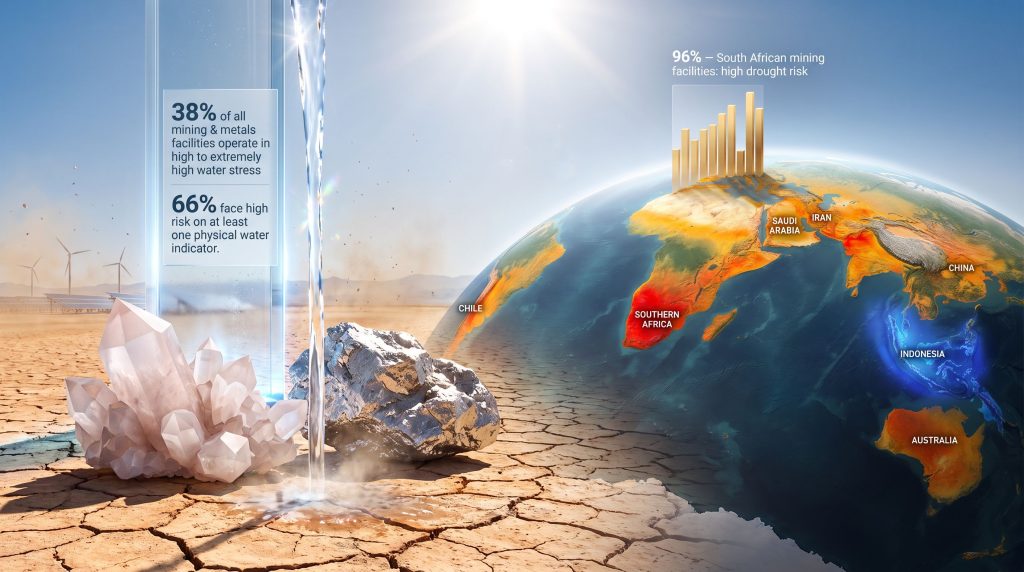
The headline figure is striking: 38% of all mining and metals facilities globally either operate in areas of high to extremely high water stress or are situated in arid zones where water is functionally unavailable. Of that already-alarming subset, more than 70% are additionally located in areas experiencing high or extremely high water depletion, meaning the problem is not just one of temporary shortage but of long-run structural decline in available water supply.
Research from the ICMM's Global Mining and Metals Water Dataset, published in July 2026, confirms that competition for finite water resources is not a future concern but a present operational reality and a structural constraint on the expansion of the mining and metals sector, as well as the pace of the energy transition itself.
What Water Risk Actually Means: Distinguishing Between Types
Four Distinct Categories of Physical Water Risk
A common misconception is that water risk is synonymous with water scarcity. In reality, the term encompasses four distinct physical dimensions, each with different geographic profiles, timelines, and mitigation requirements.
| Water Risk Type | Definition | Key Exposed Regions |
|---|---|---|
| Baseline Water Stress | Ratio of total water withdrawal to available renewable supply | China, Chile, Saudi Arabia, Iran, Mexico |
| Drought Risk | Susceptibility to prolonged precipitation deficits | Africa, Middle East, South Africa, Zambia, Ghana |
| Flood Risk | Exposure to high-volume inundation events | Indonesia, Southeast Asia |
| Interannual Variability | Year-to-year fluctuation in water supply reliability | Australia, Oceania |
Each of these categories demands a different response. Baseline water stress calls for long-term water sourcing diversification and efficiency investment. Drought risk requires operational contingency planning and community-level water sharing agreements. Flood risk demands infrastructure resilience and site engineering. Interannual variability, perhaps the most insidious of the four, requires adaptive management frameworks that can flex in real time as seasonal water availability swings unpredictably from one year to the next.
Water Stress vs Water Depletion: A Critical Distinction
Water stress measures the ratio of demand to supply. Water depletion measures the fraction of available water that is consumed and not returned to the watershed. A mine can operate in a technically water-stressed basin but still be sustainable if it recycles water efficiently. However, when high stress and high depletion coincide, the resource base itself is being drawn down faster than it can recover, creating a trajectory toward irreversible constraint. The energy transition minerals driving this demand are concentrated in precisely these vulnerable regions.
Country-Level Exposure: Where the Risk Is Most Concentrated
The Global Depletion Hotspots
Certain countries stand out not merely for elevated risk but for near-total exposure across their mining and metals asset base:
- Saudi Arabia: 100% of mining and metals facilities exposed to water depletion
- Chile: 96% of facilities exposed to water depletion, with the Atacama lithium operations facing some of the most acute baseline stress globally
- Iran and Mexico: 81% of facilities each facing water depletion conditions
- China: 59% of facilities located in water-stressed basins, with 45% exposed to extremely high baseline water stress and a further 10% in high-stress conditions
China's position deserves particular attention. As the world's dominant processor of most critical minerals, including rare earths, lithium, cobalt, and graphite, water stress within Chinese processing facilities creates a systemic vulnerability in global clean energy supply chains that extends well beyond China's borders. Disruption to Chinese mineral processing capacity caused by water constraints would reverberate across battery, wind turbine, and electric vehicle manufacturing globally.
Drought, Floods, and Variability: Mapping Physical Risk Across Commodities
Drought: The Second Most Prevalent Threat
27% of all global mining and metals facilities face high drought risk, making it the second most common physical water risk indicator in the dataset after baseline stress. The geographic concentration is severe:
- 81% of facilities across Africa and the Middle East operate under high or very high drought exposure
- In Zambia, Ghana, and Uzbekistan, drought exposure is described as near-total
- 96% of South African mining and metals facilities face high or extremely high drought risk
The commodities carrying the greatest drought-driven vulnerability are platinum group metals (PGMs), chromite, and diamonds. This is a particularly uncomfortable intersection for energy transition planners. Furthermore, South Africa green iron production ambitions face additional headwinds given that PGMs are essential for hydrogen fuel cell catalysts and emissions control systems, whilst chromite underpins stainless steel production critical to clean energy infrastructure.
Flood Risk: Underestimated and Unevenly Distributed
Flood risk affects 14% of mining and metals facilities globally, but that aggregate figure obscures sharp regional disparities. Indonesia records the highest regional flood exposure rate at 32%, a concern given its significant nickel laterite operations central to battery supply chains.
Above-average flood exposure affects several key commodities:
- Alumina refining: 27%
- Steel production: 27%
- Molybdenum production: 25%
- Aluminium smelting: 24%
Interannual Variability: Australia's Unique Planning Challenge
Interannual variability — the degree to which annual water availability fluctuates unpredictably — affects 16% of global mining and metals facilities. However, Australia and Oceania face exposure rates that are categorically different from any other region:
- Australia: 79% of facilities exposed to high interannual variability
- Oceania: 74%, more than double the next most-exposed region
In Australia, commodities including coal, copper, gold, iron ore, and nickel all face variability rates well above global averages. At the global commodity level, diamonds (46%), barium (37%), heavy mineral sands (37%), and manganese (31%) all exceed global benchmarks for interannual variability exposure.
When Multiple Risks Converge: The 5% Problem
Multi-Risk Compounding and Its Strategic Implications
Perhaps the most operationally alarming finding in the dataset is not the breadth of single-risk exposure but the concentration of multi-risk convergence. While 66% of global mining and metals facilities face high risk on at least one physical water indicator, a critical subset of 5% of facilities simultaneously face high risk across three or more water risk indicators.
When independent water pressures converge on the same operational site, the result is not additive risk but multiplicative fragility. A facility contending with baseline water stress, drought exposure, and high interannual variability cannot hedge each risk in isolation. The pressures interact, amplify, and collectively undermine the viability of mitigation strategies designed for single-risk environments.
Consider a platinum group metals operation in South Africa facing all three of the following simultaneously:
- Extremely high baseline water stress from limited renewable water supply in the catchment
- High drought risk, given that 96% of South African mining facilities operate under such conditions
- High interannual variability, meaning even in non-drought years, supply reliability cannot be assumed
This convergence demands a fundamentally different risk management architecture than any single-risk framework can provide, yet most current industry disclosure and planning norms are not built to address it.
The next major ASX story will hit our subscribers first
The Paradox: Clean Energy Technologies Can Intensify Water Competition
Low-Carbon Technologies and Their Water Footprints
One of the least-discussed dimensions of water risk and the energy transition is that several low-carbon technologies are themselves significant water consumers, particularly when deployed in already-stressed regions.
| Low-Carbon Technology | Water Intensity Concern |
|---|---|
| Biofuels | High water consumption in feedstock agriculture |
| Concentrated Solar Power (CSP) | Cooling water requirements in arid deployment zones |
| Carbon Capture and Storage (CCS) | Additional water demand in capture and compression |
| Nuclear Power | Cooling water dependency and thermal discharge constraints |
| Green Hydrogen | Electrolysis water consumption and treatment requirements |
Green hydrogen, in particular, presents a structural tension. It is positioned as a cornerstone of hard-to-abate sector decarbonisation, yet its production via electrolysis requires high-quality water inputs. Scaling green hydrogen in water-stressed regions such as the Middle East, northern Chile, or parts of Australia could directly compete with existing water allocations for agriculture, communities, and other industries.
The Critical Minerals Demand Surge Will Make This Worse
The International Energy Agency projects that critical minerals demand could increase by three to six times current levels by 2040 under net-zero scenarios. Each new mine or processing facility required to meet that demand introduces additional water withdrawals into basins that, in many cases, are already operating at or beyond sustainable yield. The energy transition is therefore not just a consumer of water through the technologies it deploys — it is a consumer of water through the mining and metallurgical infrastructure it requires to function.
Disclosure Gaps: The Information Crisis Undermining Water Risk Management
How Few Companies Are Reporting Adequately
Across water-intensive industries engaged in low-carbon technology development and critical mineral production, fewer than half of companies report water-related risks at all. Only 26% of companies disclose risks alongside both mitigation actions and measurable performance targets, leaving investors, regulators, and surrounding communities with an incomplete and often misleading picture of actual water exposure.
Responsible mining, as articulated by the World Resources Institute's Food, Land and Water Programs global director Crystal Davis, begins with shared access to credible, publicly available data on where water risks are greatest. Without that foundation, governments, communities, investors, and companies cannot plan or act effectively across the full value chain.
Credible water risk disclosure should include, at minimum:
- Facility-level water withdrawal, consumption, and discharge data
- Basin-level contextualisation of water stress and depletion conditions
- Quantified targets for water use intensity reduction
- Community impact assessments covering shared water resource dependencies
- Scenario analysis covering drought and variability conditions
What Industry, Investors, and Governments Must Do
A Three-Axis Response Framework
No single actor can resolve water risk in the energy transition. The challenge requires coordinated action across multiple domains simultaneously.
| Actor | Required Action | Timeframe |
|---|---|---|
| Governments | Basin-level water screening for new mining and energy permits | Immediate |
| Investors | Integrate water risk into ESG due diligence and asset valuation | Near-term |
| Mining Industry | Adopt water performance standards and public disclosure targets | Near-term |
| Energy Developers | Prioritise low-water renewable technologies in water-stressed regions | Medium-term |
| International Bodies | Harmonise cross-border water risk data and reporting frameworks | Medium-term |
The Three Pillars of Responsible Water Stewardship in Mining
The ICMM articulates responsible water management through three interlocking principles:
- Social Equity — Ensuring communities and industries share fair and sustainable access to water resources, with particular attention to indigenous water rights and downstream dependencies
- Environmental Sustainability — Managing extraction volumes and discharge quality to preserve watershed function, groundwater recharge, and aquatic ecosystems
- Economic Benefit — Embedding water efficiency as a core operational discipline to reduce both cost exposure and regulatory risk over asset life
Why Basin-Level Screening Must Precede Project Approval
One of the most consequential policy interventions available to governments is to make basin-level water screening a prerequisite for new mining and energy permits. Currently, project-level environmental impact assessments often evaluate water use in isolation from cumulative basin-wide demand. As multiple critical mineral projects are approved in the same watershed simultaneously, the aggregate water draw can exceed sustainable limits even when each individual project appears compliant in isolation.
In addition, the adoption of renewable energy in mining operations can partially reduce site-level water intensity, though process innovation remains equally essential. The challenges facing the lithium brine market in South America further illustrate how water scarcity and mineral extraction ambitions are already in direct competition.
Frequently Asked Questions: Water Risk and the Energy Transition
What is the difference between water stress and water depletion?
Water stress refers to the ratio of total demand to available renewable supply in a given basin. Water depletion refers to the proportion of available water that is consumed and not returned to the watershed. High depletion in an already-stressed basin indicates that the resource base is being structurally eroded, not merely competed over.
Which commodities face the highest combined water risk exposure?
Platinum group metals, chromite, and diamonds carry the highest drought exposure. Aluminium, alumina, and steel face above-average flood risk. Manganese, diamonds, heavy mineral sands, and copper face elevated interannual variability. Lithium, particularly from brine operations in the Atacama, faces acute baseline water stress.
How should investors assess water risk in mining or clean energy assets?
Investors should look beyond single-indicator water risk disclosures and assess whether companies report at the basin level, disclose depletion data, quantify year-on-year variability exposure, and set measurable efficiency targets. Assets in regions with multi-risk convergence — particularly those combining baseline stress, drought, and variability — warrant additional scrutiny in valuation models and ESG frameworks. Research on water and decarbonisation from the World Economic Forum reinforces the case for integrating these factors into mainstream investment analysis.
Can renewable energy technologies reduce water demand in mining?
Selectively, yes. Transitioning mine power from diesel or coal-fired generation to solar or wind reduces the water intensity of energy supply at the site level. However, water consumption in ore processing, which represents the dominant share of most mines' water footprint, is not materially reduced by renewable energy substitution alone. Process innovation, water recycling infrastructure, and dry-stack tailings technology are more directly impactful for reducing operational water intensity.
Water Is a Primary Constraint, Not a Secondary Risk
The data published through the ICMM's Global Mining and Metals Water Dataset represents a foundational contribution to how the mining industry, investors, and policymakers should understand water risk and the energy transition. The finding that 38% of global mining and metals facilities already operate under high to extreme water stress or in functionally arid conditions is not a warning about the future. It is a description of the present.
The energy transition requires more mines, faster permitting, expanded processing capacity, and greater volumes of critical minerals than the world has ever produced. Each of those requirements places additional claims on water resources that, in dozens of key producing regions, are already oversubscribed.
Without basin-level planning, mandatory disclosure reform, and water-aware project screening embedded into approval frameworks, water risk will increasingly function as a structural ceiling on the pace of decarbonisation. The minerals are in the ground. The capital is increasingly available. In a growing number of regions, it is the water that will determine whether the energy transition proceeds at the speed the climate requires.
This article draws on publicly available research published by the ICMM, the World Resources Institute's Aqueduct platform, and the International Energy Agency. Projections and forward-looking assessments reflect current analytical frameworks and should not be construed as investment advice. Mineral demand forecasts and water stress projections are subject to revision as methodologies, climate models, and policy environments evolve.
Want to Stay Ahead of Critical Mineral Discoveries Shaping the Energy Transition?
As water scarcity tightens its grip on the world's most vital mineral-producing regions, identifying the right discoveries early has never been more consequential — Discovery Alert's proprietary Discovery IQ model delivers real-time ASX mineral discovery alerts, transforming complex data across 30+ commodities into clear, actionable insights for both traders and long-term investors. Explore how major mineral discoveries have historically generated substantial returns by visiting Discovery Alert's dedicated discoveries page, and begin your 14-day free trial today to position yourself ahead of the market.