June 12, 2026
The Geology That Drives the Stakes: Why Bushveld PGM Projects Carry Exceptional Risk and Reward
Few geological formations on Earth command the strategic attention that South Africa's Bushveld Complex does. Hosting an estimated 70-80% of the world's known platinum group metal reserves, this layered igneous intrusion stretching across the North West, Limpopo, and Mpumalanga provinces has shaped global PGM supply chains for more than a century. Yet the very scale that makes Bushveld projects so compelling also makes them extraordinarily difficult to develop.
Underground reefs are deep, labour-intensive to mine, and highly sensitive to cost inflation. New entrants attempting to build greenfield operations within this geological belt face challenges that established multi-shaft majors have spent decades learning to manage. Furthermore, the broader PGM supply constraints affecting global markets add another layer of complexity for development-stage operators.
It is within this demanding operational context that the Wesizwe Platinum JSE trading resumption must be understood. The return to active trading on 12 June 2026 is not simply a compliance formality. It opens a window onto a project that has absorbed more than a decade of capital, navigated extraordinary disruption, and now stands at a fundamental strategic crossroads.
When big ASX news breaks, our subscribers know first
Why JSE Suspensions Carry More Weight Than Investors Often Realise
The Mechanics of Financial Disclosure Obligations on the JSE
The Johannesburg Stock Exchange's listing requirements impose clear, non-negotiable timelines on issuers for the publication of audited annual financial statements. When a company fails to meet these deadlines, the JSE's issuer regulation division has limited discretion: suspension of trading is the prescribed consequence. This mechanism exists not as a punitive measure, but as a market integrity protection, ensuring that investors cannot trade in a company's shares without access to current, verified financial information.
What makes JSE suspensions particularly significant for smaller mining companies is the compounding effect they create. Shareholders who wish to reduce or exit their positions are frozen out of the market entirely. New institutional investors who may otherwise provide liquidity cannot take positions. The share price, when trading does resume, must absorb all accumulated developments simultaneously, creating conditions for sharp and often disorderly price moves.
The Wesizwe Suspension: A Timeline of Key Events
| Milestone | Date |
|---|---|
| Suspension imposed | June 2025 |
| Suspension update confirmed | 9 December 2025 |
| Trading statement issued | 27 March 2026 |
| Interim results expected | ~31 March 2026 |
| JSE trading reinstatement announced | 11 June 2026 |
| Shareholders permitted to trade | 12 June 2026 |
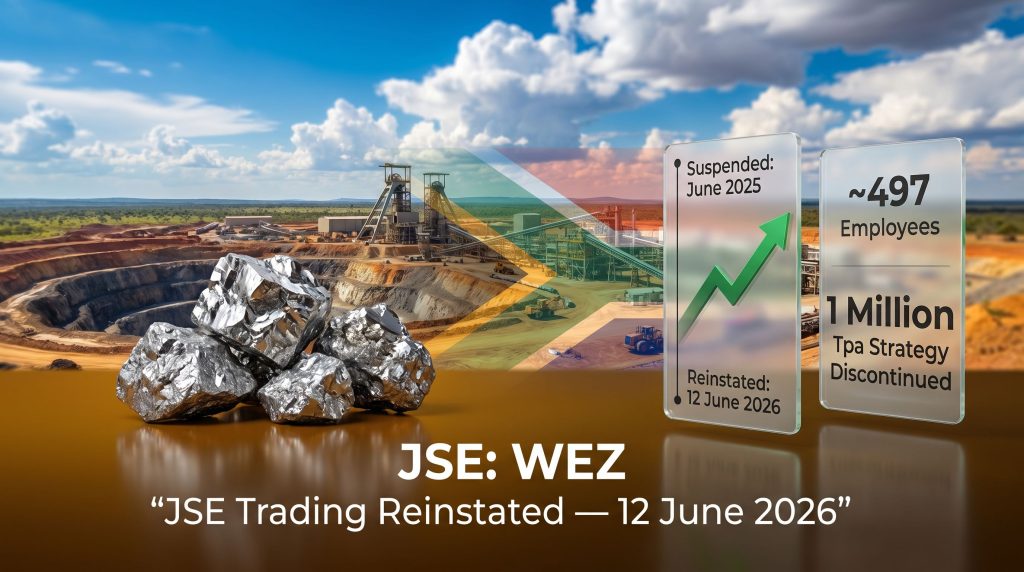
Wesizwe's suspension was triggered by its failure to publish audited annual financial statements for the 2024 financial year within the required regulatory window. The company subsequently published its delayed financial statements and integrated annual report, satisfying the JSE's preconditions for reinstatement. The approximately 12-month suspension period meant that shareholders had no pricing mechanism available to them throughout a period that included significant operational announcements, PGM commodity price movements, and the initiation of a major restructuring process.
The reinstatement of trading does not erase the accumulated uncertainty of the suspension period. It simply channels that uncertainty into the price discovery process for the first time in over a year.
Bakubung's Geological Credentials Versus Its Operational Reality
What Makes the Bushveld Complex Uniquely Valuable
The Bushveld Complex hosts three primary PGM-bearing reef horizons: the Merensky Reef, the UG2 Chromitite layer, and the Platreef. Each carries a distinctive mineralogical profile. The UG2 reef, which is the primary target at many newer Bushveld operations, is characterised by higher palladium and rhodium content relative to platinum, along with significant chrome byproduct potential.
The Merensky Reef has historically been the preferred target for its higher platinum grades and more consistent metallurgical behaviour, though many near-surface Merensky resources have been substantially depleted by decades of mining by established producers. In this context, Anglo Platinum operations provide a useful benchmark for understanding what operational maturity looks like in the Bushveld environment.
Bakubung's position within the western limb of the Bushveld Complex places it in geological company with some of the world's most productive PGM mines. The western limb is known for relatively consistent reef geometry and favourable grades across both the Merensky and UG2 horizons. On paper, Bakubung's resource endowment represents genuine long-term value.
Why Resource Quality Does Not Guarantee Operational Success
The persistent gap between Bakubung's geological credentials and its commercial performance illustrates a critical reality in greenfield mining development: resource quality is a necessary but insufficient condition for a viable operation. Several compounding factors have prevented the project from reaching its potential:
- Construction commenced in 2011 with full commercial production targeted for 2020
- The COVID-19 pandemic caused extended site shutdowns and supply chain disruptions from 2020 onward
- Technical challenges at the processing plant required costly redesigns that delayed throughput ramp-up
- Community unrest and protests in the North West province created recurring operational interruptions, a persistent challenge across the region
- A 2024 cybersecurity incident compromised key corporate functions including finance, procurement, legal, and human resources, adding administrative strain during an already difficult period
The cumulative effect of these disruptions was not merely a delay in reaching nameplate capacity. Each setback increased the cost base, extended the pre-revenue period, and progressively eroded confidence in the original production model.
The Abandoned 1 Mtpa Strategy: What It Signals to the Market
Understanding the Strategic Discontinuation
The decision by Bakubung Minerals' board to formally discontinue the 1-million-tonne-per-annum ore throughput strategy with immediate effect is among the most significant operational announcements in the project's history. In the language of mining development, abandoning a long-standing nameplate capacity target signals that the original engineering and financial model has been determined to be unachievable within a commercially viable timeframe or cost envelope.
Formal abandonment of a production strategy target in a listed mining company typically precedes restructuring events and carries direct implications for workforce levels, capital expenditure planning, and the long-term revenue profile used in any valuation model.
For investors attempting to model Wesizwe's forward earnings, the discontinuation of the 1 Mtpa target creates immediate valuation uncertainty. Any discounted cash flow analysis built on the original throughput assumptions is now obsolete. A replacement production strategy, with its own ramp-up timeline, capital requirements, and cost projections, will need to be evaluated from the ground up. Consequently, understanding how commodity prices and miners interact becomes especially relevant when assessing any revised model.
Cost Inflation in South African Mining: The Structural Headwind
The decision to abandon the high-volume strategy also reflects a broader cost environment that has made large-scale production targets increasingly difficult to sustain for development-stage operations. South African mining has faced sustained cost pressure across several key input categories:
- Electricity tariffs: Eskom's tariff increases have significantly inflated energy costs for energy-intensive underground mining and processing operations
- Labour costs: Wage inflation above CPI, combined with complex union negotiation environments, has compressed per-unit margins
- Logistics and consumables: Rand depreciation has elevated the rand-denominated cost of imported mining equipment and chemical reagents
- Community relations costs: Social licence maintenance increasingly requires structured community investment commitments that add to the operating cost base
These structural pressures affect all South African PGM producers, however their impact is disproportionately severe for pre-revenue or early-revenue operations that cannot yet offset fixed costs against meaningful sales volumes.
The Human Dimension: What Section 189A Means for Bakubung's 497 Workers
How South Africa's Large-Scale Retrenchment Law Works in Practice
Section 189A of the Labour Relations Act applies when a company with 50 or more employees contemplates retrenching 10 or more workers. The law creates a structured consultation framework designed to ensure that large-scale job losses are not implemented without genuine engagement with affected employees and organised labour. It is important to understand that initiating a Section 189A process does not predetermine the outcome: voluntary separation packages, redeployment, reduced hours, or alternative operational arrangements may emerge from the consultation.
| Stage | Description | Typical Duration |
|---|---|---|
| Initiation | Employer issues formal notice to employees and unions | Day 1 |
| Facilitation | CCMA or private facilitator appointed | Within 15 days |
| Consultation Period | Structured engagement on alternatives and severance | 60 days minimum |
| Outcome | Agreement reached or dispute referred | Post-consultation |
The approximately 497 employees at Bakubung Minerals facing this process represent a workforce drawn primarily from the North West province, a region where mining employment carries significant community-level economic weight. Retrenchments at this scale in a single operation have ripple effects well beyond the mine gate, affecting dependent households, local businesses, and municipal revenue bases.
Employee Rights During the Consultation Process
Workers subject to a Section 189A process retain meaningful protections:
- The right to representation by a recognised trade union or employee representative
- The right to receive full disclosure of the financial and operational reasons for the proposed retrenchments
- The right to propose alternatives including work-sharing arrangements, temporary layoffs, or voluntary separations
- The right to challenge the process or substantive fairness of any dismissals through the CCMA or Labour Court
- Minimum severance pay entitlements of one week's remuneration per completed year of service, subject to negotiation above this floor
Who Controls Wesizwe and What the Chinese Investment Thesis Has Delivered
The Consortium Structure Behind the JSE Listing
| Entity | Role | Primary Business Focus |
|---|---|---|
| Jinchuan Group International Resources | Majority shareholder | Nickel, cobalt, copper, platinum group metals |
| China-Africa Development Fund (CADFund) | Strategic co-investor | Development finance across African markets |
| Wesizwe Platinum (JSE: WEZ) | Operating entity | PGM extraction, Bushveld Complex, North West Province |
Jinchuan Group is one of China's largest state-owned mining enterprises, with its primary production base in nickel and cobalt centred on operations in Gansu Province. The group has progressively expanded its international footprint across copper, cobalt, and PGM assets, consistent with China's broader strategic objective of securing upstream supply across critical mineral categories. The China-Africa Development Fund operates as a state-backed development finance vehicle, designed to facilitate commercially structured Chinese investment across African markets.
Has the Strategic Thesis Survived Contact With Reality?
The original investment thesis for Bakubung was built on two interconnected propositions: that South African PGM output would be constrained by ageing infrastructure at established mines, creating a market opportunity for new entrants; and that long-term demand growth from automotive catalytic converter production and emerging hydrogen fuel cell applications would sustain robust PGM prices.
Both propositions retain structural validity at a macro level. However, the gap between a sound macro thesis and a successfully executing operation has proven far wider than the original investment case anticipated. The latest restructuring effectively acknowledges that the execution model, specifically the 1 Mtpa throughput strategy, did not translate the resource's geological quality into commercial performance.
It is also worth noting that palladium-to-platinum substitution in automotive catalysts has been an ongoing trend as palladium prices surged and then corrected sharply. This shift has created more complex demand dynamics for platinum than a simple automotive growth thesis would have predicted at the time of Jinchuan's original investment. In addition, platinum investment opportunities elsewhere in the sector have evolved considerably, adding further context to the strategic challenges Wesizwe now faces.
The next major ASX story will hit our subscribers first
What Investors Should Prioritise Now That Wesizwe Shares Are Trading Again
Key Variables Requiring Immediate Assessment
The Wesizwe Platinum JSE trading resumption creates the first genuine price discovery opportunity in over a year. Investors approaching the stock for the first time post-reinstatement, or reassessing existing positions, should focus on the following variables in order of materiality:
- Revised production strategy details: What throughput target replaces the abandoned 1 Mtpa model, and over what timeframe is ramp-up projected?
- Financial position in the delayed 2024 annual report: Cash balance, debt covenants, and any going concern qualifications carry immediate share price implications
- Section 189A process outcome and cost: Severance obligations and operational disruption during the consultation period represent near-term cash flow pressure
- Chinese consortium capital commitment: Whether Jinchuan and CADFund are prepared to provide bridge financing through the transition to a revised production model is arguably the single most important variable for near-term solvency
- PGM basket price environment: The realised price per PGM ounce, blended across platinum, palladium, rhodium, and byproduct metals, determines whether a revised, lower-volume strategy can generate positive operating cash flow
Key Financial Metrics to Examine in the 2024 Annual Report
| Metric | Why It Matters |
|---|---|
| Cash and equivalents balance | Determines liquidity runway without additional financing |
| Total debt and covenant structure | Identifies financial stress triggers |
| Operating cost per tonne milled | Benchmarks competitive position against PGM basket price |
| Capital expenditure commitments | Quantifies ongoing funding requirements under revised strategy |
| Impairment charges | Reflects write-down of assets tied to the discontinued 1 Mtpa model |
| Going concern disclosure | Most critical indicator of near-term financial risk |
Disclaimer: This article is intended for informational purposes only and does not constitute financial advice. Investing in mining equities involves significant risk, including the potential loss of capital. Past operational performance is not necessarily indicative of future results. Readers should conduct their own due diligence and consult a qualified financial adviser before making investment decisions.
Development-Stage vs. Producing PGM Operations: A Structural Comparison
| Dimension | Development-Stage Projects | Established PGM Producers |
|---|---|---|
| Revenue profile | Pre- or early-revenue | Diversified, multi-year revenue streams |
| Capital intensity | Extremely high; ongoing capex requirements | Sustaining capex only |
| Operational risk | High; ramp-up and technical uncertainty | Lower; proven processing infrastructure |
| Workforce flexibility | Limited; high fixed cost base | Greater operational leverage |
| Market sentiment sensitivity | Extreme; event-driven price moves | Moderate; commodity price-driven |
| Balance sheet resilience | Typically dependent on shareholder or debt financing | Self-funding from operating cash flow |
The comparison above illustrates why Wesizwe operates in an entirely different risk category from JSE-listed PGM majors. Unlike producers with decades of operational track record and diversified shaft networks, Bakubung remains structurally exposed to a single-asset, single-strategy risk profile. The abandonment of the 1 Mtpa model does not change this fundamental characteristic. It simply resets the parameters within which that risk must now be evaluated.
Furthermore, the broader mining geopolitical landscape shapes the environment in which Wesizwe must now execute its revised strategy, adding an external dimension to what is already a complex operational picture.
Three Scenarios for Bakubung's Path Forward
Scenario 1: Successful Operational Reset Under a Scaled-Down Model
A revised, lower-throughput strategy reduces capital intensity and improves unit cost competitiveness. The Section 189A process results in a rightsized workforce aligned with the new production model. The Chinese consortium provides structured bridge financing, and Bakubung achieves stable, albeit modest, commercial production within a revised timeline. This scenario preserves long-term optionality on the full resource potential.
Scenario 2: Extended Transition With Ongoing Capital Erosion
The consultation process becomes protracted, creating operational uncertainty and reputational strain. Technical and infrastructure constraints that frustrated the original 1 Mtpa strategy persist under the revised model. PGM commodity prices remain under pressure, particularly platinum which has historically traded at a discount to palladium in recent cycles. The financial position disclosed in the 2024 annual report reveals tighter liquidity than the market had anticipated.
Scenario 3: Strategic Reconfiguration or Partial Asset Transaction
The Chinese consortium undertakes a fundamental reassessment of its long-term commitment to Bakubung. Options explored include a partial asset sale to an established South African mining operator with existing infrastructure in the western Bushveld, a joint venture restructuring that brings in operational expertise alongside capital, or a staged development arrangement that preserves the resource value without requiring immediate high-capital production scaling. Bakubung's geological position in the Bushveld Complex ensures the resource retains long-term optionality value regardless of near-term operational outcomes.
Key Data Summary
| Data Point | Detail |
|---|---|
| JSE suspension period | June 2025 to June 2026 (~12 months) |
| Employees affected by restructuring process | ~497 |
| Original production target (now discontinued) | 1 million tonnes per annum |
| Mine construction commencement year | 2011 |
| Original full production target year | 2020 |
| Controlling shareholders | Jinchuan Group International Resources and China-Africa Development Fund |
| Mine location | Bushveld Complex, North West Province, South Africa |
| Retrenchment regulatory framework | Section 189A, Labour Relations Act |
| JSE reinstatement announced | 11 June 2026 |
| Trading permitted from | 12 June 2026 |
Frequently Asked Questions
Why was Wesizwe Platinum's JSE trading suspended?
The JSE suspended Wesizwe's shares in June 2025 after the company failed to publish its audited annual financial statements for the 2024 financial year within the timeframe required under JSE listing rules. Trading was reinstated after the company published its delayed financial statements and integrated annual report. The official reinstatement notice published on Wesizwe's corporate website confirms the precise conditions that were satisfied prior to trading resuming.
When did the Wesizwe Platinum JSE trading resumption take effect?
Wesizwe announced on 11 June 2026 that the JSE had reinstated trading in its shares, with shareholders able to transact from 12 June 2026 onward.
What is the Bakubung platinum mine?
Bakubung is one of South Africa's largest greenfield platinum group metal projects, situated within the Bushveld Complex in the North West province. Construction began in 2011, with full production originally targeted for 2020. The project has experienced persistent delays due to the pandemic, technical challenges, community disruptions, and a 2024 cybersecurity incident.
How many jobs are potentially affected by Wesizwe's restructuring?
Approximately 497 employees at Bakubung Minerals, a Wesizwe Platinum subsidiary, are potentially affected by the restructuring process initiated under Section 189A of the Labour Relations Act.
Who owns and controls Wesizwe Platinum?
Wesizwe is controlled by a Chinese consortium comprising Jinchuan Group International Resources, one of China's largest state-owned mining enterprises, and the China-Africa Development Fund, a state-backed development finance institution focused on African markets. Investors seeking live pricing data can track the stock's performance via Wesizwe's JSE listing profile on the exchange's official portal.
What does the abandonment of the 1 Mtpa production strategy mean?
The formal discontinuation of the 1-million-tonne-per-annum ore throughput strategy signals that the original engineering and financial model for Bakubung has been determined to be unachievable within a commercially viable timeframe. It typically precedes restructuring events and requires investors to build new valuation models based on a replacement production framework that has not yet been fully disclosed.
For ongoing coverage of South African capital markets and the PGM sector, Business Insider Africa at africa.businessinsider.com provides continued reporting on JSE-listed mining companies and broader African market developments.
Ready to Identify the Next Major Mineral Discovery Before the Broader Market?
Discovery Alert's proprietary Discovery IQ model scans ASX announcements in real time, instantly translating complex mineral data into actionable investment insights for traders and long-term investors alike — explore historic discoveries and the exceptional returns they generated to understand what early positioning can mean in practice, then begin your 14-day free trial at Discovery Alert to secure your market-leading edge.