
May 22, 2026
The Quiet Architecture Behind a Continent's Wealth
For centuries, the flow of gold out of West Africa has defined the region's relationship with the global financial order. Long before European colonisation reshaped political boundaries, the Mali Empire's gold trade financed Mediterranean commerce, and the legendary wealth of Mansa Musa famously destabilised Cairo's gold markets during his 1324 pilgrimage to Mecca. Today, that same geological bounty continues to flow outward, but now through a more sophisticated mechanism: the reserve management architecture of the Central Bank of West African States, known by its French acronym, BCEAO.
What makes the contemporary picture striking is not merely the scale of assets involved, but the degree to which a region producing nearly 12 million ounces of gold annually continues to store the vast majority of its monetary wealth in vaults located thousands of kilometres away. The question of why West Africa reserves in European banks and gold hubs persist is not a simple one, and the answer involves market economics, institutional inertia, post-colonial monetary architecture, and the limits of political reform acting independently of operational infrastructure.
When big ASX news breaks, our subscribers know first
The Numbers Behind the Dependency
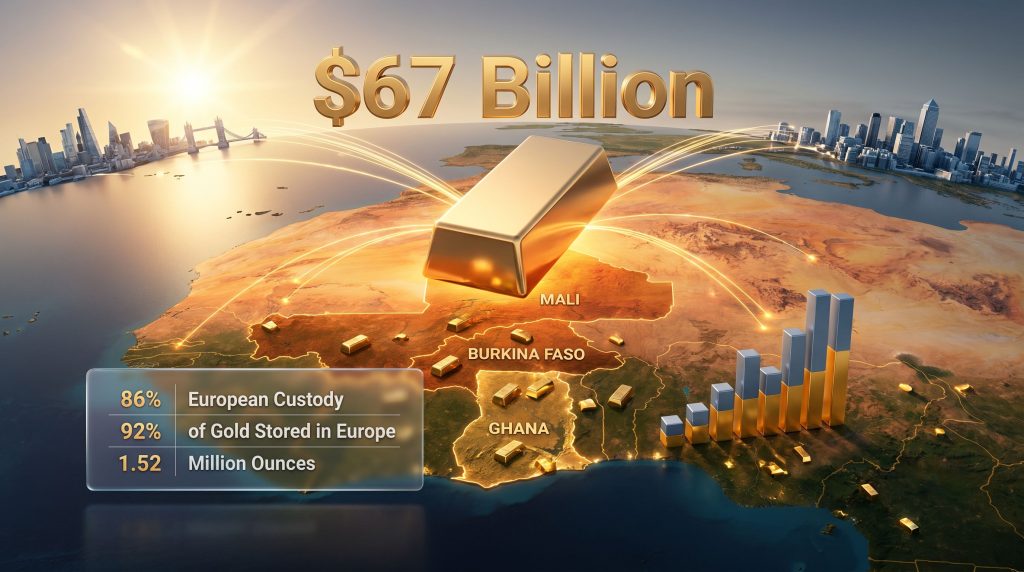
The BCEAO manages approximately $67 billion in total assets on behalf of the eight member states of the West African Economic and Monetary Union (WAEMU). These nations include Senegal, Côte d'Ivoire, Mali, Burkina Faso, Niger, Togo, Benin, and Guinea-Bissau, collectively representing a significant share of West Africa's economic output and gold production capacity.
The most recent audited accounts, certified by Deloitte Côte d'Ivoire in 2025, reveal the following custodial breakdown:
| Reserve Category | European Share | Non-European Share |
|---|---|---|
| External assets held with European counterparties | 86% | 14% |
| Foreign exchange reserves (euro-denominated) | 82% | 18% |
| Physical gold stored in European vaults | 92% | 8% |
| Combined gold and FX assets in Europe | 87% | 13% |
These figures confirm that West Africa reserves in European banks and gold hubs have not materially shifted since the region's landmark monetary reform in 2019. A further detail embedded in the audit data is particularly revealing: 76% of total reserves are structured as correspondent deposits, meaning that routine settlement and liquidity operations for the entire monetary union flow through foreign banking networks on a daily basis.
The BCEAO's gold stock stood at 1.52 million ounces at the close of 2025, carrying a value of approximately CFA 3,640 billion, equivalent to roughly €5.5 billion. Notably, the 44% year-on-year appreciation in that gold position was driven almost entirely by rising global prices rather than new acquisitions. The region is not aggressively purchasing gold to build reserves; it is benefiting passively from bull market conditions while the structural composition of its holdings remains unchanged.
How Do These Figures Compare Globally?
According to gold reserves by country data published by the World Gold Council, BCEAO's domestic custody share of approximately 8% sits dramatically below the global emerging market average. Furthermore, central bank gold demand across other developing regions has been rising steadily, highlighting how the BCEAO's passive accumulation approach diverges from the more assertive strategies adopted elsewhere.
Is This Custody a Market Constraint or a Political Legacy?
The instinctive framing of European custodianship as a colonial hangover is politically appealing but analytically incomplete. Economists and monetary analysts consistently point to genuine market liquidity as a primary driver of where central banks, globally, choose to hold their gold and foreign exchange reserves.
London, administered through the LBMA gold market structure, and Zurich, supported by Swiss banking infrastructure, collectively represent the world's deepest and most operationally efficient physical gold markets. As one economist noted to Ecofin Agency, the location of gold reserves in Europe reflects market constraint as much as political choice, given that London and Zurich remain the world's most liquid gold hubs. Holding assets outside these centres creates measurable operational disadvantages:
- Reduced access to gold repo markets and lending facilities
- Higher transaction costs and wider bid-ask spreads on physical gold
- Slower settlement timelines for large sovereign transactions
- Limited availability of gold-backed financial instruments
A useful comparative lens is provided by examining how other central banking systems around the world approach custody decisions:
| Institution / Region | Primary Custody Location | Key Driver |
|---|---|---|
| BCEAO (West Africa) | Europe (London, Zurich) | Historical legacy + market liquidity |
| BEAC (Central Africa) | Europe | Historical legacy + market liquidity |
| Emerging market central banks (broadly) | New York Fed, Bank of England | Safety and liquidity |
| Gulf sovereign wealth funds | Diversified (US, Europe, Asia) | Yield optimisation + diversification |
| China's PBoC | Domestic + diversified | Strategic autonomy |
The BCEAO's pattern is not an isolated anomaly. The Bank of Central African States (BEAC) operates under a comparable custodial structure, suggesting this is a continental dynamic rooted in post-colonial monetary architecture. What distinguishes the situation, however, is the degree of concentration. At 86-92% across key asset categories, BCEAO's European dependency significantly exceeds the 40-60% range typically observed across broader emerging market benchmarks.
How the CFA Franc System Built This Architecture
The structural roots of European custodianship trace directly to the Franco-African monetary cooperation agreements formalised in the post-independence era. The CFA franc was pegged first to the French franc and, following the euro's introduction in 1999, to the euro itself, creating an institutional binding of West African monetary policy to European financial infrastructure.
Under the original arrangement, WAEMU member states were required to deposit 50% of their foreign exchange reserves with the French Treasury as a guarantee for the fixed exchange rate. This mechanism was not merely technical; it created operational habits, banking relationships, and settlement pathways that have proven far more durable than the legal obligations themselves.
The 2019 reform formally ended the deposit obligation with the French Treasury, representing a genuine political milestone. Yet the audit data from 2025 demonstrates a critical and often underappreciated truth:
Institutional inertia can outlast policy reform. The 2019 change altered legal obligations without redesigning operational infrastructure. Settlement systems, correspondent banking relationships, and liquidity access continue to run through European channels because no comparable regional alternative has yet been constructed.
This gap between the formal and the operational is one of the most important dynamics in African monetary economics. Consequently, political declarations about sovereignty have not yet translated into measurable changes in reserve geography.
West Africa as a Gold Production Powerhouse
Understanding the stakes of this discussion requires appreciating the scale of West Africa's gold production capacity. The region produced approximately 11.83 million ounces of gold in 2024, positioning it among the world's foremost gold-producing provinces. Ghana, Burkina Faso, and Mali lead regional output, each contributing substantially to export earnings that ultimately feed into the BCEAO's reserve pools.
Over the past two decades, an estimated 95 million ounces of gold have been discovered across the region, a discovery rate that competes with major global mining provinces including parts of Australia and North America. This geological endowment creates the foundation for potentially transformative reserve accumulation, yet the value chain from ore body to monetary reserve currently exits the continent at nearly every stage.
The pipeline works as follows:
- Gold is extracted by multinational and artisanal operators across the region
- Export revenues generate hard currency inflows, primarily in USD and EUR
- Hard currency earnings flow into national accounts and ultimately BCEAO reserve pools
- Reserve managers allocate assets based on liquidity and safety criteria that favour European counterparties
- Physical gold holdings are transferred to custodians in London gold vaults for storage and potential monetisation
At each of these stages, value is captured outside the region. Gold is refined abroad, stored abroad, and traded through markets located abroad. The discovery and extraction of world-class ore deposits has not yet translated into proportionate monetary sovereignty, because the institutional infrastructure required to capture and retain that value domestically remains underdeveloped.
The Illegal Mining Dimension
A further complication is the scale of artisanal and small-scale mining (ASM) and illegal extraction operating outside formal channels across Ghana, Burkina Faso, and Mali. Unrecorded gold production of this nature undermines the accuracy of official reserve statistics and reduces the volume of export earnings that flow into formal monetary channels. Addressing the informal gold economy is not merely a governance challenge; it is a prerequisite for maximising the reserve accumulation potential that West Africa's geological endowment theoretically supports.
The Sovereignty Debate: What It Actually Means in Practice
The conversation around monetary sovereignty in West Africa has historically been a technocratic discussion conducted among economists and central bankers. Political developments across the Sahel have, however, changed that dynamic dramatically.
Coup-led governments in Mali, Burkina Faso, and Niger have explicitly positioned themselves as opponents of French monetary influence, using reserve dependency as a visible symbol of the broader sovereignty argument. As noted in a widely cited opinion on African financial sovereignty, nations that genuinely believe in financial independence cannot continue to park the bulk of their foreign exchange reserves in London, New York, and Paris. These governments have consequently pursued closer ties with alternative partners including Russia and China, signalling a potential medium-term realignment of financial relationships.
However, the gap between political declaration and operational transition is substantial. Replacing European financial infrastructure requires building regional settlement systems, establishing internationally recognised refining and assay certification capabilities, negotiating new custody agreements with alternative financial centres, and developing the institutional depth to manage liquidity crises without recourse to European counterparties.
The proposed Eco currency, a unified monetary instrument intended to replace the CFA franc across ECOWAS member states, has been under active discussion since 2019. A genuine transition would require restructuring reserve management from the ground up:
| Dimension | Current State | Reform Aspiration |
|---|---|---|
| Custody | 92% of gold in European vaults | Regional or genuinely diversified custody |
| Currency denomination | 82% euro-denominated FX | Multi-currency basket approach |
| Settlement infrastructure | Correspondent banking via European networks | Regional payment and settlement systems |
| Monetary policy independence | Euro-anchored framework | Autonomous interest rate and FX policy |
Warning: Rapid reserve repatriation without adequate domestic or regional custodial infrastructure in place could expose West African monetary systems to serious liquidity shortfalls and settlement disruptions. The transition, if pursued, demands careful sequencing rather than politically motivated speed.
The next major ASX story will hit our subscribers first
The Real Risks of Diversifying Away from European Hubs
The case for diversification is intellectually straightforward. The operational risks of executing it are, however, considerably more complex. Any strategy to reduce the concentration of West Africa reserves in European banks and gold hubs must contend with the following constraints:
- Liquidity access: Reserves held outside major global financial centres face meaningfully reduced access to overnight repo markets, gold lending facilities, and emergency liquidity mechanisms
- Counterparty depth: European custodians offer institutional networks that regional alternatives currently lack the scale and creditworthiness to replicate
- Settlement risk: Moving large volumes of physical gold requires secure logistics chains, internationally recognised assay certification, and insurance frameworks that remain underdeveloped across West Africa
- Yield considerations: Euro-denominated instruments offer predictable returns within a well-regulated framework; alternative custodians in emerging financial centres introduce currency, political, and counterparty risks that must be carefully priced
Nations that have pursued active de-dollarisation and reserve diversification strategies, including Russia, China, and several Gulf states, provide instructive but not directly transferable models. Each of these economies possessed domestic financial infrastructure, refining capacity, and institutional depth that West African monetary unions are still working to build.
Furthermore, central bank gold reserves data from across the developing world confirms that no major emerging market has successfully executed a rapid custodial transition without encountering significant operational disruption.
Benchmarking Against Global Reserve Norms
Situating the BCEAO's reserve structure within a global comparative framework reveals the degree to which its concentration exceeds typical emerging market practice:
| Metric | BCEAO (West Africa) | Typical Emerging Market | Advanced Economy |
|---|---|---|---|
| Share held in European institutions | ~86-87% | 40-60% | Varies widely |
| Gold as % of total reserves | ~8% (at €5.5bn) | 5-15% | 10-70% |
| Currency diversification | Predominantly EUR | USD, EUR, CNY mix | Broad basket |
| Domestic custody share | ~8% | 20-50% | 60-100% |
The data reveals that BCEAO's domestic custody share of approximately 8% is substantially below the 20-50% range observed across comparable emerging market institutions. In addition, gold in the monetary system has taken on renewed strategic importance globally, making the BCEAO's passive stance increasingly conspicuous. This gap represents both the challenge and the opportunity: there is significant room to build domestic and regional custodial capacity without abandoning the liquidity access that European markets provide.
What a Realistic Diversification Strategy Could Look Like
A credible pathway toward reduced European dependency would need to be sequenced carefully across an extended time horizon. Based on frameworks discussed in academic and institutional monetary policy literature, a phased approach might involve:
Phase 1: Institutional Groundwork (Years 1-3)
- Establish regional gold refining and internationally recognised assay certification infrastructure
- Develop ECOWAS-level reserve management protocols and governance frameworks
- Negotiate bilateral custody agreements with alternative financial centres such as the UAE, Singapore, or China
Phase 2: Gradual Custodial Redistribution (Years 3-7)
- Incrementally shift a target of 15-20% of physical gold to regional or diversified custody
- Introduce a multi-currency reserve basket to reduce euro concentration from 82% toward a 60-65% target
- Build correspondent banking relationships with non-European settlement networks
Phase 3: Monetary Architecture Reform (Years 7-15)
- Launch a functional Eco currency with an operationally independent monetary policy framework
- Work toward a reserve structure where no single geographic region holds more than 50% of total assets
- Develop domestic capital markets capable of absorbing a portion of reserve investment flows
Note: This scenario is illustrative and draws on policy frameworks discussed in academic and institutional literature. Actual reform timelines would depend on political consensus across ECOWAS member states, institutional capacity development, and prevailing global market conditions.
Frequently Asked Questions
Why does the BCEAO keep most of its gold in Europe?
The primary drivers are market liquidity and operational infrastructure. London and Zurich host the world's most liquid physical gold markets, offering deep counterparty networks, gold lending facilities, and efficient settlement systems that regional alternatives cannot yet replicate.
Did the 2019 CFA franc reform change where reserves are held?
The reform ended the formal obligation to deposit reserves with the French Treasury, a significant policy achievement. However, the actual geographic distribution of assets has not changed materially, as operational and liquidity considerations continue to favour European custodians.
How much gold does West Africa produce annually?
The region produced approximately 11.83 million ounces of gold in 2024, with Ghana, Burkina Faso, and Mali as the leading contributors. Approximately 95 million ounces have been discovered across the region over the past two decades.
What is the Eco currency and how does it relate to reserve management?
The Eco is a proposed unified currency for ECOWAS member states intended to replace the CFA franc. A successful transition would require fundamental restructuring of reserve management, including reduced euro dependency and the construction of new custodial frameworks.
Are other African central banks similarly dependent on European institutions?
Yes. The Bank of Central African States (BEAC) exhibits a comparable custodial structure, confirming that European financial dependency in reserve management reflects a broader continental pattern rooted in post-colonial monetary architecture rather than a WAEMU-specific condition.
What risks would West Africa face from rapid reserve repatriation?
Rapid repatriation without adequate infrastructure could create liquidity shortfalls, settlement disruptions, and reduced access to emergency financial facilities. A phased and carefully sequenced approach is therefore essential to manage transition risks effectively.
Sovereignty Requires More Than Political Will
The data assembled from BCEAO's 2025 audited accounts is unambiguous: West Africa reserves in European banks and gold hubs account for 86-92% of key asset categories concentrated in European custodians. Political reforms have altered the legal framework without transforming the operational reality.
What the evidence ultimately demonstrates is that monetary sovereignty is not a destination that can be reached through declarations or policy reforms alone. It requires the patient, technically demanding construction of regional financial infrastructure that can genuinely match the liquidity depth, settlement efficiency, and institutional reliability of the systems it seeks to complement or eventually replace.
West Africa possesses the geological endowment to support genuine monetary strength. The region's gold production capacity, its expanding discovery pipeline, and its growing economic weight within the global south all point toward a future where reserves need not be concentrated thousands of kilometres from the economies they are meant to serve. That future will be built through institutional investment, regional cooperation, and operational credibility, not through the political momentum alone that currently dominates the sovereignty conversation.
For investors, analysts, and policymakers monitoring the region, the most important signal to watch is not which governments are making the loudest declarations about financial independence, but which institutions are quietly building the infrastructure that would make independence operationally viable.
This article draws on publicly available data from BCEAO audited accounts as reported by Business Insider Africa, and reflects frameworks discussed in academic and institutional monetary policy literature. It does not constitute financial advice. Forecasts, scenarios, and projections referenced herein are illustrative and subject to significant uncertainty.
Want to Stay Ahead of Significant Mineral Discoveries Across West Africa and Beyond?
West Africa's expanding gold discovery pipeline — with an estimated 95 million ounces discovered over the past two decades — represents exactly the kind of high-potential environment where timing matters most; Discovery Alert's proprietary Discovery IQ model delivers real-time ASX mineral discovery alerts, turning complex geological data into actionable investment insights for both short-term traders and long-term investors. Explore how historic mineral discoveries have generated substantial returns and begin your 14-day free trial today to position yourself ahead of the broader market.