
July 5, 2026
Why Gold Margin Economics Are Rewriting the Rules for Mid-Tier Producers
The economics of gold mining have rarely looked this compelling. When the spread between a producer's all-in sustaining cost and the prevailing gold price widens beyond US$2,000 per ounce, something structurally significant begins to happen: free cash flow generation accelerates faster than most valuation models anticipate, balance sheets strengthen ahead of schedule, and exploration budgets expand without straining capital allocation. This dynamic is not theoretical in mid-2026. It is playing out in real time across a select cohort of ASX-listed gold producers, and the West African Resources gold production update confirms that WAF (ASX: WAF) sits near the centre of that story.
Understanding why requires looking beyond the headline production number and examining how operational execution, mine geology, state partnership structures, and cost discipline interact to create durable investor value in the current gold price outlook.
When big ASX news breaks, our subscribers know first
West African Resources Gold Production Update: June 2026 Quarter at a Glance
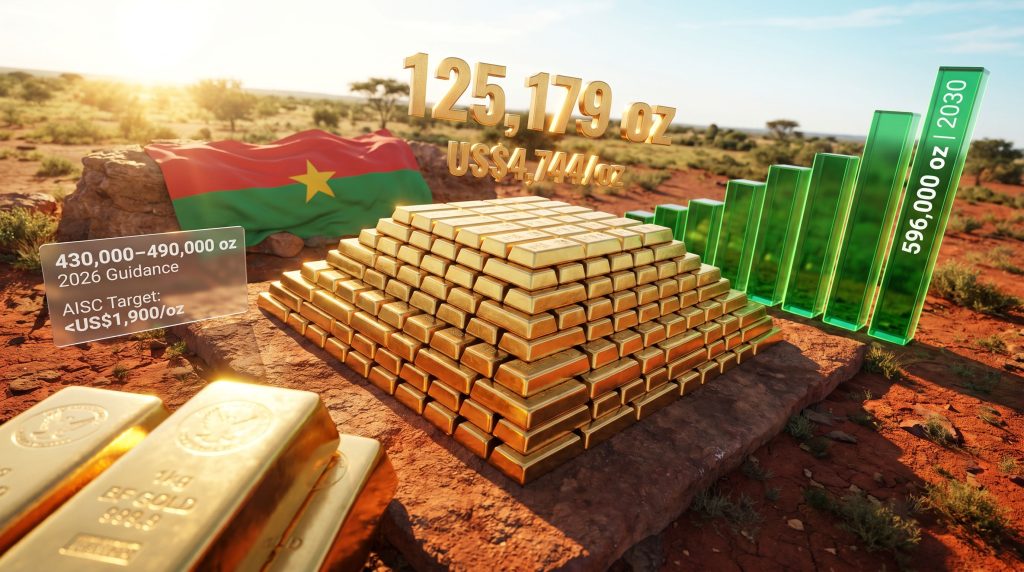
The June 2026 quarter West African Resources gold production update confirmed group output of 125,179 ounces, drawn from two geologically distinct production centres in Burkina Faso. Sanbrado contributed 57,608 ounces while the newer Kiaka operation delivered 67,571 ounces, making it the larger contributor by volume in the period.
| Metric | Q2 2026 | H1 2026 Year-to-Date |
|---|---|---|
| Group Gold Production | 125,179 oz | 232,905 oz |
| Group Gold Sales | 110,737 oz | 214,883 oz |
| Average Realised Price | US$4,556/oz | US$4,744/oz |
| Sanbrado Production | 57,608 oz | — |
| Kiaka Production | 67,571 oz | — |
| 2026 Full-Year Guidance | — | 430,000–490,000 oz |
With 232,905 ounces banked across the first half of 2026, the company has achieved approximately 49% to 54% of its full-year guidance midpoint of 460,000 ounces. That positioning, achieved before the typically stronger second half of the operational calendar, gives management a meaningful production buffer heading into Q3 and Q4.
An average realised gold price of US$4,744 per ounce across the first six months of 2026 reflects the broader structural shift in gold markets driven by central bank accumulation, persistent geopolitical uncertainty, and sustained institutional demand for hard assets. Furthermore, the gold price and miners relationship has rarely been this favourable for margin expansion.
Sanbrado: Underground Mining Acceleration and What It Signals
The 60% Underground Uplift Is More Than a Quarterly Statistic
Sanbrado's 37% quarter-on-quarter production increase is impressive at face value, but the more technically significant figure sits underneath it. Underground mined ounces at Sanbrado rose 60% from the prior quarter, reflecting expanding ore access at depth and improving development metres per month.
In underground hard rock mining, this kind of sequential uplift generally indicates one of three things: improved development advance rates creating better ore face access, grade reconciliation coming in above resource model expectations, or enhanced metallurgical recovery from ore blend optimisation. At Sanbrado, the combination of higher head grades feeding the process plant and improved recovery rates suggests all three dynamics may be operating simultaneously.
This is operationally meaningful because underground mining grades at Sanbrado have historically been materially higher than open pit grades. The M1 South underground zone, which has been the primary contributor to recent production growth, is known for hosting high-grade shoots within a broader lower-grade envelope. As development metres extend deeper into this orebody, grade consistency tends to improve, reducing the processing plant's reliance on blending with lower-grade open pit material.
Sanbrado's Forward Development Pipeline
- Sanbrado's 2026 standalone production guidance range: 190,000 to 210,000 ounces
- Development of the M5 South underground zone is targeted to begin in early 2027, subject to government approvals
- Mine planning at Sanbrado incorporates scheduling flexibility to accommodate permit timing variations without materially disrupting throughput
- The Sanbrado process plant has demonstrated capacity to absorb grade improvements through recovery optimisation
The 60% quarter-on-quarter uplift in underground mined ounces at Sanbrado is a leading operational indicator. In underground mining, sequential volume growth of this magnitude typically foreshadows improving grade consistency as development faces move into higher-grade ore domains.
Kiaka: Navigating Regulatory Disruption Without Losing Production Momentum
Free-Dig Mining as an Operational Contingency Tool
Kiaka is West African Resources' dominant production asset by guidance contribution, targeting 240,000 to 280,000 ounces in 2026. In Q2, open pit mining volumes fell 24% from Q1 levels, primarily due to lower ore tonnes and a softening in head grade delivered to the processing plant.
The primary driver of this disruption was a regulatory delay affecting explosives supply. In open pit hard rock mining, explosives are the critical enabler of ore fragmentation. Without blasting capability, conventional mining sequences are disrupted and material movement rates decline sharply.
WAF's operational response was to reprioritise mining activity toward what the industry terms free-dig zones: areas within the pit where material is sufficiently weathered or fractured to be excavated by mechanical equipment without requiring blasting. This is a well-established contingency technique in tropical West African mining environments, where deep laterite and saprolite weathering profiles can extend tens of metres below surface, providing a viable ore source during blasting restrictions.
The fact that Kiaka still achieved quarter-on-quarter growth in gold produced despite the open pit volume decline demonstrates that the processing plant maintained reasonable throughput during the disruption. This speaks to the depth of the free-dig ore inventory available at Kiaka and the operational team's ability to sequence mining activities under constraint.
Regulatory Risk in Burkina Faso: A Structural Consideration for Investors
Explosives supply in Burkina Faso is subject to regulatory oversight that has become more complex in the current operating environment. The country has experienced elevated political instability since the military transitions of 2022 and 2023, and regulatory processes across multiple government departments have at times moved more slowly than companies and investors would prefer.
WAF management confirmed active engagement with Burkina Faso authorities to secure outstanding explosives approvals, and the company expressed confidence that 2026 full-year production guidance remains achievable despite the Q2 disruption. In addition, gold production insights from comparable West African operations suggest that gold production insights during regulatory disruptions often rebound sharply once supply constraints are resolved.
Investors should treat explosives supply constraints as a country-specific operational variable rather than a mine-level engineering failure. WAF's contingency response at Kiaka reflects sound operational planning, but a prolonged permitting delay extending into Q3 2026 would require close monitoring of throughput data in the next quarterly report.
The SOPAMIB Transaction: State Participation and Its Long-Term Implications
Deal Structure at a Glance
WAF is in the process of finalising an agreement under which SOPAMIB, the Burkina Faso state mining company, will acquire a 25% interest in Kiaka SA for approximately A$176 million. The transaction involves coordination between WAF, the Burkina Faso government, and SOPAMIB as principal parties.
| Dimension | Strategic Implication |
|---|---|
| Regulatory Relationships | Deeper government alignment on the country's largest gold mine |
| Economic Interest | WAF's effective share of Kiaka SA economics reduces to 75% post-transaction |
| Operational Control | WAF retains management and operational responsibility |
| Country Risk Profile | Formalised state participation can reduce expropriation risk perceptions |
| Social Licence | Strengthens WAF's long-term community and government relationships |
Why State Participation Is Becoming the New Normal in West Africa
Across Francophone West Africa, governments have progressively asserted greater participation in mining revenues over the past decade. This trend accelerated following commodity price recoveries post-2020 and has been reinforced by broader resource nationalism sentiment across sub-Saharan Africa. Consequently, Australian gold M&A activity has increasingly reflected similar state-partnership dynamics as acquirers price in sovereign risk more carefully.
What distinguishes the SOPAMIB transaction from more adversarial forms of state intervention is its structured, negotiated character. WAF is receiving A$176 million in consideration for the 25% stake, rather than facing a forced participation requirement without compensation. This transactional approach reflects a pragmatic alignment of interests: the Burkina Faso government gains meaningful economic participation in one of the country's largest gold mines, while WAF retains operational control and secures a more durable social and political foundation for long-term production.
Cost Economics: Why the Margin Story Matters Now More Than Ever
AISC Positioning Against a Generational Gold Price Environment
WAF is targeting an all-in sustaining cost below US$1,900 per ounce for 2026. Against an average realised price of US$4,744 per ounce across H1 2026, this implies a gross margin per ounce exceeding US$2,800, a figure that would rank among the widest in the ASX gold sector.
| Gold Price Scenario | Target AISC | Implied Margin per oz | Implied Annual Margin (460,000 oz midpoint) |
|---|---|---|---|
| US$3,500/oz | below US$1,900/oz | ~US$1,600/oz | ~US$736 million |
| US$4,000/oz | below US$1,900/oz | ~US$2,100/oz | ~US$966 million |
| US$4,500/oz | below US$1,900/oz | ~US$2,600/oz | ~US$1.196 billion |
Note: These figures are illustrative and based on guidance midpoints. Actual results will vary based on realised gold prices, production volumes, cost outcomes, and foreign exchange movements. This does not constitute financial advice.
The structural advantage here is not purely cyclical. Both Sanbrado and Kiaka are characterised by large-scale, bulk-mineable orebodies with favourable strip ratios and straightforward metallurgical processing profiles. Gold in West African shear-hosted deposits of this type is predominantly free-milling, meaning it responds well to conventional carbon-in-leach (CIL) processing without requiring complex flotation circuits or refractory treatment. This simplicity suppresses operating costs relative to more metallurgically complex deposit types found in other jurisdictions.
The next major ASX story will hit our subscribers first
Long-Range Production Outlook: Building Toward 500,000+ Ounces Per Year
The 10-Year Production Framework
WAF's updated long-range plan targets an average of 533,000 ounces per annum across the 2026 to 2035 period, with production projected to peak at 596,000 ounces in 2030 as both Sanbrado and Kiaka reach full operational maturity. According to West African Resources, this trajectory is supported by a robust reserve base and disciplined capital allocation across both production centres.
Executive Chairman and CEO Richard Hyde has articulated the company's strategic objective of establishing West African Resources as a sustainable 500,000-plus ounce per annum gold producer by 2030, a threshold that would place WAF firmly in the second tier of global mid-cap gold producers by output.
Underpinning this outlook is a total gold reserve base of approximately 6.5 to 7.0 million ounces across the combined portfolio. Reserve life of this magnitude provides the raw material for sustained long-range production, but ongoing reserve replacement through exploration is critical to extending the production profile beyond 2030.
The $20 Million Exploration Program: Reserve Replacement in Focus
- $20 million allocated to exploration across 2026
- Target drilling program: more than 100,000 metres across Sanbrado, Kiaka, and surrounding tenements
- Primary objective: converting exploration resources to mineable reserves to sustain the 10-year production plan
- Secondary objective: identifying potential satellite deposits that could be processed through existing infrastructure
In the context of the current gold price environment, a $20 million exploration budget on orebodies that are already producing is a high-value deployment of capital. Reviewing gold drilling results from analogous West African projects underscores how infill drilling on known mineralisation consistently delivers superior reserve conversion rates compared to greenfield exploration, and each incremental ounce added to reserves at Sanbrado or Kiaka has minimal incremental infrastructure cost.
Share Price Performance and Key Catalysts to Monitor
29% Outperformance Against the Broader Market
West African Resources shares have appreciated 29% over the past 12 months, against a 3% return from the S&P/ASX 200 Index over the same period. This 26 percentage point outperformance reflects a combination of gold price tailwinds and company-specific operational execution.
Looking ahead, the key catalysts that are likely to drive further re-rating include:
- H2 2026 production delivery confirming full-year guidance achievement within the 430,000 to 490,000 oz range
- Finalisation of the SOPAMIB transaction for Kiaka SA, removing deal uncertainty from the investment thesis
- Resolution of Kiaka explosives supply permitting, restoring full open pit mining capacity
- Release of the full Q2 2026 quarterly activities report, expected in coming weeks and likely to contain additional cost and development data
- Commencement of M5 South underground development at Sanbrado, targeted for early 2027 subject to government approvals
Risk Matrix: What Investors Need to Monitor Closely
| Risk Category | Specific Risk | Current Status | Mitigation Approach |
|---|---|---|---|
| Regulatory | Explosives supply approvals at Kiaka | Active delays | Free-dig mining strategy in operation |
| Country Risk | Burkina Faso political and security environment | Elevated | SOPAMIB partnership; government engagement |
| Development | M5 South government approval timing | Pending | Sanbrado mine plan scheduling flexibility |
| Commodity | Gold price volatility | Favourable | Low AISC provides substantial downside buffer |
| Corporate | SOPAMIB transaction finalisation | In progress | Active negotiation with government parties |
Burkina Faso has experienced significant political transitions since 2022. While WAF has maintained continuous production at both Sanbrado and Kiaka throughout this period, the country risk dimension remains a material consideration. Investors should monitor the broader security and governance environment alongside company-specific operational updates.
Frequently Asked Questions: West African Resources June 2026 Quarter Update
What was West African Resources' total gold production in Q2 2026?
Group gold production for the June 2026 quarter totalled 125,179 ounces, comprising 57,608 oz from Sanbrado and 67,571 oz from Kiaka.
Is WAF on track to meet its 2026 annual guidance?
Yes. With 232,905 ounces produced in the first half of 2026, the company has confirmed it remains on track to achieve full-year guidance of 430,000 to 490,000 ounces.
What is WAF's all-in sustaining cost target for 2026?
The company is targeting an AISC below US$1,900 per ounce, which at current gold prices implies margins well in excess of US$2,500 per ounce.
What caused Kiaka's Q2 production softness?
Open pit mining volumes at Kiaka fell 24% from Q1, driven by lower ore tonnes and grade, compounded by regulatory delays affecting explosives supply. The operational team responded by focusing activity on free-dig mining areas.
What is the SOPAMIB transaction?
SOPAMIB, Burkina Faso's state mining company, is acquiring a 25% stake in Kiaka SA for approximately A$176 million. The deal is pending finalisation between WAF and Burkina Faso government parties.
What is WAF's long-range production target?
The 10-year production plan covering 2026 to 2035 targets an average of 533,000 ounces per annum, with a projected peak of 596,000 ounces in 2030.
Key Takeaways for Investors Following the West African Resources Gold Production Update
- Guidance trajectory intact: 232,905 ounces in H1 2026 positions WAF comfortably within the tracking range for its 430,000 to 490,000 oz full-year target
- Sanbrado accelerating meaningfully: A 60% uplift in underground mined ounces signals expanding ore access and improving grade delivery to the process plant
- Kiaka demonstrating resilience under constraint: Regulatory disruption to explosives supply was managed through free-dig mining, with gold production still growing quarter-on-quarter at the plant level
- Margin profile is exceptional: An AISC target below US$1,900/oz against a realised price environment above US$4,700/oz creates a margin per ounce that is rare by global standards
- State partnership adds complexity but also durability: The SOPAMIB transaction reduces WAF's economic interest in Kiaka SA but strengthens its long-term operating foundation in Burkina Faso
- Reserve base and exploration program support the long-range thesis: 6.5 to 7.0 million ounces in reserves, backed by a 100,000-metre drilling program, provides the geological foundation for sustained production through 2035
This article contains general information only and does not constitute financial advice. Investments in mining companies involve material risks including commodity price volatility, operational disruption, and country-specific regulatory and political risk. Past share price performance is not indicative of future returns. Readers should seek independent financial advice before making investment decisions.
Want to Catch the Next Major ASX Gold Discovery Before the Market Does?
West African Resources demonstrates how transformative gold margin economics can be for patient investors — but the real opportunity often lies in identifying significant discoveries at the earliest possible stage. Discovery Alert's proprietary Discovery IQ model scans ASX announcements in real time, delivering instant alerts on high-potential mineral discoveries across gold and 30-plus other commodities, so subscribers can act on actionable opportunities ahead of the broader market. Explore historic discovery returns on Discovery Alert's discoveries page and begin a 14-day free trial to position yourself at the forefront of the next major ASX find.