June 16, 2026
The Processing Gap That Mining Alone Cannot Fix
The geology was never the problem. Across six continents, the earth holds sufficient reserves of lithium, cobalt, nickel, rare earth elements, and graphite to sustain the clean energy transition for generations. What the West lacks is not ore in the ground but the industrial infrastructure to transform that ore into usable materials. Understanding why that distinction matters more than any mining permit or exploration discovery is the starting point for any serious analysis of the West critical minerals supply chain challenge.
This is fundamentally a structural crisis rooted in decades of misaligned industrial strategy, not a resource scarcity problem. Closing that gap requires confronting a set of uncomfortable truths about timelines, processing dependencies, and the compounding difficulty of catching up with an opponent who began building industrial capacity two decades earlier.
When big ASX news breaks, our subscribers know first
What Actually Makes a Mineral Critical
The Three Tests of Criticality
Not every scarce material earns the designation. Governments and multilateral agencies apply a consistent analytical framework to determine which minerals warrant strategic attention:
- Strategic application: Is the mineral essential to defence systems, clean energy technologies, or digital infrastructure where no ready substitute exists?
- Supply concentration: Is production or processing controlled by a small number of actors or nations to a degree that creates systemic vulnerability?
- Long substitution lead times: Would replacing the mineral in its primary applications require years or decades of technology development?
The European Commission's 2023 Critical Raw Materials Act operationalises this framework directly. The Act is a central pillar of the broader critical raw materials transition agenda. Of the 34 materials on its critical list, 17 were elevated to strategic status, including lithium, cobalt, nickel, rare earth elements, and natural graphite. The Act also established a concrete diversification benchmark: by 2030, no single third country should account for more than 65% of the EU's annual consumption of any strategic raw material.
The Demand Multipliers Driving Urgency
The International Energy Agency's modelling of clean energy technology pathways provides some of the most cited quantitative evidence for why this matters now. In climate-aligned scenarios consistent with the Paris Agreement, the IEA projected that:
- Lithium demand from clean energy technologies could rise by more than 40 times by 2040 compared to 2020 levels
- Cobalt and nickel demand could increase by approximately 20 times
- Graphite and rare earth element demand could grow by 7 to 25 times, depending on the technology pathway
Electric vehicles and battery storage systems are the primary drivers. In the IEA's Sustainable Development Scenario, these two technology categories alone account for roughly 70% of total lithium demand, around 40–50% of cobalt demand, and a comparably large share of nickel demand by 2040.
For rare earth elements, permanent magnets used in wind turbine generators and EV motors could drive a three- to seven-fold increase in neodymium and dysprosium demand by the same date. These are not marginal adjustments to existing commodity markets. They represent a structural transformation of global mineral demand at a pace that existing supply infrastructure was never designed to accommodate.
How China Built an Unassailable Processing Lead
Two Decades of Deliberate Industrial Strategy
The asymmetry between Chinese and Western capacity at the processing stage of the West critical minerals supply chain is the defining strategic reality of this era. It was not accidental. Over more than two decades, China pursued a systematic policy of investing in midstream refining and processing infrastructure, supported by state-directed capital that could tolerate lower returns and longer timelines than private Western investors would accept.
Furthermore, China's rare earth export restrictions have reinforced this leverage, demonstrating how processing dominance translates directly into geopolitical leverage. Chinese firms, backed by patient state financing, absorbed the environmental costs, technology development risks, and thin early margins that characterise the establishment of new processing capacity. Western governments, distracted by the assumption that open markets and comparative advantage would produce efficient supply chains, progressively exited the midstream space.
The result is a processing map that concentrates extraordinary leverage in a single country:
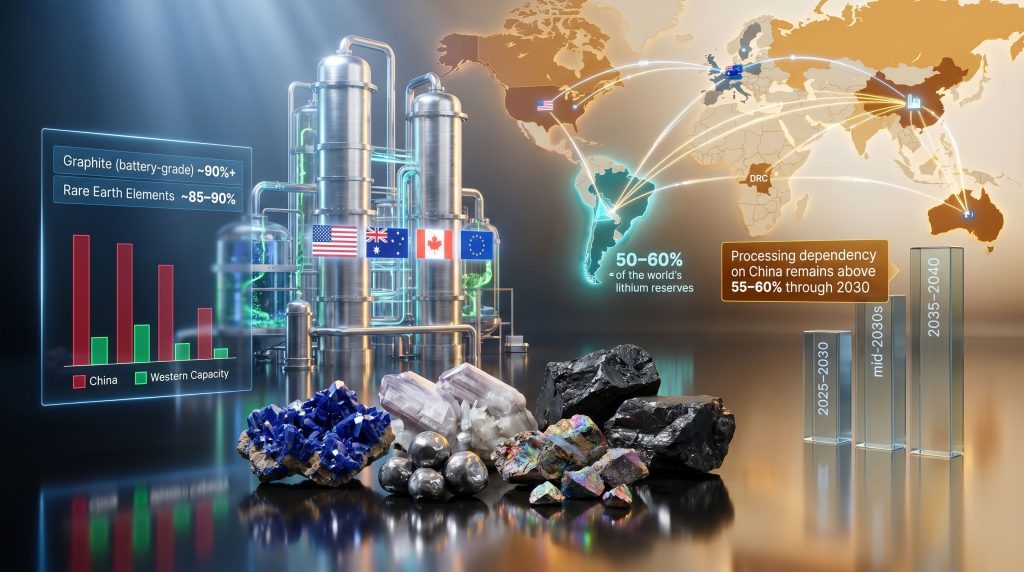
| Mineral | China's Share of Global Refining Capacity | Notable Western Alternatives |
|---|---|---|
| Lithium | ~60% | Australia and Chile at early processing stages |
| Cobalt | ~70–80% | Minimal; DRC extracts, China processes |
| Rare Earth Elements | ~85–90% | U.S. and Australia developing capacity |
| Battery-grade Graphite | ~90%+ | Near-zero outside China |
| Class 1 Nickel | ~35–40% | Indonesia growing, largely China-linked |
Sources: IEA Critical Minerals Report; U.S. Geological Survey Mineral Commodity Summaries; BloombergNEF
The Mine-to-Nowhere Problem
One of the least widely understood vulnerabilities in Western supply chain planning is that increased mining activity without corresponding processing capacity does not reduce strategic dependency. Australian lithium is perhaps the clearest illustration of this dynamic. Australia produces more than half of global mined lithium, primarily as spodumene concentrate. The overwhelming majority of that concentrate has historically been shipped to China for conversion into battery-grade lithium carbonate or lithium hydroxide before re-entering global supply chains as usable material.
The consequence is a supply chain that looks diversified at the extraction stage but remains fully exposed to Chinese processing control at the midstream stage. A Western government that permits and finances a new lithium mine without simultaneously securing domestic or allied-nation processing infrastructure has not resolved its vulnerability. It has simply moved the bottleneck slightly upstream.
Western supply chain strategy that focuses on mining output while leaving processing dependency unaddressed is not a solution. It is a more expensive version of the same problem.
Five Policy Levers Western Governments Are Deploying
Governments across NATO-aligned economies have moved from diagnosis to action, though at varying speeds and with varying commitment. The policy toolkit being assembled broadly includes five instruments:
- Permitting reform designed to compress mine development timelines from the current average of 10–17 years toward a target of under seven years in priority jurisdictions
- Strategic stockpiling through national reserve programmes intended to provide 90–180 days of industrial buffer against supply disruption
- Domestic processing investment via co-financing arrangements that reduce the risk premium facing private sector refinery developers
- Multilateral coordination through frameworks like the Minerals Security Partnership, which brings together the United States, European Union, Australia, Canada, Japan, South Korea, and the United Kingdom
- Offtake guarantees and financing commitments that de-risk early-stage projects by providing commercial certainty before production begins
The Minerals Security Partnership represents the most ambitious of these mechanisms, but its effectiveness is constrained by the voluntary nature of member participation and the absence of binding capital commitments. Coordinating fourteen separate national investment frameworks across different legal systems, electoral cycles, and domestic political priorities remains a significant operational challenge.
The IRA's Hard Commercial Incentive for Supply Chain Restructuring
The U.S. Inflation Reduction Act introduced a mechanism that goes beyond financing incentives by embedding sourcing requirements directly into the economics of battery manufacturing. The Act's foreign entity of concern provisions, which tightened progressively from 2024 through 2027, effectively disqualify battery components with material content traced to Chinese, Russian, North Korean, or Iranian entities from eligibility for federal tax credits.
For battery manufacturers and EV producers who depend on those credits to maintain competitive pricing, this creates a hard commercial incentive to restructure procurement toward non-Chinese processed materials. However, the practical challenge is that alternative processing capacity at scale does not yet exist. The IRA has consequently created a demand signal for alternative supply before the supply itself is ready — a sequencing problem that the industry is racing to resolve.
A Regional Map of Western Sourcing Strategy
South America: The Most Accessible Diversification Zone
The concentration of lithium reserves in Argentina, Bolivia, and Chile — a formation known within the industry as the Lithium Triangle — positions South America as the most strategically significant diversification opportunity. Collectively, these three nations hold an estimated 50–60% of global lithium reserves. In addition, innovations such as direct lithium extraction technology are making it increasingly viable to develop these resources more efficiently and with a lower environmental footprint.
Argentina and Chile in particular offer comparatively stable governance frameworks relative to other high-mineral regions. Brazil contributes additional strategic depth, with significant nickel, rare earth, and graphite endowments, while Peru and Chile anchor copper and molybdenum supply chains critical for grid infrastructure.
Africa: Mineral Wealth Without Processing Infrastructure
The Democratic Republic of Congo holds approximately 70% of global cobalt reserves, making it the single most important source of a mineral essential for high-energy-density lithium-ion batteries. Yet the DRC ranks among the lowest decile of nations on the Human Development Index, with poverty rates among the highest in the world despite extraordinary mineral endowments.
This paradox reflects the structural failure to convert resource extraction into broad economic development — a failure that Chinese firms have in many cases compounded by securing dominant offtake positions through early-stage financing arrangements that prioritise export of raw material over local value-addition. The G7's Partnership for Global Infrastructure and Investment represents the primary Western framework for engaging mineral-rich African nations on terms that could build processing capacity locally, though the initiative remains underfunded relative to its ambitions.
Greenland and the Arctic: Strategic Endowment, Sovereignty Constraints
Greenland hosts one of the world's largest undeveloped rare earth and critical mineral deposits. Its strategic value has attracted considerable international attention, and the geopolitical contest for Arctic access has intensified considerably in the current decade. However, the limits of external development agreements are set by principles of Greenlandic self-determination that cannot be circumvented by strategic interest alone.
Australia and Canada: The Anglosphere's Anchor Suppliers
Australia's position as the world's largest lithium producer, combined with its significant nickel, cobalt, and rare earth endowments, makes it the most immediately accessible high-volume supplier for Western supply chain diversification. As Europe's critical minerals supply chain strategy continues to mature, partnerships with Australia and Canada are increasingly central to reducing European dependency on Chinese processing. Canada's own critical minerals strategy targets rare earth processing capacity and battery material supply, with the institutional advantage of existing allied-nation trade frameworks.
The Risks Western Policymakers Are Underestimating
Asset Acquisition Before Production Begins
One of the most structurally significant and least publicly discussed vulnerabilities in the West critical minerals supply chain involves the timing of Chinese investment activity. Chinese state-linked entities have demonstrated a consistent pattern of acquiring strategic equity stakes and offtake rights during the exploration and development phase of mineral projects, often years before any production decision is made.
The consequence is that a project may be permitted in a Western or allied jurisdiction, financed partially by domestic capital, and developed under local regulatory frameworks, while its production is contractually committed to Chinese processing infrastructure through offtake agreements signed at the exploration stage. Existing foreign investment screening frameworks in most Western nations were not designed to capture this early-stage exposure.
The Timeline Mismatch
The single most analytically important constraint on Western supply chain strategy is the mismatch between policy urgency and geological reality. The average timeline from mineral discovery to first commercial production runs between 10 and 17 years, encompassing feasibility studies, environmental assessments, community consultation processes, permitting, financing, construction, and commissioning.
The demand curve for critical minerals driven by EV adoption, grid storage deployment, and defence procurement is accelerating on a timeline measured in years, not decades. Projected shortfalls in lithium, cobalt, and nickel relative to energy transition demand scenarios are expected to be acute by 2030 — a date by which mines permitted today will still be in construction. Building a greenfield processing refinery adds a further 5–8 years and requires sustained policy support that extends across multiple electoral cycles.
Even with accelerated permitting and scaled-up financing commitments, the West's near-term exposure window remains wide open. The gap is not closable before the mid-2030s under any realistic scenario.
The next major ASX story will hit our subscribers first
Comparing Western and Chinese Strategic Approaches
The strategic divergence between Western and Chinese approaches to critical mineral supply chain development reflects fundamentally different institutional capacities and time horizons:
| Dimension | Western Approach | Chinese Approach |
|---|---|---|
| Investment Model | Public-private co-financing | State-directed capital deployment |
| Planning Horizon | Electoral cycle (4–5 years) | Generational (20–30 years) |
| Processing Focus | Emerging; policy-driven | Established; market-dominant |
| Risk Tolerance | Low to medium | High |
| Asset Acquisition Timing | Reactive | Proactive at exploration stage |
| Multilateral Framework | MSP, G7, PGII | Belt and Road Initiative, bilateral agreements |
The most consequential column in this comparison is the planning horizon. Chinese state industrial strategy for critical mineral processing was initiated in the late 1990s and early 2000s, with consistent policy and capital support maintained across administrations for more than two decades. Western governments are attempting to compress a comparable industrial build-out into a five-to-ten-year window using instruments that remain subject to electoral discontinuity.
The Recycling Contribution: Supplement, Not Substitute
Battery recycling is increasingly cited as a structural lever for reducing primary extraction dependency. The logic is sound in the medium term: as the first generation of large-scale EV batteries reaches end of life, recovery of lithium, cobalt, and nickel from spent cells creates a secondary supply stream geographically distributed across Western markets.
Current recycling recovery rates for lithium remain modest, with commercial-scale hydrometallurgical recycling processes recovering approximately 80–90% of cobalt and nickel but lower shares of lithium. By 2035, battery recycling could recover volumes that meaningfully reduce primary extraction requirements. However, secondary supply at scale is itself time-dependent, requiring a large installed base of batteries approaching end of life — which in turn requires the EV adoption rates that are driving primary demand in the first place.
Three Scenarios for the Western Supply Chain Through 2035
Scenario A: Accelerated Diversification
MSP financing commitments scale into operational projects, permitting timelines compress toward the seven-year target, and allied-nation processing capacity for tier-1 minerals comes online by 2032. Western exposure to Chinese processing falls below 40% for priority minerals by 2035. This scenario requires sustained policy commitment across multiple election cycles and significant de-risking of private capital at the processing stage.
Scenario B: Incremental Progress (Base Case)
Policy momentum continues but faces persistent headwinds from cost overruns, community opposition, and electoral cycle disruption. Processing dependency on China remains above 55–60% through 2030, declining gradually through the mid-2030s as new Western-aligned capacity matures. This scenario accepts a prolonged vulnerability window and manages it through strategic stockpiling and allied-nation coordination.
Scenario C: Strategic Fragmentation
Geopolitical escalation, potentially triggered by export control measures on processed materials from China, disrupts Western industrial supply chains before adequate alternative capacity is established. EV manufacturing, defence procurement, and grid storage deployment face acute material shortages. This scenario, while not the base case, is material enough in probability to justify defensive policy action now.
The Competitive Window Is Narrowing
The offtake agreements, equity positions, and processing partnerships that will define the supply architecture of the 2030s and 2040s are being negotiated and executed now. Junior developers in Argentina, Australia, and Canada are making financing decisions today that will lock in their processing routes and customer relationships for the life of their projects.
Furthermore, the nexus between critical minerals and energy security means that delays in establishing the West critical minerals supply chain carry consequences that extend well beyond commercial risk, encompassing defence readiness and long-term geopolitical positioning.
The nations and companies that position themselves decisively within the 2025–2030 window will establish structural advantages that compound over subsequent decades. Those that defer will face a market where the most strategically attractive assets are already committed and the processing partners with capacity are already fully contracted.
The West critical minerals supply chain challenge is ultimately not a geological problem. The reserves are there. It is a structural, financial, and political problem centred on the processing bottleneck that no amount of upstream mining activity can resolve on its own. Solving it demands a level of policy continuity, capital commitment, and multilateral coordination that Western democracies have not yet demonstrated at the required scale. The geological clock is indifferent to electoral cycles, and the window for decisive action is narrowing with each passing year.
This analysis draws on data and projections published by the International Energy Agency, the U.S. Geological Survey, the European Commission, and the World Bank. Scenario projections and timeline estimates represent analytical frameworks rather than guaranteed outcomes. Readers are encouraged to consult primary sources for the most current quantitative data on mineral reserves, production, and demand forecasting.
Want to Know Which ASX Mineral Discoveries Could Benefit From the Critical Minerals Supply Chain Race?
Discovery Alert's proprietary Discovery IQ model scans ASX announcements in real time, instantly identifying significant mineral discoveries across lithium, cobalt, rare earth elements, and other critical commodities — turning complex geological data into actionable investment insights for both short-term traders and long-term investors. Explore how historic ASX mineral discoveries have generated substantial returns and begin your 14-day free trial today to position yourself ahead of the market.