June 8, 2026
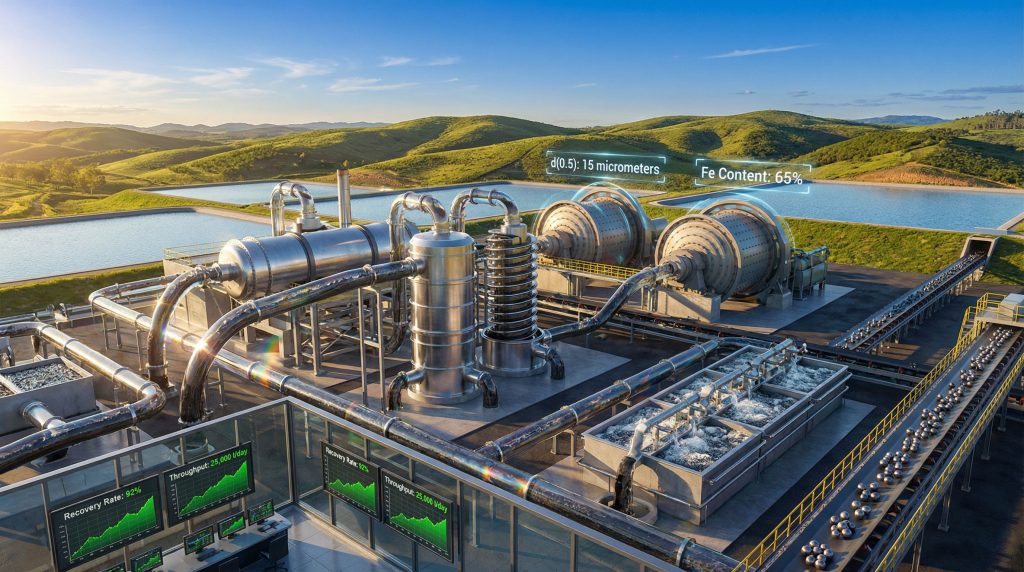
Industrial iron ore processing has undergone a fundamental transformation over the past two decades, driven by declining ore grades and increasing market demands for high-quality concentrates. The evolution from simple crush-and-ship operations to sophisticated wet processing technologies for iron ore represents one of the most significant technological shifts in modern mineral beneficiation. Understanding these aqueous processing methodologies and their implementation challenges provides crucial insights for both operators and investors navigating this complex sector.
Understanding the Fundamentals of Aqueous Iron Ore Processing
Wet processing technologies for iron ore leverage water as both a transport medium and chemical catalyst to achieve mineral separation at unprecedented fineness levels. These systems enable operators to reach liberation sizes below 25 micrometers while maintaining throughput rates exceeding 20 million tonnes annually at major installations. The transformation from historical high-grade operations becomes evident when examining grade evolution data.
According to industry experts, historical Australian iron ore industry advantages primarily focused on crush-and-ship methodologies for ore containing 60 to 65 percent iron content. However, as higher-grade deposits have been depleted, producers increasingly require beneficiation technologies to maintain marketable quality standards. This shift reflects broader global trends where raw ore grades have declined from historical averages of 65% Fe to current ranges of 55-65% Fe across major producing regions.
Core Separation Mechanisms in Wet Processing
Modern wet processing technologies for iron ore exploit three fundamental physical properties to achieve separation:
Magnetic Susceptibility Differentials
- Magnetite exhibits magnetic susceptibility of approximately 100 SI units
- Hematite demonstrates moderate magnetic response requiring higher field intensities
- Silica gangue minerals show negative susceptibility around -8 SI units
- These variations enable magnetic separation across different particle size ranges
Density-Based Separation Parameters
- Iron minerals: Hematite (5.3 g/cm³), Magnetite (5.2 g/cm³)
- Gangue minerals: Silica (2.65 g/cm³), Clay minerals (2.2-2.8 g/cm³)
- Density differential ratios exceeding 2:1 facilitate gravity concentration
- Spiral concentrators and hydrocyclones leverage these differences effectively
Surface Chemistry Properties
- pH-dependent mineral surface charge variations
- Flotation reagent selectivity based on surface hydrophobicity
- Clay mineral electrokinetic properties enabling washing separation
- Chemical conditioning requirements for optimal separation efficiency
Slurry Environment Optimization
Successful wet processing requires precise control of slurry characteristics to maximize separation efficiency. Modern installations operate at specific solids concentrations optimized for each processing stage:
| Processing Stage | Solids Concentration | Primary Objective | Typical Recovery |
|---|---|---|---|
| Primary Grinding | 65-75% by weight | Liberation achievement | 88-92% |
| Magnetic Separation | 25-35% by weight | Coarse recovery | 85-94% |
| Classification | 15-25% by weight | Size separation | 75-85% |
| Flotation Cells | 20-30% by weight | Fine particle recovery | 88-95% |
The aqueous environment enables particle suspension and transport while providing the medium for chemical reagent distribution. Water quality parameters including pH, dissolved solids content, and temperature significantly influence separation performance. Optimal pH ranges typically fall between 10.5-11.5 for reverse flotation circuits targeting silica removal.
When big ASX news breaks, our subscribers know first
Advanced Equipment Technologies Driving Wet Processing Operations
Primary Liberation Systems
Wet Grinding Circuit Design
Ball mills represent the cornerstone of modern wet processing technologies for iron ore, operating at solids concentrations between 30-35% to optimize grinding efficiency while maintaining adequate slurry transport properties. These units achieve particle size targets with d(50) values ranging from 6-25 micrometers depending on ore mineralogy and liberation requirements.
Furthermore, rod mills complement ball mill operations by handling primary size reduction from feed material typically ranging 6-20mm. The rod grinding action provides controlled particle breakage that minimizes over-grinding of liberated iron minerals while ensuring adequate liberation of composite particles.
In addition, autogenous grinding systems utilize ore hardness variations as natural grinding media, reducing steel media consumption while achieving effective particle size reduction. These systems prove particularly effective for processing hard, competent ores where natural fracture patterns align with mineral boundaries.
Magnetic Separation Technologies
Low-intensity magnetic separators (LIMS) operate at field strengths between 1,000-3,000 Gauss to capture strongly magnetic minerals including magnetite and maghemite. These systems excel at coarse fraction recovery, typically processing particles larger than 150 mesh while achieving concentrate grades of 50-55% solids.
Moreover, high-intensity magnetic separation systems employ field strengths reaching 10,000-20,000 Gauss to capture weakly magnetic hematite and intermediate minerals. Advanced drum configurations enable continuous operation while maintaining high throughput rates exceeding 100 tonnes per hour on individual units.
According to equipment manufacturers, magnetic separator specifications typically follow standardized ranges with low-intensity units operating at 0.1-0.3 Tesla and high-intensity systems reaching 1-2 Tesla field strength. These specifications enable operators to match equipment selection with specific ore magnetic response characteristics.
Specialized Separation Equipment Performance
Gravity Concentration Systems
| Technology Type | Size Range | Iron Recovery | Water Consumption | Capital Cost |
|---|---|---|---|---|
| Spiral Concentrators | 0.1-3.0mm | 85-92% | 2-4 m³/tonne | $150-300K |
| Hydrocyclones | 5-500 μm | 75-85% | 3-6 m³/tonne | $80-150K |
| Jig Concentrators | 0.5-25mm | 80-90% | 4-8 m³/tonne | $200-400K |
| Shaking Tables | 0.05-2mm | 90-95% | 5-10 m³/tonne | $120-250K |
Spiral concentrators achieve separation through differential settling velocities in flowing film applications. These units process intermediate size fractions effectively while requiring minimal maintenance and operating costs. Consequently, multi-stage spiral circuits enable progressive upgrading with each stage targeting specific gravity ranges.
Hydrocyclone arrays provide classification and concentration simultaneously, utilizing centrifugal forces to separate particles based on size and density. Modern installations employ multi-stage cyclone circuits with cut points ranging from 15-25mm for effective gangue rejection.
Flotation Circuit Integration
Reverse flotation systems specifically target silica removal while depressing iron minerals to remain in the concentrate stream. These circuits achieve final silica levels below 4% through selective reagent chemistry and controlled pH conditions.
However, flotation cell design has evolved to include mechanical cells with capacities exceeding 300 cubic meters for high-throughput applications. Column flotation technology provides enhanced selectivity for fine particle recovery, particularly effective for particles below 150 mesh size range.
Chemical conditioning requires precise reagent dosing with typical consumption rates of 200-500 grams per tonne for collector systems and 50-150 grams per tonne for depressant chemicals. Reagent costs typically represent 15-25% of total operating expenses in flotation circuits.
Multi-Stage Circuit Architecture and Grade Progression
Sequential Processing Strategy
Modern wet processing technologies for iron ore employ cascading upgrade sequences where each stage targets specific liberation and separation objectives. This approach maximizes overall recovery while achieving premium product specifications through controlled grade progression.
Stage 1: Primary Magnetic Recovery
Initial processing focuses on coarse particle magnetic separation at field intensities between 1,200-1,800 Gauss. This stage typically upgrades feed material from 35-40% Fe to intermediate concentrates containing 58-62% Fe while rejecting coarse gangue minerals exceeding 150 microns.
Primary stage operations achieve iron recovery rates of 88-92% for particles larger than 100 microns through optimized magnetic drum configurations. Throughput capacity ranges from 150-300 tonnes per hour on individual separators depending on unit size and ore characteristics.
Stage 2: Hydroclassification and Intermediate Upgrading
Cyclone separation systems remove minus 10-micron particles that typically contain elevated clay and ultrafine silica content. This desliming operation reduces silica content from initial ranges of 15-20% to intermediate levels of 8-12% while maintaining iron mineral recovery.
Spiral gravity concentration processes middling products generated during primary separation, recovering additional iron values while rejecting intermediate-density gangue minerals. Multi-flight spiral configurations enable continuous processing of size fractions between 0.5-3.0mm.
Industry data indicates that maintaining lump production becomes crucial at this stage since lump ore typically commands premium pricing of $5-15 per tonne compared to fine products. However, fines streams often contain elevated clay content requiring additional processing to achieve saleable specifications.
Stage 3: Final Polish and Quality Control
Reverse flotation circuits target residual silica removal through selective mineral surface chemistry modification. These systems achieve final product specifications of 63-67% Fe with silica content reduced to 4-6% levels required for premium pellet feed applications.
Furthermore, high-intensity magnetic cleaning provides final separation of weakly magnetic gangue minerals including clay components and residual silica. Field strengths reaching 15,000-20,000 Gauss enable capture of transition minerals while rejecting non-magnetic contaminants.
Final polishing stages typically increase product value by $20-30 per tonne through grade enhancement, though processing costs range $12-15 per tonne. Net margins vary significantly based on final product grade achieved and prevailing iron ore price trends and premium structures.
Grade Enhancement Economics
Market Premium Analysis
| Product Grade | Market Premium | Processing Cost | Net Margin | Market Demand |
|---|---|---|---|---|
| 58-60% Fe | $5-8/tonne | $12-15/tonne | ($4-10)/tonne | Standard |
| 61-63% Fe | $12-18/tonne | $12-15/tonne | $0-6/tonne | Growing |
| 64-67% Fe | $20-30/tonne | $12-15/tonne | $8-18/tonne | Premium |
Multi-stage processing enables operators to target specific market segments based on customer requirements and premium pricing opportunities. Consequently, steelmakers increasingly demand higher-grade concentrates to reduce pelletizing costs and improve blast furnace efficiency, creating market incentives for advanced beneficiation investment.
Processing complexity increases substantially with each upgrade stage, requiring sophisticated control systems and specialized expertise. Operations may introduce fines washing circuits incorporating cyclones, classifiers, or spirals to remove impurities and produce saleable products from previously waste streams.
Water Management and Closed-Loop Circuit Design
Integrated Water Recovery Systems
Thickening Technology Integration
High-rate thickeners represent critical infrastructure for wet processing technologies for iron ore, achieving underflow densities between 65-75% through optimized settling and compaction. These units enable water recovery rates exceeding 95% while producing clarified overflow suitable for process reuse.
Flocculant dosing systems consume typically 15-25 grams per tonne of processed ore, utilizing polyacrylamide-based polymers to enhance particle agglomeration and settling rates. Advanced dosing control systems adjust polymer consumption based on real-time settling performance to minimize chemical costs while maintaining separation efficiency.
Moreover, elevated thickener designs provide operational advantages in modern installations by enabling gravity flow to subsequent processing stages while reducing pumping requirements. These configurations prove particularly effective in high-throughput operations where multiple thickener units operate in parallel processing arrangements.
Dewatering Equipment Performance Comparison
| Equipment Type | Final Moisture | Capacity | Energy Use | Capital Cost |
|---|---|---|---|---|
| Vacuum Filters | 8-12% | 50-150 t/h | 15-25 kWh/t | $2-4M |
| Pressure Filters | 6-10% | 20-80 t/h | 25-40 kWh/t | $3-6M |
| Belt Filters | 12-18% | 100-400 t/h | 8-12 kWh/t | $1-3M |
| Centrifuges | 10-15% | 100-300 t/h | 8-15 kWh/t | $1.5-4M |
Equipment selection depends on final moisture requirements, with pressure filtration systems achieving lowest moisture levels necessary for long-distance shipping and storage applications. Vacuum filtration provides balance between moisture control and operating costs for regional market applications.
Regional Water Availability Considerations
Arid Region Processing Challenges
Water-scarce regions require additional infrastructure investment including desalination facilities that add $2-4 per tonne to processing costs. Alternative water sources such as mine dewatering, brackish groundwater, or recycled municipal water require specific treatment systems to achieve processing water quality standards.
Closed-loop water circuits achieve recycling efficiency rates of 85-95% through proper circuit design and water treatment infrastructure. Advanced water treatment may include reverse osmosis, ion exchange, or evaporation systems to manage dissolved solids accumulation and maintain optimal process chemistry.
Water Quality Impact on Processing
Dissolved solids content affects flotation reagent performance and magnetic separation efficiency through interference with particle surface chemistry. Total dissolved solids (TDS) levels exceeding 2,000 ppm may require bleed-and-feed water management strategies to maintain separation performance.
pH control systems consume 0.5-2.0 kg of lime per tonne processed to maintain optimal separation conditions while neutralizing acidic components introduced through water recycling. Water treatment costs typically represent 10-15% of total processing operating expenses.
Operational Complexity and Scale Management
Equipment Reliability in High-Throughput Operations
Maintenance Scheduling and Wear Management
Modern iron ore processing plants operate at capacities exceeding 20 million tonnes annually, requiring continuous operation cycles of 12-13 weeks between scheduled maintenance shutdowns. Equipment reliability becomes paramount when single-unit failures can impact entire production systems processing thousands of tonnes hourly.
Abrasion-resistant materials and wear component design must accommodate processing conditions where individual plants handle 20+ million tonnes annually. Wear rates vary significantly based on ore hardness, with quartzitic ores generating wear rates 2-3 times higher than softer hematite compositions.
Furthermore, predictive maintenance systems utilize vibration monitoring, thermal imaging, and oil analysis to extend component life and reduce unplanned downtime by 15-25%. These systems prove particularly valuable for rotating equipment including mills, pumps, and magnetic separators operating in continuous duty cycles.
Process Variability Management
Ore hardness fluctuations require automated grinding circuit adjustments to maintain target particle size distributions. Clay content variations affect separation efficiency through changes in slurry rheology and settling characteristics, demanding real-time process optimization.
Advanced control systems respond to mineralogy changes through automated adjustments of separator field strength, flotation reagent dosing, and cyclone operating pressures. These systems reduce product grade variability while maximizing throughput during ore characteristic transitions.
Equipment must perform consistently under abrasive conditions for extended periods, with suppliers working closely with operators to match wear component life with scheduled shutdown intervals. This approach ensures parts longevity without premature failure while optimizing maintenance efficiency.
Capital Investment and Operating Cost Structures
Infrastructure Investment Requirements
Wet processing plants require capital investment of $150-300 million for 20 million tonne annual capacity installations, significantly higher than equivalent dry processing facilities due to water handling infrastructure complexity.
Water infrastructure represents an additional 15-25% of processing plant costs, including thickeners, pumps, piping systems, and water treatment facilities. Tailings management infrastructure adds another 20-30% of total project investment through dam construction and long-term environmental management requirements.
Operating Cost Analysis
| Cost Component | Wet Processing | Dry Processing | Additional Cost |
|---|---|---|---|
| Water Treatment | $0.50-1.20/t | $0.10-0.25/t | $0.40-0.95/t |
| Energy Consumption | 12-18 kWh/t | 8-12 kWh/t | 4-6 kWh/t |
| Maintenance | $2.50-4.00/t | $1.50-2.50/t | $1.00-1.50/t |
| Reagents | $0.80-1.50/t | $0.20-0.40/t | $0.60-1.10/t |
Maintenance intensity increases 2-3 times compared to equivalent dry circuits due to corrosion, erosion, and scaling issues associated with water-based processing. However, product quality improvements often justify additional operating expenses through market premium capture.
Labor requirements increase approximately 25-35% for wet processing operations due to additional process complexity, water management systems, and specialised maintenance requirements. Training costs for specialised wet processing skills represent significant ongoing investment.
Magnetite vs Hematite Processing Distinctions
Ultra-Fine Grinding Requirements for Magnetite
Magnetite processing demands fundamentally different approaches compared to hematite operations, requiring ultra-fine grinding to achieve liberation sizes below 325 mesh (45 microns). This grinding intensity consumes 25-35 kWh per tonne, substantially higher than hematite processing energy requirements of 12-18 kWh per tonne.
Multi-stage grinding circuits with intermediate classification stages optimise energy consumption while achieving target particle size distributions. Ball mill configurations employ steel media ranging from 50mm to 12mm diameter to accommodate progressive size reduction requirements.
Target liberation specifications for magnetite concentrate typically require d(80) values below 25 microns to achieve adequate mineral separation and product grade objectives. This fineness level enables magnetic separation at low field intensities while ensuring complete gangue rejection.
Enhanced Dewatering Complexity
Moisture Control Challenges
Ultra-fine magnetite concentrates present significant dewatering challenges due to high specific surface area and particle packing characteristics. Achieving shipping moisture specifications of 8-10% requires high-pressure filtration systems consuming additional energy of 3-5 kWh per tonne.
Filtration costs increase substantially for magnetite concentrates, adding $3-5 per tonne in additional processing expense compared to coarser hematite concentrates. Pressure filtration systems operating at 6-10 bar pressure achieve necessary moisture reduction for pellet feed applications.
Product Specification Requirements
Magnetite concentrates achieve higher iron grades of 68-70% Fe compared to typical hematite concentrates of 63-67% Fe, commanding premium pricing for pelletising applications. However, the ultra-fine particle size creates handling and transportation challenges requiring specialised equipment and procedures.
Silica rejection in magnetite circuits typically achieves 85-90% removal efficiency through combined magnetic separation and flotation processes. Low-intensity magnetic separation operates effectively at 1,000-2,000 Gauss due to magnetite's strong magnetic response compared to hematite's weaker magnetic properties.
The next major ASX story will hit our subscribers first
Automation and Digital Process Optimisation
Real-Time Process Control Implementation
Advanced Monitoring Systems
X-ray transmission analysers provide continuous monitoring of iron content throughout processing circuits, enabling real-time adjustment of separation equipment to maintain product specifications. These systems achieve measurement precision within ±0.5% Fe content while operating in harsh processing environments.
Particle size analysers optimise grinding circuit performance through continuous monitoring of mill discharge particle size distribution. Automated control systems adjust grinding media addition, water flow rates, and classifier operating parameters to maintain target liberation specifications.
Furthermore, AI transforming drilling and other mining operations has extended to magnetic intensity controllers that automatically adjust separator field strength based on real-time ore magnetic response characteristics. These systems compensate for ore variability while maintaining separation efficiency and product quality consistency.
Predictive Maintenance Integration
Vibration monitoring systems track rotating equipment condition across processing circuits, providing early warning of bearing wear, misalignment, or component degradation. Advanced analytics predict component failure 2-4 weeks before occurrence, enabling planned maintenance scheduling.
Remote diagnostics capabilities reduce unplanned downtime by 15-25% through proactive maintenance intervention and expert technical support. Digital connectivity enables equipment manufacturers to provide real-time optimisation support and predictive maintenance recommendations.
Machine learning algorithms analyse historical performance data to optimise processing parameters for varying ore characteristics. These systems continuously improve separation efficiency while reducing energy consumption and reagent usage.
Emerging Technology Applications
Enhanced Flotation Chemistry
Selective depressant systems achieve silica reduction below 4% through advanced collector and frother combinations specifically designed for iron ore applications. pH control maintains optimal separation conditions typically between 10.5-11.5 while minimising reagent consumption.
Collector systems improve fine iron recovery through enhanced particle-bubble attachment mechanisms. Modern flotation chemicals achieve 88-95% iron recovery for particles below 150 microns while maintaining selectivity against silica gangue minerals.
Automated reagent dosing systems adjust chemical addition rates based on real-time ore composition and flotation performance monitoring. These systems optimise reagent efficiency while maintaining consistent product quality across varying feed conditions.
Advanced Classification Technologies
Multi-stage cyclone arrays employ cut points ranging from 15-25mm to achieve sharp particle size separations while maximising capacity throughput. These systems replace traditional classifier equipment while providing superior separation efficiency and reduced maintenance requirements.
Reflux classifiers achieve sharp separations through enhanced settling mechanisms that combine gravity and centrifugal forces. These units prove particularly effective for processing fine particles typically lost in conventional classification equipment.
Teeter bed separators enable fine particle recovery through controlled upward water flow that suspends gangue minerals while allowing iron particles to settle. This technology recovers valuable iron from size fractions previously considered too fine for conventional separation methods.
Future Technology Evolution and Industry Transformation
Sensor Integration and Artificial Intelligence
Next-Generation Monitoring Technologies
Real-time mineralogy analysers enable instant process adjustments based on continuous ore composition monitoring. These systems utilise X-ray diffraction or laser-induced breakdown spectroscopy to identify mineral phases and optimise separation parameters automatically.
AI-driven optimisation reduces energy consumption by 10-15% through predictive control algorithms that anticipate ore variability impacts. Machine learning systems analyse thousands of process variables simultaneously to identify optimisation opportunities invisible to conventional control systems.
Digital twin technologies create virtual processing plant models that enable operators to test process modifications and predict equipment performance without production disruption. These systems accelerate optimisation cycles while reducing operational risk.
Sustainability Enhancement Technologies
Dry stacking technologies reduce water consumption by 40-60% through enhanced dewatering and tailings disposal methods. These systems address water scarcity concerns while reducing environmental footprint of processing operations through mining waste management solutions.
Energy recovery systems capture waste heat from grinding circuits to generate electricity or provide heating for other plant processes. These systems improve overall energy efficiency while reducing operating costs and carbon footprint.
Circular economy approaches maximise resource utilisation through recovery of previously waste materials including ultrafine iron particles and process water. Advanced separation technologies enable economic recovery of materials previously considered too fine or low-grade for processing.
Process Intensification Developments
Microflotation and Enhanced Recovery
Microflotation cells improve fine particle recovery through enhanced bubble-particle interaction mechanisms specifically designed for particles below 10 microns. These systems achieve recovery rates 5-10% higher than conventional flotation for ultrafine material.
Enhanced gravity separators reduce energy requirements through improved separation mechanisms that achieve equivalent performance with lower power consumption. Spiral concentrator designs incorporate flow optimisation and enhanced separation zone configuration.
Integrated circuits combine multiple separation mechanisms including gravity, magnetic, and flotation processes within single equipment units. These hybrid systems reduce capital requirements while improving separation efficiency and reducing maintenance complexity.
Market and Investment Implications
The evolution toward sophisticated wet processing technologies for iron ore creates significant investment opportunities while reshaping competitive dynamics across the global iron ore sector. Companies implementing advanced beneficiation systems gain access to previously uneconomic ore reserves while achieving product quality premiums that justify higher processing costs.
However, the capital intensity and operational complexity of modern wet processing systems create substantial barriers to entry for smaller operators. Success requires not only significant financial resources but also specialised technical expertise and operational experience across complex processing circuits.
Understanding these technological developments and their implementation requirements becomes crucial for investors evaluating iron ore sector opportunities and operators planning long-term processing strategies. Furthermore, the focus on green iron production sustainability drives continued innovation in wet processing technologies, creating opportunities for companies that can successfully integrate environmental considerations with operational efficiency in an increasingly competitive global marketplace.
Ready to capitalise on the next breakthrough in iron ore technology?
Discovery Alert's proprietary Discovery IQ model delivers real-time notifications about significant ASX mineral discoveries, including advanced processing technology developments that could transform iron ore operations. By instantly identifying companies announcing breakthrough wet processing innovations or major iron ore discoveries, subscribers gain crucial market advantages to position themselves ahead of broader market recognition. Begin your 14-day free trial today to ensure you never miss the next transformative opportunity in the evolving iron ore sector.