White Cliff Minerals Ltd
- ASX Code: WCN
- Market Cap: $44,273,403
White Cliff Minerals Hulk Copper Drilling Results in Nunavut Canada: Visible Copper Sulphides in All 2026 Holes
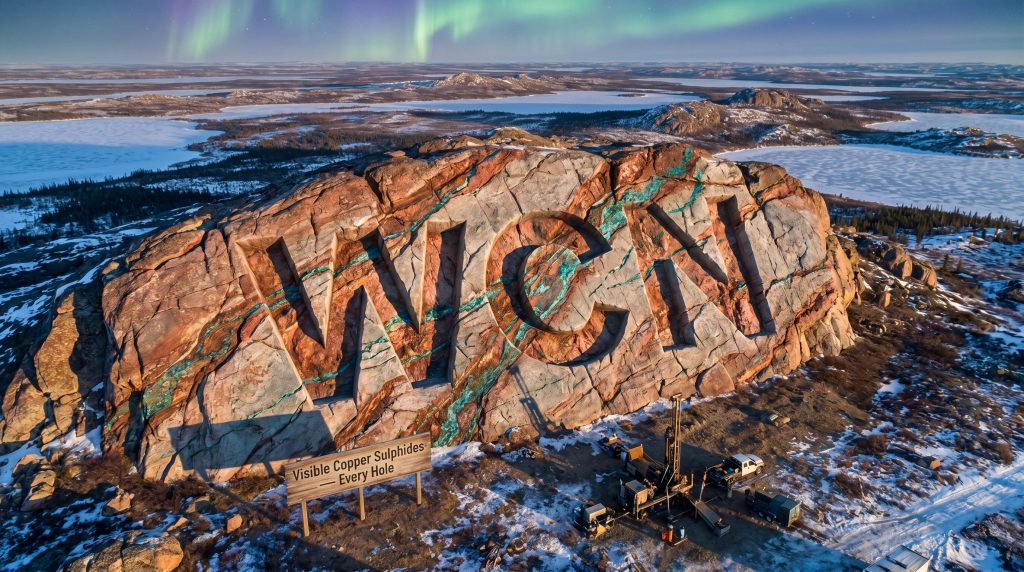
White Cliff Minerals Ltd (ASX: WCN; OTCQB: WCMLF) has reported that its 2026 diamond drilling program at the Hulk sediment-hosted copper target within the Rae Copper Project in Nunavut, Canada has intersected visible copper sulphides in all three drillholes completed to date. According to the ASX announcement, these observations extend copper sulphide mineralisation to 3.7 km east of 2025 hole STK25004 and support an interpreted mineralised footprint of approximately 6.3 km² along a key geological contact within the Rae Group basin.
The update positions Hulk as a large sediment-hosted copper target within White Cliff Minerals Ltd's broader 1,228 km² Rae Copper Project, which also includes the Danvers copper silver system and multiple regional targets.
"Hulk continues to deliver on exactly what we set out to test, a large, laterally extensive copper system developed along the key Rae Group-Husky Creek Formation contact. Our 2026 program has deliberately tested the system with widely spaced, regional step-out drilling, and we are now seeing copper sulphide mineralisation over at least 3.7 kilometres of strike. Importantly, every drillhole completed at Hulk this year has intersected visible chalcopyrite at this key contact, reinforcing the laterally extensive redox boundary as the primary control on mineralisation. These early observations continue to validate our geological model and targeting approach, and support our view that Hulk has the potential to develop into a major basin-scale copper system," said Troy Whittaker, Managing Director of White Cliff Minerals Ltd.
When big ASX news breaks, our subscribers know first
2026 Drilling: Every Hulk Hole Intersects Visible Copper Sulphides
According to the quarterly exploration update, the 2026 diamond drilling at Hulk was designed as regional-scale step-out drilling along the contact between the Rae Group sediments and the underlying Husky Creek Formation and Coppermine River Group basalts.
This contact acts as a redox boundary or unconformity and is interpreted by White Cliff Minerals Ltd as the primary control on copper sulphide mineralisation within the Hulk sedimentary target.
The company reports that:
- Visible chalcopyrite (a copper iron sulphide mineral that is a common copper ore) has been observed in all three 2026 Hulk drillholes.
- Copper sulphides are typically hosted within basal Rae Group conglomerates and veinlets, concentrated along or immediately above the unconformity with the Husky Creek Formation.
- The drilling confirms mineralisation across the interpreted Rae Group sub basin at Hulk and extends copper sulphides 3.7 km east of STK25004, supporting a mineralised footprint of approximately 6.3 km².
Drillhole Observations
The 2026 Hulk drillholes are reported as follows:
-
SED26001
- Targeted a NNW trending magnetic low at a similar northing to 2025 hole STK25004.
- Intersected 1.5 m of chalcopyrite mineralisation at and around the basal contact between the Rae Group sediments and the Coppermine River Group basalts (which include the Husky Creek Formation).
- Mineralisation is described as chalcopyrite cement and fracture-fill within the basal conglomerate.
-
SED26002
- Collared 2.6 km west of SED26001, closer to STK25004, to test a structural intersection that appears as a magnetic low.
- Intersected just over 5 m of chalcopyrite in Rae Group sediments above the target redox boundary.
- Mineralisation is logged as fine-grained, disseminated chalcopyrite within the basal conglomerate at the Rae Group contact.
-
SED26003
- Collared 7.3 km to the north to test deeper within the Rae Group sub basin, across the interpreted continuation of the Herb Dixon fault.
- Observed trace chalcopyrite as replacement of pyrite in calcite veinlets and along fractures around the basement contact.
Furthermore, White Cliff Minerals Hulk copper drilling results in Nunavut Canada highlight that these findings demonstrate continuity of copper sulphide mineralisation along the Rae Group Husky Creek Formation contact over multi-kilometre scale distances, with the contact interpreted as a laterally extensive, stratiform copper horizon.
Visual Copper Intervals: Summary Table of 2026 Hulk Observations
The ASX announcement provides a table summarising visual chalcopyrite estimates across the 2026 Hulk diamond holes. These are qualitative observations only.
Important qualification: The company cautions that visual estimates of sulphide abundance are not a proxy or substitute for laboratory assays. Reported intervals represent down hole lengths, and true widths are not yet known. Laboratory assay results are expected within approximately four weeks.
| Hole ID | From (m) | To (m) | Interval (m) | Style (logged) | Chalcopyrite % (visual) |
|---|---|---|---|---|---|
| SED26001 | 238.27 | 238.40 | 0.13 | Patchy | 5% |
| SED26001 | 238.40 | 238.52 | 0.12 | Patchy | 2% |
| SED26001 | 238.52 | 239.83 | 1.31 | Fracture | 1% |
| SED26002 | 204.70 | 207.10 | 2.40 | Fracture | 1% |
| SED26002 | 207.10 | 207.50 | 0.40 | Fracture | 3% |
| SED26002 | 207.50 | 208.50 | 1.00 | Fracture | 2% |
| SED26002 | 208.50 | 210.16 | 1.66 | Fracture | 1% |
| SED26003 | 260.90 | 261.10 | 0.20 | Replacement | 0.1% |
| SED26003 | 261.10 | 265.00 | 3.90 | Fracture | 0.1% |
The table reflects chalcopyrite observed in drill core as patchy (discrete patches), fracture-fill, or replacement textures. The low visual percentages in SED26003 are consistent with the hole's purpose as a basin test rather than a targeted high-grade intercept.
Educational Focus: What Is a Sediment-Hosted Copper System?
The Hulk target is described in the ASX announcement as a sediment-hosted copper deposit, more specifically the reduced facies subtype. Understanding this deposit class provides context for the scale and geometry that White Cliff Minerals Ltd is aiming to define.
Basic Definition
A sediment-hosted copper deposit forms where copper-bearing fluids move through layers of sedimentary rock and deposit copper minerals when they encounter a chemical boundary.
Key points:
- These deposits typically form in large sedimentary basins, which are long-lived, broad depressions filled with sediments such as sandstone, siltstone and shale.
- Copper-bearing fluids move through permeable layers and interact with reduced sediments (rocks that contain minerals like pyrite and organic material).
- At a redox boundary where oxidised and reduced conditions meet, chemical reactions cause copper sulphides such as chalcopyrite, chalcocite and bornite to precipitate.
- The mineralisation is usually stratiform (layered and parallel to sedimentary bedding), forming relatively thin but laterally extensive sheets that can continue for several kilometres.
Global Context
According to the announcement and referenced USGS grade tonnage models:
- Sediment-hosted copper deposits contribute roughly 20% of global copper production and are important sources of cobalt and silver.
- For the reduced facies subtype, the average copper grade is reported as around 1.4% Cu, based on data from more than 120 deposits.
- Examples quoted include White Pine at 1.14% Cu and Kupferschiefer at approximately 1.5–2% Cu.
- Economic mineralised thickness is typically 2–30 m in true vertical thickness, although higher-grade zones can be thinner.
These deposits include many operations in the Central African Copperbelt, a benchmark region for this style of copper mineralisation. White Cliff Minerals Ltd explicitly notes that previous work in the Rae area has recorded chalcocite bornite chalcopyrite zonation upwards from the unconformity, a pattern considered characteristic of major sediment-hosted copper systems.
Why Hulk's Setting Is Considered Favourable
Within the Rae Copper Project:
- The lower Rae Group contains reduced marine sediments.
- These lie directly above volcanic rocks and red bed sandstones of the Husky Creek Formation and other Coppermine River Group units.
- This arrangement creates an unconformity redox boundary that White Cliff Minerals Ltd interprets as an ideal chemical trap for copper-bearing fluids.
At Hulk, drilling in both 2025 and 2026 has intersected copper sulphides concentrated:
- Within basal Rae Group conglomerates.
- At or just above the Rae Group Husky Creek Formation contact.
This is the same contact that has now been tracked across a reported 3.7 km strike extent at Hulk, with visible chalcopyrite logged in every 2026 hole targeting this horizon.
Key Geological Terms Explained
To support non-specialist readers, several terms in the update are clarified below:
- Chalcopyrite: A common copper iron sulphide mineral and a primary source of copper. It often appears brassy yellow in drill core.
- Bornite: A copper-rich sulphide mineral with higher copper content than chalcopyrite. It is often associated with higher-grade copper zones.
- Redox boundary: A boundary in the rock sequence where conditions shift from oxidising (oxygen-rich) to reducing (oxygen-poor). This change can cause dissolved metals to come out of solution and form minerals.
- Unconformity: A surface that separates younger rocks from older rocks where there was a gap in deposition or erosion. It can act as a fluid pathway and mineral trap.
- Stratiform: Mineralisation that is layered and broadly parallel to sedimentary bedding, often forming sheet-like horizons.
Building on the 2025 Hulk Drilling Results
The 2026 program at Hulk was planned to extend and test the mineralised contact defined in 2025. According to White Cliff Minerals Ltd, earlier work at Hulk in 2025 identified sediment-hosted copper mineralisation along the same Rae Group Husky Creek Formation contact.
Those results, previously reported to the market, include:
| 2025 Hulk Drilling Highlight | Details (previously announced) |
|---|---|
| High-grade interval | 3.5 m @ 7.2% Cu in hole STK25001 (28 October 2025) |
| Broader mineralised interval | 25 m @ 0.6% Cu in hole STK25003 (26 November 2025) |
| Sulphide zonation | Chalcocite bornite chalcopyrite upward from the unconformity |
The company states that 2026 drilling at Hulk has been designed to:
- Test the lateral continuity of this contact over a broader area.
- Confirm whether the same style of mineralisation persists along strike and across the inferred Rae Group sub basin.
The observation of chalcopyrite at the target horizon in SED26001 and SED26002 along section from STK25004 over a 3.7 km strike length is cited as evidence that the contact is mineralised on a regional scale. SED26003, drilled 7.3 km to the north, provides additional information on basin architecture and supports the broader geological model.
Next Steps at Hulk and Across the Rae Copper Project
With visible copper sulphides now reported across a 6.3 km² footprint at Hulk, White Cliff Minerals Ltd is adjusting its near-term exploration focus within the Rae Copper Project.
Hulk: Vectoring Toward Higher Grade Core Zones
The company outlines several planned next steps:
-
Target the core of the Hulk system — Drilling is expected to focus on areas showing stronger alteration and textures that may indicate bornite-rich mineralisation. Bornite typically contains higher copper content than chalcopyrite, so these zones are considered high priority.
-
Test EM defined conductors — Electromagnetic (EM) surveys completed in earlier campaigns have outlined conductivity anomalies at depths comparable to the STK25001 discovery. These conductors may represent additional sulphide-rich zones and are described as high priority targets for follow-up drilling.
-
Receive and interpret assays — Laboratory assay results for the 2026 Hulk drillholes are expected within approximately four weeks. These data will provide copper grades and, potentially, silver and other elements, allowing a more quantitative assessment of the mineralised horizons.
-
Continue regional sediment-hosted copper targeting — The Rae project area includes further sedimentary targets in the Rae Group beyond Hulk Stark, supported by prior MobileMT airborne EM and HeliTEM surveys. The company indicates that follow-up drilling and geophysical work will continue to test for additional sediment-hosted copper positions.
Parallel Copper Silver System at Danvers
The Rae Project also contains the Danvers copper silver system along the Teshierpi Fault Zone. According to the ASX materials summarised in the corporate section of the announcement:
-
Danvers hosts a historic, non-JORC compliant resource estimate of 4.16 Mt @ 2.96% Cu, defined in the 1960s. White Cliff Minerals Ltd notes that this estimate is not reported under the JORC Code 2012, and a competent person has not completed sufficient work to classify it as a current resource.
-
Drilling at Danvers has previously reported high-grade copper silver intervals such as:
- 175 m @ 2.5% Cu & 8.66 g/t Ag
- 90 m @ 4% Cu & 7.5 g/t Ag
- 58 m @ 3.08% Cu & 13.3 g/t Ag
- 105 m @ 2.25% Cu
- 63 m @ 2.23% Cu
- 75 m @ 2% Cu
-
Regional step-outs include:
- Danvers 2, over 5 km down strike, returned 15 m @ 4.8% Cu.
- Danvers 3 drilling includes 20 m @ 6.64% Cu and 79.24 m @ 1.59% Cu.
These results suggest a separate style of epithermal copper silver breccia and flow top replacement mineralisation within the Coppermine River Group basalts. In addition, the company has reported metallurgical testwork (8 April 2026 announcement) on Danvers material, indicating up to 95.4% Cu recovery and 93.3% Ag recovery using conventional flotation, with no deleterious elements identified in the concentrates.
The next major ASX story will hit our subscribers first
Why Investors Are Watching Developments at Hulk
The 2026 drilling update positions Hulk as a growing sediment-hosted copper system where every 2026 drillhole targeting the Rae Group Husky Creek Formation contact has intersected visible chalcopyrite at or near the key horizon.
From an investor's perspective, the White Cliff Minerals Hulk copper drilling results in Nunavut Canada indicate:
- A 100% hit rate on visible copper sulphides at the target contact in the 2026 Hulk program.
- An interpreted 6.3 km² mineralised footprint and 3.7 km strike length of mineralisation along a single redox boundary.
- Consistency with global sediment-hosted copper models, including thickness ranges and sulphide zonation patterns.
- A clear plan to move from footprint definition to higher-grade targeting at Hulk, alongside continued drilling at the Danvers copper silver system.
Furthermore, the Rae Copper Project holds both a sediment-hosted copper system at Hulk and a high-grade epithermal copper silver system at Danvers within a single 1,228 km² landholding
Ready to Learn More About White Cliff Minerals' Rae Copper Project?
White Cliff Minerals (ASX: WCN) is advancing a compelling dual-system copper project in Nunavut, Canada, with visible copper sulphides now confirmed across a 6.3 km² footprint at Hulk and high-grade results continuing to emerge from the Danvers copper silver system. With assay results expected within weeks and higher-grade targeting next on the agenda, investors seeking exposure to a large-scale sediment-hosted copper discovery at an early stage may want to keep a close eye on WCN. Visit wcminerals.com.au to explore the full scope of the Rae Copper Project and stay up to date with the latest exploration developments.