White Cliff Minerals Ltd
- ASX Code: WCN
- Market Cap: $54,530,634
White Cliff Minerals Extends High-Grade Copper Discovery Across Nearly 10km of Strike at Rae Project
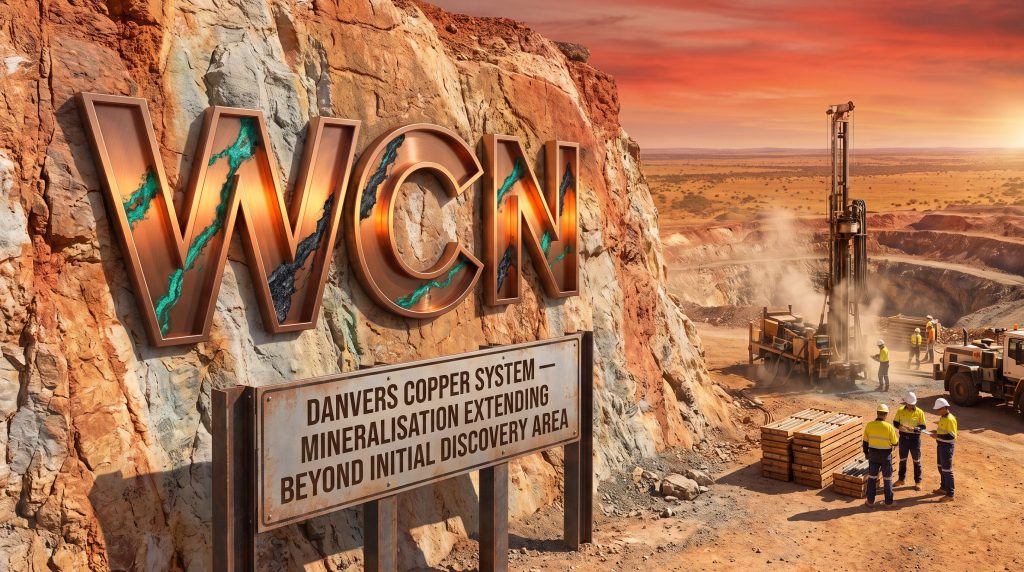
White Cliff Minerals (ASX: WCN; OTCQB: WCMLF) has reported new step-out drilling results from its Rae Copper Project in Nunavut, Canada, confirming that the White Cliff Minerals Rae Copper Project high-grade copper discovery extension in Nunavut Canada is expanding well beyond the footprint identified during initial drilling. The headline intersection of 42m at 1.43% copper (Cu) from 200m in hole DAN26025 was collared 250m northwest of the exceptional-grade discovery hole DAN26012, demonstrating lateral continuity of the mineralised breccia system across a substantially larger area than previously understood.
Across the broader Danvers trend, assayed copper mineralisation has now been confirmed over 6.6km of combined strike, with copper sulphides visually logged across 9.8km. Furthermore, with two diamond rigs active on site, more than 20 holes pending assay, and results arriving approximately every 10 to 14 days, the company describes the current period as a sustained phase of exploration news flow across multiple high-grade targets.
When big ASX news breaks, our subscribers know first
The Headline Result: Danvers 3 Grows in Every Direction
The Danvers 3 area has emerged as the focal point of the current drilling programme, and the latest results reinforce its scale. Hole DAN26025 was drilled 250m northwest of DAN26012, the discovery hole that previously returned 19.81m at 6.64% Cu, and delivered a broad, high-grade intersection indicating the mineralised breccia system extends well beyond the initial discovery footprint.
DAN26025 key assay results:
| Interval | From (m) | Grade (% Cu) |
|---|---|---|
| 42m (composite) | 200m | 1.43% Cu |
| 5.25m (internal) | 207.15m | 2.72% Cu |
| 4.00m (internal) | 226m | 2.42% Cu |
| 4.73m (internal) | 232.5m | 2.23% Cu |
These internal high-grade zones, sitting within the broader 42m envelope, are consistent with the chaotic and crackle breccia textures observed in the original discovery hole, suggesting the same mineralising system is active across a wider area.
Complementing DAN26025, hole DAN26028 was collared just 10m southwest of DAN26012 and drilled in the opposite direction, forming a structural fence with DAN26025. It returned 8m at 0.9% Cu from 309m, including 5m at 1.18% Cu from 312m, confirming copper mineralisation on the opposite fault boundary and helping define the three-dimensional geometry of the system.
Notably, hole DAN26036, collared more than 105m west of DAN26012 and drilled near-perpendicular to previous holes, intersected a combined 83.1m of visually logged copper sulphides, including chalcocite-rich chaotic and crackle breccias with up to an estimated 7% chalcocite. Assays for DAN26036 remain pending, though the visual observations indicate a strike expansion of the chalcocite-dominant Danvers 3 system of more than 280m to the southwest.
"DAN26025 is a strong step-out result that expands Danvers 3 collared 250m northwest of the exceptional-grade intersection in DAN26012, returning 42m at 1.43% Cu, with several higher-grade internal intervals, the result demonstrates that the mineralised breccia system extends well beyond the initial discovery area," said Troy Whittaker, Managing Director.
What Is a Chalcocite Breccia System and Why Does It Matter?
For investors less familiar with copper geology, understanding what makes the Danvers 3 system notable requires a brief look at two key terms: chalcocite and breccia mineralisation.
Chalcocite (Cu₂S) is one of the richest copper-bearing minerals, containing approximately 79.8% copper by weight, making it among the more economically favourable copper sulphide minerals a drilling programme can encounter. It typically forms through secondary enrichment processes, where copper-bearing fluids replace or overprint earlier minerals, concentrating copper into higher-grade zones.
Breccia-hosted mineralisation describes copper deposited within fractured or broken rock zones, often along fault systems, where mineralising fluids have moved through the rock, filling voids and cementing rock fragments with copper sulphides. At Danvers, the breccia system sits within the Teshierpi Fault Zone, a major structural corridor that appears to act as a conduit for copper enrichment across a substantial strike length.
Chalcocite-dominant systems are generally understood to respond well to conventional flotation processing. White Cliff's metallurgical test work, completed in early 2026, returned up to 95.4% Cu recovery and 93.3% silver (Ag) recovery through conventional flotation, producing concentrates of approximately 40% Cu — results that support the processing potential of this style of mineralisation.
Key Geological Terms Explained
- Chalcocite (Cc): A copper sulphide mineral (Cu₂S) with approximately 79.8% copper content.
- Chalcopyrite (Cp): A common copper iron sulphide mineral (CuFeS₂) with approximately 34.5% copper content.
- Breccia: Rock consisting of angular fragments cemented by a finer matrix, which at Danvers is often copper sulphide.
- Strike: The horizontal direction of a geological structure or mineralised zone.
- Downhole length: The measured length of an intersection along the drill path, which may differ from true width.
- Oriented core: Diamond drill core marked during drilling to preserve directional information, allowing geologists to measure the orientation of structures within the rock.
Regional Drilling Confirms Copper Across Nearly 10km of Strike
Beyond Danvers 3, the Phase 1 regional programme has tested more than 7,000m of strike along the Teshierpi Fault Zone and an additional 2,700m along the Danvers 1 structure. Assayed mineralisation is confirmed across 6.6km of strike, with visual copper sulphide observations extending to 9.8km.
Summary of regional drill highlights:
| Hole | Location | Key Observation |
|---|---|---|
| DAN26031 | 628m NE of DAN26029 | 4m visually logged chalcocite veining; first test of >1km greenfield strike NE of Danvers 1 |
| DAN26033 | 670m NE step-out from DAN26031 | 105.3m combined visually logged chalcopyrite-dominant copper sulphides across 3 intervals |
| DAN26034 | Beneath RC hole DAN26016 | 19.35m combined visually logged chalcocite-dominant copper sulphides across 3 intervals |
| DAN26035 | 310m NE step-out from DAN26033 | 39m combined visually logged chalcopyrite-dominant copper sulphides across 3 intervals |
| DAN26032 | 317m NE of DAN26015 | Structural information hole; 2 x 0.1m chalcopyrite intervals at SW margin of main fault zone |
DAN26031 is described as the first hole to test more than 1km of previously undrilled greenfield strike northeast of Danvers 1. The intersection of chalcocite veining at this location extends the observed copper sulphide footprint and opens a new area of the system for follow-up work.
"These observations, together with the 42m at 1.43% Cu result in DAN26025, demonstrate that the breccia system extends well beyond DAN26012 and provide clear structural vectors towards the thicker and higher-grade parts of the system. The next phase of drilling will directly test these extensions along strike and at depth," said Eric Sondergaard, Executive Technical Director.
Oriented Core Is Sharpening the Drill Targeting
A key operational feature of this programme is the use of oriented diamond core — drill core that is marked during extraction to preserve directional information about structures within the rock. This allows the geological team to directly measure the orientation of copper sulphide textures, breccia fabrics, and fault planes in three dimensions.
At Danvers 3, this structural dataset is being used to identify the thicker and higher-grade portions of the system, representing areas where mineralising fluid appears to have been most concentrated. Hole DAN26036, drilled near-perpendicular to the main mineralised trend, has added a further perspective by confirming the breccia system carries substantial width in multiple orientations.
This approach — using structural data from oriented core to progressively refine drill targeting — reflects a maturing exploration programme moving from discovery toward more systematic delineation of the mineralised system.
What Comes Next: A Busy Pipeline of Results and Drilling
The upcoming activity schedule remains dense, with results expected to continue at a steady pace across the White Cliff Minerals Rae Copper Project high-grade copper discovery extension in Nunavut Canada.
Immediate Catalysts
- Assay results from more than 20 holes currently pending laboratory analysis, with results being received approximately every 10 to 14 days.
- DAN26036 assay results, covering 83.1m of visually logged copper sulphides including up to an estimated 7% chalcocite — a result that could further expand the known system once assays are received.
Next Phase Drilling Priorities
- Step-outs from high-grade copper zones at Danvers 3, building on the 280m-plus expansion already indicated.
- Testing strike and depth extensions at Danvers 1, including follow-up from the greenfield northeast extension identified by DAN26031.
- Testing extensions to Danvers 2 and Danvers 4, where previous drilling has returned high-grade copper.
- Infill drilling between widely-spaced Phase 1 regional holes, progressively tightening the understanding of mineralisation continuity.
Exploration timeline summary:
| Activity | Status |
|---|---|
| Phase 1 regional drilling (12km corridor) | Complete |
| Assays confirmed over 6.6km strike | Confirmed |
| Copper sulphides visually logged over 9.8km | Confirmed |
| DAN26036 assays (83.1m visual copper sulphides) | Pending |
| 20+ holes awaiting assay results | Pending (results ~every 10 to 14 days) |
| Danvers 3 step-out and depth extension drilling | Underway |
| Danvers 1, 2 and 4 extension drilling | Underway |
The Investment Case: Scale, Grade and a System Still Growing
White Cliff Minerals' investment case rests on three factors that appear to be compounding: expanding scale, high-grade copper intersections, and a pipeline of near-term catalysts.
Scale: The Danvers system has demonstrated copper mineralisation across 6.6km of confirmed strike, a footprint that has continued to grow with each successive drilling programme. The Teshierpi Fault Zone, which hosts the mineralisation, has been drilled across more than 7,000m of strike in Phase 1 alone, with regional targets remaining untested.
Grade: The grades reported at Danvers are materially above typical thresholds referenced for copper project economics. Intersections including 42m at 1.43% Cu, 19.81m at 6.64% Cu (DAN26012), 175m at 2.5% Cu, and 90m at 4% Cu from the maiden drilling campaign are consistent with a high-grade system. The dominance of chalcocite, rather than lower-copper-content minerals, further supports the quality of the mineralisation observed to date.
Metallurgical confirmation: Test work completed in 2026 on Danvers material produced up to 95.4% Cu recovery and 93.3% Ag recovery through conventional flotation, with concentrates grading approximately 40% Cu and 150g/t Ag. No deleterious elements were identified in the concentrates — an important de-risking milestone for the project's processing potential.
Jurisdiction: The White Cliff Minerals Rae Copper Project high-grade copper discovery extension in Nunavut Canada is located in a jurisdiction with a long history of mineral exploration. The project covers 1,228km² across 93 mineral claims and a mineral lease, providing White Cliff with a large land package in the region.
Hulk sediment-hosted copper: Beyond Danvers, the company's Hulk prospect is developing as a separate, large-footprint sediment-hosted copper target. In addition, 2026 diamond drilling has extended mineralisation 3.7km east of a 2025 discovery hole, expanding the interpreted footprint to approximately 6.3km².
The next major ASX story will hit our subscribers first
Why Investors Should Keep a Close Eye on White Cliff Minerals
The combination of high-grade copper assays, an expanding mineralised footprint, a substantial pipeline of pending results, and two rigs actively drilling makes the coming weeks and months a period of considerable interest for White Cliff Minerals.
The structural work being conducted through oriented core adds a layer of geological detail intended to improve the targeting quality of future drilling, potentially increasing the likelihood that step-out and depth-extension holes intersect thicker and higher-grade portions of the system.
With assay results expected on a near-fortnightly basis from more than 20 pending holes, investors will have regular opportunities to assess how the Danvers system develops over time.
Key Points for Investors Monitoring White Cliff Minerals (ASX: WCN)
- Copper sulphides now confirmed or visually observed across 9.8km of strike — a system that continues to expand.
- Headline assay of 42m at 1.43% Cu with multiple high-grade internal zones indicates the breccia system extends at least 250m beyond the initial discovery hole.
- DAN26036's 83.1m of visually logged copper sulphides (assays pending) has the potential to further expand Danvers 3 once results are received.
- Metallurgical test work reporting greater than 95% Cu recovery via conventional flotation supports processing potential, subject to further evaluation.
- A historic (non-JORC) resource estimate at Danvers of 4.16 million tonnes at 2.96% Cu provides contextual reference for the scale of the known system, though the company notes this predates JORC standards and requires modern validation.
- Two rigs active, more than 20 holes pending assay, and results flowing every 10 to 14 days point to a sustained news flow period.
Key Takeaway: The White Cliff Minerals Rae Copper Project high-grade copper discovery extension in Nunavut Canada is progressively expanding what current drilling suggests may be a large-scale, high-grade copper system. With mineralisation confirmed across 6.6km of strike, an active dual-rig drilling programme, and more than 20 holes pending assay, the company is entering a period of exploration catalysts that investors focused on copper exploration may wish to monitor closely.
Want to Learn More About White Cliff Minerals' Expanding Copper Discovery?
With high-grade copper intersections confirmed across nearly 10km of strike at the Rae Copper Project, two diamond rigs turning, and more than 20 holes pending assay, White Cliff Minerals (ASX: WCN) is entering one of its most active exploration periods to date. Investors looking to dig deeper into the Danvers system, the company's broader project portfolio, and the latest news flow can find full details at the White Cliff Minerals website.