August 10, 2026
The Periodic Table Didn't Lie: Understanding Why Gold Is Valuable at the Molecular and Monetary Level
Monetary systems do not fail dramatically. They erode. Across recorded history, every society that delegated the storage of purchasing power to a material or instrument subject to political manipulation eventually confronted the same outcome: the unit of account shrank while the asset denominated in it appeared to rise. The question of why gold is valuable cannot be answered by looking at a price chart. It can only be answered by understanding what gold is, what everything else is not, and what happens to money when it is untethered from physical constraint.
When big ASX news breaks, our subscribers know first
What a Genuine Store of Value Actually Requires
Most assets satisfy one or two of the criteria required of a true monetary anchor. Very few satisfy all three simultaneously, and the failure to recognise this distinction explains why so many alternative monetary experiments throughout history have collapsed.
The three non-negotiable properties are:
- Scarcity: Supply must be constrained by something beyond human decision-making. Political scarcity is not scarcity; it is a promise.
- Durability: The asset must resist physical, chemical, and institutional degradation across time horizons that exceed any single political or economic cycle.
- Cross-cultural recognition: Monetary utility cannot depend on a single jurisdiction's legal framework. It must function across borders, regimes, and centuries without reissuance.
Real estate satisfies location-specific scarcity but fails on portability, liquidity, and jurisdictional independence. Equities represent productive ownership but are priced in the very currency units they are meant to outpace. Commodities like oil and wheat are consumed on use, eliminating the stock accumulation that monetary assets require. Gold is the only physical asset that satisfies all three criteria in full, and the chemistry of the periodic table explains precisely why. As Investopedia notes, gold's unique combination of properties has made it the most enduring store of value in human history.
What the Periodic Table Reveals About Monetary Candidates
Running the Systematic Elimination
Columbia University chemist Sanat Kumar, in an analysis referenced on NPR, approached the question of monetary fitness by working through all 118 elements methodically rather than by assumption. The result was a systematic elimination that most monetary historians skip entirely.
| Elimination Category | Examples | Disqualifying Property |
|---|---|---|
| Gases and liquids | Mercury, bromine, noble gases | Cannot be physically handled as money |
| Radioactive elements | Uranium, plutonium, radium | Hazardous; decay destroys stored value |
| Violently reactive metals | Sodium, lithium, potassium | Corrode or combust on contact with air or water |
| Rare earth and platinum group (excess rarity) | Osmium, iridium, ruthenium | Impossible to smelt pre-industrially; too rare to circulate |
| Base and corrosion-prone metals | Iron, copper, lead, tin | Too abundant; corrode under ambient conditions |
After this filtration, four candidates survive: gold, silver, platinum, and palladium. Of these, platinum and palladium were too scarce throughout most of human history to function as circulating money at scale. Silver remained competitive for millennia but diverged from gold due to one critical structural difference: silver is consumed industrially at a rate that prevents long-run above-ground stock accumulation.
Why Gold's Chemical Inertness Is a Monetary Property, Not a Scientific Footnote
Gold resists virtually every acid and oxidising agent encountered under normal conditions. The only known substance that dissolves it is aqua regia, a mixture of hydrochloric and nitric acid first identified by medieval alchemists, and producing it requires deliberate laboratory conditions. Under every naturally occurring environment, gold simply persists.
The archaeological record confirms this at scale. Egyptian gold artefacts recovered from tombs more than 4,500 years old remain structurally intact today. Historian Peter Bernstein, in The Power of Gold (ISBN: 978-0471252108), documented that gold buried in the earth today would be recoverable and essentially unchanged 50,000 years from now. No paper instrument, digital record, base metal, or constructed asset comes close to that claim.
The monetary implication is direct: an asset that cannot degrade physically cannot be inflated through deterioration. Every other monetary instrument humans have employed, from clay tablets to electronic ledgers, relies on institutional continuity for its preservation. Gold does not.
The Scarcity Mathematics Behind Gold's Value
Total Above-Ground Stock and Annual Supply Growth
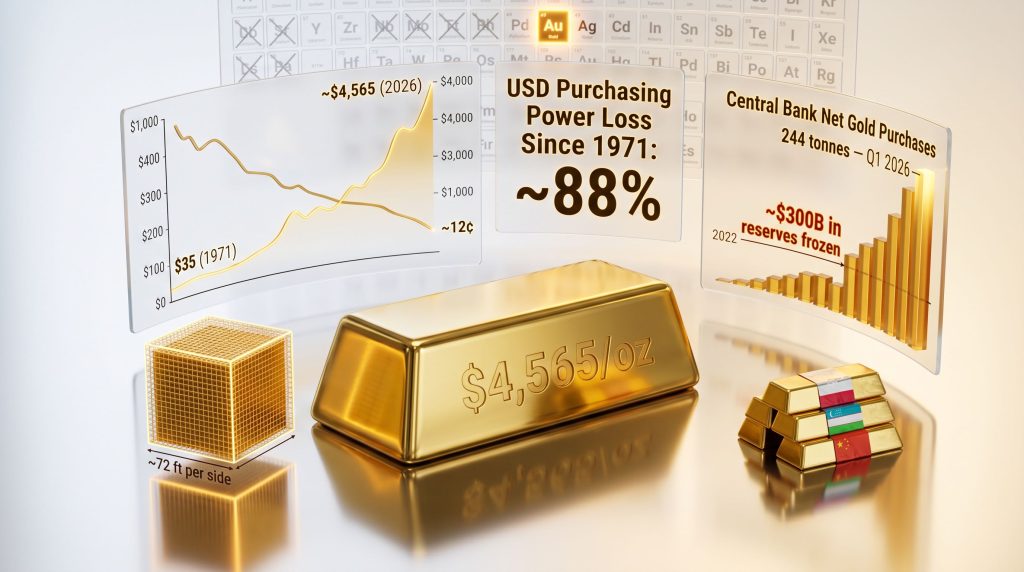
Approximately 218,000 metric tonnes of gold have been extracted across all of human history as of 2026, according to the World Gold Council. To contextualise that figure, the entire above-ground stock would fit inside a cube approximately 72 feet per side, an area small enough to occupy a single tennis court. Annual mine production adds roughly 3,600 tonnes, representing approximately 1.7% of existing supply per year [World Gold Council, Full Year 2024].
The Stock-to-Flow Ratio: The Core Scarcity Metric Most Investors Ignore
The stock-to-flow ratio measures how long it would take current annual production to double the existing supply. It is the most precise single metric for evaluating a monetary asset's supply-side scarcity.
| Asset | Annual Supply Growth | Stock-to-Flow Ratio |
|---|---|---|
| Gold | ~1.7% | ~60 |
| Silver | Higher (industrially consumed) | ~20 |
| Oil | Consumed on use | N/A |
| Wheat | Consumed annually | N/A |
| Fiat currency | Unlimited by policy decision | N/A |
Gold's stock-to-flow ratio of approximately 60 means that at current mining rates, it would take six decades to double the existing supply. No policy can accelerate this. Geological availability and mining economics are the constraints, not committee votes or printing press capacity.
A less commonly understood aspect of this dynamic is that gold's consumption profile is structurally unlike every other commodity. Nearly every ounce ever mined still exists in some form, whether as jewellery, central bank gold reserves, or investment holdings. This near-zero destruction rate is not a market characteristic; it is a consequence of gold's chemical inertness. The same property that preserves Egyptian artefacts also prevents industrial attrition from eroding the monetary stock.
The Dollar's 55-Year Decline and What Gold Reflects About It
The 1971 Inflection Point
The 1971 gold standard end occurred on August 15th, when President Nixon suspended the US dollar's convertibility to gold, formally ending the Bretton Woods system under which every dollar in circulation was theoretically redeemable for a fixed quantity of the metal. From that date forward, the dollar became a purely fiat instrument, its supply constrained only by institutional policy rather than physical reality.
The consequences of that transition have been cumulative and unambiguous.
Purchasing Power: The 55-Year Ledger
According to Bureau of Labor Statistics CPI data, the US dollar has lost approximately 88% of its purchasing power between 1971 and 2026. An item priced at $100 in 1971 costs more than $820 today [BLS CPI Inflation Calculator]. A 1971 dollar now purchases the equivalent of approximately 12 cents in real goods.
Over the same period, gold moved from $35 per ounce to approximately $4,565 per ounce as of May 2026, a nominal increase of roughly 130-fold [World Gold Council historical price data; live spot price].
| Year | Gold Price (USD/oz) | Dollar Purchasing Power (1971 = 100) |
|---|---|---|
| 1971 | $35 | 100 |
| 1980 | ~$594 | ~45 |
| 2000 | ~$279 | ~28 |
| 2011 | ~$1,895 | ~18 |
| 2020 | ~$1,770 | ~15 |
| 2026 | ~$4,565 | ~12 |
Sources: World Gold Council historical price data; Bureau of Labor Statistics CPI
The most analytically precise interpretation of gold's rising nominal price is not that gold has become more valuable. It is that the unit used to measure it has contracted. When the measuring stick shrinks, every quantity denominated in it appears larger. Gold's purchasing power, measured in real goods, has remained broadly stable across this period. The dollar's has not.
Why Central Banks Are Accumulating Gold at a Pace Not Seen in Decades
The Structural Shift in Reserve Management
Central bank gold demand has exceeded 1,000 tonnes annually in net purchases in 2022, 2023, and 2024, more than double the average acquisition rate of the preceding decade [World Gold Council]. In Q1 2026 alone, net purchases totalled 244 tonnes, with Poland, Uzbekistan, and China among the leading buyers [World Gold Council Gold Demand Trends Q1 2026]. China's People's Bank of China had added to its official gold reserves for 18 consecutive months as of April 2026 [World Gold Council, May 2026].
These are not speculative positions. Institutions managing national balance sheets on decade-long planning horizons do not make 1,000-tonne annual allocations as a tactical trade.
The 2022 Catalyst: Counterparty Risk Made Visible
In February 2022, approximately $300 billion in Russian central bank foreign exchange reserves held within Western financial institutions were frozen following the invasion of Ukraine [G7 REPO Task Force joint statement]. This single event fundamentally repriced how sovereign reserve managers globally assess political counterparty risk embedded in foreign-held dollar assets.
The logic that followed was not theoretical. It was observed in real time:
- Dollar-denominated reserves held abroad are subject to unilateral freezing by the country controlling the clearing infrastructure.
- Gold held in a domestic sovereign vault carries zero counterparty risk by definition.
- No foreign government, institution, or legal system can sanction, freeze, or devalue physically held gold.
Reserve managers did not need to theorise this advantage after 2022. They watched it being exercised against a major sovereign holder, and they adjusted their reserve composition accordingly.
The next major ASX story will hit our subscribers first
The Fiscal Architecture That Reinforces Gold's Role Going Forward
Structural Deficits and the Purchasing Power Dilution Mechanism
The United States currently services more than $39 trillion in national debt, with annual interest expenditure exceeding $1 trillion per year [Congressional Budget Office Budget Outlook 2026-2036]. US M2 money supply stands above $21 trillion. When persistent structural deficits are financed through monetary expansion rather than genuine productivity surpluses, the purchasing power of each outstanding currency unit erodes continuously, not catastrophically, but arithmetically and without interruption.
Real Interest Rates and the Opportunity Cost Equation
Gold's primary competition as a store of value is a positive real interest rate environment, where cash and sovereign bonds yield returns meaningfully above the true rate of inflation. When real rates are negative or artificially suppressed by fiscal necessity, the opportunity cost of holding gold as a gold safe haven compresses toward zero.
The fiscal mathematics of major sovereign borrowers makes sustained positive real rates structurally difficult to maintain. Raising rates to genuinely positive real levels on $39 trillion in debt would compound the annual interest burden to economically destabilising levels. The implication is that the conditions most favourable to gold's relative attractiveness are not an exceptional scenario but a structural feature of the current fiscal trajectory.
Comparing Gold Against Other Stores of Value
| Property | Gold | Fiat Currency | Real Estate | Silver |
|---|---|---|---|---|
| Supply constraint | Geological (fixed by physics) | Policy (unlimited) | Location-specific | Geological + industrial consumption |
| Durability | Indefinite | Degrades and requires reissuance | Depreciates physically | High, but consumed industrially |
| Counterparty risk | None (physical) | Sovereign and institutional | Jurisdictional and legal | None (physical) |
| Liquidity | Global, continuous | High domestically | Low | Global, continuous |
| Purchasing power (55yr) | +130x nominal | -88% real | Varies by market and jurisdiction | Variable |
Silver deserves specific attention. Its stock-to-flow ratio of approximately 20 is roughly three times lower than gold's 60, primarily because silver is consumed at industrial scale in solar panels, electronics, and medical devices [World Gold Council supply data]. This industrial absorption prevents silver from accumulating the persistent above-ground stock that gives gold its unique monetary durability.
Silver functions simultaneously as a monetary and industrial commodity. Gold functions almost exclusively as a monetary and reserve asset, and that distinction has compounding consequences over long time horizons. Furthermore, for investors weighing their options, the choice between physical gold vs ETFs introduces additional considerations around counterparty risk and accessibility that are worth examining separately.
Key Metrics at a Glance
| Metric | Figure | Source |
|---|---|---|
| Total above-ground gold stock | ~218,000 metric tonnes | World Gold Council, 2026 |
| Annual mine production | ~3,600 tonnes | World Gold Council, FY2024 |
| Annual supply growth rate | ~1.7% | World Gold Council |
| Gold stock-to-flow ratio | ~60 | Derived from WGC data |
| Gold price, 1971 | $35/oz | Historical market data |
| Gold price, May 2026 | ~$4,565/oz | Live spot price |
| Nominal price increase since 1971 | ~130x | Calculated |
| USD purchasing power loss since 1971 | ~88% | Bureau of Labor Statistics |
| Central bank net purchases, Q1 2026 | 244 tonnes | World Gold Council, Q1 2026 |
| Official central bank gold reserves globally | ~36,000 tonnes | World Gold Council |
Frequently Asked Questions: Why Is Gold Valuable?
Is gold's value based purely on collective belief?
Gold's monetary role is anchored in verifiable physical and chemical properties, not in convention alone. The fact that every major civilisation independently selected gold as a monetary standard, without coordination across continents or centuries, reflects functional selection rather than arbitrary cultural preference.
The periodic table filtration described by Columbia University chemist Sanat Kumar [NPR] confirms that gold's selection was not accidental. It was the only element remaining after all others were eliminated on objective grounds. As this analysis from JM Bullion further illustrates, gold's value proposition has remained consistent across vastly different civilisations and economic systems.
Why does gold's price rise when the US dollar weakens?
Gold is globally priced in US dollars. When the dollar's purchasing power contracts, more dollar units are required to purchase the same physical quantity of gold. The nominal price rising in dollar terms is therefore most accurately interpreted as the measuring unit shrinking rather than the underlying asset appreciating. This inverse relationship has been empirically consistent across the entire 55-year post-Bretton Woods period [BLS CPI data; World Gold Council].
Can governments produce more gold to address demand?
Gold is a chemical element. It cannot be synthesised at economically meaningful scale through any known process. New supply is constrained entirely by geological availability and mining economics, adding approximately 1.7% to existing stock annually [World Gold Council, 2024]. This is the foundational asymmetry between gold and fiat currency: one is supply-constrained by physics, the other by political will alone.
Is gold still relevant within a digital financial system?
Digital financial infrastructure, including central bank digital currencies, tokenised assets, and electronic payment networks, addresses transactional efficiency but does not resolve the store-of-value problem. Digital instruments depend on functioning technological infrastructure, institutional continuity, and jurisdictional legal frameworks. Gold requires none of these.
The world's most sophisticated institutional actors, central banks collectively holding over 36,000 tonnes in official reserves [World Gold Council], continue to treat gold as a relevant component of reserve architecture within a fully digitalised financial environment. That behaviour is more informative than any theoretical argument to the contrary.
What portfolio allocation to gold is appropriate?
No universal figure applies across all investors, and this does not constitute financial advice. The practically relevant consideration is the proportion of long-term savings currently denominated in currency units that have lost 88% of their purchasing power since 1971 [BLS CPI], and whether that concentration is an intentional decision or an unconsidered default.
Financial advisers commonly reference allocations of 5–15% as a purchasing power hedge, though individual circumstances vary substantially. Gold is not a growth asset in the conventional sense. Its function is preservation across time, not capital appreciation.
Disclaimer: This article is for informational and educational purposes only and does not constitute financial or investment advice. All investments involve risk, including precious metals. Past performance is not indicative of future results. Please consult a qualified financial adviser before making any investment decisions.
Want to Discover the Next Major ASX Gold Find Before the Market Does?
While gold's chemical inertness and stock-to-flow ratio make it the ultimate store of value, the real opportunity for investors lies in identifying significant new discoveries the moment they are announced — exactly what Discovery Alert's proprietary Discovery IQ model is built to do, delivering real-time ASX mineral discovery alerts and turning complex geological data into actionable insights. Explore how historic discoveries have generated substantial returns on Discovery Alert's dedicated discoveries page, then begin your 14-day free trial to position yourself ahead of the broader market.