June 4, 2026
The Fiscal Architecture of Sovereign Steel: Why Australia Is Spending Billions to Save Whyalla
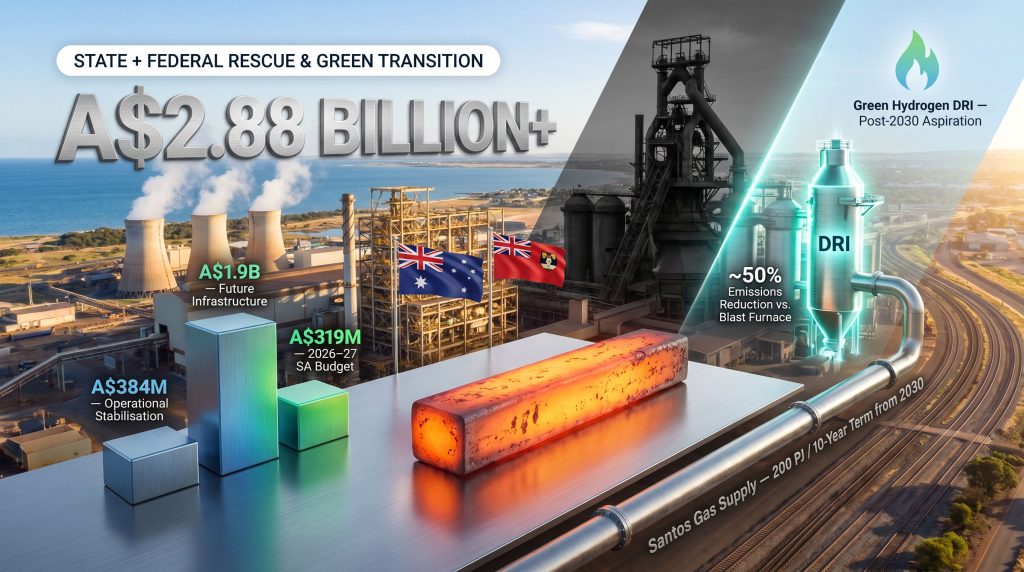
Few industrial policy decisions reveal a government's true economic priorities more clearly than the choice to rescue a struggling steelworks. When policymakers weigh the cost of inaction against the expense of intervention, they are making an implicit statement about what kinds of productive capacity a nation considers non-negotiable. Australia's ongoing commitment to Whyalla steelworks funding, now exceeding A$2.88 billion in combined state and federal support, represents exactly that kind of defining choice.
Understanding why that number exists, how it is structured, and what it is designed to achieve requires looking beyond the headlines and into the mechanics of sovereign industrial policy, green manufacturing transitions, and the geopolitics of steel ownership.
When big ASX news breaks, our subscribers know first
Why Domestic Steelmaking Capacity Is Treated as a Strategic Asset
Steel is not merely a commodity. For governments managing defence supply chains, infrastructure programmes, and long-term industrial employment, the ability to produce steel domestically functions as a form of economic sovereignty. When a country loses its steelmaking capability, it does not simply lose an industry. It loses leverage over input costs for construction, rail, and defence manufacturing, and it becomes permanently dependent on offshore producers whose priorities and pricing are entirely outside national control.
The Whyalla steelworks, operating at a nameplate capacity of 1.2 million tonnes per year, produces structural steel, rail, rod, and bar products that feed directly into Australia's construction and infrastructure sectors. For the city of Whyalla itself, the facility is not one employer among many. It is the economic foundation upon which the entire regional community depends, with multiplier effects extending to local businesses, services, and the broader housing market.
When the steelworks entered voluntary administration in February 2025, following a sustained period of financial pressure from high operating costs, challenging global steel and iron ore market conditions, and the significant capital requirements of necessary infrastructure upgrades, the risk of permanent closure became real. The downstream consequences, ranging from immediate workforce displacement to long-term erosion of regional economic viability, created the conditions for emergency fiscal intervention at a scale rarely seen in Australia's post-industrial policy history.
How Much Funding Has the Whyalla Steelworks Received? A Full Breakdown
The cumulative public funding committed to the Whyalla steelworks represents one of the most substantial state-federal co-investment packages in Australian industrial history. The table below consolidates the key funding streams:
| Funding Stream | Amount | Source | Purpose |
|---|---|---|---|
| Immediate operational support (co-invested) | A$384 million | State + Federal | Stabilise steelworks during administration |
| Future infrastructure and upgrades | A$1.9 billion | State + Federal | Capital investment with incoming owner |
| South Australian state total contribution | A$650 million | SA Government | Stabilisation, modernisation, emergency response |
| Broader joint support package | A$2.4 billion | State + Federal | Full rescue and transition programme |
| Additional SA budget allocation (2026-27) | A$319 million | SA Government | Two-year operational and sale support |
| Low-carbon transition allocation | A$6.5 million | SA Government | Green steelmaking transition support |
| Total cumulative public funding reported | A$2.88 billion+ | State + Federal combined | All purposes |
The 2026-27 South Australian Budget Commitment
The South Australian government's 2026-27 budget formalised a further A$319 million over two years to sustain ongoing operations and support the active sale process. An additional A$6.5 million was allocated specifically toward activities that advance Whyalla's transition to low-carbon steelmaking methods.
These allocations signal that the SA government views the Whyalla steelworks funding not as a one-time emergency measure but as a multi-year programme with a clearly defined industrial transformation objective embedded within it.
How the Funds Are Being Deployed
The funding package operates across several parallel workstreams:
- Ensuring continuity of wages and entitlements for the steelworks workforce and contractor base throughout the administration period
- Providing creditor assistance to protect local businesses caught in the financial distress
- Covering operational and infrastructure maintenance costs to prevent physical deterioration of the facility
- Funding transition planning activities for the shift toward lower-emissions steelmaking technology
- Supporting the competitive sale process to attract a financially capable and strategically aligned new owner
The Sale Process: Two Bidders, Two Very Different Strategic Profiles
On 27 May 2026, the South Australian government announced that two parties had been shortlisted to purchase the steelworks. The contrast between the two candidates is analytically significant.
| Bidder | Origin | Strategic Rationale | Key Considerations |
|---|---|---|---|
| M Resources | Australia (independent) | Domestic ownership continuity; sovereign alignment | Financing capacity; operational track record |
| Jindal Steel | India | Global steelmaking scale; DRI technology experience | Foreign ownership review (FIRB); decarbonisation alignment |
What the Shortlist Reveals About Global Steel Capital
The inclusion of India's Jindal Steel as a shortlisted bidder carries implications that extend well beyond the Whyalla transaction itself. Jindal operates one of the most technically advanced DRI facilities in the world: its nearly 2 million tonne per year Angul plant in India, commissioned in 2014, was the first commercial-scale facility globally to produce direct reduced iron using coal gasification-derived syngas. This operational experience with DRI technology is directly relevant to Whyalla's planned transformation pathway.
However, Jindal's participation also introduces foreign ownership considerations under Australia's Foreign Investment Review Board (FIRB) framework. Any acquisition of a strategically significant industrial asset by a foreign-domiciled entity will require regulatory clearance, and the sensitivity of sovereign steelmaking to national security assessments means the FIRB dimension is not a trivial procedural step.
The shortlisting of an Indian industrial conglomerate also reflects a broader global pattern: South and Southeast Asian capital is increasingly acquiring legacy Western industrial assets as traditional owners struggle with the capital intensity of decarbonisation transitions. This dynamic carries geopolitical and supply chain implications that policymakers in Canberra and Adelaide will be weighing carefully.
Criteria Likely to Determine the Preferred Buyer
- Demonstrated commitment to the low-emissions steelmaking roadmap, including DRI technology deployment
- Financial capacity to deploy the A$1.9 billion forward investment tranche tied to the sale
- Credible plans to retain the workforce and sustain the regional economic contribution of the facility
- Ability to satisfy FIRB requirements if the buyer is a foreign entity
- Track record in operating comparable steelmaking facilities at commercial scale
The Santos Gas Deal and the DRI Technology Pathway
Perhaps the most technically consequential element of the Whyalla steelworks funding package is the 200 petajoule natural gas supply agreement secured by the South Australian government with Santos. Under a binding 10-year term sheet commencing in 2030, Santos will supply approximately 20 PJ per year (equivalent to around 534 million cubic metres per year) of natural gas to the steelworks.
This gas supply is not incidental. It is the physical input that makes the planned technology transformation possible.
Understanding Direct Reduced Iron Technology
Direct Reduced Iron (DRI): A steelmaking process that uses natural gas or hydrogen as a reducing agent to chemically strip oxygen from iron ore, producing metallic iron without the use of a coal-fired blast furnace. Because it eliminates the coking coal step entirely, DRI technology produces substantially lower carbon emissions and is widely regarded as one of the most credible near-term pathways toward industrial-scale green iron production.
At Whyalla, the Santos gas supply will enable the processing of magnetite iron ore through DRI technology. Magnetite is a distinct iron ore variety compared to the hematite that dominates Australian iron ore exports. It has a lower iron content at the mining stage but can be upgraded through concentration into a high-grade pellet feed that is particularly well-suited to DRI processing. This ore chemistry compatibility is an underappreciated technical advantage in Whyalla's green steel transition case.
Santos CEO Kevin Gallagher confirmed in February 2026 that the natural gas DRI pathway is projected to cut the steelworks' carbon emissions by approximately 50 percent compared to the former coal-fired blast furnace operations. This is a substantive reduction, though it represents an intermediate step rather than a final destination.
The Emissions Trajectory: A Three-Stage Framework
| Technology Stage | Carbon Intensity | Fuel Source | Timeline |
|---|---|---|---|
| Legacy blast furnace (former operations) | Baseline (high) | Metallurgical coal | Pre-administration |
| Natural gas DRI (planned) | ~50% reduction vs. baseline | Santos natural gas | From 2030 |
| Green hydrogen DRI (aspirational) | Near-zero | Renewable hydrogen | Post-2030 (subject to scale-up) |
The natural gas bridge is deliberate. Green hydrogen-based DRI remains the longer-term ambition, but the commercial maturity and cost competitiveness of green hydrogen supply at industrial scale in South Australia is not yet sufficient to anchor a 2030 deployment plan. Natural gas DRI provides a credible, fundable, near-term decarbonisation step while the hydrogen economy matures around it. Furthermore, advances in hydrogen iron ore reduction technology will likely play a key role in the post-2030 phase.
This sequencing mirrors the approach being considered in other resource-rich economies. In India, for example, coal gasification-derived syngas is being explored as an analogous bridging strategy, using domestic coal reserves to reduce dependence on imported natural gas while longer-term clean technologies develop. Jindal Steel's Angul facility is again instructive here: its experience operating syngas-based DRI at commercial scale for over a decade provides empirical evidence that non-conventional gas feedstocks can sustain DRI operations, though the emissions profile of coal-derived syngas without carbon capture is considerably less favourable than natural gas DRI.
The Broader Policy Implications: Is Whyalla a Template?
State-Federal Co-Investment as an Industrial Policy Instrument
The funding architecture deployed at Whyalla, combining emergency operational support with a long-dated forward investment commitment contingent on a successful sale, is structurally distinct from simpler forms of industrial subsidy. It is designed to accomplish two things simultaneously: prevent the immediate collapse of a critical asset and attract private capital by reducing the financial risk profile for an incoming owner.
This dual-purpose design draws some comparison to how the United Kingdom structured its interventions in British Steel's Scunthorpe operations, and to the conditional financing mechanisms used under the European Just Transition Fund for coal-region industrial restructuring. In the United States, Section 232 steel protections operate through a different mechanism (tariffs rather than direct fiscal support), but the underlying logic of treating domestic steel as strategically non-fungible is common across all three jurisdictions.
The Whyalla intervention is notable because it couples a sovereign industrial rescue with an explicit low-emissions transformation mandate, which is relatively novel in the Australian policy context and potentially instructive for how future industrial restructuring events in manufacturing-dependent regional communities might be approached.
Downstream Demand: Who Buys Green Steel?
The viability of Whyalla's green steel ambitions is not purely a supply-side question. Demand signals from key end-use sectors matter enormously, and consequently, green steel pricing dynamics will be critical to the long-term business case:
- Construction and infrastructure: Australia's pipeline of major infrastructure projects, including road, rail, and renewable energy installations, creates a structural domestic demand base for locally produced structural steel and rail products.
- Defence procurement: As Australia expands its defence industrial base, the case for sovereign steel supply in shipbuilding and military infrastructure construction strengthens.
- Renewable energy infrastructure: Wind tower fabrication, transmission infrastructure, and grid-scale energy storage facilities all require substantial steel inputs, and low-carbon steel credentials are increasingly valued by project developers managing Scope 3 emissions obligations.
The next major ASX story will hit our subscribers first
Fiscal Risk and Accountability: The Taxpayer Dimension
A funding commitment exceeding A$2.88 billion in public money demands serious scrutiny of the contingent liability profile it creates. Several risk scenarios warrant consideration:
- Sale process failure: If neither shortlisted bidder can satisfy the financial, regulatory, and strategic criteria required, the administration could extend indefinitely, consuming operational funding without a clear resolution pathway.
- New owner underperformance: Even with a successful sale, the A$1.9 billion forward investment tranche is only valuable if the incoming owner has both the financial capacity and operational capability to deploy it effectively toward the DRI transformation.
- Technology and market risk: Natural gas prices, green hydrogen cost trajectories, and global steel market conditions between now and 2030 will all influence whether the planned DRI transition is commercially executable at the scale required.
- Regional dependency risk: Whyalla's single-industry structure means that any partial failure in the rescue programme carries outsized social consequences for the community, creating political pressure that may complicate commercially rational decision-making.
Risk Callout: Public funding packages of this magnitude require robust contractual protections, milestone-based disbursement structures, and genuinely independent oversight mechanisms to protect taxpayer interests. The longer the asset remains in administration, the more critical these governance frameworks become.
Frequently Asked Questions: Whyalla Steelworks Funding
How much has the Australian government committed to the Whyalla steelworks?
Combined state and federal funding commitments have exceeded A$2.88 billion, covering operational support during administration, creditor assistance, and a forward-looking A$1.9 billion investment tranche linked to the sale of the facility to a new owner.
Why did the Whyalla steelworks go into administration?
The steelworks entered voluntary administration in February 2025 following a sustained period of financial pressure, including high operating costs, difficult global steel market conditions, and the significant capital requirements of necessary infrastructure upgrades.
Who is buying the Whyalla steelworks?
As of late May 2026, two parties have been shortlisted: Australian independent steelmaker M Resources and India's Jindal Steel. A preferred bidder had not yet been publicly announced.
What is the Santos gas deal and how does it support Whyalla?
The South Australian government secured a binding 10-year term sheet with Santos to supply approximately 20 PJ of natural gas per year to the Whyalla steelworks from 2030, totalling around 200 PJ over the agreement period. This supply underpins the planned transition to DRI steelmaking, projected to reduce emissions by around 50 percent compared to former coal-fired blast furnace operations.
What is direct reduced iron steelmaking?
DRI is a process that uses natural gas or hydrogen to chemically reduce iron ore into metallic iron without a traditional blast furnace. It produces significantly lower carbon emissions than conventional steelmaking and is widely regarded as a central technology in the global transition to green steel manufacturing.
Will Whyalla eventually use green hydrogen instead of natural gas?
Natural gas DRI is the planned intermediate step from 2030. Green hydrogen-based DRI remains the longer-term aspiration, subject to the commercial maturity and cost competitiveness of green hydrogen supply in South Australia. The sequencing is deliberate and reflects current technology and infrastructure realities.
Key Takeaways: What the Whyalla Package Signals for Australian Industry
- The scale of intervention, surpassing A$2.88 billion, reflects the elevated strategic weight that Australian governments now assign to domestic steelmaking within critical supply chains
- The dual-purpose design of the funding, combining immediate operational rescue with a forward-looking green transition mandate, represents a more sophisticated form of industrial policy than simple subsidy
- The Santos gas deal provides a technically credible near-term decarbonisation pathway, while longer-term green hydrogen infrastructure continues to develop
- The competitive sale process, involving both a domestic independent and a major Indian industrial group, will test Australia's willingness to accept foreign ownership of sovereign industrial assets
- The magnetite ore chemistry at Whyalla is an underappreciated technical advantage for DRI processing, making the facility's green steel transition case more credible than it might appear from surface-level analysis
- The outcome at Whyalla is likely to establish precedents for how state and federal governments structure future interventions in manufacturing-dependent regional communities across Australia
This article contains forward-looking assessments regarding technology transitions, investment timelines, and policy outcomes. These involve inherent uncertainty and should not be construed as financial or investment advice. Readers should conduct independent research before making any decisions based on the information presented here.
Want to Track the Next Major ASX Mineral Discovery Before the Market Does?
While Australia's industrial policy shifts reshape the commodities landscape, Discovery Alert's proprietary Discovery IQ model instantly alerts subscribers to significant ASX mineral discoveries — turning complex data across 30+ commodities into clear, actionable opportunities. Explore historic discoveries and their returns, then begin your 14-day free trial to position yourself ahead of the broader market.