June 4, 2026
When Geopolitical Risk Becomes a Balance Sheet Problem
The global scramble to secure battery metals has exposed a structural vulnerability that corporate governance frameworks were never designed to handle: the point at which foreign policy decisions in Washington can unravel the financial reporting infrastructure of a Canadian mining company operating thousands of kilometres away. This is not a theoretical risk. It is precisely the scenario now unfolding for one of North America's most strategically positioned critical minerals processors, and it raises fundamental questions about how resource companies should think about geopolitical exposure as a first-order governance concern rather than a footnote in an annual report's risk disclosures.
Understanding what has happened to Sherritt International Corporation (TSX: S) over recent weeks requires thinking about interconnected systems rather than isolated events. The crisis did not begin with a leadership departure or a regulatory filing deadline. It began with a foreign policy decision that cascaded through an integrated operational model, exposing structural dependencies that, under normal conditions, remained invisible to investors and regulators alike.
When big ASX news breaks, our subscribers know first
Why Sherritt International Is Facing a Corporate Governance Crisis in 2026
The Convergence of Sanctions, Leadership Departures, and Regulatory Pressure
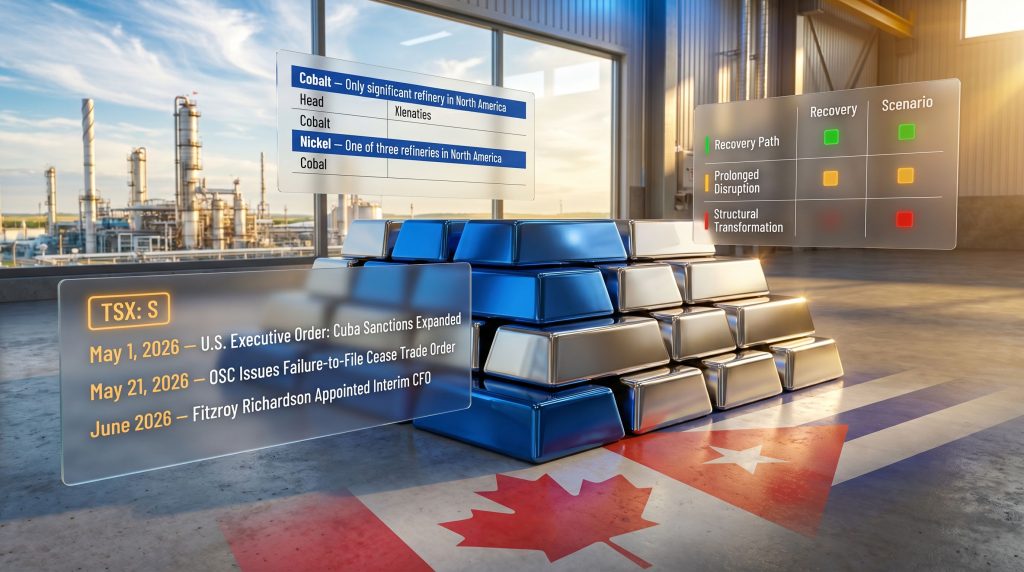
Few corporate crises arrive as a single event. What typically occurs is a sequence of individually manageable disruptions that, when they arrive simultaneously, overwhelm an organisation's capacity to respond. Sherritt's current situation fits this pattern precisely, with three distinct pressure points converging in rapid succession following the U.S. administration's announcement of an executive order expanding Cuba sanctions on May 1, 2026.
The sequence of events that followed illustrates how a single regulatory action in one jurisdiction can cascade through an integrated business model and destabilise governance structures in an entirely different country:
- The May 1, 2026 executive order expanded U.S. sanctions targeting Cuba, creating immediate compliance complications for Sherritt's Cuban joint venture participation
- Within the same month, CFO Yasmin Gabriel resigned from her position, removing senior financial leadership at a moment of acute complexity
- Also in May 2026, the company's external auditor departed, eliminating the verification mechanism required to complete financial statements
- On May 21, 2026, the Ontario Securities Commission responded to the resulting filing failures by issuing a failure-to-file cease trade order (FFCTO), halting trading of Sherritt securities in Canadian markets
- In June 2026, Fitzroy Richardson was appointed as interim CFO to restore financial reporting capacity and navigate the path toward FFCTO revocation
The company's warning to shareholders about acute financial, legal, and operational challenges ahead of these developments represented an unusual degree of candour about the severity of the situation, signalling that management recognised the scale of the disruption even as it was unfolding.
Why This Matters Beyond a Single Company
Sherritt's predicament carries implications that extend well beyond its own shareholder register. The company operates what is recognised as the only significant cobalt refinery in North America, along with one of just three nickel refineries on the continent, located in Fort Saskatchewan, Alberta. Furthermore, any sustained disruption to this facility's operational continuity creates downstream supply chain consequences for North American battery and specialty materials manufacturers who depend on domestically processed cobalt and nickel.
At a moment when continental supply chain resilience for critical minerals demand has become a policy priority across multiple jurisdictions, the operational vulnerability of this particular refinery represents a systemic concern rather than an isolated corporate governance story.
What Does the Appointment of an Interim CFO Signal for Sherritt's Financial Stability?
The CFO Transition and What Internal Succession Reveals
When companies face acute regulatory and operational crises, the nature of leadership appointments tells a great deal about the board's strategic priorities. Sherritt's decision to appoint Fitzroy Richardson as Sherritt interim CFO Cuba sanctions responder with immediate effect in June 2026 reflects a deliberate choice to prioritise institutional continuity over the kind of external credentialing signal that a high-profile outside hire would provide.
Richardson brings close to three decades of accumulated institutional knowledge within Sherritt's financial and treasury operations. His most recent role was as president of New Providence Metals Marketing, a Sherritt subsidiary, meaning his understanding of the company's commercial relationships and financial architecture is current and operational rather than historical. The fact that he has held a range of senior finance and treasury roles across his nearly 30-year tenure gives him familiarity with the cross-border complexity that defines Sherritt's integrated business model.
Interim President and CEO Peter Hancock described the appointment as providing "continuity and support at an important time", noting Richardson's deep knowledge of Sherritt's business and his experience spanning treasury and international operations. The emphasis on continuity is significant: in a regulatory crisis context, the ability to rapidly reconstruct the financial picture of a complex, internationally integrated business is more valuable than the external credibility signal of a new appointment, at least in the immediate term.
What "Interim CFO" Means in a Regulatory Crisis Context
The distinction between a permanent CFO appointment and an interim appointment during an active cease trade order is more than semantic. In this context, Richardson's immediate mandate is specifically defined: complete the outstanding quarterly financial filings that are necessary preconditions for seeking revocation of the OSC's FFCTO. This is a compliance-first appointment, not a strategic transformation mandate.
The complexity of that task should not be underestimated. Sherritt must produce compliant financial statements covering a period during which:
- Its Cuban joint venture operations were suspended mid-quarter following the May 1 executive order
- The CFO who oversaw the period in question had resigned
- The external auditor responsible for verifying those statements had also departed
- The precise accounting treatment for suspended international joint venture operations under U.S. sanctions remained legally unclear
Richardson's treasury background is particularly relevant to the third and fourth challenges. Navigating the accounting implications of suspended cross-border operations under sanctions requires deep familiarity with the company's historical treatment of Cuban joint venture revenues, intercompany transactions, and asset valuations — precisely the kind of institutional knowledge that nearly three decades at Sherritt would provide.
How Does the Ontario Securities Commission Cease Trade Order Work and What Are the Stakes?
Understanding the FFCTO Mechanism
A failure-to-file cease trade order is one of the most significant enforcement tools available to Canadian provincial securities regulators, and it is important to understand both its mechanics and its limits. An FFCTO is issued when a reporting issuer fails to file required financial disclosure documents within the timeframes mandated under Canadian securities legislation. The practical effect is immediate: once issued, the order prohibits trading of the company's securities in Canadian markets until the outstanding filings are completed and the regulator lifts the restriction.
Critically, an FFCTO is reversible. Unlike a cease trade order issued for substantive securities law violations, a failure-to-file order does not imply fraud or misconduct. It is a procedural enforcement mechanism designed to ensure investors have access to current financial information before making trading decisions. Once the outstanding filings are submitted and accepted as complete, the regulator can revoke the order, restoring normal trading activity.
However, the stakes escalate significantly the longer the order remains in place. Extended FFCTO periods can:
- Erode institutional investor confidence as position-holding becomes untenable under fund mandates that require regular financial statement availability
- Trigger covenant review clauses in credit facilities that reference continued listing or financial disclosure requirements
- Create reputational damage with suppliers, joint venture partners, and offtake customers who use financial statement information to assess counterparty risk
- Complicate the auditor replacement process, as incoming audit firms require access to prior financial records and often conduct their own due diligence before accepting a mandate from a company under regulatory action
Timeline of Key Events
| Date | Event |
|---|---|
| May 1, 2026 | U.S. executive order expanding Cuba sanctions effective |
| May 2026 | CFO Yasmin Gabriel resigns; external auditor also departs |
| May 21, 2026 | OSC issues Failure-to-File Cease Trade Order (FFCTO) |
| May 2026 | Sherritt warns shareholders of acute financial, legal, and operational challenges |
| June 2026 | Fitzroy Richardson appointed Interim CFO, effective immediately |
| Pending | Q1 2026 financial statements outstanding; FFCTO revocation sought upon filing completion |
What Is Sherritt's Strategic Position in North America's Critical Minerals Landscape?
The Alberta Refinery: A Continental Asset With No Domestic Equivalent
To understand why the Sherritt interim CFO Cuba sanctions crisis carries weight beyond its immediate corporate context, it is necessary to appreciate the singular position the Fort Saskatchewan, Alberta refinery occupies within North American industrial infrastructure. Sherritt is recognised as a world leader in using hydrometallurgical processes to mine and refine nickel and cobalt. The Alberta facility is the only significant cobalt refinery in North America, and one of only three nickel refineries currently operating on the continent.
This is not a ranking based on scale alone. It reflects a near-absence of comparable domestic processing capacity for two metals that are considered essential inputs in lithium-ion battery cathode chemistry, particularly for electric vehicle and grid-scale energy storage applications. Indeed, the global cobalt supply chain has few comparable facilities anywhere in the Western world.
| Metal | Sherritt's North American Position | Primary Industrial Application |
|---|---|---|
| Cobalt | Only significant refinery in North America | EV battery cathode production (NMC, NCA chemistries) |
| Nickel | One of three operating refineries in North America | Battery-grade nickel sulphate for energy storage |
| Hydrometallurgical Processing | World-leading proprietary technology | Cleaner, lower-temperature refining vs. pyrometallurgical alternatives |
Why Hydrometallurgy Matters as a Competitive Differentiator
Sherritt's use of hydrometallurgical processing is worth examining as a distinct technical advantage rather than merely a descriptor. Hydrometallurgy involves using aqueous chemical solutions to extract, purify, and recover metals from ores and concentrates, operating at significantly lower temperatures than conventional smelting or pyrometallurgical approaches. This has several important implications:
- Purity levels: Hydrometallurgical refining can achieve very high product purities suited to battery-grade specifications, which require minimal levels of contaminants that can degrade electrochemical performance
- Environmental footprint: Lower processing temperatures and the absence of sulphur dioxide emissions associated with smelting make hydrometallurgical operations generally more environmentally acceptable under modern regulatory frameworks
- Feedstock flexibility: Hydrometallurgical circuits can in principle be adapted to process a range of sulphide and mixed sulphide-oxide feed materials, which has implications for any future consideration of alternative feedstock sources
- Capital intensity: Purpose-built hydrometallurgical plants represent significant fixed capital investments that cannot be easily replicated or replaced, reinforcing the strategic value of Sherritt's existing Alberta infrastructure
This technical architecture makes the Fort Saskatchewan refinery difficult to substitute in the near term, consequently reinforcing the case that its operational continuity is a matter of continental supply chain concern.
Cuba as an Upstream Source: The Geopolitical Feedstock Risk
Sherritt's operational model is vertically integrated, with Cuban mining and processing activities serving as the upstream feedstock source for the Alberta refinery's downstream refining operations. The May 1, 2026 executive order, by forcing a suspension of Sherritt's direct participation in Cuban joint venture activities, created what can be described as a geopolitical feedstock risk: the vulnerability of a strategically important processing facility to supply disruption caused not by geological, technical, or commercial factors, but by foreign policy decisions in a third country.
This form of risk is structurally distinct from the commodity price risk, reserve depletion risk, or operational execution risk that conventional mining investment frameworks typically model. For context, broader geopolitical mining risks have been escalating across multiple jurisdictions simultaneously, making Sherritt's experience part of a wider pattern rather than an isolated outlier.
How Do U.S. Cuba Sanctions Affect Canadian Mining Companies Operating Internationally?
The Extraterritorial Reach of U.S. Sanctions Policy
A common misconception among investors in TSX-listed mining companies is that U.S. regulatory policy applies only to U.S.-domiciled businesses. The reality is considerably more complex. U.S. sanctions administered through the Office of Foreign Assets Control (OFAC) can affect non-U.S. companies through several mechanisms:
- U.S. dollar clearing: Virtually all commodity transactions settle in U.S. dollars, meaning they pass through U.S. correspondent banking infrastructure and fall within OFAC's jurisdictional reach
- U.S. investor exposure: Companies with U.S. institutional shareholders or U.S.-registered debt instruments face pressure to comply with U.S. sanctions requirements to maintain access to U.S. capital markets
- Secondary sanctions risk: Certain U.S. sanctions programmes impose penalties on non-U.S. entities that engage in transactions with sanctioned parties, even where no U.S. persons or infrastructure are directly involved
- Reputational compliance standards: Major international banks and financial institutions typically apply U.S. sanctions standards globally to avoid compliance risk, effectively extending the geographic reach of U.S. policy
The Helms-Burton Act framework, which governs many aspects of U.S. Cuba policy, includes provisions that have created legal exposure for non-U.S. companies trafficking in properties confiscated from U.S. nationals following the Cuban revolution. This adds an additional layer of U.S. legal risk for companies with Cuban operations regardless of their own nationality.
Canadian companies operating in Cuba face a unique dual-compliance challenge. While Canadian law does not prohibit Cuban operations, U.S. secondary sanctions and dollar-clearing dependencies can expose companies to significant financial and reputational risk, particularly where U.S. capital markets access or U.S. institutional shareholders are involved.
What Suspending Direct Participation in Cuban JVs Actually Means
Sherritt has described its response to the executive order as suspending direct participation in joint venture activities in Cuba while working with stakeholders and advisers to implement appropriate steps. This formulation is legally and operationally precise in ways that matter for investors attempting to assess the depth of the operational disruption. Sherritt's move to dissolve its Cuba ventures entirely represents one possible endpoint of this restructuring process.
Possible restructuring pathways that companies in comparable situations have explored include:
- Transitioning to a passive royalty or offtake arrangement rather than active joint venture participation
- Transferring operational management to a joint venture partner while retaining an economic interest structured to minimise direct engagement with sanctioned entities
- Negotiating an orderly divestiture of the Cuban assets to parties not subject to the same sanctions constraints
- Applying for specific licences from OFAC to continue limited forms of engagement within defined parameters
The involvement of legal advisers in assessing these options suggests the situation is being treated with appropriate complexity, though the timeline for resolution remains uncertain.
The next major ASX story will hit our subscribers first
What Are the Broader Investor Implications of Sherritt's Current Situation?
Risk Factors Requiring Active Monitoring
Investors holding or evaluating Sherritt positions should monitor a layered set of risk factors across multiple dimensions simultaneously:
- Regulatory risk: The FFCTO revocation timeline is entirely dependent on the speed at which Richardson and a replacement auditor can complete Q1 2026 financial statements in a form acceptable to the OSC
- Operational risk: Suspended Cuban feedstock supply creates throughput uncertainty for the Alberta refinery, potentially affecting production volumes and unit economics
- Leadership risk: The company currently operates under dual interim executive leadership, with both the CEO and CFO positions held by interim appointees, creating strategic continuity uncertainty
- Geopolitical risk: The trajectory of U.S. Cuba policy under the current administration will determine whether the sanctions expansion represents a temporary compliance disruption or a permanent structural change to Sherritt's operational model
- Liquidity risk: Outstanding financial statements may trigger covenant review clauses in existing credit facilities, and the inability to access capital markets while the FFCTO is in place limits financial flexibility
Scenario Analysis: Three Possible Outcomes
The following scenarios are speculative projections based on available information and should not be interpreted as financial advice or predictions.
| Scenario | Description | Key Dependency |
|---|---|---|
| Recovery Path | FFCTO lifted after Q1 filings completed; Cuban operations restructured under a sanctions-compliant framework that preserves feedstock supply | Speed of auditor replacement and legal restructuring of Cuban JV arrangements |
| Prolonged Disruption | Extended filing delays deepen regulatory scrutiny; Cuban feedstock gap widens as restructuring options prove legally complex | Complexity of accounting for suspended Cuban operations and timeline for auditor appointment |
| Structural Transformation | Sherritt divests Cuban assets and pivots to an Alberta-only refining model sourcing alternative feedstock | Permanence of U.S. sanctions trajectory and investor pressure on board to resolve uncertainty |
The outcome will likely depend on factors that are currently unknowable, including the pace of internal financial statement preparation, the willingness of potential replacement auditors to accept the engagement, and whether U.S. sanctions policy evolves in ways that create compliance pathways for Canadian companies with Cuban operations.
Frequently Asked Questions: Sherritt, Cuba Sanctions, and the Interim CFO Appointment
What Is the Sherritt Interim CFO Cuba Sanctions Situation in Plain Terms?
The U.S. administration's May 1, 2026 executive order expanding Cuba sanctions forced Sherritt to suspend its direct participation in Cuban joint venture activities. This triggered the resignation of CFO Yasmin Gabriel and the departure of the company's external auditor, creating a financial reporting gap. The inability to complete quarterly financial filings prompted the Ontario Securities Commission to issue a failure-to-file cease trade order on May 21, 2026, halting trading of Sherritt securities. In June 2026, Fitzroy Richardson was appointed as the Sherritt interim CFO Cuba sanctions point-person with the specific mandate of completing outstanding filings to seek FFCTO revocation.
Who Is Fitzroy Richardson and Why Was He Selected as Interim CFO?
Richardson brings approximately three decades of continuous experience within Sherritt's finance and treasury functions, spanning a range of senior roles before his most recent position as president of New Providence Metals Marketing, a Sherritt subsidiary. His selection reflects a continuity-first strategy: his institutional knowledge of Sherritt's complex, cross-border financial architecture is considered more immediately valuable in a compliance-critical period than the external credentialing signal of an outside appointment.
What Is a Failure-to-File Cease Trade Order and How Serious Is It?
An FFCTO is a regulatory enforcement instrument issued by a Canadian provincial securities regulator that halts trading of a company's securities when required financial disclosures are not filed on time. It is a serious regulatory event with significant market and operational implications, but it is procedural rather than punitive in nature. It does not imply fraud or misconduct, and it is revocable once outstanding filings are completed and accepted by the regulator.
What Does Sherritt's Alberta Refinery Produce and Why Does It Matter?
The Fort Saskatchewan, Alberta facility uses hydrometallurgical processing to refine cobalt and nickel. It is the only significant cobalt refinery in North America and one of only three nickel refineries operating on the continent. Both metals are critical inputs in lithium-ion battery cathode chemistry, making the facility a strategically important node in the North American battery and electric vehicle supply chain. Furthermore, the broader battery metals investment landscape makes the facility's continuity a concern that extends well beyond Sherritt's shareholders alone.
Can Sherritt Survive Without Its Cuban Operations?
This question remains open and depends significantly on whether the Alberta refinery can source alternative feedstock at comparable cost and quality. Hydrometallurgical circuits can in principle process a range of sulphide feed materials, which theoretically creates feedstock optionality. However, securing alternative supply at scale, at comparable economics, and in a timeframe that prevents extended refinery underutilisation would represent a significant operational and commercial challenge. Sherritt has navigated Cuba-related pressures before, though not at this combined level of governance, operational, and regulatory disruption occurring simultaneously.
What Comes Next: The Road to Regulatory Compliance and Operational Stabilisation
Immediate Priorities Under Richardson's Interim Leadership
The near-term compliance pathway for Sherritt is relatively clearly defined, even if the timeline for completing it remains uncertain. Richardson's immediate priorities can be understood as a sequential dependency chain rather than parallel workstreams:
- Securing a replacement external auditor willing to accept the engagement given the regulatory context and the complexity of accounting for suspended Cuban operations
- Working with the incoming auditor to reconstruct and verify the Q1 2026 financial statements in a form that accurately reflects the operational changes resulting from the sanctions announcement
- Submitting completed filings to the OSC and formally applying for FFCTO revocation
- Re-establishing investor and creditor communication cadence to manage confidence during the period of ongoing trading restriction
Each step carries uncertainty. Auditor replacement for a company under an active FFCTO requires the incoming firm to conduct enhanced due diligence, which adds time. The accounting treatment for suspended international joint venture operations under active sanctions is technically complex and may require specialist opinions before the auditor can sign off.
Medium-Term Strategic Questions the Board Must Answer
Beyond the immediate compliance horizon, Sherritt faces a set of strategic questions with longer-term implications for the company's business model and competitive positioning:
- Whether the Cuban joint venture can be restructured into a legal form that allows some form of economic participation while satisfying U.S. sanctions compliance requirements
- Whether viable alternative feedstock sources exist for the Alberta refinery at economics that preserve the facility's competitiveness without Cuban supply
- What governance reforms are necessary to prevent a recurrence of the compounding failure pattern, particularly regarding contingency planning for geopolitical disruption to upstream operations
- When and how the dual-interim leadership structure will transition to permanent appointments, and what type of executive profile the board will seek given the changed strategic environment
The Broader Signal for Mining Companies in Politically Exposed Jurisdictions
Sherritt's situation will likely serve as a case study in how boards and management teams at internationally operating mining companies should approach geopolitical risk as a governance issue rather than a background assumption. The rapid escalation from foreign policy announcement to trading halt over a period of weeks demonstrates that geopolitical feedstock risk can materialise at a speed that outpaces conventional governance response mechanisms.
The increasing willingness of major economies to use sanctions and trade policy as instruments of foreign policy creates a structural challenge for resource companies operating in jurisdictions that may become targets of such measures. This is particularly relevant for the broader critical minerals trade environment, where supply chain security has become a geopolitical priority across multiple Western economies. For mining companies considering investment in politically exposed jurisdictions, the Sherritt experience points to several governance design principles worth internalising:
- Maintaining financial reporting infrastructure that does not depend entirely on personnel with direct exposure to sanctioned operations
- Building feedstock diversification optionality into refining facility design rather than treating single-source upstream supply as a permanent baseline
- Establishing legal contingency frameworks in advance that can be activated rapidly if sanctions or regulatory changes require operational restructuring
- Ensuring boards have direct access to sanctions compliance expertise as part of their governance advisory structure, not just at the management level
The path forward for Sherritt will require navigating all of these dimensions simultaneously, under the added pressure of a trading restriction that limits the company's ability to access equity capital markets while the resolution process unfolds.
Investors and analysts seeking additional context on U.S. Cuba sanctions policy can consult publicly available regulatory guidance from the U.S. Office of Foreign Assets Control at ofac.treasury.gov. Ontario Securities Commission enforcement actions and FFCTO precedents are publicly searchable at osc.ca.
Want to Stay Ahead of the Next Major ASX Mineral Discovery?
Discovery Alert's proprietary Discovery IQ model delivers real-time alerts on significant ASX mineral discoveries, transforming complex geological and commodity data into actionable investment insights for both short-term traders and long-term investors — explore historic discovery returns to understand the scale of opportunity, then begin your 14-day free trial at Discovery Alert to position yourself ahead of the broader market.