August 6, 2026
Silver's Moment: Why the Sunshine Silver NYSE IPO Signals a Structural Shift in Precious Metals Capital Markets
The history of precious metals capital markets is punctuated by distinct windows when institutional confidence, commodity fundamentals, and investor psychology converge to create conditions that reward decisive action. These windows are rarely announced in advance; they are recognised in retrospect through the volume and quality of transactions they produce. The arrival of at least eighteen mining companies pursuing U.S. listings in 2026, compared to just three in 2025, is precisely the kind of data point that marks one of these moments. At its centre sits the Sunshine Silver NYSE IPO, a $270 million transaction that encapsulates both the opportunity and the complexity facing silver investors navigating the current market landscape.
When big ASX news breaks, our subscribers know first
What the Sunshine Silver NYSE IPO Actually Represents
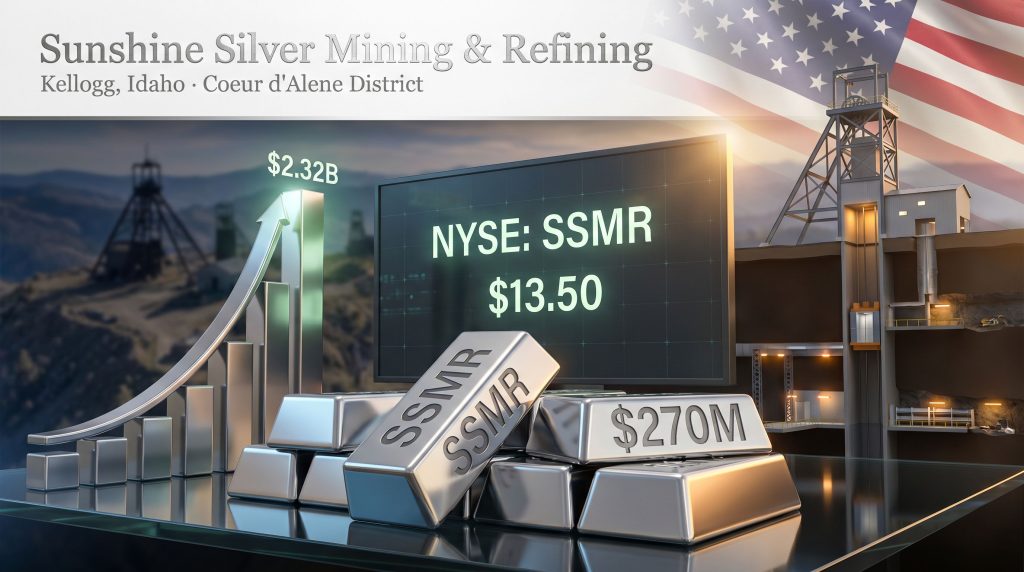
Sunshine Silver Mining & Refining Company completed its initial public offering on the New York Stock Exchange on June 4, 2026, raising $270 million through the sale of 20 million shares priced at $13.50 per share. The company trades under the ticker symbol SSMR. With a 30-day overallotment option covering an additional 3 million shares, total proceeds could reach up to $330 million if fully exercised, implying a maximum valuation ceiling of approximately $2.32 billion for this pre-production silver asset.
Reuters reported that the following table summarises the key mechanics of the offering:
| Parameter | Detail |
|---|---|
| Shares Offered | 20 million |
| IPO Price | $13.50 per share |
| Indicated Price Range | $13.50 – $16.50 per share |
| Gross Proceeds | $270 million |
| Maximum Proceeds (incl. overallotment) | $330 million |
| Overallotment Option | 3 million shares (30-day window) |
| Implied Maximum Valuation | ~$2.32 billion |
| Exchange / Ticker | NYSE: SSMR |
Founded in 2010 and headquartered in Kellogg, Idaho, Sunshine Silver focuses on the acquisition, redevelopment, and operation of precious metal assets across North America. The company's core mandate centres on restarting and expanding a previously shuttered mining operation in Idaho's Silver Valley, a corridor historically recognised as one of the most prolific silver-producing regions in the United States.
Pricing at the Floor: What $13.50 Per Share Signals to the Market
The fact that the offering priced at $13.50, the absolute lower boundary of the indicated $13.50 to $16.50 range, carries meaningful interpretive weight. In IPO market mechanics, pricing below the midpoint of an indicated range typically reflects cautious institutional demand rather than competitive oversubscription. This does not necessarily indicate a failed offering. A $270 million raise for a pre-production silver asset in a single transaction is a substantial capital event. However, it does suggest that book-running managers encountered resistance at higher price levels, requiring the offer to be positioned at its most conservative valuation to achieve full subscription.
For context, several resource sector IPOs that priced at mid-range or above in 2026 benefited from specific catalysts: strong near-term production profiles, established cash flows, or direct exposure to commodities experiencing acute supply deficits. Sunshine Silver's redevelopment-stage positioning places it in a different risk category, which institutional buyers appropriately reflected in their willingness to engage only at the floor price.
Key Insight: Pricing at the lower boundary of an indicated range is a market signal worth examining carefully. It narrows the upside buffer between IPO cost basis and secondary market performance during the critical post-listing stabilisation window.
The greenshoe mechanism deserves specific attention here. The 30-day overallotment option of 3 million additional shares functions as a price stabilisation tool post-listing. If the share price trades below $13.50 in secondary markets following the IPO, the underwriting syndicate can buy back shares in the open market rather than issuing the overallotment shares, creating a price floor through genuine demand. This is a standard mechanism in U.S. equity offerings, and its presence in the SSMR transaction provides a technical buffer for early investors during the initial trading weeks.
The Sunshine Mine: Redevelopment-Stage Asset Fundamentals
What Distinguishes a Mine Restart From Greenfield Development?
Understanding the SSMR investment thesis requires an appreciation of what distinguishes a mine restart from a greenfield development project. Idaho's Coeur d'Alene mining district carries one of the most significant production histories of any silver region globally, with cumulative historical output that established it as a defining asset in U.S. silver mining heritage. The Sunshine Mine within this district operated for decades before being shuttered, and its legacy infrastructure represents both an advantage and a complexity for redevelopment.
The primary advantage is that existing shafts, tunnels, surface facilities, and supporting infrastructure reduce the capital intensity of returning the asset to production compared to building a new mine from scratch. Historical geological data provides a foundation for resource estimation that greenfield explorers must spend years and significant capital to develop. These factors are genuine accelerants to production timelines relative to pure exploration plays.
The complexity lies in what changes during extended periods of non-operation. Underground mines require continuous maintenance of ventilation systems, ground support structures, and water management infrastructure. A shuttered operation accumulates deterioration that must be assessed, remediated, and brought to current regulatory and safety standards before production can resume. The capital expenditure requirements for this remediation work are inherently less predictable than construction on a clean project, introducing a category of cost risk that investors must factor into their return assumptions.
Investor Consideration: Redevelopment-stage assets offer a fundamentally different risk-reward profile compared to both producing mines and early-stage exploration projects. The valuation premium assigned to existing infrastructure must be weighed against the cost uncertainty of rehabilitation work and the time value of capital deployed before first production.
Critically, IPO proceeds are specifically earmarked for the mine restart and production expansion. This capital allocation signals that the company views the current silver price environment as sufficient to justify significant upfront investment, furthermore reflecting management's confidence in both silver price durability and the technical feasibility of bringing the operation back to nameplate capacity within a commercially viable timeline.
Who Controls Sunshine Silver: The Electrum Group and Ospraie Management
The post-IPO ownership structure of SSMR is a governance consideration that deserves direct attention. The Electrum Group, a private investment firm specialising in precious metals, is expected to retain more than 50% of outstanding shares following completion of the offering. This means that despite raising $270 million from public markets, the company remains under the effective control of its primary pre-IPO backer.
Ospraie Management, a commodity-focused investment firm with a long track record in natural resource equities, serves as a co-backer alongside Electrum. The combined presence of two dedicated commodity specialists as anchor investors provides a level of sector-specific credibility that generalist institutional investors often weigh positively when evaluating resource sector offerings.
However, the majority retention by Electrum creates governance dynamics that warrant careful analysis:
- Public shareholders collectively hold a minority economic and voting position
- Strategic decisions including capital allocation, executive appointments, and potential future transactions will be subject to Electrum's majority influence
- Minority shareholders have limited recourse if Electrum's strategic priorities diverge from maximising near-term shareholder returns
- Future dilutive capital raises, should the mine restart require additional funding beyond IPO proceeds, would require majority shareholder approval that Electrum controls
Due Diligence Reminder: When a single pre-IPO backer retains majority control post-listing, public shareholders must carefully review the company's SEC registration statement for provisions governing related-party transactions, board composition, and minority shareholder protections before making investment decisions.
Investors should verify the current effective status of the SEC registration statement through the EDGAR database at sec.gov before transacting in SSMR shares, as SEC registration must be declared effective before shares can legally be sold to the public.
The Banking Syndicate: Six Institutions and What the Structure Reveals
The composition of the underwriting syndicate for a mining IPO communicates information about the issuer's intended investor distribution and the institutional confidence behind the transaction. According to the Junior Mining Network, the SSMR offering was structured with the following panel:
Joint Lead Book-Running Managers:
- Morgan Stanley
- Scotiabank
- BMO Capital Markets
Joint Bookrunners:
- Canaccord Genuity
- Citigroup
- RBC Capital Markets
The deliberate positioning of Scotiabank and BMO Capital Markets as co-leads alongside Morgan Stanley reflects the importance of the Canadian institutional investor base to this offering. Both Canadian banks maintain some of the deepest specialist mining research capabilities globally, with dedicated teams covering hundreds of mining equities across multiple commodities. Their involvement signals that the issuer sought broad geographic distribution across U.S., Canadian, and international institutional investors rather than relying solely on U.S.-based demand.
Canaccord Genuity's inclusion as a joint bookrunner is particularly telling for a different reason. Canaccord's strength lies in the junior and mid-tier mining investor universe, a segment populated by high-conviction resource specialists, family offices with natural resource mandates, and retail investors sophisticated enough to navigate pre-production mining equities. Their participation indicates recognition that SSMR's pre-production status makes it a natural fit for this investor category rather than purely for large-cap institutional allocators.
A six-institution syndicate for a single-asset redevelopment-stage company represents a meaningful commitment of banking resources. This scale of syndicate is typically reserved for transactions where the issuer seeks to minimise execution risk through broad distribution, consequently suggesting that the deal architects prioritised deal completion certainty over fee concentration.
The next major ASX story will hit our subscribers first
The 2026 Mining IPO Wave: How SSMR Fits the Broader Picture
The Sunshine Silver NYSE IPO does not exist in isolation. It is one of at least eighteen resource company listings completed or actively in progress during 2026, a dramatic acceleration from 2025 when only three comparable transactions occurred. Furthermore, the simultaneous pursuit of U.S. listings by predominantly Canadian and Australian mining companies reflects a structural recalibration in how resource companies think about capital market access.
The NYSE offers deeper liquidity pools, stronger retail investor participation through U.S.-focused brokerage platforms, and generally higher valuation multiples for comparable assets when measured against Toronto Stock Exchange or Australian Securities Exchange peers. For a sector that has historically accepted a structural valuation discount relative to technology equities, the ability to narrow that gap through U.S. exchange positioning represents a meaningful strategic consideration. In addition, gold and silver trends in 2025 and into 2026 have reinforced the broader investment case, with supply constraints and rising industrial demand lending structural support to the sector's resurgence in public markets.
This migration has been further accelerated by the simultaneous clustering of high-profile technology IPOs including SpaceX and Anthropic, which have elevated overall IPO market sentiment and created favourable conditions for new issues across multiple sectors. The broader "IPO window" effect reduces execution risk for individual transactions by improving market liquidity and general investor appetite for new listings.
The SSMR transaction's scale makes it arguably the most significant silver-focused public offering since 2020, a period when silver prices reached multi-year highs above $29 per ounce during the pandemic-driven monetary expansion cycle. The combination of a domestically situated U.S. asset, a historically significant mining district, and a $270 million capital raise positions SSMR as a benchmark transaction that will influence how subsequent silver mining companies approach U.S. capital markets.
Silver's Dual Nature: Industrial Metal Meets Monetary Hedge
Why Silver's Two Roles Matter for SSMR Investors
What makes the Sunshine Silver NYSE IPO particularly relevant to a broad spectrum of investors is the nature of the underlying commodity itself. Silver's dual role as both a monetary hedge and an industrial critical mineral creates two distinct demand drivers that respond to fundamentally different economic conditions, giving silver a genuinely unique position in the commodities landscape.
The industrial demand profile has transformed significantly over the past decade. Photovoltaic solar manufacturing has emerged as one of silver's largest and fastest-growing consumption categories, with each solar panel requiring meaningful quantities of silver paste for electrical conductivity in cell interconnections. As global solar installation targets continue to accelerate under national clean energy commitments, this demand vector shows no structural ceiling within currently available forecasting horizons. Furthermore, silver supply deficits have emerged as a structural feature of the market, with annual demand consistently outpacing mined supply across multiple consecutive years.
Beyond solar, silver's demand profile includes:
- Semiconductor applications: Silver paste in advanced electronics growing alongside AI infrastructure buildout and next-generation computing requirements
- Electric vehicle components: Silver usage in EV charging systems, power management electronics, and advanced driver assistance systems
- Medical applications: Antimicrobial silver coatings in wound care, surgical instruments, and medical devices where biocompatibility is critical
- Telecommunications: 5G infrastructure deployment requiring high-performance electrical connections where silver's conductivity advantages are commercially decisive
The monetary dimension operates through a different mechanism. When inflation expectations rise, real interest rates fall, or the U.S. dollar weakens, silver functions as a store of value in parallel with gold. The gold-silver ratio remains a widely watched indicator for gauging silver's relative valuation versus gold, and historically, silver tends to outperform gold during sustained precious metals bull markets given its smaller market size relative to investment flows, though this same characteristic creates sharper drawdowns during risk-off periods.
This dual nature means that silver equities like SSMR can attract institutional capital from two distinct investor pools simultaneously: commodity specialists focused on industrial supply-demand dynamics and macro-oriented investors seeking hard asset exposure. This overlap in potential demand creates a more diversified institutional shareholder base than pure-play gold or base metal companies typically achieve.
Key Risks Every SSMR Investor Must Evaluate
A balanced assessment of the Sunshine Silver NYSE IPO requires direct acknowledgment of the material risks inherent in this investment. These risks are not speculative; they are structural characteristics of the asset class and specific features of this transaction.
Operational Risks
- The company currently generates no production revenue, operating entirely in restart and expansion phase
- Capital expenditure requirements for mine rehabilitation carry inherent estimation uncertainty
- Environmental permitting timelines in Idaho's Silver Valley, a historically regulated mining corridor with complex environmental legacy issues, can extend project timelines unpredictably
- Underground mine redevelopment involves ground stability assessments, water management challenges, and ventilation engineering that can generate cost overruns relative to pre-IPO capital projections
Market and Commodity Risks
- Silver price volatility has historically been greater than gold price volatility, with standard deviation measures approximately 30% higher on an annualised basis
- Single-commodity mining companies amplify underlying metal price movements, creating leverage that works in both directions
- U.S.-based underground mining operations face labour cost inflation and energy cost exposure that can compress project economics if silver prices soften
- Those considering shorting precious metals should moreover be aware that silver's volatility amplifies risk in both directions, making position sizing critical
Governance Risks
- Electrum Group's post-IPO majority stake creates potential misalignment between majority and minority shareholder interests
- The SEC registration statement's specific terms governing voting rights, board composition, and related-party transaction approvals should be verified by prospective investors before committing capital
This article is for informational purposes only and does not constitute financial advice. Prospective investors should conduct their own due diligence, consult qualified financial advisors, and review all SEC filings, including the effective registration statement available through the EDGAR database at sec.gov, prior to making any investment decision regarding SSMR or any other security.
Frequently Asked Questions: Sunshine Silver NYSE IPO (SSMR)
What is the Sunshine Silver IPO ticker symbol?
Sunshine Silver Mining & Refining Company lists on the New York Stock Exchange under the ticker symbol SSMR.
How much did Sunshine Silver raise in its NYSE IPO?
The company raised $270 million by selling 20 million shares at $13.50 per share. With full exercise of the overallotment option, total proceeds could reach up to $330 million.
What is the implied maximum valuation from the IPO?
Based on the upper end of the pricing range and full overallotment exercise, the implied maximum valuation is approximately $2.32 billion.
Where is the Sunshine Mine located?
The mine is situated in Idaho's Coeur d'Alene mining district, near Kellogg, Idaho, historically recognised as one of the most productive silver-producing regions in the United States.
Who are the major shareholders after the IPO?
The Electrum Group is expected to retain more than 50% of outstanding shares following completion of the offering, maintaining majority control of the company.
What will IPO proceeds be used for?
Proceeds are allocated toward the restart and expansion of the Sunshine Mine, covering capital expenditure for redevelopment, infrastructure rehabilitation, and operational scaling.
Who underwrote the Sunshine Silver IPO?
The offering was managed by a six-bank syndicate: Morgan Stanley, Scotiabank, and BMO Capital Markets as joint lead book-running managers, with Canaccord Genuity, Citigroup, and RBC Capital Markets as joint bookrunners.
Readers seeking independent context on silver market fundamentals and supply-demand dynamics may find value in reviewing publicly available research from the Silver Institute at silverinstitute.org and regulatory filings accessible through the SEC EDGAR database at sec.gov, both of which provide independently developed perspectives relevant to evaluating silver mining equities.
Want to Catch the Next Major Mineral Discovery Before the Market Does?
Discovery Alert's proprietary Discovery IQ model scans ASX announcements in real time, instantly transforming complex mineral data into actionable investment insights across silver, gold, and more than 30 other commodities — explore historic discoveries and the returns they generated, then begin your 14-day free trial at Discovery Alert to position yourself ahead of the broader market.