June 4, 2026
The Hidden Anatomy of a Mining Project in Freefall
There is a persistent myth in commodity investing that resource-rich geology is sufficient protection against project failure. The reasoning feels intuitive: if the ore body is world-class and the metal price is rising, the investment case should be secure. Bakubung Mine in South Africa's North West province is a sustained, two-decade-long rebuttal of that assumption.
The Wesizwe Platinum Bakubung mine job cuts now unfolding represent far more than a workforce reduction at a troubled operation. They expose the compounding fragility that builds inside projects where operational dysfunction, governance failures, and strategic miscalculation are allowed to accumulate across years without resolution. Understanding what went wrong here, and why it matters beyond one mine's balance sheet, requires looking well beneath the headline numbers.
When big ASX news breaks, our subscribers know first
The Scale of the Bakubung Mine Job Cuts: What the Numbers Actually Mean
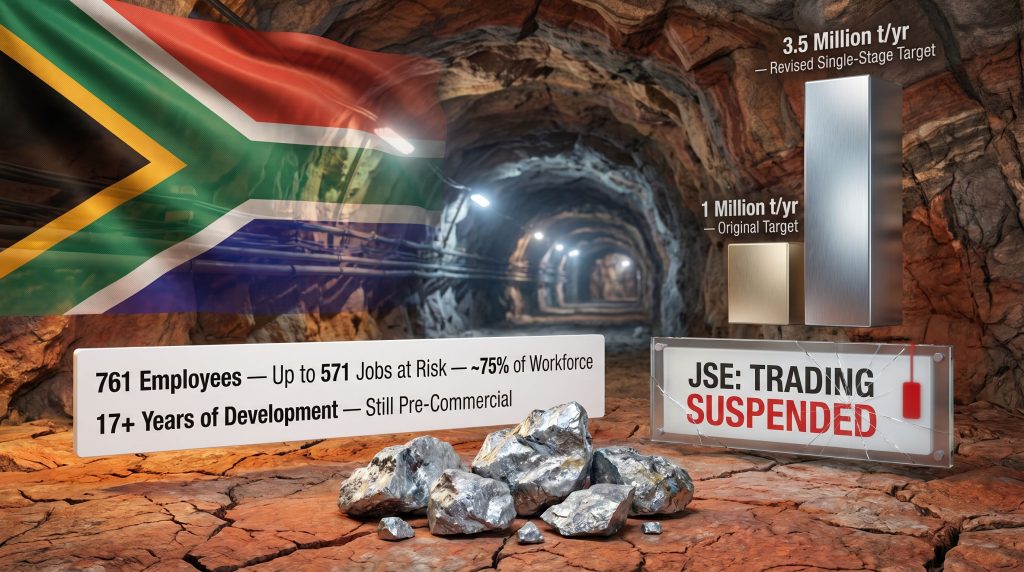
The Wesizwe Platinum Bakubung mine job cuts involve a formal Section 189 consultation process under South Africa's Labour Relations Act, with up to 571 employees potentially facing retrenchment from a total workforce of approximately 761 people. That translates to roughly 75% of the mine's entire headcount being placed at risk simultaneously.
Earlier reported figures cited 497 potential job losses from a workforce of 706. The updated numbers reflect the full formal disclosure required once the Section 189 process is officially initiated, and the most current figures should be treated as definitive for analytical purposes.
| Data Point | Figure |
|---|---|
| Total Bakubung workforce | ~761 employees |
| Jobs at risk under Section 189 process | Up to 571 |
| Proportion of workforce affected | ~75% |
| Years of mine development | 17+ years |
| Original annual PGM production target | ~420,000 oz |
| Original ore throughput target | 1 million tonnes/year |
| Revised ore throughput target | 3.5 million tonnes/year (single-stage) |
To contextualise the severity: the South African mining industry consolidation trend has seen periodic large-scale retrenchments, but a single project placing three-quarters of its workforce under formal consultation while simultaneously announcing a fundamental strategic overhaul is unusual by any measure. This is not a cyclical adjustment. It is a structural reset.
What Section 189 Really Means for Workers and Investors
Understanding the Consultation Framework
South Africa's Labour Relations Act Section 189 is frequently mischaracterised as a procedural formality. In practice, it is a substantive legal framework that imposes real obligations on employers contemplating large-scale job losses.
The process requires employers to:
- Issue a formal written notice to all affected employees and their elected or union representatives
- Disclose the full reasons driving the proposed retrenchments, including financial and operational justifications
- Actively explore and document alternatives to dismissal, such as reduced working hours, temporary lay-offs, or redeployment to other roles
- Negotiate severance terms where retrenchments ultimately proceed
Workers and unions retain enforceable rights to challenge the process if procedural requirements are not satisfied. A flawed Section 189 process can be taken to the Commission for Conciliation, Mediation and Arbitration, and courts have the power to declare dismissals procedurally or substantively unfair, exposing employers to compensation obligations.
What Wesizwe's Process Signals
Critically, formal Section 189 initiation does not arrive without prior warning signals. At Bakubung, a sequence of pre-retrenchment cost measures had already been implemented before the formal consultation commenced:
- Suspension of all overtime and weekend shift allowances
- Non-renewal of fixed-term contractor agreements as they expired
- A blanket freeze on new permanent hiring across the project
These measures collectively indicate that management had been managing a deteriorating situation for an extended period before concluding that incremental cost controls were insufficient. The Section 189 process formalises what operational conditions had already made evident. Furthermore, the management red flags visible in this sequence are consistent with patterns seen at other distressed mining operations before formal restructuring is announced.
Seventeen Years of Setbacks: A Geological and Operational Post-Mortem
The Bushveld Igneous Complex Context
Bakubung sits within the Bushveld Igneous Complex (BIC), the world's largest layered igneous intrusion and the source of an estimated 70-80% of global platinum reserves. The BIC hosts the Merensky Reef and UG2 Reef, the two principal platinum-bearing geological horizons mined across the North West and Limpopo provinces.
A critical point rarely appreciated by non-specialist investors: the BIC's platinum reefs are notoriously variable in terms of depth, reef width, and structural complexity. While average grades across the complex can appear attractive on paper, individual orebody sections can contain significant geological disruptions, faults, and potholes that dramatically complicate mining. The Bakubung orebody is considered a meaningful resource, but the practical extraction economics depend heavily on local geological conditions that are only fully understood once mining is underway.
This is why the mining method changes disclosed by Wesizwe are significant. Mid-project revisions to the extraction methodology suggest that original geological or geotechnical assumptions embedded in the mine plan proved materially inaccurate once underground development progressed. In reef mining, the transition from one mining method to another is not a minor operational tweak. It can require redesigning stope layouts, changing blasting patterns, modifying support systems, and retraining the entire underground workforce. Understanding cut-off grade economics becomes especially critical when method changes alter the viable extraction envelope of the orebody.
The Concentrator Plant Problem
Beyond the underground operation, Bakubung's concentrator plant has been identified as a source of technical difficulty. In PGM mining, the concentrator is the facility that processes crushed ore through flotation circuits to produce a platinum-bearing concentrate, which is then sent to smelters and refineries for further processing.
Concentrator performance is directly tied to the mineralogical characteristics of the ore feed. The ratio of Merensky Reef to UG2 Reef ore processed matters enormously because UG2 ore contains significantly higher chromite content, which can cause chromite build-up in smelter furnaces if concentrate grades are not carefully managed. A concentrator designed around one ore type may underperform if the actual ore blend shifts during mining. This technical dimension adds another layer of complexity to Bakubung's production challenges that goes beyond simple operational inefficiency.
Labour Disruptions and Their Compounding Effect
The project experienced formal strikes and an illegal underground sit-in that materially disrupted operations. In deep-level reef mining, production continuity is critical because underground development is a continuous process. When miners stop advancing development ends or stope faces, the entire production pipeline stalls in ways that take months, not weeks, to recover from. Each disruption at Bakubung added cumulative delay to a project that was already behind its original timeline. According to reporting on the mine's job losses, these disruptions compounded an already precarious operational trajectory.
The 3.5 Million Tonne Strategy: Credible Pivot or Aspirational Escape?
Why Management Has Abandoned Incremental Ramp-Up
Wesizwe's decision to abandon the original 1 million tonne per annum ramp-up strategy in favour of a direct single-stage leap to 3.5 million tonnes per annum reflects a specific logic: at smaller throughput levels, fixed costs per tonne of ore processed remain too high to achieve viable unit economics. The argument is that scale is the only mechanism capable of diluting the mine's substantial fixed cost base sufficiently to reach profitability.
This reasoning is not without precedent. Several large-scale South African platinum operations have demonstrated that below certain throughput thresholds, even well-managed mines struggle to cover their cost structures. The unit cost curve in PGM mining is highly sensitive to volume, and projects that never reach critical mass can remain structurally loss-making regardless of metal price movements.
The Critical Unanswered Questions
| Strategic Question | Why It Matters |
|---|---|
| Capital requirement for 3.5 Mtpa expansion | Determines whether additional Chinese capital injection or third-party financing is needed |
| Concentrator plant capacity for revised throughput | Existing infrastructure may require major engineering upgrades |
| Skills and capacity alignment with expansion | A 75% workforce cut before a 3.5x throughput increase creates an apparent operational paradox |
| Revised timeline to commercial production | After 17+ years, further delay compounds credibility damage |
| New mining method equipment requirements | Method changes introduce unfamiliar execution risks mid-project |
The most striking paradox in the current strategy is the workforce mathematics. Cutting up to 571 employees while planning a throughput expansion of 3.5 times the original target appears contradictory. One plausible interpretation is that the reductions target non-production roles such as administrative, supervisory, and surface support functions, while production-critical underground personnel are retained. However, Wesizwe has not explicitly confirmed this breakdown in available public disclosures, and investors should flag this gap as requiring clarification.
A credible path forward would typically require a definitive feasibility study underpinning the 3.5 Mtpa expansion, yet no such updated study has been confirmed in public disclosures at the time of writing.
The combination of a JSE trading suspension, delayed financial reporting, large-scale workforce reductions, and a fundamental strategy overhaul represents a multi-dimensional risk event rarely concentrated within a single mining project simultaneously. Each element alone would warrant heightened investor scrutiny. Together, they raise material questions about the project's path to bankable feasibility.
China-Africa Jinchuan Investments and the Sino-African Mining Model Under Pressure
China-Africa Jinchuan Investments holds approximately 45% of Wesizwe Platinum, making it the dominant shareholder. The investment was positioned as part of a broader Chinese strategic push to secure upstream exposure to critical minerals across the African continent, with platinum group metals representing a particularly attractive target given their applications in catalytic converters, fuel cells, and industrial chemistry.
Bakubung has become an uncomfortable case study in the practical limitations of this investment model. Chinese capital entered the project at scale, but capital alone proved insufficient to resolve the operational, technical, and geological challenges that accumulated over nearly two decades. The model's assumption that financial backing from a well-resourced strategic investor would smooth the path to production has not been validated at Bakubung. Indeed, the broader geopolitical mining landscape increasingly shapes how such Sino-African resource partnerships are scrutinised by regulators, analysts, and civil society groups.
The scale of the proposed workforce reductions, potentially affecting 75% of local employees, will attract attention from South African labour bodies, community groups in the North West province, and broader civil society stakeholders engaged with questions about the employment outcomes of Chinese resource investment on the continent. This dimension adds a political economy layer to what might otherwise appear to be a purely commercial restructuring.
The next major ASX story will hit our subscribers first
How Bakubung Compares to Established South African Platinum Producers
| Operational Dimension | Bakubung (Wesizwe) | Sector Benchmark |
|---|---|---|
| Development timeline | 17+ years, pre-commercial | Typically 8-12 years to production |
| Ownership structure | ~45% Chinese-backed | Predominantly South African or diversified |
| JSE listing status | Suspended | Active |
| Financial reporting | Delayed (2025 results late) | On schedule |
| Labour relations | Strike history, illegal sit-in recorded | Variable but generally managed |
| Production status | Pre-commercial | Operational |
The JSE trading suspension deserves particular attention. Wesizwe failed to publish financial results within deadlines required by JSE listing rules. While the company eventually released delayed interim and full-year 2025 results, the suspension has not been lifted. For institutional investors, a suspended listing eliminates liquidity and creates governance uncertainty that is difficult to price. For project financing counterparties, it raises questions about the reliability of financial disclosures underpinning any future capital raising or debt facility. Coverage of the Bakubung mine closure announcement provides additional context on the sequence of events leading to the current situation.
Three Scenarios for What Comes Next
Scenario 1: Successful Restructuring and Phased Recovery
The Section 189 process concludes with an agreed retrenchment outcome. Additional capital flows from China-Africa Jinchuan Investments or a new financing partner to fund the 3.5 Mtpa expansion. Engineering challenges at the concentrator are resolved. The mine achieves stable commercial production within a three-to-five-year window. This outcome is possible but requires simultaneous execution improvements across multiple complex domains.
Scenario 2: Prolonged Suspension and Strategic Drift
The JSE trading suspension continues, limiting equity market access. Union challenges extend the Section 189 timeline. The 3.5 Mtpa expansion remains aspirational without a fully funded implementation plan. The mine operates at reduced capacity in an indefinite holding pattern. This represents the path of least resistance given current conditions and is arguably the base case scenario.
Scenario 3: Asset Sale or Strategic Divestment
Continued operational and governance failures position Bakubung as a potential acquisition target for a larger, better-capitalised PGM producer with the operational expertise and balance sheet capacity to execute the required expansion. A distressed asset valuation could make the orebody attractive to a strategic acquirer. This scenario becomes increasingly plausible if Wesizwe cannot self-fund the expansion strategy within a credible timeframe.
Frequently Asked Questions: Wesizwe Platinum Bakubung Mine Job Cuts
How many jobs are being cut at the Bakubung mine?
The formal Section 189 consultation process places up to 571 employees at risk of retrenchment from a total workforce of approximately 761 people, representing roughly 75% of total headcount.
Why is Wesizwe cutting jobs at Bakubung?
The company has cited a combination of persistent operational challenges, past labour unrest, technical difficulties with mining methods and processing infrastructure, and a fundamental decision to replace the original production strategy with a single-stage throughput expansion to 3.5 million tonnes per annum.
What is Section 189 and how does it protect workers?
Section 189 of South Africa's Labour Relations Act mandates a formal, structured consultation process before large-scale retrenchments can proceed. Workers and union representatives must be consulted, alternatives to job losses must be explored, and severance terms must be negotiated before any dismissals can be implemented.
Who owns Wesizwe Platinum?
China-Africa Jinchuan Investments holds approximately 45% of Wesizwe Platinum, making it the company's dominant shareholder. Wesizwe is listed on the Johannesburg Stock Exchange, though its shares are currently suspended from trading.
Why is Wesizwe's JSE listing suspended?
Wesizwe failed to publish its financial results within JSE-mandated deadlines. While delayed 2025 interim and full-year results were eventually released, the trading suspension remains in place.
What is the new production strategy at Bakubung?
Wesizwe has discarded its original incremental ramp-up plan targeting 1 million tonnes of ore per annum and is instead pursuing a single-stage expansion to 3.5 million tonnes per annum, arguing that scale is necessary to achieve viable unit economics at the mine.
What Bakubung Teaches About Mining Project Risk
The Wesizwe Platinum Bakubung mine job cuts are not an isolated event in South Africa's mining calendar. They are a culmination of conditions that were identifiable years before the Section 189 notices were issued. Several lessons emerge that extend well beyond this single project:
- Commodity price recovery cannot substitute for operational competence. Strong PGM prices have failed to rescue Bakubung because the mine's problems are structural, not cyclical.
- Geological complexity in the Bushveld Igneous Complex is routinely underestimated in pre-development studies. The mining method revisions at Bakubung are consistent with a pattern seen across multiple BIC projects where underground conditions diverge from feasibility assumptions.
- The Section 189 process is a lagging indicator, not a leading one. By the time formal consultations begin, the conditions driving the retrenchments have typically been building for years.
- JSE governance compliance is a material investment risk factor. Trading suspensions caused by reporting failures are not administrative inconveniences. They eliminate liquidity, damage credibility, and constrain future capital access.
- Strategy pivots mid-project carry compounding execution risk. Changing mining methods, throughput targets, and workforce structure simultaneously demands a management capability that must be demonstrated, not assumed.
Disclaimer: This article is intended for informational purposes only and does not constitute financial or investment advice. The scenarios and probability assessments presented are analytical frameworks, not forecasts. Readers should conduct independent research and consult qualified advisers before making investment decisions. All figures are sourced from publicly available disclosures and may be subject to revision.
Want to Identify ASX Mining Opportunities Before the Broader Market Does?
Discovery Alert's proprietary Discovery IQ model delivers real-time alerts on significant ASX mineral discoveries, cutting through complex geological and operational data to surface actionable investment insights — precisely the kind of edge that separates informed investors from the crowd. Explore historic examples of major mineral discoveries and their market returns, then begin your 14-day free trial to position yourself ahead of the next significant find.