June 4, 2026
The Commodity Fault Lines Cracking Beneath Australian Equities
When a single export commodity accounts for a disproportionate share of a nation's trade revenue, the equity market built around it becomes structurally sensitive to forces most developed-market investors rarely have to consider. Australia sits squarely in that category. The ASX 200's heavy weighting toward materials and mining stocks means that when iron ore prices weaken and geopolitical anxiety rises simultaneously, the resulting compression is rarely linear. It is amplified, reflexive, and often indiscriminate.
That is precisely the environment Australian investors are navigating in early June 2026. ASX miners sink as iron ore slides and Middle East tensions flare, creating a confluence of supply-side disruption and sentiment-driven risk aversion that has dragged the broader index lower while exposing the vulnerability embedded in Australia's commodity-heavy market structure. Furthermore, iron ore surplus fears have been building for some time, and the current session is forcing investors to confront what that surplus means in practice.
When big ASX news breaks, our subscribers know first
What Is Driving Iron Ore to a Two-Month Low?
The Simandou Supply Shock: A New Variable in the Global Iron Ore Equation
Iron ore's recent price trajectory is being shaped by a structural development that commodity analysts have anticipated for years but markets are only now pricing in earnestly. Guinea's Simandou project, widely regarded as one of the largest and highest-grade undeveloped iron ore deposits on the planet, is beginning to export at meaningful volumes. The deposit contains an estimated 2.4 billion tonnes of high-grade hematite ore, and its ramp-up represents a genuine step-change in global supply dynamics rather than a marginal adjustment.
What makes Simandou particularly significant is the quality of its ore. The project produces ore grading approximately 65% iron content, which sits at the premium end of the global quality spectrum. For context, Australia's iron ore advantage has historically rested on Pilbara region exports in the 58–62% Fe range, meaning Simandou ore commands a quality premium that could structurally displace lower-grade supply over time. This grade differential is a detail that rarely surfaces in broad market commentary but carries real implications for Australian miners operating at the standard benchmark grade.
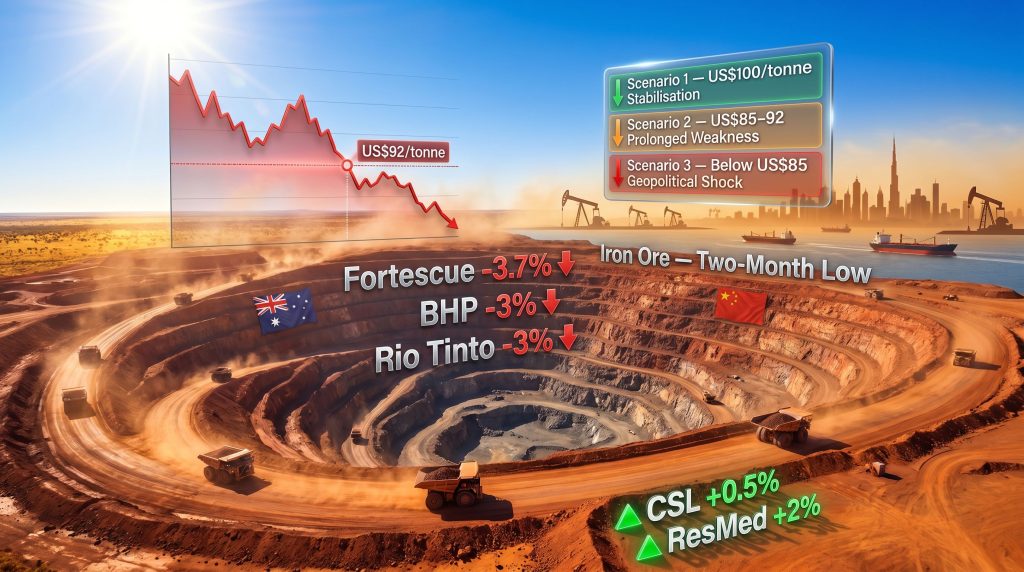
Singapore iron ore futures have fallen sharply in response, breaching the psychologically important US$92 per tonne threshold and sitting at a two-month low. Futures markets are forward-looking instruments, and the pricing compression here reflects not just current export volumes from Simandou but anticipated trajectory: if ramp-up continues as scheduled, the supply overhang narrative will intensify through the second half of 2026.
Chinese Steel Demand: The Demand-Side Pressure Compounding the Supply Story
The supply-side shock does not exist in isolation. Simultaneously, China steel demand trends are exhibiting seasonal and structural softness that represents the single most important demand variable for Australian iron ore exporters.
China's steel production tends to follow a predictable seasonal cadence, with output typically moderating during warmer months before recovering ahead of major construction seasons. However, the current slowdown carries additional structural weight. The prolonged contraction in China's property development sector, which historically consumed roughly 35–40% of domestic steel output, has suppressed mill order books well beyond normal seasonal patterns.
When steel mills operate at reduced margins, their restocking behaviour changes: spot buying of iron ore contracts, inventories are drawn down rather than replenished, and price discovery shifts lower. This feedback loop is now operating in full effect. Lower Chinese steel margins are producing reduced mill restocking, which is suppressing spot demand for Australian ore at precisely the moment Simandou supply is expanding. The convergence of these two forces explains why the move below US$92/t has been sharp rather than gradual.
| Pressure Variable | Direction | Impact on ASX Miners |
|---|---|---|
| Simandou export surge | Supply increase ↑ | Negative — oversupply fears |
| Chinese steel output | Demand decrease ↓ | Negative — reduced buying |
| Iron ore spot price | Price decline ↓ | Direct earnings compression |
| Geopolitical risk index | Uncertainty ↑ | Risk-off rotation away from miners |
How Do Middle East Tensions Translate Into ASX Market Volatility?
The US-Iran Escalation Pathway and Its Ripple Effect on Risk Assets
Geopolitical risk operates as an amplifier within financial markets rather than a direct economic variable. When US-Iran tensions escalate, the immediate market reaction is not driven by precise calculation of economic impact but by a collective repricing of uncertainty. Investors do not wait for supply chain disruptions to materialise; they sell cyclical and commodity-exposed assets pre-emptively and rotate into instruments perceived as safer stores of value.
The ASX under commodity pressure is particularly exposed to this mechanism. Because the index derives such a significant portion of its market capitalisation from resources and materials companies, a geopolitical-driven flight to defensives hits the Australian market harder than most comparable developed-market indices. When the same session that brings commodity price weakness also brings geopolitical escalation, the two pressures compound each other in ways that can overshoot fundamental valuations.
According to reporting on the US-Iran market fallout, the ASX plunged as strikes rattled markets, with gold stocks among the hardest hit despite conventional safe-haven expectations — a dynamic that underscores just how indiscriminate institutional de-risking can become during acute geopolitical episodes.
Scenario Alert: In a sustained escalation scenario, oil price spikes raise operational costs for mining companies while simultaneously suppressing risk appetite. This dual margin squeeze can accelerate share price declines beyond what commodity price moves alone would justify, particularly for energy-intensive bulk commodity operations.
Geopolitical Risk as a Supply Chain Multiplier for Metals and Mining
There is a less discussed dimension to geopolitical risk and its effect on bulk commodity exporters: shipping corridor disruption. Australia's iron ore exports travel through Indian Ocean and South China Sea trade routes that are sensitive to broader regional instability. Any sustained escalation in the Middle East raises insurance premiums for bulk carriers, elevates freight costs, and introduces timing uncertainty into supply chains that depend on predictable logistics windows.
For operations running on tight cost margins, particularly those exporting lower-grade ore at benchmark prices, even modest freight cost increases can compress realised margins meaningfully. This indirect transmission mechanism from geopolitical risk to mining economics is a dynamic that pure commodity price analysis frequently underestimates.
ASX 200 Performance Breakdown: Who Is Falling and Why?
Major Miners: Quantifying the Damage Across BHP, Rio Tinto, and Fortescue
The ASX 200 fell approximately 1.3% in early afternoon trading on 4 June 2026, with the materials sector bearing the heaviest losses. The divergence between Fortescue and its larger diversified peers is analytically instructive.
Fortescue's -3.7% decline reflects its structural position as a pure-play iron ore exporter. Unlike BHP or Rio Tinto, which generate meaningful revenue from copper, coal, aluminium, and other commodities, Fortescue's earnings are almost entirely a function of iron ore price realisations. When the iron ore price falls, there is no portfolio offset. This concentration risk is well understood by institutional investors, which is precisely why Fortescue tends to overshoot on both the upside during iron ore rallies and the downside during corrections.
BHP and Rio Tinto, both down approximately -3%, demonstrate that diversification provides relative but not absolute protection during iron ore selloffs. Their revenue bases are broader, but iron ore remains the dominant earnings driver for both companies, ensuring meaningful correlation to spot price movements.
The Banking Contagion: Why the Big Four Are Also Selling Off
The simultaneous weakness in Australia's major banks adds a second dimension to the session's risk-off character.
- Commonwealth Bank fell -1.1%
- Westpac declined -2.3%
- NAB was off -1.7%
- ANZ slipped -1.3%
The transmission mechanism from commodity weakness to banking sector pressure is indirect but logical. Reduced commodity sector earnings flow through to weaker business investment, reduced corporate borrowing, and softer credit demand. For banks with significant exposure to resources sector corporate lending and to regional economies dependent on mining activity, the earnings risk is real rather than purely psychological. When the ASX's two largest sector weightings — materials and financials — decline in tandem, the index-level impact is magnified.
Gold Miners: Counterintuitive Weakness Despite Safe-Haven Gold Demand
Northern Star Resources falling -5% in a session characterised by geopolitical anxiety represents one of the more counterintuitive observations of the day. The divergence here is best understood through the lens of gold miners vs bullion, where equity performance frequently decouples from commodity performance during periods of acute market stress.
Gold mining equities carry operational leverage to the gold price but also carry equity market beta. During broad risk-off selloffs, institutional investors frequently reduce equity exposure indiscriminately, unwinding positions in gold miners alongside cyclical stocks. This is particularly evident when positions have been built up during prior rallies and contain embedded profits that investors are motivated to protect.
Which Sectors Are Holding Up? The Defensive Rotation Playbook
Healthcare and Consumer Staples as Risk-Off Beneficiaries
The defensive rotation visible in this session offers a clear illustration of how institutional capital repositions during uncertainty. CSL gained 0.5%, ResMed advanced 2%, and Woolworths edged modestly higher, collectively demonstrating the portfolio hedging function that these sectors serve.
Healthcare companies like CSL and ResMed generate earnings that are structurally independent of commodity cycles. Their revenue streams derive from long-term healthcare contracts, regulatory approvals, and demand for treatments that does not fluctuate with Chinese steel production or iron ore spot prices. Consumer staples companies like Woolworths provide essential goods regardless of macro conditions, making both sectors natural destinations for capital during risk-off repositioning.
Standout Performers: Corporate Catalysts Cutting Through Market Noise
Endeavour Group: Analyst Upgrade as a Contrarian Signal
Endeavour Group's 3.3% gain following Citi's upgrade to a Buy rating is a reminder that stock-specific catalysts retain the power to generate positive returns even within broadly negative market sessions. Citi's thesis centres on the potential for market share gains in the liquor retail segment during a period when consumer spending is under pressure — a counterintuitive but defensible position given that value-seeking consumers may trade down from premium hospitality experiences toward home consumption.
Treasury Wine Estates: Strategic Overhaul Rewarded by the Market
The session's standout performer was Treasury Wine Estates, which surged nearly 11% following an investor day presentation that outlined a substantial strategic restructuring. The company's plan to concentrate its portfolio around 10 core brands represents capital allocation discipline that markets have been waiting to see. The simultaneous expansion into low and zero-alcohol offerings aligns the company with one of the clearest structural consumption shifts in the beverage industry, while the announced review of underperforming US operations adds further optionality for investors.
What Does Iron Ore's Decline Mean for Australia's Broader Economy?
The Macro Transmission Mechanism: From Ore Price to Federal Budget
Iron ore's significance to Australian economic outcomes extends well beyond the equity market. The commodity consistently ranks as Australia's largest goods export by value, generating export receipts that flow directly into corporate tax collections, state royalty revenues, and the terms of trade calculation that underpins the Australian dollar's valuation.
A sustained iron ore price below US$90 per tonne carries implications for federal budget projections that depend on Treasury price assumptions typically set well above that level. Each sustained US$10/t decline in average realised iron ore prices represents a material reduction in royalty income for Western Australia and in corporate tax receipts from the major miners nationally.
The AUD/USD exchange rate functions as a real-time indicator of this transmission mechanism. The Australian dollar carries a well-documented positive correlation with iron ore prices, given the commodity's dominance in the export mix. Sustained iron ore weakness, consequently, tends to weaken the Australian dollar, which has its own second-order effects on import costs, inflation, and monetary policy considerations.
Scenario Modelling: Three Trajectories for Iron Ore in the Second Half of 2026
Scenario 1 — Stabilisation: Simandou's ramp-up proceeds more slowly than forward supply models project, Chinese policymakers introduce targeted infrastructure stimulus, and iron ore recovers toward the US$100/t range. ASX miners stabilise and partially retrace recent losses.
Scenario 2 — Prolonged Weakness: Simandou export volumes accelerate on schedule, Chinese steel demand remains structurally constrained by the property sector contraction, and iron ore settles in the US$85–92/t range for an extended period. Australian bulk miners face sustained earnings pressure and dividend reviews.
Scenario 3 — Geopolitical Shock Amplification: Middle East conflict escalates materially, oil prices spike, global growth forecasts deteriorate, and iron ore falls below US$85/t. A broad ASX correction follows with the materials sector leading the decline and the Australian dollar weakening sharply.
The next major ASX story will hit our subscribers first
Is AI Beginning to Reshape Australia's Labour Market?
Deloitte's Findings: Hiring Slowdowns in AI-Exposed Occupations
Away from commodity markets, a Deloitte research report is adding a longer-term structural dimension to Australia's economic outlook. The findings indicate that hiring activity is already decelerating across occupational categories with high exposure to automation and generative AI capabilities. Importantly, the research draws a distinction between hiring slowdowns — which are already measurable — and outright job displacement, which has not yet emerged at scale.
This distinction matters for investors. Labour market tightness has been a key support for Australian consumer spending and, by extension, for domestically oriented businesses within the ASX. If AI-driven hiring deceleration gradually broadens, the impact on wage growth, consumer confidence, and retail spending could become an additional headwind over a multi-year horizon. It is a structural theme still in its early stages, but one that sophisticated investors are beginning to incorporate into long-duration portfolio thinking.
How Should Investors Interpret Today's ASX Selloff?
Distinguishing Temporary Volatility from Structural Trend Shifts
Not every sharp one-day decline signals a durable trend reversal, and disciplined analysis requires distinguishing between event-driven volatility and structural deterioration. As noted by market analysts covering the session, ASX miners sink as iron ore slides and Middle East tensions flare in a session that encapsulates precisely this analytical challenge. The key variables to monitor include:
- Iron ore futures curve shape: A flattening or inverted iron ore futures curve signals persistent oversupply expectations rather than a temporary spot market correction.
- Chinese PMI data: Monthly manufacturing and construction PMI readings from China will determine whether steel demand weakness is cyclical or structural.
- Simandou ramp-up cadence: Quarterly export volume data from Guinea will indicate whether the supply shock is accelerating or moderating.
- Middle East diplomatic developments: De-escalation signals would reduce the risk-off premium currently embedded in equity valuations.
- Institutional positioning data: CFTC and futures market positioning data can reveal whether large investors are making tactical short-term adjustments or executing longer-term de-risking of commodity exposure.
Sector Rotation Strategy: Positioning for Uncertainty
| Sector | Current Pressure | Defensive Appeal | Key Watch Variable |
|---|---|---|---|
| Iron Ore Miners | High | Low | Simandou ramp-up pace |
| Diversified Miners (BHP, RIO) | Moderate-High | Moderate | Chinese stimulus signals |
| Gold Miners | Moderate | Moderate | Equity vs. commodity divergence |
| Big Four Banks | Moderate | Low-Moderate | Business confidence data |
| Healthcare (CSL, ResMed) | Low | High | Earnings consistency |
| Consumer Staples | Low | High | Domestic spending trends |
| Consumer Discretionary | Variable | Low-Moderate | Analyst upgrade catalysts |
Frequently Asked Questions: ASX Miners, Iron Ore, and Market Volatility
Why does iron ore have such a large impact on the ASX?
Iron ore is Australia's largest export commodity by value, and the ASX 200 carries significant weighting in materials and mining stocks. When iron ore prices fall, the earnings outlook for major miners deteriorates, creating downward pressure on both the sector and the broader index through direct earnings impact and through sentiment-driven risk-off selling.
What is the Simandou project and why does it matter for iron ore prices?
Simandou is one of the world's largest undeveloped iron ore deposits, located in Guinea, West Africa. Its high-grade hematite ore and large reserve base mean that as export volumes increase, global supply rises materially. This is a structural shift with long-anticipated implications for the iron ore price equilibrium that has historically supported Australian mining profitability.
Why are gold miners falling when geopolitical tensions usually support gold?
Gold as a commodity may find safe-haven support during geopolitical uncertainty, but gold mining equities carry equity market beta in addition to commodity exposure. During broad market selloffs, profit-taking and position unwinding in gold equities can override the commodity price signal, particularly when those positions carry embedded gains from prior rallies.
How do Middle East tensions affect Australian mining stocks?
Geopolitical escalation elevates global risk aversion, prompting investors to reduce exposure to cyclical and commodity-linked equities. It also raises oil prices, which increases fuel and energy costs for mining operations, compressing margins from two directions simultaneously. In sessions where ASX miners sink as iron ore slides and Middle East tensions flare, these twin pressures are particularly difficult for fund managers to hedge efficiently.
What is a risk-off market environment?
A risk-off environment describes a collective investor shift away from higher-risk assets such as equities, commodities, and growth-sensitive currencies toward safer instruments including government bonds, cash, and the US dollar. Defensive equity sectors typically outperform during these periods while cyclical and commodity-exposed names underperform.
Key Takeaways: Navigating the Dual-Shock Environment
- The ASX 200's -1.3% decline reflects the convergence of iron ore supply concerns and geopolitical risk escalation operating simultaneously
- Iron ore at a two-month low, driven by Simandou export growth and weak Chinese steel demand, represents the primary structural driver for miner underperformance
- Fortescue's -3.7% decline highlights the amplified downside risk of concentrated commodity exposure, while BHP and Rio Tinto's -3% falls demonstrate sector-wide contagion
- Defensive sectors, particularly healthcare and consumer staples, are demonstrating measurable portfolio hedging value in the current environment
- Stock-specific catalysts, including analyst upgrades (Endeavour) and strategic corporate restructuring (Treasury Wine Estates), retain the capacity to generate meaningful positive returns even within broadly negative market sessions
- The AI-driven labour market shift identified in Deloitte research represents an emerging structural theme with long-duration implications for Australian consumer spending and investment strategy
- Simandou's high-grade ore quality creates a nuanced supply threat for Australian exporters that goes beyond simple volume competition, potentially pressuring benchmark grade price realisations over time
This article is for informational purposes only and does not constitute financial advice. Readers should conduct independent research and consult a licensed financial adviser before making any investment decisions. Past market performance is not indicative of future results.
Want to Stay Ahead of the Next Major ASX Mineral Discovery?
While iron ore dynamics and geopolitical pressures reshape the ASX landscape, Discovery Alert's proprietary Discovery IQ model scans ASX announcements in real time, instantly identifying significant mineral discoveries and delivering actionable insights before the broader market catches on — explore historic examples of major discovery returns to understand the opportunity, then begin your 14-day free trial at Discovery Alert to position yourself ahead of the next significant find.