June 4, 2026
The Capital Allocation Test That Development-Stage Gold Projects Keep Failing
Across West Africa's goldfields, the gap between geological promise and operational reality has widened considerably over the past decade. Pre-feasibility studies routinely confirm multi-million-ounce resource bases. Construction financing proves elusive. Timelines stretch. And quietly, balance sheets absorb the consequences through impairment charges that tell a more honest story than any project update ever could.
This dynamic sits at the heart of what is unfolding at Mali's Kalana gold project, where Endeavour seeks local partners for Mali's Kalana gold project — a strategic exit from an asset it has held for nearly a decade without ever breaking ground. Understanding why this outcome occurred, and what it signals for capital flows into Sahelian mining, requires looking beyond the headlines and examining the structural forces that have made Kalana a case study in development-stage risk.
When big ASX news breaks, our subscribers know first
What Is the Kalana Gold Project and Why Does It Matter to West African Mining?
A Legacy Asset With Soviet-Era Roots and Modern-Day Complications
Kalana's mining history stretches back to 1984, when the deposit entered commercial production with Soviet technical assistance, yielding approximately 500 kilograms of gold per year before operations ceased in 1991. The shutdown coincided with the collapse of Soviet aid programmes across Africa, leaving behind ageing infrastructure and an unfinished mining narrative.
Endeavour acquired an 80% interest in Kalana in June 2017 for $122 million, structured as part of its broader acquisition of Avnel Gold. The Malian government retained the remaining 20% stake through Société des mines d'or de Kalana (Somika). The asset sits approximately 250 km south of Bamako, in a region with established but ageing infrastructure connectivity.
A 2021 pre-feasibility study delivered figures that would have justified the acquisition price on paper. The study projected peak annual output of up to 150,000 ounces, a total mine life yield of approximately 1.65 million ounces (51.3 tonnes) across an eleven-year operating period, and construction costs of $297 million. On those numbers alone, the economic logic appeared sound.
Kalana's Resource Profile at a Glance
| Metric | Detail |
|---|---|
| Projected Annual Production | Up to 150,000 oz/year |
| Total Mine Life Output | ~1.65 million oz (51.3 tonnes) |
| Projected Mine Life | 11 years |
| Estimated Construction Cost | $297 million |
| Endeavour Ownership Stake | 80% |
| Government of Mali Stake | 20% |
| Acquisition Cost (2017) | $122 million (via Avnel Gold) |
| Distance from Bamako | ~250 km south |
Key Insight: Despite its substantial resource potential, Kalana has never advanced beyond the pre-feasibility stage under Endeavour's ownership. A gap of more than four years between study completion and any construction activity is a structural warning signal, not a scheduling delay.
What the pre-feasibility study could not model was the pace at which Mali's political and regulatory environment would transform. The military transitions that reshaped governance across the Sahel from 2020 onward created a fundamentally different risk calculus for foreign operators, particularly those holding development-stage assets without the buffer of existing cash flows from the same jurisdiction. Indeed, geopolitical mining risks of this nature have become increasingly central to how investors evaluate West African exposure.
How Did Endeavour's Relationship With Kalana Deteriorate Over Time?
From Memorandum of Understanding to Strategic Abandonment
The most instructive chapter in Kalana's recent history begins in July 2025, when Endeavour and the Malian transitional government signed a memorandum of understanding intended to revive the project. The MoU was framed publicly as a commitment to move forward, with Somika director Abdoul Aziz Sy indicating at the time that construction would commence within six months of signing and that the mine could reach operational status within eighteen months of that point.
Ten months after the MoU's signing, Endeavour had disclosed no verifiable progress across any of the key milestones that would characterise genuine development intent: no confirmed construction timeline, no financing arrangement, no contractor appointments, and no engineering advancement beyond what existed before the agreement was executed.
By June 2026, Endeavour confirmed directly to Ecofin Agency that Kalana is not classified as a strategic asset within its portfolio and that the company is actively working with local partners who may acquire and develop the project independently. This statement, carefully worded, represents the clearest signal yet that Endeavour's internal capital allocation committees have permanently redirected resources away from this asset.
The Accounting Trail: Impairments Tell the Real Story
In corporate accounting, impairment charges function as management's formal acknowledgement that an asset's carrying value exceeds its recoverable amount. They are not administrative adjustments — they are strategic verdicts.
The impairment trail at Kalana is unambiguous:
- Endeavour recorded an impairment of $133.1 million against Kalana's carrying value in its 2024 annual report
- A further $9.5 million write-down appeared in the 2025 annual report, attributed to revised assumptions on project risk and the proportion of resources deemed economically recoverable
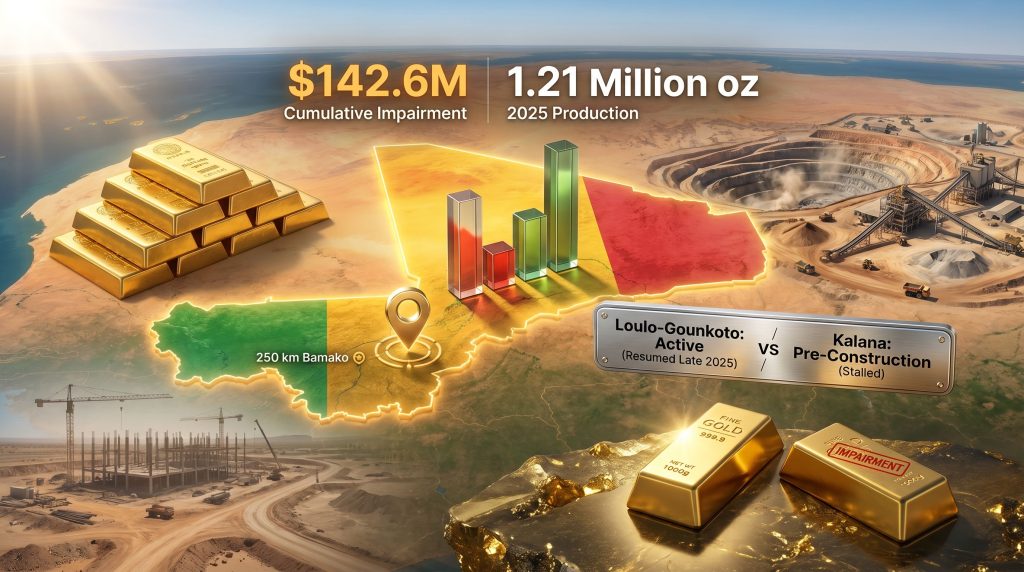
- Combined impairments now total approximately $142.6 million, representing a near-total write-off of the original $122 million acquisition cost plus subsequent development expenditure
Financial Callout: When cumulative impairments exceed the original acquisition price, as they now do at Kalana, the accounting message is unequivocal. Internal valuations have collapsed to near zero, and the probability of the company committing fresh capital to the asset is functionally negligible.
This sequence also reveals a lesser-understood dynamic in junior and mid-tier mining finance: impairments applied across consecutive reporting periods, rather than as a single large charge, often signal ongoing internal debate about asset classification. The split between 2024 and 2025 write-downs suggests Kalana's fate was not decided all at once but rather confirmed progressively as development options were evaluated and discarded.
What Does Mali's 2023 Mining Code Mean for Foreign Gold Producers?
Understanding the Regulatory Architecture Reshaping West African Resource Sovereignty
Mali's 2023 mining code represents the most significant revision of the country's resource governance framework in decades. The code grants the Malian state the right to increase its equity participation in mining projects to 35%, up from the previous ceiling of 20%. Within that expanded state stake, 5% is specifically reserved for Malian private investors, institutionalising a mandatory local participation structure that previous frameworks lacked.
Bringing Kalana under this new framework was a formal condition of the July 2025 MoU. Endeavour accepted these revised terms, which is itself significant. A company that agrees to dilute its effective ownership share from 80% to 65% in exchange for project revival rights is signalling that the resource potential justifies the equity cost, at least theoretically. The practical challenge is that a $297 million construction requirement against a reduced equity stake and elevated political risk produces a financing proposition that is structurally more difficult to execute.
Furthermore, mining industry consolidation across the Sahel is increasingly driven by exactly these regulatory pressures, as international operators seek partners to share diluted equity positions and construction risk.
Comparative Regulatory Exposure: Mali vs. Côte d'Ivoire
| Regulatory Factor | Mali (2023 Code) | Côte d'Ivoire |
|---|---|---|
| State Equity Entitlement | Up to 35% | Lower/more negotiable |
| Local Investor Reserve | 5% of total stake | Varies by project |
| Political Risk Classification | Elevated (Sahel instability) | Comparatively stable |
| Recent Major Disputes | Loulo-Gounkoto (Barrick) | None reported at scale |
| Endeavour Operational Presence | None (pre-Barrick deal) | Two active mines |
The broader pattern across the Sahel is worth noting here. Resource nationalism — defined as the progressive expansion of state equity rights and local participation mandates in extractive industries — has accelerated measurably since 2020. Guinea, Burkina Faso, Niger, and Mali have all revised or signalled intent to revise mining codes during this period. For foreign operators, this means the regulatory baseline at project acquisition is no longer a reliable indicator of the terms that will govern production, particularly for assets that remain in the development stage when new codes take effect.
What Is Endeavour's Real Strategic Priority Right Now?
Assafou and the Côte d'Ivoire Consolidation Play
Endeavour's declared development focus is the Assafou gold project in Côte d'Ivoire, a jurisdiction where the company already operates two producing mines and has established regulatory and operational relationships over multiple years. This concentration of development capital into a single jurisdiction where Endeavour holds a demonstrated track record reflects a deliberate risk-adjusted capital allocation philosophy.
The company's operational performance provides important context for this strategic positioning:
- 2025 production reached 1.21 million ounces, representing approximately 10% growth year-on-year
- Endeavour's current market capitalisation stands at approximately $15 billion
- Active operations span Côte d'Ivoire, Burkina Faso, and Senegal, with no producing assets in Mali prior to any Barrick transaction
- The company holds the position of leading gold producer in West Africa by output volume
The strategic logic of deepening Côte d'Ivoire exposure while reducing development-stage risk in Mali reflects a mature portfolio management approach. Assafou benefits from proximity to existing infrastructure, established community relationships, and a regulatory environment that has remained comparatively predictable. These are not trivial advantages when evaluated against the construction and permitting challenges that define Sahelian project development in the current climate.
In addition, elevated gold M&A activity across global markets in 2025 has reinforced the premium that investors are placing on producers with clear, low-risk development pipelines rather than stalled pre-construction assets.
Three Strategic Scenarios for Endeavour's Mali Positioning
Scenario A: Local Partner Transition Only (Base Case)
Endeavour transfers Kalana to Malian private or state-linked investors under the 2023 mining code framework. The company exits without committing additional capital, absorbs the accounting losses already recorded, and consolidates its development focus on Assafou. This path offers portfolio simplification and reduced political risk exposure, but leaves the MoU's original intent only partially fulfilled.
Scenario B: Barrick Alliance Materialises (Transformative Case)
Endeavour and Barrick Mining complete a jointly held entity, listed in London, incorporating Barrick's African mine portfolio at a reported combined valuation of approximately $30 billion. Endeavour gains operational responsibility for Loulo-Gounkoto, Mali's largest gold mining complex, which resumed production in late 2025 following a negotiated resolution of the dispute between Barrick and Malian authorities. Under this scenario, Endeavour simultaneously exits a written-down development asset and enters Mali as the operator of its most significant producing mine.
Scenario C: Kalana Stalls, No Barrick Deal (Downside Case)
The local partner search yields no credible acquirer. Barrick alliance discussions collapse or are indefinitely deferred. Kalana remains in an administrative limbo, fully impaired but unresolved. The financial impact is contained given write-downs already absorbed, but the reputational consequences of an unfulfilled MoU create relationship friction with Malian authorities at a time when other transactions may require goodwill.
Scenario Probability Note: Scenario B represents the highest-value but most contingent outcome. Neither Endeavour nor Barrick has publicly confirmed the terms, valuation, or timeline of any proposed alliance. A London-listed joint entity incorporating assets across multiple African jurisdictions would require regulatory, shareholder, and governance approvals across several sovereign frameworks simultaneously.
How Does Loulo-Gounkoto Compare to Kalana as a Strategic Asset?
Understanding the Scale Differential That Makes the Barrick Deal So Significant
The contrast between Kalana and Loulo-Gounkoto within the same country illuminates exactly why Endeavour's strategic calculus has shifted so decisively. Loulo-Gounkoto is not simply a larger version of Kalana — it operates in an entirely different category of mining asset.
Asset Comparison: Kalana vs. Loulo-Gounkoto
| Attribute | Kalana | Loulo-Gounkoto |
|---|---|---|
| Production Status | Pre-construction (stalled) | Active (resumed late 2025) |
| Scale Classification | Junior/mid-tier development | Major producing complex |
| Endeavour Ownership | 80% (pre-partner transfer) | Contingent on Barrick deal |
| Strategic Classification | Non-core (confirmed) | Potentially core (if acquired) |
| Write-Down Applied | ~$142.6 million cumulative | N/A |
| Mali State Relationship | MoU signed, progress unclear | Dispute resolved, operational |
The Loulo-Gounkoto complex was largely idle throughout 2025 as a consequence of a contractual and fiscal dispute between its operator, Barrick Mining, and the Malian transitional government. Operations resumed at the end of 2025 following a negotiated settlement. The fact that a mine of this scale could resume production after a full year of inactivity speaks to its embedded infrastructure and the mutual economic incentive for both operator and state to reach workable terms.
If the Barrick-Endeavour alliance proceeds as reported, Endeavour would emerge from the transaction in a position of considerable irony within Mali. A company that is currently unable to advance a development-stage asset with a $297 million construction price tag would become the operator of the country's principal gold mine, a major fiscal contributor to the Malian state, and an established partner of the very government that signed the Kalana MoU.
The next major ASX story will hit our subscribers first
What the Local Partner Search Signals About West African Mining Governance
Reading Between the Lines of Endeavour's Kalana Exit
The framing of Kalana's transition as a local partner handover rather than a conventional divestiture to another international operator is not incidental. It reflects the intersection of commercial necessity and political sensitivity in a way that is worth unpacking.
Several dynamics are at work simultaneously:
- Mali's 2023 mining code mandates local investor participation, which structurally constrains the buyer universe for any project transfer
- The elevated political risk perception of Sahelian jurisdictions has narrowed the pool of international operators willing to acquire a development-stage asset requiring $297 million in construction capital
- The MoU signed in July 2025 created a public commitment that Endeavour is now managing carefully; the local partner framing allows the company to honour the spirit of the agreement without committing its own capital to execution
- Formal exit is politically sensitive in an environment where Malian authorities are actively negotiating with multiple foreign operators simultaneously; staged disengagement creates fewer friction points than a clean break
This approach mirrors strategies employed by other international miners navigating resource nationalism across the Sahel. Where full operational withdrawal risks diplomatic consequences, the transfer of development responsibility to local entities functions as a politically acceptable middle path that satisfies the letter of regulatory requirements while allowing the international operator to redeploy capital elsewhere.
For junior developers watching this situation unfold, the Kalana case carries a specific and important lesson. Acquiring assets in jurisdictions undergoing rapid regulatory transformation without a clear financing pathway to construction creates a category of stranded development risk that is exceptionally difficult to resolve. The combination of rising state equity claims, elevated construction costs, and tightening international capital markets for Sahelian projects has compressed the viable development window for assets like Kalana considerably.
What Are the Broader Implications for West African Gold Investment?
Portfolio Realignment, Resource Nationalism, and the New Rules of Engagement
Endeavour's decision to seek local partners for Kalana is not an isolated corporate event. It is a data point in a larger pattern of international gold producers recalibrating their exposure to Sahelian development-stage assets in response to structural changes in the regulatory and geopolitical environment.
The divergence between Kalana and Loulo-Gounkoto within a single country illustrates a principle that is increasingly shaping capital allocation decisions across West Africa: asset-level characteristics — specifically production status, scale, and the quality of the state relationship — now determine capital flows more decisively than resource potential alone. A deposit with 51.3 tonnes of projected output cannot attract development capital if the construction financing proposition is structurally impaired by equity dilution, political risk premiums, and management bandwidth competition from higher-priority projects.
For investors evaluating exposure to West African gold, several structural observations emerge from the Kalana situation. However, it is worth noting that undervalued mining stocks across the sector continue to attract opportunistic capital precisely because regulatory risk is often already priced in at depressed valuations.
The key structural observations are as follows:
-
Pre-feasibility studies are necessary but insufficient. A technically competent study that does not account for regulatory transformation risk over a multi-year development timeline will systematically overstate project value.
-
Consecutive impairment charges signal internal conviction. When a company writes down an asset across multiple reporting periods rather than in a single charge, it is communicating progressive internal consensus that development is not viable under current conditions.
-
MoU commitments without accompanying financial disclosures rarely advance to construction. The absence of financing arrangements, contractor appointments, or engineering progress within twelve months of an MoU signing is a reliable indicator of strategic disengagement.
-
Scale and operational status increasingly dominate over resource upside. Loulo-Gounkoto's strategic attractiveness to Endeavour is grounded in its status as an active, large-scale producer, not in exploration potential.
-
Definitive feasibility studies represent a critical threshold. Assets that remain at the pre-feasibility stage for extended periods face compounding obstacles as regulatory environments evolve and financing conditions tighten.
Investment Takeaway: The divergence between Kalana (written down, partner-sought) and Loulo-Gounkoto (dispute resolved, operationally active) within the same sovereign jurisdiction demonstrates that country-level risk assessments are becoming insufficient analytical tools. Asset-specific characteristics, including the maturity of state relationships, production status, and scale, are increasingly the primary determinants of which projects attract capital and which are quietly transferred to local partners.
This article is intended for informational purposes only and does not constitute financial, investment, or legal advice. Statements regarding potential transactions, including any Barrick-Endeavour alliance, are based on publicly available reporting and have not been confirmed by the parties involved. Readers should conduct independent due diligence before making investment decisions related to any companies or projects mentioned herein.
For ongoing coverage of West African mining, energy, and finance developments, Ecofin Agency at ecofinagency.com provides sector-focused reporting across African extractive industries and economic policy.
Want to Spot the Next Major Mineral Discovery Before the Market Does?
Discovery Alert's proprietary Discovery IQ model delivers real-time alerts on significant ASX mineral discoveries, transforming complex geological and market data into actionable investment insights for both short-term traders and long-term investors. Explore historic discoveries and their exceptional returns to understand what early positioning can mean, then start your 14-day free trial at Discovery Alert to secure your market-leading edge before the next major find is announced.