June 4, 2026
The Policy Paradox at the Heart of Australian Gas Reform
Energy policy rarely succeeds when it attempts to solve a short-term supply problem by imposing obligations that discourage the long-term investment required to fix that very same problem. This tension sits at the core of the Australia domestic gas reservation scheme, a structural intervention that has the potential to reshape the country's entire LNG export and domestic supply landscape from 1 July 2027 onward. Furthermore, understanding Australia's resource export challenges provides essential context for evaluating whether this intervention will ultimately help or hinder the sector.
The debate is not simply about how much gas Australians should have access to. It is about whether the mechanism chosen to secure that access will, over time, produce more gas or less of it.
When big ASX news breaks, our subscribers know first
What the Australia Domestic Gas Reservation Scheme Actually Proposes
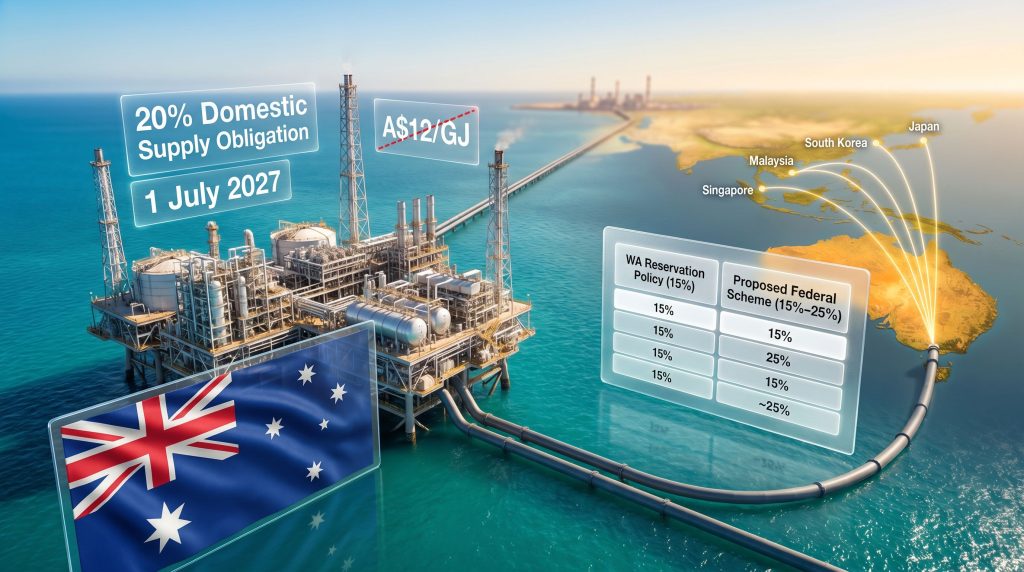
The federal government's draft consultation paper, released through the Department of Climate Change, Energy, the Environment and Water (DCCEEW), centres on a 20% domestic supply obligation applied to all LNG exporters operating in Australia. The target implementation date is 1 July 2027, with the final reservation percentage to be confirmed following a public consultation process running through 2026 and potentially settling anywhere within a 15% to 25% range.
The draft framework is structured around four core regulatory pillars:
- Regulatory architecture covering governance, enforcement bodies, and legal obligations
- Reservation design specifying how the 20% obligation is calculated, allocated, and verified
- Compliance and operational elements including reporting requirements, exemption criteria, and penalty structures
- Integrated market reforms addressing the interaction between the reservation scheme and existing gas market rules and pricing mechanisms
Critically, the draft includes legacy contract protections, meaning existing long-term export agreements are intended to be insulated from immediate compliance obligations. However, the precise design detail governing those protections has already become a source of significant industry contention.
How This Differs from Existing Gas Security Tools
Australia already operates the Australian Domestic Gas Security Mechanism (ADGSM), introduced in 2017, which can restrict LNG exports when domestic shortfalls are forecast. The key distinction is that the ADGSM is reactive and conditional. It activates only when a supply gap is anticipated.
The proposed Australia domestic gas reservation scheme is fundamentally different in character. It would impose a permanent, structural supply obligation regardless of prevailing market conditions, meaning LNG exporters would be required to reserve domestic volumes even when no shortfall exists.
| Mechanism | Trigger | Obligation Type | Geographic Scope |
|---|---|---|---|
| ADGSM | Forecast domestic shortfall | Conditional and reactive | National |
| WA Domestic Reservation Policy | Structural, always active | 15% of export equivalent | Western Australia only |
| Proposed Federal Scheme | Structural, always active | 15-25% (20% proposed) | All national LNG exporters |
The A$12/GJ Price Cap: A Concurrent Reform Adding Complexity
Running parallel to the reservation obligation debate is the potential removal of the A$12 per gigajoule domestic gas price cap, which has been in place since late 2022 following the energy price shock triggered by global supply disruptions. The cap was introduced as an emergency measure and is now under active review as part of the broader reform package.
The simultaneous consideration of removing a price ceiling whilst introducing a mandatory supply obligation creates a layered pricing dynamic that energy economists have described as genuinely difficult to model. The reservation obligation theoretically increases domestic supply, which would exert downward pressure on prices. However, removing the price cap simultaneously eliminates the administrative ceiling that has kept prices artificially low.
The net directional effect on domestic gas prices is, at this stage, contested. Broader commodity price impacts on the wider resource sector add further complexity to an already volatile pricing environment.
Critical Insight: Investors and industrial gas buyers who have structured procurement contracts around the A$12/GJ cap should be stress-testing their cost models against a range of domestic price scenarios, since both the removal of the cap and the introduction of reservation volumes could pull prices in opposing directions simultaneously.
Industry's Core Objections: Why Australian Energy Producers Is Pushing Back
Australian Energy Producers (AEP), the peak industry body representing the nation's gas producers, has formally opposed the draft framework and articulated its concerns across several dimensions.
The body's chief concern is what it describes as investment signal suppression. By mandating that a fixed proportion of output be directed to the domestic market regardless of price signals, the framework could entrench conditions where domestic gas prices remain structurally below the level needed to justify capital investment in new field development. In a sector where individual upstream projects can require billions of dollars and decades of productive life, this is not a theoretical risk.
AEP's documented concerns include:
- Investment signal suppression: Structural oversupply conditions reduce the price signals that attract capital to new domestic supply projects
- Displacement of smaller producers: The mandatory reservation volumes could crowd out domestic-focused, smaller-scale gas producers who already serve the local market without LNG export exposure
- Compliance opacity: The patchwork of exemptions in the draft creates regulatory uncertainty, particularly for producers with operations spanning both Western Australia and the Northern Territory, where overlapping state and federal frameworks may generate contradictory obligations
- Sovereign risk transmission: The framework's design, if implemented unchanged, sends a negative signal to foreign investors and long-term contract counterparties about Australia's regulatory predictability
AEP's formal position is that it supports a prospective reservation policy applied to future projects, not a retrospective obligation imposed on existing operations. The body has stated that a well-designed scheme should encourage new investment and promote competitive market function, not constrain producers already operating within existing commercial frameworks.
The Diplomatic Dimension: What Asia's LNG Buyers Are Watching
Australia's LNG export relationships with key Asian economies are not passive commercial arrangements. For countries like Japan, South Korea, Malaysia, and Singapore, Australian LNG represents a foundational pillar of national energy security strategy. Long-term supply agreements with Australian exporters have, in many cases, been in place for decades and are embedded in national energy planning frameworks.
| Trading Partner | Nature of Exposure to Australian LNG |
|---|---|
| Japan | Major holder of long-term LNG offtake contracts |
| South Korea | Significant import dependency on Australian supply volumes |
| Malaysia | Regional LNG trade partner with bilateral supply arrangements |
| Singapore | Strategic energy import partner with price-sensitive exposure |
Prime Minister Anthony Albanese has provided repeated diplomatic assurances to these nations that existing LNG export contracts would not be disrupted by any domestic reservation mechanism. The credibility of those assurances now depends entirely on the final design of the framework.
AEP has characterised the current draft, if implemented without substantial modification, as an outcome that would undermine those assurances and damage Australia's long-standing reputation as a reliable, rule-of-law energy exporter. The phrase used internally within industry circles to describe this outcome is an own goal for Australia's energy and economic security — a term that captures the self-defeating nature of a policy that harms the investment environment it depends on.
Indeed, these concerns must be understood in the context of the broader geopolitical risk landscape affecting global energy and resource markets in 2025 and beyond.
Sovereign Risk Note: In LNG project financing, sovereign risk premiums can materially affect the cost of capital. If international lenders and equity partners begin pricing Australian regulatory risk at a higher level, the effect on future greenfield LNG development economics could be significant and lasting, even if the policy itself is later amended or withdrawn.
The Western Australia Reservation Model: Lessons from Three Decades of Operation
Western Australia's domestic gas reservation policy has been operational since the early 2000s and requires that new gas developments set aside the equivalent of 15% of export volumes for the domestic WA market. The policy is widely credited with keeping Western Australian domestic gas prices below export parity, providing a structural cost advantage for WA-based manufacturers and industrial users that their east coast counterparts have not enjoyed.
However, the WA model also carries cautionary lessons directly relevant to the federal scheme's design. Academic analysis of the WA policy has identified that when the reservation threshold becomes the binding constraint on production decisions, it can produce two measurable negative effects:
- A reduction in total gas production volumes, because producers respond to mandated reservation costs by producing less overall
- Economic inefficiency from distortions to the marginal cost of supply, as producers optimise for compliance rather than market-clearing output levels
| Dimension | WA Reservation Policy | Proposed Federal Scheme |
|---|---|---|
| Reservation threshold | 15% of export equivalent | 15-25% (20% proposed) |
| Scope | WA new developments only | All national LNG exporters |
| Legacy contract treatment | Established over decades | Protections proposed in current draft |
| Domestic price impact | Below export parity | Uncertain (concurrent cap review) |
| Key academic critique | Efficiency losses when binding | Investment signal suppression risk |
The federal scheme proposes a higher threshold than WA's established model and applies it to a broader universe of producers across more complex jurisdictional arrangements. If the binding-constraint effect observed in WA is replicated at the federal level, the supply-reduction outcome could be proportionally larger.
The next major ASX story will hit our subscribers first
The Supply Investment Paradox: Could This Policy Worsen What It Seeks to Fix?
The east coast gas market is already experiencing structural supply pressure. Legacy fields in Queensland and South Australia are in production decline, and the replacement pipeline of new developments faces a combination of permitting complexity, community opposition, and increasingly challenging investment economics. This is the environment into which a 20% reservation obligation would be introduced.
The paradox embedded in the policy design is as follows: a scheme intended to increase domestic gas availability may, through its effect on investment signals and producer economics, reduce the number of new supply projects that proceed — creating a medium-term supply cliff where short-term reservation volumes are delivered but long-term field development activity decelerates.
Consider a plausible scenario for a mid-tier Queensland LNG operator. If the 20% domestic obligation, combined with compliance costs, exemption uncertainty, and the removal of the price cap, renders a planned upstream expansion uneconomic at the margin, that operator may defer or cancel the project entirely. The domestic market receives no benefit from reservation volumes that are never produced.
This mechanism, sometimes described as the chilling effect on marginal supply decisions, is one of the more sophisticated risks embedded in the framework. Furthermore, when considered alongside supply chain disruptions affecting upstream equipment and construction costs globally, the investment calculus for new field development becomes even more challenging.
Preparing for 1 July 2027: A Stakeholder Action Framework
The consultation window running through 2026 represents the most consequential period for shaping the final policy design. Affected parties across the supply chain have distinct preparatory priorities.
For LNG exporters:
- Model compliance costs across the full 15% to 25% reservation range, not just the 20% headline figure
- Assess exemption eligibility under the draft framework and identify jurisdictional overlaps with WA and NT regulatory obligations
- Review existing long-term export contracts for regulatory change and force majeure provisions
For domestic gas buyers and industrial users:
- Evaluate how increased reservation volumes may affect contract availability, pricing dynamics, and counterparty risk in the short to medium term
- Assess exposure to domestic price movements if the A$12/GJ cap is removed concurrent with scheme commencement
For investors in Australian LNG-linked assets:
- Monitor consultation outcomes for material regulatory shifts that could affect production volumes, export revenues, or project economics
- Stress-test portfolio exposures against scenarios where the final reservation percentage exceeds 20% or where exemption frameworks prove more restrictive than currently drafted
- Consider sovereign risk premium adjustments for Australian upstream assets in multi-jurisdiction energy portfolios
Key Questions Still Unanswered Before the Scheme Takes Effect
What will the final reservation percentage be?
The 15% to 25% range remains wide, and the difference between 15% and 25% represents a materially different set of implications for producer economics and domestic pricing.
How will the exemption framework interact with state-level regulatory regimes?
Producers operating in WA and the NT face the prospect of overlapping obligations. The draft's exemption patchwork has been specifically called out by AEP as a source of ongoing uncertainty that could affect investment decisions before the scheme even commences. Consequently, global trade war impacts on LNG demand forecasts add yet another variable that producers must account for when modelling compliance scenarios.
Will legacy contract protections hold in practice?
Diplomatic assurances have been given to key Asian trading partners, but the legal architecture underpinning those protections in the draft framework will be subject to intense scrutiny during the consultation period.
What happens to the A$12/GJ price cap?
The timing and conditions of any cap removal will determine whether the Australia domestic gas reservation scheme's intended supply benefit translates into lower domestic prices or simply different price dynamics under a less regulated structure. In addition, Australia's resource export challenges across the broader energy sector mean that the final policy design carries consequences well beyond the gas market alone.
This article is intended for informational purposes only and does not constitute financial, legal, or investment advice. The regulatory framework discussed is subject to ongoing consultation and the final policy design may differ materially from the draft described. Readers with material exposure to Australian gas markets should seek independent professional advice.
Want to Stay Ahead of Major Australian Resource Discoveries?
While policy shifts like the domestic gas reservation scheme reshape Australia's energy landscape, Discovery Alert's proprietary Discovery IQ model instantly identifies significant ASX mineral discoveries across 30+ commodities — delivering real-time, actionable alerts to both short-term traders and long-term investors. Explore historic discoveries and their returns to understand the opportunity, then begin your 14-day free trial at Discovery Alert to position yourself ahead of the broader market.