August 24, 2026
The Supply-Side Shift That Iron Ore Markets Have Been Dreading
For more than a decade, the global iron ore industry has operated with a particular assumption baked into its pricing models: that the world's largest untapped high-grade iron ore deposit, buried beneath the mountains of Guinea in West Africa, would remain a future threat rather than a present reality. That assumption is now being dismantled, shipment by shipment, through the Morebaya port on Guinea's Atlantic coast.
Understanding why the BHP share price sinking on Simandou iron ore exports makes logical sense requires stepping back from the day's trading numbers and examining the structural mechanics of how seaborne iron ore markets function. Furthermore, how equity valuations absorb forward supply signals, and what this project's emergence actually means for the competitive architecture of one of the world's most traded bulk commodities.
When big ASX news breaks, our subscribers know first
What Makes Simandou Fundamentally Different From Typical Iron Ore Projects
Geology, Grade, and the Premium Ore Advantage
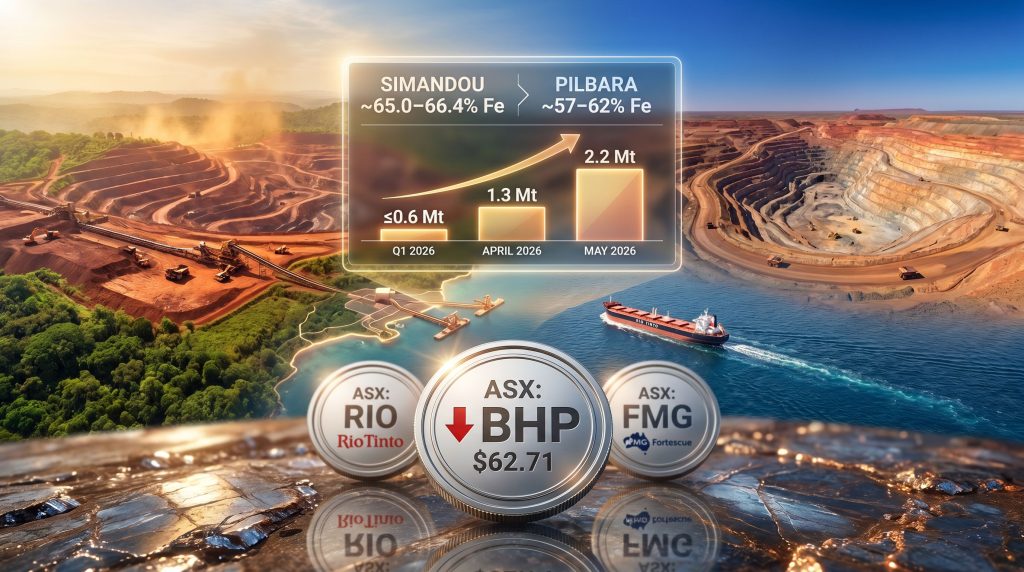
Most discussion of Simandou focuses on its scale, but the more consequential characteristic is its ore quality. The deposit's iron content averages between 65.0% and 66.4% Fe, placing it firmly in the top tier of global iron ore by grade. To understand why this matters, consider how Chinese blast furnaces operate.
Steel mills optimise their furnace feed to maximise iron output per unit of energy consumed. Higher-grade ore reduces the volume of slag generated, lowers coke consumption, and increases furnace productivity. In practical terms, a Chinese steelmaker purchasing 65% Fe ore from Simandou rather than a typical 58-62% Fe Pilbara blend can produce meaningfully more steel from the same furnace capacity. The market reflects this through a grade premium, a price adjustment mechanism built into iron ore spot trading that rewards higher Fe content with a per-tonne premium above the benchmark 62% Fe index price.
This grade dynamic is not static. As Australian Pilbara deposits mature through decades of extraction, the average Fe content of ore shipped from Western Australia has gradually declined. What was once a reliable mid-60s grade profile at some operations now frequently sits in the upper 50s to low 60s range. Simandou, as a greenfield deposit with minimal depletion, enters the market at the top of the quality spectrum precisely as incumbent supply is drifting down it. Consequently, understanding iron ore prices and China demand becomes increasingly critical for investors navigating this shift.
Infrastructure Scale and the Morebaya Export Gateway
The export infrastructure underpinning Simandou's ramp-up is itself a significant engineering achievement. The Morebaya port facility, constructed specifically to service the project, provides the seaborne access necessary to reach Asian steel markets. What the export volume trajectory reveals is not just capacity, but confidence in logistics systems that many observers expected to face far greater operational friction.
| Period | Monthly Export Volume (Mt) | Stage Characterisation |
|---|---|---|
| January 2026 | 0.6 Mt or less | Commissioning/early ramp |
| February 2026 | 0.6 Mt or less | Commissioning/early ramp |
| March 2026 | 0.6 Mt or less | Commissioning/early ramp |
| April 2026 | 1.3 Mt | Accelerating commercial ramp |
| May 2026 | 2.2 Mt | Meaningful commercial production |
The near-quadrupling of monthly volumes between the first quarter of 2026 and May signals something qualitatively significant: Simandou has transitioned from a construction story into an operational supply reality. For iron ore market participants, this crossing of the commissioning threshold into genuine commercial ramp-up carries an outsized psychological weight relative to the actual tonnes involved.
How Iron Ore Price Sensitivity Flows Through to BHP's Valuation
The Mechanics of Earnings Repricing
The BHP share price sinking on Simandou iron ore export data is not a direct response to lost sales or production disruption. BHP's own mines continue operating. The mechanism is more subtle and, arguably, more consequential: forward earnings repricing. As iron ore surplus risks grow more pronounced, the market's pricing calculus shifts meaningfully.
Institutional investors who hold large positions in BHP maintain dynamic models that link assumed iron ore prices to projected EBITDA, free cash flow, and dividend capacity. When supply-side data shifts the probability distribution of future iron ore prices downward, these models automatically generate lower valuation outputs. The result is selling pressure even before a single tonne of Australian iron ore loses a customer.
A commonly cited rule of thumb among resources analysts is that every US$10 per tonne movement in the iron ore benchmark price produces a material change in BHP's EBITDA. When Simandou export data is interpreted as evidence that a sustained price-suppressive supply increment is entering the market, the market discounts a lower long-run price into current valuations. This explains how a 3% intraday decline to approximately $62.71 can be triggered by supply volumes that, in absolute terms, remain a fraction of global seaborne trade.
Broker Sentiment and the Sector-Wide Feedback Loop
The share price pressure on BHP did not occur in isolation. RBC's decision to downgrade Rio Tinto (ASX: RIO) on iron ore price outlook concerns created a negative sentiment signal that rippled across the entire Australian iron ore producer universe. This is a well-understood market dynamic: when a major broker publicly reduces its iron ore price forecasts, the effect is sector-wide rather than company-specific, because the underlying commodity risk is shared.
Key Distinction: The difference between a valuation-driven sell-off and a sentiment-driven sell-off matters significantly for investment decision-making. A sentiment-driven decline often overshoots fundamental value, creating potential re-entry opportunities for long-term investors. A valuation-driven decline reflects genuine structural earnings impairment. The current move contains elements of both, which makes calibration difficult.
Simandou vs. Pilbara: The Competitive Landscape Unpacked
Grade Premium Dynamics and the Lump Ore Response
Australian producers have not ignored the competitive threat from high-grade African supply. One structural response has been to shift product mix toward lump ore, which is a coarser, partially upgraded form of iron ore that carries a natural quality premium over fines in the spot market. Lump ore can be charged directly into blast furnaces without sintering, reducing energy costs at the steel mill and commanding a premium that partially mirrors the grade advantage of high-Fe fines.
BHP's ability to sustain favourable lump-to-fines ratios in its product mix becomes a more strategically important lever in a market where Simandou's high-grade fines are growing in volume. However, lump ore production is constrained by the physical characteristics of the ore body and cannot be infinitely scaled as a competitive offset.
The Freight Offset: A Partial Natural Hedge
One factor that partially tempers Simandou's competitive advantage is shipping distance. Guinea sits on Africa's western coast, requiring vessels to navigate around the Cape of Good Hope or through various routing alternatives to reach Chinese ports. This creates a structural freight cost disadvantage relative to Australian Pilbara supply, which benefits from significantly shorter transit times to Northeast Asian steel mills.
| Competitive Factor | Simandou (Guinea) | Pilbara (Australia) |
|---|---|---|
| Ore Grade (Fe%) | ~65.0-66.4% | ~57-62% (trending lower) |
| Freight Distance to China | Longer (higher cost) | Shorter (cost advantage) |
| Project Maturity | Early commercial ramp | Mature, sustaining production |
| Geopolitical/Logistics Risk | Elevated | Lower |
| Long-Term Volume Potential | Very large (greenfield upside) | Constrained by grade decline |
| Infrastructure Risk | Present but diminishing | Minimal |
In delivered cost terms, Simandou's grade premium must be large enough to offset its freight disadvantage for Chinese buyers. At current grade differential levels, the economics generally favour Simandou for steel mills prioritising furnace efficiency, but the margin of advantage narrows when freight rates spike. The broader China steel and iron ore market dynamics add another layer of complexity to how this competitive tension ultimately resolves.
BHP's Portfolio Beyond Iron Ore: The Copper Growth Thesis
Why the Simandou Threat Does Not Define BHP's Entire Investment Case
An analytical framework that evaluates BHP exclusively through an iron ore lens is increasingly misaligned with the company's actual strategic direction. Iron ore remains the dominant near-term earnings contributor, but BHP's capital allocation and long-duration growth positioning has been shifting toward copper for several years.
The structural demand drivers for copper are independent of iron ore dynamics and operate across multiple concurrent growth themes:
- Grid electrification infrastructure requires substantial copper for transmission and distribution systems
- Data centre construction driven by artificial intelligence and cloud computing demands significant copper in power and cooling systems
- Renewable energy generation from wind and solar installations is highly copper-intensive relative to fossil fuel equivalents
- Electric vehicle manufacturing uses substantially more copper per vehicle than internal combustion alternatives
- Charging network deployment represents an additional copper demand vector not present in the traditional auto sector
Critically, copper supply is not keeping pace with these demand drivers. Existing mine grades are declining globally, permitting timelines for new projects span a decade or more, and the discovery-to-production pipeline remains structurally thin. This supply-demand tension supports a structurally constructive long-term copper price outlook that Simandou does not disrupt in any way. In addition, Rio Tinto copper expansion strategies illustrate how major miners are broadly repositioning toward this commodity.
BHP's Commodity Earnings Diversification: A Stress Test
| Commodity Segment | Current Earnings Weight | Long-Term Growth Trajectory | Simandou Price Sensitivity |
|---|---|---|---|
| Iron Ore | High (dominant) | Declining under supply pressure | High |
| Copper | Growing | Strong structural demand | None |
| Potash (Jansen) | Pre-revenue (development) | Long-term optionality | None |
| Coal (residual) | Declining (managed exit) | Minimal | None |
The Jansen potash project in Canada represents a long-duration optionality asset that adds exposure to agricultural demand growth over a multi-decade horizon, further insulating BHP's total group value from iron ore pricing cycles.
Differential Exposure Across ASX Iron Ore Producers
Which Miner Faces the Steepest Simandou Headwind?
Not all ASX iron ore producers carry equal exposure to competitive pressure from high-grade African supply. Understanding the differential helps investors position across the sector more precisely.
| Company | Iron Ore Revenue Dependence | Grade/Product Mix | Copper Diversification | Simandou Risk Assessment |
|---|---|---|---|---|
| BHP (ASX: BHP) | High, but diversifying | Lump-focused, mixed grades | Significant and growing | Moderate-High |
| Rio Tinto (ASX: RIO) | Very high | Pilbara Blend, lump and fines | Limited (growing) | High, partially hedged via equity stake |
| Fortescue (ASX: FMG) | Near-total dependence | Lower-grade fines dominant | Minimal | Very High |
Fortescue carries the most acute competitive risk from Simandou because its product profile sits furthest from the high-grade positioning of African ore, yet it competes within the same Chinese steel mill purchasing pool. Lower-grade fines from Fortescue are subject to a grade discount rather than a premium, and as Simandou volumes grow, the relative disadvantage of discount-priced product widens.
Rio Tinto occupies an interesting position: the company holds an equity stake in the Simandou project itself, which functions as a partial natural hedge. Furthermore, Rio Tinto tax and royalty pressures add an additional dimension to evaluating the miner's overall earnings resilience. While Rio's Pilbara operations face pricing pressure from Simandou's volumes, its ownership interest in the project means it participates in the upside from African production growth — a complexity that purely Pilbara-focused valuation analysis tends to underweight.
The next major ASX story will hit our subscribers first
Evaluating BHP at Current Levels: A Scenario-Based Framework
Three Trajectories for Simandou and Their Earnings Implications
| Scenario | Simandou Volume Path | Iron Ore Price Impact | BHP Earnings Consequence |
|---|---|---|---|
| Bear Case | Rapid scale toward 100+ Mtpa within 3 years | Significant price compression, especially mid-grade fines | Material EBITDA headwind, dividend capacity under pressure |
| Base Case | Gradual ramp with ongoing infrastructure and logistics constraints | Moderate pressure offset partially by demand growth | Manageable earnings drag with copper growth offsetting over time |
| Bull Case | Slower-than-expected ramp due to political or operational disruption | Limited near-term pricing impact | Minimal earnings revision, sentiment recovers |
Key Monitoring Indicators for Investors
Rather than reacting to individual data points, investors benefit from tracking a set of leading indicators that collectively signal which scenario is materialising:
- Monthly export volumes from Morebaya port, particularly whether the trajectory toward 5-10 Mt per month is sustained or stalls
- Chinese steel mill purchasing behaviour and whether buyers are actively substituting Simandou ore for traditional Australian supply
- The iron ore grade premium spread, which reflects whether the market is pricing Simandou's quality advantage into the differential pricing structure
- Infrastructure expansion announcements from the Simandou project, which would signal confidence in accelerating long-term ramp-up
- Iron ore spot price and futures curve, particularly the 12-month forward price which most directly influences near-term equity valuations
Investment Time Horizon Considerations
Scenario-Based Time Horizon Framework:
- Short-term (0-12 months): Iron ore price volatility is likely to persist as Simandou volumes continue growing. The BHP share price sinking on Simandou iron ore exports may continue to reflect each monthly export update from Guinea.
- Medium-term (1-3 years): Copper's contribution to BHP's earnings grows as existing projects ramp and exploration assets mature. Iron ore remains material but progressively less dominant in the group earnings mix.
- Long-term (3-10 years): BHP's fundamental value proposition increasingly reflects copper exposure from global electrification and energy transition demand. Iron ore transitions toward a cash-generative but mature segment, with Simandou fully absorbed into market pricing assumptions.
Frequently Asked Questions
Why does Guinea's iron ore production affect an Australian mining company's share price?
Equity markets price forward earnings expectations rather than present-quarter production. When Simandou export data accelerates, investors interpret this as evidence of growing high-grade supply entering global markets, which risks compressing iron ore prices over a multi-year horizon. Since iron ore remains BHP's largest earnings contributor, lower expected prices translate into lower expected earnings and reduced dividend capacity, triggering share price adjustments today even though no BHP mine has lost production.
Does Simandou directly displace BHP's iron ore product in Chinese markets?
The competitive dynamic is real but nuanced. Simandou's 65-66% Fe ore competes most directly for Chinese steel mill demand that prioritises grade quality and furnace efficiency. BHP's lump ore products carry a natural quality premium that provides partial insulation, but both compete within the same Chinese purchaser pool. Grade-based competition will intensify as Simandou volumes grow.
What is the significance of the ore transitioning from commissioning to commercial ramp-up?
Commissioning volumes are widely discounted by markets as temporary and variable. The sustained acceleration from under 0.6 Mt per month to 2.2 Mt in May 2026 signals that Simandou has crossed a qualitative threshold into genuine operational production. This shift changes the market's probability weighting for Simandou becoming a persistent, large-scale supply contributor rather than a delayed or constrained project.
Is BHP's copper exposure sufficient to offset iron ore headwinds in the near term?
In the near term, copper's offsetting effect is limited because iron ore still dominates BHP's earnings. The copper offset becomes progressively more significant over a three-to-ten year horizon as BHP's copper production grows and the relative earnings contribution shifts. Near-term investors should not rely on copper diversification to neutralise iron ore earnings pressure within the current financial year.
Key Takeaways for ASX Investors
- Simandou's export ramp from Guinea represents a genuine structural supply-side inflection in the global iron ore market, not a short-term disruption that will self-correct
- The BHP share price sinking on Simandou iron ore exports reflects forward earnings repricing mechanics rather than direct production loss, a distinction with important implications for how investors should interpret the sell-off
- Grade competition from Simandou's high-Fe ore is most damaging to lower-grade Australian producers; BHP's lump ore strategy provides partial but not complete insulation
- Freight cost disadvantages from Guinea's longer shipping routes to China partially offset Simandou's grade premium in delivered cost calculations, preserving some competitive headroom for Pilbara producers
- Fortescue carries the highest structural risk among ASX iron ore producers; Rio Tinto holds a partial hedge through its Simandou equity stake; BHP sits in an intermediate position with growing copper diversification
- BHP's long-term investment thesis is migrating toward copper and future-facing commodities that Simandou cannot threaten, but this transition operates over a multi-year timeline that does not insulate near-term earnings from iron ore pricing cycles
- Investors evaluating BHP at current levels should weigh short-term iron ore earnings risk against balance sheet resilience, commodity diversification depth, and the long-duration copper growth optionality that becomes progressively more material to group valuation over time
This article contains general analysis and commentary only and does not constitute personalised financial advice. Commodity price forecasts and earnings scenarios involve inherent uncertainty. Past performance is not indicative of future returns. Investors should consider their own circumstances and seek professional financial advice before making investment decisions.
Want To Identify the Next Major ASX Mineral Discovery Before the Broader Market?
Discovery Alert's proprietary Discovery IQ model delivers real-time alerts on significant ASX mineral discoveries, transforming complex mineral data into clear, actionable insights for both short-term traders and long-term investors. Explore how historic discoveries have generated extraordinary returns and begin your 14-day free trial today to position yourself ahead of the market.