June 4, 2026
The Quiet Death of Market Logic: When National Security Rewrites Energy Economics
Energy markets operate on a brutal and simple principle: the cheapest electrons win. For most of the past decade, that principle has systematically dismantled the US coal industry, as natural gas from shale formations and rapidly declining solar and wind costs made coal-fired generation increasingly uncompetitive. Dozens of plants have retired annually since 2010, and utilities have largely stopped fighting the economic tide.
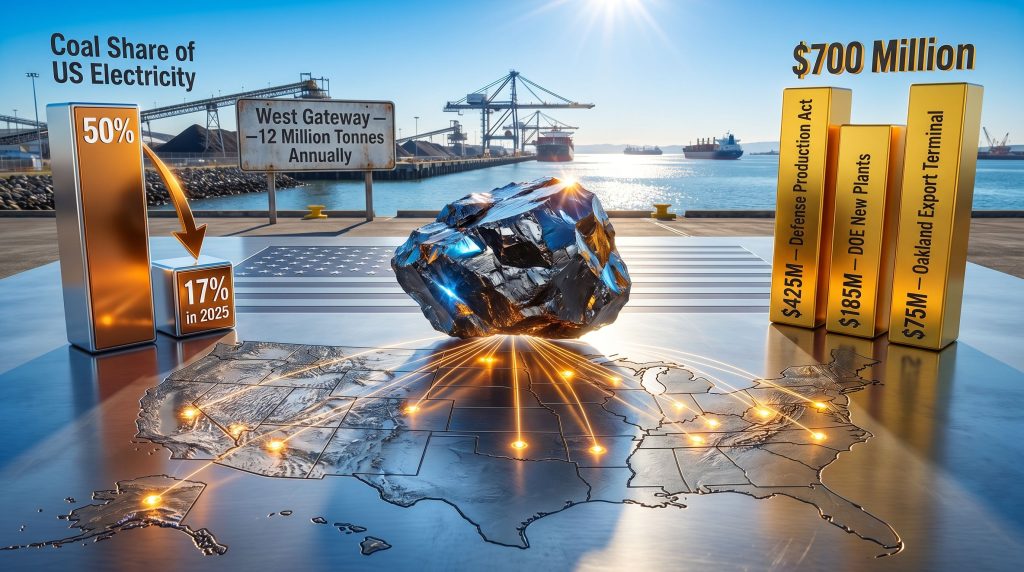
Yet in 2026, Trump plans $700 million to build coal plants and export site infrastructure, invoking a 1950 wartime statute to fund coal plant upgrades, underwrite new construction, and open a Pacific-facing export corridor that conservationists have resisted for nearly two decades. The initiative, framed around artificial intelligence energy demand and grid reliability, represents one of the most significant federal interventions in energy markets in modern history, and raises questions that extend far beyond coal itself.
When big ASX news breaks, our subscribers know first
Breaking Down the $700 Million Federal Coal Package
The administration's plan, announced under the heading "Beautiful, Clean Coal", allocates federal capital across three distinct channels. Understanding each component separately is essential to grasping both the scale and the strategic intent of the overall package.
| Funding Stream | Amount | Mechanism | Purpose |
|---|---|---|---|
| Existing coal plant support | $425 million | Defense Production Act | Upgrades across 13 operating plants |
| New plant construction grants | $185 million | Department of Energy grants | Two new plants plus one restart |
| West Gateway export terminal | $75 million | Defense Production Act | Oakland, California export facility |
| Total Federal Commitment | $685-$700 million | Mixed DPA and DOE | Coal generation and export infrastructure |
| Private matching funds | ~$201 million | Company co-investment | Brings total new plant spend to ~$386 million |
The $425 million in Defense Production Act (DPA) funds targets 13 existing coal facilities across West Virginia, Kentucky, North Carolina, Indiana, Tennessee, Arkansas, Arizona, Oklahoma, North Dakota, and Wisconsin. Named utility beneficiaries include Duke Energy Corp., Hallador Energy Co., Oklahoma Gas & Electric Co., and at least one subsidiary of American Electric Power Company Inc. The funding is expected to support operational upgrades that could extend plant lifespans beyond previously scheduled closure dates.
The $185 million in Department of Energy grants targets three specific projects:
- Terra Energy Center Corp. in Alaska, pursuing what would become the first newly constructed coal plant in the United States since 2013
- TerraPurus Inc. at Mount Storm, West Virginia, developing a new generation facility
- AES Warrior Run near Cumberland, Maryland, targeted for restart after previous closure
Private companies must contribute matching capital under the grant structure, bringing combined planned expenditure across these three projects to approximately $386 million in total.
The remaining $75 million flows through the DPA to the proposed West Gateway export terminal in Oakland, California, a facility designed to ship up to 12 million tonnes of coal annually to Asian markets from Wyoming, Montana, and other western producing states.
Why Coal? The AI Energy Demand Argument Explained
To understand the administration's logic, it helps to examine the specific energy characteristics that differentiate coal from alternatives in the context of modern computing infrastructure.
AI data centres are not ordinary electricity consumers. Large-scale training clusters and inference facilities operate continuously at extremely high power densities, requiring power supplies that can maintain consistent output regardless of weather conditions, time of day, or grid fluctuations. This is known in the industry as dispatchable baseload power, meaning generation that can be called upon reliably and held at a consistent output level on demand.
Intermittent sources such as wind and solar, while dramatically cheaper per unit of energy produced at optimal conditions, cannot independently guarantee this consistency without significant battery storage infrastructure, which at grid scale remains expensive and technically constrained. Coal and natural gas plants, by contrast, can hold steady output around the clock.
Interior Secretary Doug Burgess has publicly framed winning the artificial intelligence race as a national security imperative, with coal-fired generation positioned as a foundational ingredient. The administration has repeatedly characterised coal as essential infrastructure for the next technological era, a rhetorical repositioning that reframes a legacy fuel as a forward-looking strategic asset.
This framing carries significant policy implications. Once coal is classified as AI infrastructure rather than legacy energy, the political and legal architecture for federal intervention expands considerably. The question is whether the underlying physical argument holds up under scrutiny.
Furthermore, critics point out that natural gas, nuclear, and increasingly long-duration battery storage can all provide dispatchable baseload capacity, often at lower cost per megawatt-hour than coal. The specific choice of coal as the preferred dispatchable resource, rather than gas or nuclear, reflects political economy as much as technical optimisation.
The Defense Production Act: From Steel Mills to Coal Plants
The statute at the centre of this initiative has a history worth understanding. The Defense Production Act was enacted in 1950 under President Harry Truman, originally designed to accelerate steel output during the Korean War by granting the executive branch authority to direct private sector production toward national security priorities.
Defense Production Act powers have since been invoked for a striking range of purposes:
- Korean War era: Steel and industrial materials for military production
- COVID-19 pandemic: Acceleration of N95 mask and ventilator manufacturing
- Energy transition: Domestic solar panel manufacturing support
- Food security: Baby formula supply chain restoration during national shortage
- Offshore energy: Restarting oil production off California's coast under the current administration
The application of DPA authority to fund coal plant upgrades and export terminal construction represents a meaningful expansion of the statute's doctrinal scope. Legal scholars and environmental organisations are expected to challenge whether subsidising a commercially declining energy source constitutes a legitimate national security application of the law.
The administration's counter-argument is straightforward: grid reliability during peak AI-era demand constitutes a genuine national security concern, and coal capacity provides the dispatchable generation necessary to underpin that reliability. Whether courts accept this framing remains to be seen.
The Oakland Export Terminal: 18 Years of Resistance
Of all the components within the Trump plans $700 million to build coal plants and export site initiative, the Oakland terminal carries perhaps the most complex history. The proposed West Gateway export terminal, also known as the Oakland Bulk and Oversized Terminal, has faced continuous legal and regulatory opposition for approximately 18 years.
The terminal's strategic rationale is compelling from a pure logistics perspective:
- Western US coal basins, particularly in Wyoming's Powder River Basin and Montana, produce enormous volumes of thermal coal but lack direct Pacific export infrastructure
- Without a West Coast terminal, coal must be routed through Gulf Coast or Atlantic ports, adding significant transportation cost and transit time
- A functioning Oakland terminal would open a direct Pacific corridor to Asian markets, particularly Japan, South Korea, and potentially India, which remain substantial thermal coal importers
- The facility is designed to handle up to 12 million tonnes annually, a volume that would represent meaningful additional export capacity for western producers
Opposition to the terminal has, however, centred on several concerns:
- Coal dust dispersion from uncovered rail cars supplying the site, with documented studies showing measurable particulate deposition along rail corridors
- Local air quality degradation in surrounding Oakland communities, which already carry disproportionate pollution burdens
- The terminal's role in sustaining global fossil fuel demand at a time when international climate commitments call for coal phase-down
- The City of Oakland previously blocked an earlier iteration of the terminal project through municipal authority
The $75 million in DPA funding represents a federal attempt to override years of local and state-level resistance through the application of federal authority, a dynamic that is itself legally contested and likely to generate further litigation.
Geographic Winners: Which States Benefit Most
| State | Type of Benefit | Key Details |
|---|---|---|
| West Virginia | New plant grant and existing plant DPA funds | TerraPurus new facility; multiple existing plant upgrades |
| Alaska | New plant grant | Terra Energy Center Corp.; potentially first new US coal plant since 2013 |
| Wyoming | Export corridor access | Coal sourced for Oakland terminal shipments |
| Montana | Export corridor access | Western basin coal routed to Oakland terminal |
| Kentucky | Existing plant DPA funds | Operational upgrades at existing facilities |
| North Carolina | Existing plant DPA funds | Duke Energy facilities among recipients |
| Oklahoma | Existing plant DPA funds | Oklahoma Gas & Electric among named beneficiaries |
| Maryland | Plant restart grant | AES Warrior Run station near Cumberland |
| Indiana, Tennessee, Arkansas, Arizona, North Dakota, Wisconsin | Existing plant DPA funds | Multiple utility operators across these states |
The next major ASX story will hit our subscribers first
The Economic and Environmental Counterarguments
The critique of this intervention operates on two distinct levels: fiscal and environmental.
On the fiscal side, coal's market decline has not been primarily regulatory in origin. The commodity lost ground to natural gas after hydraulic fracturing dramatically lowered gas production costs during the 2010s, and then faced a second wave of competition as utility-scale solar and wind costs fell below coal's operational costs in most US markets. Subsidising a structurally uncompetitive energy source risks locking in long-term infrastructure liabilities that will require ongoing support to remain viable.
Kit Kennedy, Managing Director for Power at the Natural Resources Defense Council, characterised the federal outlay as a taxpayer-funded rescue operation for coal industry stakeholders, arguing that the same capital directed toward grid modernisation or clean energy capacity would produce superior long-term energy security outcomes at lower ongoing cost.
On the environmental side, coal combustion remains the most carbon-intensive form of electricity generation per unit of output, producing approximately 820 grams of CO2 equivalent per kilowatt-hour compared to roughly 490 g for natural gas and under 50 g for wind and solar on a lifecycle basis. Communities near coal facilities and rail corridors face compounding risks from particulate matter, sulfur dioxide, mercury emissions, and coal ash disposal.
The underlying tension in this policy debate is not simply about coal. It is about who bears the costs of energy transitions, and whether markets or governments should determine which technologies survive. Coal communities have absorbed enormous economic disruption over the past two decades, and the administration's intervention reflects genuine political pressure from those constituencies.
In addition, this initiative reflects the broader pattern of Trump's mining policy shift, which has sought to elevate domestic resource extraction across multiple sectors simultaneously, framing each intervention as a response to national security imperatives.
The Broader $56 Billion Energy Context
The $700 million coal package does not stand alone. It represents one component within a substantially larger federal energy investment framework that the administration has assembled during its second term. Separate reporting indicates the administration has announced approximately $56 billion in broader energy-sector commitments, including a $1 billion agreement in principle for a coal power project in Alaska and a $500 million equity commitment from a South Korean firm toward US energy assets.
This broader context matters for interpreting the coal package. Rather than an isolated intervention, it reflects a systematic attempt to redirect federal capital toward fossil fuel infrastructure across multiple energy categories simultaneously. The administration has used a combination of DPA authority, emergency energy orders, expanded federal land leasing, and direct military procurement to create demand and funding streams that bypass normal market mechanisms.
Consequently, the coal revival executive orders form just one part of a wider suite of interventions reshaping the US energy sector from the top down. The Department of Energy has issued emergency directives requiring coal plants to continue operating beyond planned retirement dates, citing grid reliability. The Pentagon has been instructed to purchase coal-generated electricity for military base operations. The Interior Department has reopened federal lands for coal leasing across North Dakota, Montana, and Wyoming.
Each of these moves individually represents a significant policy shift; collectively, they constitute a structural reorientation of federal energy policy. Moreover, the national security production order framework underpinning much of this activity reflects a deliberate strategy to use executive authority to reshape energy markets in ways that traditional regulatory channels would not permit. The evolving geopolitical mining landscape further complicates the picture, as allied nations watch these federal moves closely for signals about US energy export strategy.
What Happens Next: Legal, Market, and Structural Risks
Several significant uncertainties will shape whether this initiative delivers its stated objectives:
-
Legal challenges to DPA authority: Environmental legal organisations are expected to contest whether fossil fuel infrastructure subsidies constitute legitimate national security applications of the Defense Production Act, a question with no clear precedent.
-
Construction timelines for new plants: Even with federal funding secured, building a coal plant from greenfield in the United States involves multi-year permitting, procurement, and construction timelines. The Alaska and West Virginia projects face significant lead times before any generation contribution materialises.
-
Market economics: Federal subsidies can extend the operational lives of existing plants, but they cannot permanently overcome the structural cost disadvantage coal faces relative to gas and renewables in most US electricity markets. The long-term commercial viability of subsidised plants after funding expires remains an open question.
-
Oakland terminal litigation: The West Gateway terminal has survived nearly two decades of opposition and is likely to face renewed legal challenges, particularly given that the federal funding mechanism itself may be contestable.
-
Asian coal demand trajectory: The terminal's commercial rationale depends on sustained Asian demand for thermal coal. Japan and South Korea have both made commitments to reduce coal consumption over time, and India's import patterns are price-sensitive. Demand projections over a 20–30 year infrastructure horizon carry substantial uncertainty.
Frequently Asked Questions
What is the total federal commitment in the Trump coal funding plan?
The package totals approximately $700 million, comprising $425 million in Defense Production Act funds for 13 existing plants, $185 million in Department of Energy grants for new construction and a plant restart, and $75 million in DPA funds for the Oakland export terminal. With private matching capital, total planned spending across new plant projects reaches approximately $386 million.
Why is the Defense Production Act being applied to coal?
The DPA grants the president authority to direct industrial production for national security purposes. The administration frames coal-fired generation as essential to grid reliability and AI-era energy demand, characterising these as genuine national security concerns. Critics argue this stretches the statute beyond its intended scope.
Has coal ever accounted for more than half of US electricity generation?
Yes. Coal once supplied more than 50% of US electricity generation. By 2025, that figure had declined to approximately 17%, displaced primarily by cheaper natural gas and rapidly falling renewable energy costs. The Department of Energy's position on coal's continued role has shifted markedly under the current administration.
How long has the Oakland coal export terminal been contested?
The Oakland Bulk and Oversized Terminal project has faced legal and regulatory opposition for approximately 18 years, with the City of Oakland previously moving to block an earlier version of the proposal.
When was the last new coal plant built in the United States?
The last new coal plant constructed in the US came online in 2013. If the Alaska and West Virginia projects proceed to completion, they would represent the first new coal-fired generation facilities built in the country in over a decade. Trump plans $700 million to build coal plants and export site infrastructure precisely to make such projects viable once more.
Disclaimer: This article is intended for informational purposes only and does not constitute financial or investment advice. Forecasts, policy outcomes, and construction timelines discussed herein involve significant uncertainty. Readers should conduct independent research before making any investment or commercial decisions related to the energy sector.
Want to Stay Ahead of the Next Major Resource Discovery Reshaping Energy Markets?
As federal policy rewrites the rules of energy economics and capital flows into resource infrastructure at scale, Discovery Alert's proprietary Discovery IQ model scans ASX announcements in real time, instantly identifying significant mineral discoveries before the broader market reacts — from critical minerals powering the AI revolution to the commodities at the heart of the global energy transition. Explore how historic discoveries have delivered extraordinary returns and start your 14-day free trial today to position yourself ahead of the market.