June 4, 2026
The Urban Mining Imperative: Rethinking Waste as a Resource
The conventional mining industry operates on a fundamental principle: extract metal-bearing rock from the earth, process it at enormous energy cost, and deliver refined metal to market. But a parallel ore body has been accumulating for decades inside the global consumer economy, one that requires no drilling, no blasting, and no exploration licence. Every discarded smartphone, decommissioned server rack, and end-of-life printed circuit board represents a concentrated deposit of gold, copper, silver, palladium, and rare earth elements that, in many cases, exceeds the grade of commercially viable primary ore. The Lithium Universe e-waste gold and copper technology is one of the most compelling recent developments in this space.
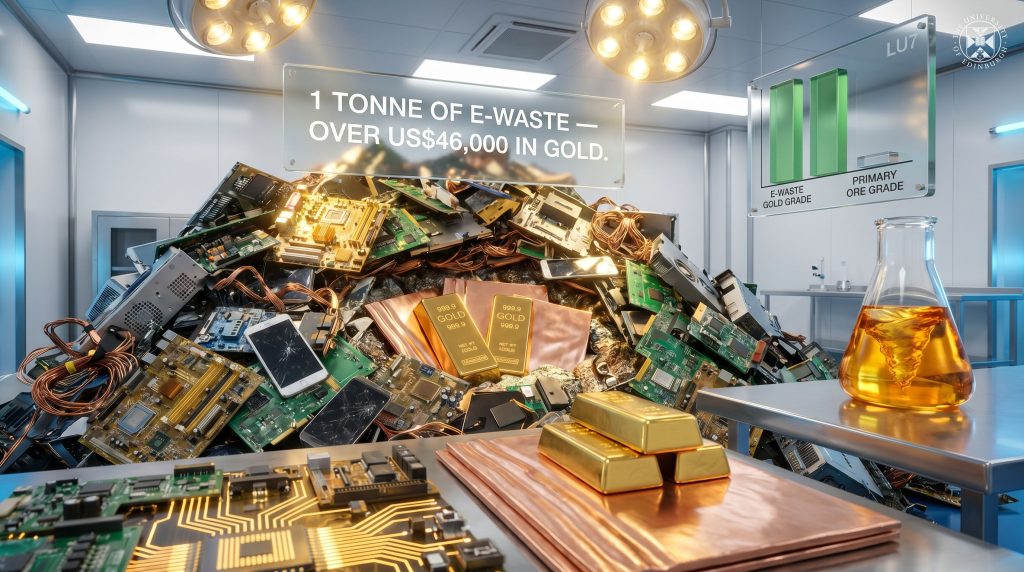
Research published by the University of Edinburgh found that a single tonne of standard e-waste can contain more than US$46,000 worth of gold and approximately US$2,000 worth of copper at prevailing market prices. For context, a high-grade hard rock gold mine might process ore averaging 5 to 10 grams per tonne. The gold concentration in certain categories of electronic scrap, particularly printed circuit boards from computers and telecommunications equipment, can reach 200 to 350 grams per tonne, an order of magnitude higher than most economically mineable primary deposits.
Yet despite this extraordinary concentration of value, the global e-waste recycling rate remains deeply inadequate. The United Nations Global E-waste Monitor has tracked annual e-waste generation surpassing 62 million tonnes in recent years, a figure projected to exceed 80 million tonnes by 2030. Of that total, less than a quarter is formally documented and recycled through controlled processes. The remainder is either stockpiled, exported to informal processing operations, or landfilled, representing both an environmental liability and an enormous unrealised economic opportunity.
The concept of urban mining captures this shift in thinking: treating the built environment and its discarded outputs as a primary metal source rather than a waste management problem. The economic case strengthens considerably when two high-value metals, gold and copper, can be recovered simultaneously from the same feedstock, as the processing economics of co-extraction are fundamentally different from recovering a single commodity.
When big ASX news breaks, our subscribers know first
How Does Hydrometallurgical E-Waste Processing Work?
The Science Behind Selective Metal Recovery from Electronic Scrap
Hydrometallurgy, at its core, is the application of aqueous chemistry to dissolve, separate, and recover metals from complex solid matrices. Unlike pyrometallurgy, which uses extreme heat to smelt and separate metals, hydrometallurgical processes work at comparatively low temperatures using liquid reagents to selectively target specific metals within a mixed feed.
Conventional e-waste processing has historically relied on smelting. Large-scale integrated smelters, particularly those in Europe and Asia, accept mixed electronic scrap and recover a range of base and precious metals through high-temperature processing. While effective at scale, pyrometallurgical methods carry significant drawbacks:
- Extreme energy consumption, with furnace temperatures frequently exceeding 1,200 degrees Celsius
- Toxic emissions including dioxins, furans, and heavy metal particulates requiring expensive abatement systems
- Limited selectivity, meaning fine-grained separation of individual metals requires additional downstream refining
- Reagent waste from fluxing agents and off-gas treatment chemicals
Cyanide leaching, a widely used hydrometallurgical method for gold recovery in primary mining, presents its own complications when applied to e-waste. Cyanide is highly effective at dissolving gold, but it is acutely toxic, subject to strict regulatory controls, and generates hazardous waste streams that are difficult and costly to manage.
Gold Copper Diamide Extraction (GCDE): A Technical Breakdown
The Gold Copper Diamide Extraction process, developed at the University of Edinburgh, approaches the selectivity problem from a fundamentally different chemical angle. The process centres on diamide ligands, organic compounds engineered to form stable complexes with specific metal ions in acidic aqueous solutions. The University of Edinburgh licensing announcement outlines the foundational science underpinning this approach in greater detail.
A ligand, in coordination chemistry, is a molecule that binds to a central metal atom through one or more electron pair donations. The diamide class of ligands has attracted significant academic interest because of their tuneable selectivity, meaning the molecular structure can be designed to preferentially bind certain target metals while leaving others in solution.
The GCDE process operates in two primary stages:
-
Gold extraction stage: The e-waste feedstock is first processed through an acidic leach, dissolving the metallic components into an aqueous solution containing multiple dissolved metals. The diamide reagent is then introduced, selectively complexing gold ions from the complex leach liquor. The gold-loaded reagent is then stripped and processed to precipitate refined gold product.
-
Copper recovery stage: Following gold extraction, a separate precipitating agent targets copper remaining in solution, enabling high-purity copper recovery through an electrowinning circuit that produces copper cathode directly.
Critically, the organic diamide reagent is recyclable, meaning it can be regenerated and reused across multiple processing cycles. This closed-loop reagent system is central to the process economics because reagent cost is typically a major operating expense in hydrometallurgical operations.
The comparative profile of GCDE against competing processing technologies is striking:
| Processing Method | Temperature Requirement | Cyanide Use | Reagent Recyclability | Relative Energy Cost |
|---|---|---|---|---|
| Pyrometallurgy (Smelting) | Very High | No | Low | High |
| Conventional Hydrometallurgy | Moderate | Often Yes | Moderate | Moderate |
| Cyanide Leaching | Low to Moderate | Yes | Low | Low to Moderate |
| GCDE (Diamide Extraction) | Low | No | High | Low |
The elimination of cyanide, mercury, and organic solvent extraction from the process flowsheet carries meaningful implications beyond operational efficiency. From a regulatory standpoint, cyanide-free processing significantly simplifies permitting in most jurisdictions. From an ESG perspective, the absence of acutely toxic reagents strengthens the environmental credentials of the technology and improves its positioning with offtake partners and institutional investors who apply responsible sourcing criteria.
What Is the Global E-Waste Opportunity and Why Is It Growing?
Quantifying the Scale of the Electronic Waste Metal Market
The structural drivers behind e-waste volume growth are well understood but underappreciated in their compounding effect. Three forces are converging simultaneously:
- Consumer electronics replacement cycles have shortened dramatically over the past two decades, with smartphones typically replaced every two to three years and laptops every four to five years
- Electric vehicle battery end-of-life is beginning to generate substantial volumes of high-value scrap as the first generation of mass-market EVs reaches end-of-service life
- Industrial equipment turnover, including data centre hardware, telecommunications infrastructure, and manufacturing control systems, produces consistent high-grade e-waste streams with predictable composition
The geographic concentration of e-waste generation closely tracks economic development. Asia, Europe, and North America together account for the majority of formal e-waste generation, though informal collection and processing systems in developing economies mean a significant proportion of global e-waste is processed without metal recovery optimisation or environmental controls.
Why Gold and Copper Recovery Economics Are Compelling
The economic case for e-waste metal recovery is highly sensitive to gold and copper spot prices, but the grade differential compared to primary ore makes the mathematics compelling even at conservative price assumptions. Furthermore, the battery recycling outlook points to rapidly expanding volumes of recoverable materials entering waste streams in the years ahead.
Unlike primary mining operations, e-waste feedstock does not require geological exploration, resource definition drilling, or discovery risk. The ore body is continuously and predictably replenished by the global consumer economy, creating a structurally different risk profile for processing technology developers.
Printed circuit boards from computers typically contain gold concentrations of 200 to 350 grams per tonne, compared to average grades of 1 to 5 grams per tonne in most operating hard rock gold mines. The copper content of high-grade electronic scrap, including wiring harnesses, transformer windings, and PCB traces, can reach 10 to 30 percent by weight in certain component categories, far exceeding the 0.3 to 1.0 percent copper grades typical of large-scale porphyry copper deposits.
When gold and copper are recovered simultaneously from the same feedstock and processing operation, the combined revenue per tonne of material processed can make processing economics viable at lower throughput volumes than would be required for a single-metal recovery operation.
Lithium Universe's Strategic Pivot: From Battery Metals to Urban Mining
Why an ASX-Listed Lithium Explorer Is Entering the E-Waste Technology Space
Lithium Universe (ASX: LU7) has built its identity around battery metals, specifically lithium project development. The company's decision to acquire an exclusive worldwide licence to the GCDE technology developed at the University of Edinburgh represents a meaningful strategic repositioning, adding a technology commercialisation dimension to a business that has primarily operated as an exploration-stage mining company. The Lithium Universe e-waste gold and copper technology acquisition is detailed in the company's official ASX announcement.
With a market capitalisation of approximately A$13 million at the time of its development roadmap announcement, Lithium Universe sits firmly in the micro-cap category. This scale carries both opportunity and constraint: the company is small enough that a successful technology commercialisation outcome could be highly transformative for shareholders, but also faces genuine questions about its capacity to fund the capital intensity of pilot plant construction and full-scale processing infrastructure.
The exclusive worldwide licence structure is commercially significant. An exclusive licence prevents the licensor, in this case the University of Edinburgh, from licensing the same technology to competing parties. Worldwide exclusivity extends that protection across all jurisdictions, enabling Lithium Universe to pursue both direct commercialisation and sublicensing revenue streams globally. For a company of this size, the sublicensing pathway may ultimately prove more capital-efficient than building and operating processing plants directly.
The 10-Step Commercialisation Roadmap: What Each Phase Involves
Lithium Universe has outlined a structured 10-step development program for the GCDE technology. Each phase addresses a distinct set of technical, economic, or commercial challenges:
- Feedstock optimisation: Identifying and securing consistent, high-volume e-waste input streams with appropriate metal grades
- Leaching condition development: Refining acid concentration, temperature profiles, and residence time parameters for the initial dissolution stage
- Reagent recovery circuit design: Engineering the closed-loop organic reagent recycling system that underpins process economics
- Gold precipitation circuit development: Achieving target purity thresholds for gold product meeting commercial refinery standards
- Copper electrowinning flowsheet: Integrating copper cathode production into the downstream processing sequence
- Metallurgical testwork and recovery assessment: Quantifying gold and copper recovery rates across varied feedstock compositions
- Operating cost modelling: Translating testwork results into processing economics and break-even analysis at target throughput
- Environmental management systems: Designing waste stream handling and regulatory compliance frameworks for target jurisdictions
- Commercial scalability evaluation: Assessing capital and engineering requirements for pilot-scale and full-scale plant design
- Market pathway development: Establishing feedstock supply agreements and offtake arrangements with downstream metal buyers
What Are the Key Technical and Commercial Risks for GCDE Technology?
Evaluating the Challenges Between Laboratory Validation and Commercial Scale
The path from university-originated intellectual property to a commercially operating processing plant is rarely linear, and the GCDE technology faces several categories of genuine risk that investors should weigh carefully:
- Feedstock variability: E-waste composition varies enormously by source, region, and equipment category. A reagent system optimised for one feedstock type may underperform on others, requiring significant reformulation work
- Scale-up engineering: Bench-scale chemistry does not translate automatically to continuous industrial processing. Heat and mass transfer dynamics, reagent mixing efficiency, and residence time requirements all change significantly as vessel sizes increase
- Reagent degradation: Organic ligands can degrade over repeated recycling cycles through side reactions, oxidation, or contamination. Maintaining selectivity and purity at commercial throughput requires rigorous quality management
- Capital intensity: Pilot plant construction for a hydrometallurgical process typically requires several million dollars in capital, a significant commitment relative to the company's current market capitalisation
- Regulatory pathways: Novel processing chemistries require regulatory approval in each target jurisdiction, with timelines that can extend development programs by years
The company's leadership has publicly acknowledged that substantial metallurgical and engineering work remains before pilot-scale validation becomes achievable. Investors should treat the 10-step roadmap as a development framework rather than a guaranteed commercial outcome.
Competitive Landscape: How Does GCDE Compare to Existing E-Waste Recycling Technologies?
The e-waste recycling technology space is not without competition. Several alternative approaches are in various stages of development globally:
- Ionic liquid processes offer high selectivity but face significant challenges around liquid stability, cost, and scale-up complexity
- Bioleaching uses microorganisms to solubilise metals from e-waste, an inherently low-energy approach but one constrained by slow kinetics and sensitivity to feedstock contamination
- Solvent extraction with conventional organic diluents is widely practiced but relies on hazardous organic solvents and generates problematic waste streams
- Integrated smelter operators such as Umicore and Aurubis possess enormous throughput capacity but focus on mixed-metal recovery without fine-grained selectivity
The university-originated IP basis of the GCDE technology provides a degree of defensibility that commercially developed processes may lack, particularly given the academic publication and peer review framework surrounding the underlying chemistry. Sublicensing to regional operators with established feedstock networks and processing infrastructure could represent a faster path to commercial relevance than building a vertically integrated processing business from scratch. In addition, high-voltage battery recycling developments are creating complementary secondary recovery streams that could feed into similar processing frameworks.
How Does E-Waste Metal Recovery Fit Within the Broader Critical Minerals Strategy?
Urban Mining as a Supply Chain Diversification Tool
The growing emphasis on supply chain resilience for critical and strategic metals has elevated secondary recovery from e-waste within the policy agendas of major economies. The European Union's Circular Economy Action Plan, the United States' critical minerals strategy, and equivalent frameworks across the Asia-Pacific region all identify e-waste recycling as a meaningful contributor to domestic metal supply security.
From a supply chain perspective, e-waste gold and copper recovery offers a compelling argument: metals recovered domestically from waste streams reduce dependence on primary mining operations concentrated in geopolitically sensitive jurisdictions. This is particularly relevant for copper, where a significant proportion of global primary production is concentrated in a small number of countries. Furthermore, critical minerals demand continues to accelerate as the global energy transition intensifies pressure on existing supply chains.
ESG and Sustainability Positioning for E-Waste Processing Technologies
The sustainability credentials of hydrometallurgical e-waste processing compare favourably with primary metal production across several dimensions. Moreover, advances in critical minerals processing are providing new benchmarks against which emerging technologies like GCDE will increasingly be measured.
| ESG Dimension | Primary Gold Mining | Primary Copper Mining | GCDE E-Waste Processing |
|---|---|---|---|
| Land Disturbance | High | Very High | Minimal |
| Water Consumption | High | Very High | Low to Moderate |
| Carbon Footprint | High | High | Low |
| Toxic Chemical Use | Cyanide-dependent | Acid-intensive | Cyanide-free |
| Community Impact | Often significant | Often significant | Low |
For electronics manufacturers operating under extended producer responsibility obligations, access to verifiably clean recycling pathways for end-of-life products is increasingly a compliance requirement rather than a voluntary sustainability initiative. This creates a potential demand-pull dynamic for processing technologies that can demonstrate robust environmental management systems and chain-of-custody documentation.
The next major ASX story will hit our subscribers first
What Milestones Should Investors Watch in the GCDE Development Program?
A Framework for Evaluating Progress Across the Commercialisation Pathway
For investors assessing the Lithium Universe e-waste gold and copper technology opportunity, a structured milestone framework provides a rational basis for evaluating progress beyond headline announcements:
| Milestone Category | Early Signal | Confirmation Signal |
|---|---|---|
| Metallurgical Performance | Positive bench-scale recovery data | Consistent results across varied feedstock types |
| Pilot Scale Validation | Pilot plant design announced | Pilot plant commissioned and operating |
| Feedstock Security | MOU with e-waste aggregator | Binding supply agreement executed |
| Commercial Offtake | Discussions disclosed | Binding offtake agreement signed |
| Technology Licensing | Sublicence interest declared | Revenue-generating sublicence executed |
The single most important near-term data point will be metallurgical testwork results demonstrating gold and copper recovery rates across a range of real-world feedstock types. Recovery rates above 90 percent for gold and 85 percent for copper would represent strong validation of the diamide selectivity claims. Anything materially below those thresholds would raise questions about commercial viability at realistic operating costs.
Frequently Asked Questions: E-Waste Gold and Copper Recovery Technology
What is the Gold Copper Diamide Extraction (GCDE) process?
The GCDE process is a hydrometallurgical technology that uses specially engineered organic diamide compounds to selectively bind and extract gold and copper from acidic solutions produced by dissolving electronic waste. The sequential recovery of two commercially valuable metals from a single feedstock and processing operation improves overall economics relative to single-metal recovery approaches.
How much gold and copper is typically found in e-waste?
Metal concentrations vary significantly by equipment category:
- Smartphones: Approximately 300 to 350 grams of gold per tonne of handsets
- Computer printed circuit boards: 200 to 350 grams per tonne gold, 10 to 20 percent copper by weight
- Industrial electronics and servers: Variable but consistently high-grade relative to primary ore
- Mixed consumer electronics: Typically 20 to 100 grams per tonne gold equivalent
These concentrations compare to average primary hard rock gold mine grades of 1 to 5 grams per tonne and primary copper mine grades of 0.3 to 1.0 percent.
Why is e-waste recycling not already widespread?
Three overlapping barriers have constrained formal e-waste recycling:
- Technical complexity: Mixed feedstocks with highly variable composition make optimised metal recovery difficult with conventional processing approaches
- Collection and logistics costs: Aggregating sufficient volumes of e-waste in a form suitable for processing requires substantial collection infrastructure investment
- Regulatory constraints: Hazardous waste classifications and transboundary movement restrictions create compliance barriers that add cost and complexity to e-waste supply chains
What is an exclusive worldwide technology licence and what does it mean commercially?
An exclusive licence grants the licensee the sole right to use the licensed intellectual property, preventing the licensor from granting equivalent access to any other party. A worldwide exclusive licence extends this exclusivity across all geographic markets. In practice, this means Lithium Universe controls both the direct commercialisation rights and the sublicensing rights for the GCDE technology globally, enabling it to generate revenue either by operating processing facilities or by licensing the technology to third-party operators in exchange for fees or royalty streams.
The Investment Thesis for E-Waste Metal Recovery: Opportunity, Risk, and Realistic Timelines
Structuring a Rational View of Early-Stage Technology Commercialisation
Technology commercialisation investments occupy a distinct position in the risk-return spectrum. The value proposition is binary in its early stages: either the technology achieves validated performance at commercial scale, or it does not. The distance between a licensed university process and a revenue-generating processing operation is measured in years and tens of millions of dollars of development capital, neither of which a A$13 million market cap company can easily absorb alone.
What the University of Edinburgh IP pedigree does provide is a credible scientific foundation. Academic peer review and institutional research infrastructure create a level of chemical validation that purely commercially developed processes may lack. The diamide ligand chemistry is grounded in established coordination chemistry principles, not speculative science.
The e-waste gold and copper recovery sector sits at the intersection of two powerful structural forces: accelerating global e-waste volumes and tightening ESG standards for primary metal production. Technologies capable of delivering demonstrably high recovery rates at competitive operating costs are well positioned to attract commercial and institutional interest over time. The distance between a licensed laboratory process and a commercially operating plant, however, should not be underestimated.
Comparable technology commercialisation timelines in the hydrometallurgical sector suggest a five to ten year pathway from initial licensing to full commercial operation is realistic, with significant capital raising requirements at each stage. Strategic partnerships, joint ventures with established e-waste aggregators, and sublicensing arrangements with regional operators represent the most likely acceleration levers for a company of Lithium Universe's current scale.
Market sentiment following the development roadmap announcement was characteristically mixed for an early-stage technology announcement: supporters see a differentiated technology with strong structural tailwinds, while sceptics are appropriately waiting for testwork results, pilot milestones, and commercial partnerships before attributing meaningful value to the Lithium Universe e-waste gold and copper technology. Both positions reflect rational investor behaviour at this stage of the development cycle.
This article is intended for informational purposes only and does not constitute financial advice. Investing in early-stage technology companies involves significant risk, including the potential loss of capital. Readers should conduct their own research and consult a qualified financial adviser before making any investment decisions.
Want to Know When the Next Major ASX Mineral Discovery Is Announced?
Discovery Alert's proprietary Discovery IQ model delivers real-time alerts the moment significant mineral discoveries hit the ASX, transforming complex data across more than 30 commodities into clear, actionable insights for both short-term traders and long-term investors — visit the Discovery Alert discoveries page to explore historic examples of extraordinary returns, and begin your 14-day free trial today to position yourself ahead of the broader market.