
August 12, 2026
Africa's Gold Development Frontier: Why Namibia Is Attracting Serious Capital
The global gold mining industry has spent decades concentrating capital in a handful of proven jurisdictions, leaving vast stretches of geologically prospective African terrain largely untouched. That calculus is shifting. As traditional gold belts in West Africa face mounting cost pressures, political instability, and increasingly complex permitting environments, institutional investors and specialist mining lenders are casting their attention further south. Namibia, long regarded as a stable but underexplored frontier, is emerging as one of the continent's most compelling destinations for large-scale gold development capital.
Within this evolving landscape, the Wia Gold Kokoseb project funding in Namibia has become a reference point for how a junior developer can progress from exploration-stage asset to fully funded construction candidate in a compressed timeframe, provided the geology, economics, and capital structure align convincingly.
When big ASX news breaks, our subscribers know first
Understanding What Makes Kokoseb Geologically Distinctive
Most undeveloped gold deposits in Africa are defined by relatively constrained mineralisation envelopes, with resources concentrated in discrete zones that limit long-term mine planning flexibility. Kokoseb breaks from this pattern in several important ways.
The Kokoseb gold project occupies a mineralised system extending along a strike length exceeding 5 kilometres, and critically, the mineralisation remains open at depth across that entire corridor. In geological terms, this is a meaningful differentiator. An open system at depth implies that drilling has not yet encountered a boundary or termination to the mineralised zone, meaning the current resource estimate reflects what has been drilled to date rather than the full extent of the system.
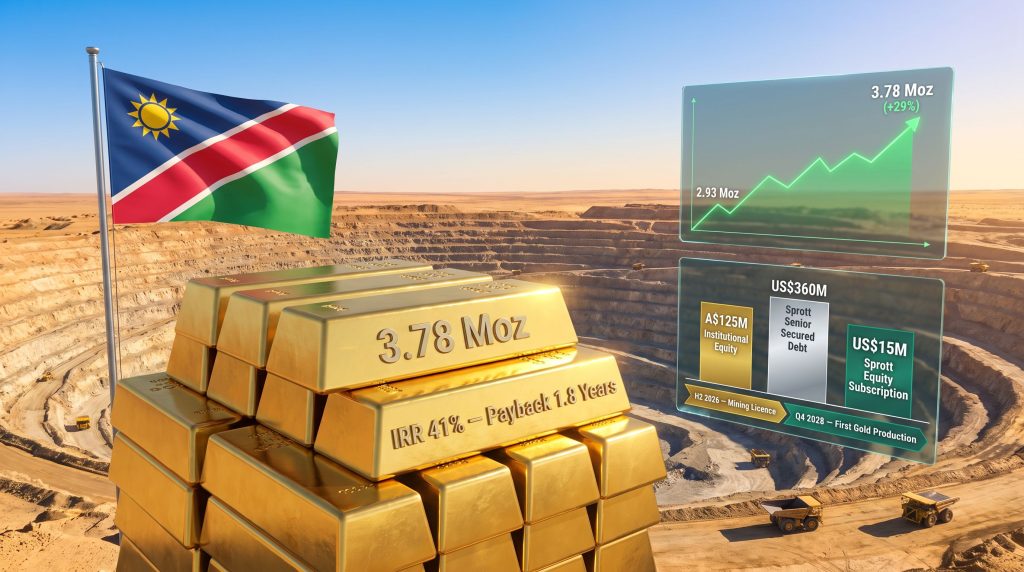
The updated Mineral Resource Estimate, released in August 2026, captures 3.78 million ounces of gold across 113 million tonnes at a grade of 1 gram per tonne. This represents a 29% uplift from the prior estimate, a growth rate that reflects the accelerated drilling campaign rather than any change in geological interpretation methodology.
Six diamond drill rigs remain active across the system, targeting depth extensions and continuity testing. Diamond drilling, as distinct from reverse circulation methods, recovers intact core samples that allow geologists to examine structural controls on mineralisation, alteration patterns, and grade continuity in three dimensions. Furthermore, this technical approach is particularly valuable for a system of Kokoseb's complexity, where understanding the structural architecture of the host rock is essential for projecting resource growth and designing underground development scenarios beyond the current open-pit mine plan. These ongoing drilling programs underscore the project's long-term upside potential.
Why Grade Matters More Than Tonnage in Open-Pit Economics
A common misconception among non-specialist investors is that resource size, measured in total ounces, is the primary driver of project value. In reality, the relationship between grade, strip ratio, and processing recovery determines whether a deposit generates attractive returns at any given gold price.
Kokoseb's resource grade of 1 g/t gold sits at the lower boundary of what is typically considered economic for open-pit operations in Africa. However, the project's DFS-confirmed economics suggest that metallurgical recovery rates, operating cost structure, and the scale of the operation more than compensate for the moderate headline grade. This is a pattern seen in several large, low-grade African open-pit operations, where bulk tonnage processing at controlled costs delivers superior project-level returns compared to higher-grade, smaller-scale alternatives.
What the DFS Numbers Actually Mean for Investors
A definitive feasibility study represents the highest level of technical and financial scrutiny applied to a mining project before a construction decision is made. The DFS incorporates detailed engineering designs, metallurgical test programs, environmental baseline studies, and comprehensive cost estimating, typically to an accuracy of plus or minus 10 to 15 percent.
For Kokoseb, the DFS confirmed the following core production and economic parameters:
| Metric | Confirmed Value |
|---|---|
| JORC Probable Ore Reserve | 69.8 Mt at 0.87 g/t Au for 1.95 Moz |
| Open Pit Mining Inventory | 72.9 Mt at 0.87 g/t Au for 2.03 Moz |
| Average Annual Production (Years 1-10) | ~150,000 oz/y |
| Total Production Over Mine Life | 1.84 million ounces |
| Mine Life | 14 years |
| Reserve Gold Price Assumption | US$2,600/oz |
| IRR (at US$3,600/oz) | 41% |
| Payback Period (at US$3,600/oz) | 1.8 years |
| Pre-Production Capital Requirement | ~US$358.8 million / N$6.2 billion |
Several aspects of these numbers warrant closer examination.
The reserve price assumption of US$2,600/oz is notably conservative relative to prevailing gold market conditions, which provides a meaningful buffer against commodity price downside. The convention in JORC-compliant reserve estimation is to use a price that can be justified as sustainable over the mine life, rather than a current spot price, which introduces speculative optimism into the reserve calculation.
The 41% IRR at US$3,600/oz is a figure that places Kokoseb in genuinely exceptional territory. Industry benchmarks for acceptable greenfield gold project returns typically range from 15% to 25% on an unlevered basis. A 41% return signals either very low capital intensity relative to production scale, an operating cost structure well below the industry average, or a combination of both.
The robust DFS outcomes have drawn considerable attention from specialist analysts, and it is easy to understand why. The 1.8-year payback period is perhaps the most striking economic indicator in the entire DFS package. For context, large open-pit gold developments in Africa typically carry payback periods of three to five years. A sub-two-year payback materially reduces the project's exposure to gold price volatility and provides a rapid return of invested capital to both equity holders and debt providers.
How Wia Gold Constructed a Fully Funded Capital Stack
The architecture of project financing for a greenfield mine of this scale is rarely straightforward. Securing full funding requires convincing multiple capital providers, each with different return expectations, risk tolerances, and security requirements, that the project merits their participation simultaneously.
The Three Pillars of the Kokoseb Funding Package
Pillar One: Institutional Equity Placement
In August 2026, Wia Gold secured firm commitments for an A$125 million equity raise from a combination of new and existing institutional and sophisticated investors. The placement is conditional on shareholder approval, with a general meeting expected in late September or early October 2026.
The proceeds are earmarked across several workstreams:
- Pre-production capital expenditure deployment
- Ongoing project studies, testwork, and development activities
- Permitting, environmental, and social compliance programs
- Regional exploration and project generation initiatives
- Corporate costs, working capital, and placement-related expenses
Pillar Two: Sprott Resource Lending Senior Debt Facility
Indicative terms have been agreed with Sprott Resource Lending for a project financing facility structured as a US$360 million senior secured debt facility. Sprott has also committed to a US$15 million equity subscription in any future equity raise by Wia Gold, subject to customary conditions precedent.
Sprott Resource Lending is a well-regarded specialist lender in the natural resources sector, and its participation in a transaction of this scale carries significant informational value for the broader market. Specialist resource lenders conduct extensive independent technical and financial due diligence before committing to facilities of this magnitude. Their willingness to structure a US$360 million senior secured position is effectively an independent validation of the DFS conclusions.
The equity co-investment component of US$15 million is particularly noteworthy from a market psychology perspective. It aligns Sprott's interests directly with Wia Gold shareholders, reducing the agency conflicts that can sometimes emerge between debt providers and equity holders in project finance structures.
Pillar Three: Existing Cash Reserves
Wia Gold's pre-existing cash position on the balance sheet contributes the final component of the fully funded capital stack, completing the package required to advance Kokoseb through construction and into first gold production.
Capital Raise History: A Progressive De-Risking Timeline
| Period | Capital Event | Amount |
|---|---|---|
| August 2025 | Equity raise for drilling, DFS advancement, and permitting | A$30 million |
| May 2026 | Institutional placement to strengthen balance sheet pre-DFS | A$92 million |
| August 2026 | Post-DFS institutional placement | A$125 million |
| 2026 (indicative) | Sprott senior secured debt facility | US$360 million |
| 2026 (indicative) | Sprott equity subscription commitment | US$15 million |
This capital raise sequence illustrates how Wia Gold systematically reduced technical risk before accessing progressively larger pools of capital. Consequently, this discipline distinguishes well-managed development companies from those that attempt to raise construction capital before completing adequate de-risking work. For investors interested in junior mining investment, Kokoseb's staged funding approach offers a compelling case study in structured de-risking.
Regulatory Pathway and Permitting Timeline
One of the less visible but critically important consequences of DFS completion is its role as a regulatory trigger. In Namibia's mining licensing framework, a completed DFS demonstrating technical and economic viability is a key input document for the mining licence application process.
Both the mining licence and associated environmental approvals are anticipated in the second half of 2026, following the DFS completion announcement. This timeline is significant because it establishes the regulatory prerequisites for construction mobilisation, which in turn gates the drawdown of the Sprott debt facility.
Namibia has developed a reputation among mining developers for relatively predictable regulatory processes compared to several other African jurisdictions. The country maintains a modern mining code, a stable legal system underpinned by the rule of law, and a government that has historically welcomed foreign direct investment in the extractive sector. These structural attributes reduce the sovereign risk premium that investors would otherwise apply to a project of this scale.
Benchmarking Kokoseb Against Africa's Development Pipeline
| Project Attribute | Kokoseb (Wia Gold) | Typical African Peer Range |
|---|---|---|
| Total MRE | 3.78 Moz | 1 to 5 Moz (mid-tier developers) |
| Annual Production Target | ~150,000 oz/y | 100,000 to 200,000 oz/y |
| IRR (at spot-adjacent pricing) | 41% | 15% to 35% |
| Payback Period | 1.8 years | 3 to 5 years |
| Mine Life | 14 years | 10 to 15 years |
| Pre-Production Capex | ~US$358.8M | US$200M to US$600M |
Viewed against this peer framework, Kokoseb's IRR and payback period position it in the upper quartile of economic performance for comparable undeveloped African gold assets. The combination of a large, growing open resource, active exploration upside along a 5+ km mineralised system, and a fully committed capital structure is relatively unusual among ASX-listed African gold developers. In addition, broader gold M&A activity in the region suggests that assets with these economic characteristics are attracting increasing attention from major producers.
The next major ASX story will hit our subscribers first
Development Roadmap: From Current Position to First Gold
The path from fully funded developer to producing gold miner involves a precise sequencing of regulatory, commercial, and technical milestones. For Kokoseb, the critical pathway looks as follows:
- Q3 2026: Shareholder approval for the A$125 million placement at the general meeting
- H2 2026: Expected grant of mining licence and environmental approvals following DFS completion
- 2026 to 2027: Pre-production capital expenditure deployment, early works, and permitting execution
- 2027 to 2028: Full construction phase, supported by Sprott debt facility drawdown
- Q4 2028: Targeted first gold production from Kokoseb
Execution Risk Considerations
No development project of this scale is without execution risk, and investors should approach the timeline above with appropriate awareness of the variables that can affect it. Key risk factors include:
- Regulatory approval timelines, which can be extended by environmental assessment requirements or community consultation processes
- Construction cost inflation, particularly for labour, steel, and energy inputs in the current macroeconomic environment
- Currency dynamics across the Australian dollar, United States dollar, and Namibian dollar, all of which are relevant to different components of the project's cost and revenue structure
- Gold price movements relative to the reserve assumption of US$2,600/oz, which determines the project's economic viability under conservative scenario planning
Disclaimer: The financial projections, IRR figures, payback periods, and production targets discussed in this article are based on information contained in the company's DFS and ASX announcements. These figures involve forward-looking assumptions and are subject to material risks and uncertainties. Readers should not rely on these figures as guarantees of future performance. Independent financial advice should be sought before making any investment decisions.
Frequently Asked Questions: Wia Gold Kokoseb Project Funding
What is the total funding secured for the Kokoseb gold project?
The Kokoseb project is fully funded through a combination of an A$125 million institutional equity placement, a US$360 million senior secured debt facility from Sprott Resource Lending, a US$15 million Sprott equity subscription, and existing cash reserves held by Wia Gold.
When is first gold production expected at Kokoseb?
Wia Gold is targeting first gold production from the Kokoseb project in Q4 2028, subject to the receipt of a mining licence and environmental approvals anticipated in the second half of 2026.
What did the Definitive Feasibility Study confirm about Kokoseb?
The DFS confirmed a JORC Probable Ore Reserve of 1.95 million ounces (69.8 Mt at 0.87 g/t Au), average annual production of approximately 150,000 oz/y over the first decade, a 14-year mine life, an IRR of 41%, and a payback period of 1.8 years at a gold price of US$3,600/oz.
How large is Kokoseb's mineral resource?
The updated MRE totals 3.78 million ounces of gold (113 Mt at 1 g/t Au), representing a 29% increase from the prior estimate.
Is the A$125 million placement conditional on any approvals?
Yes. The placement is conditional on shareholder approval, which Wia Gold expects to seek at a general meeting scheduled for late September or early October 2026.
What will the placement proceeds be used for?
Proceeds will fund pre-production capital expenditure, project studies and testwork, permitting and environmental compliance, regional exploration, and general corporate and working capital requirements.
Who is Sprott Resource Lending?
Sprott Resource Lending is a specialist natural resource lender that has agreed indicative terms with Wia Gold for a US$360 million senior secured debt facility, alongside a US$15 million equity co-investment, to support Kokoseb's development through to production.
Key Takeaways for Investors and Industry Observers
- The Wia Gold Kokoseb project funding in Namibia represents one of the most comprehensively structured development capital packages assembled for an undeveloped African gold asset in recent years
- A 41% IRR and 1.8-year payback period at a US$3,600/oz gold price assumption place Kokoseb in the top tier of economic performance among African greenfield gold developments
- The 29% resource upgrade to 3.78 Moz, combined with ongoing drilling across a 5+ kilometre mineralised system open at depth, signals meaningful long-term upside beyond the current 14-year mine plan
- Sprott Resource Lending's commitment of a US$360 million debt facility, alongside a US$15 million equity co-investment, functions as independent third-party validation of the project's economic quality
- First gold production targeted for Q4 2028 creates a clear, near-term commercial horizon for a project that has progressed from exploration candidate to fully funded developer across a disciplined capital raise sequence
For those focused on interpreting drill results and evaluating the technical underpinnings of a project like this, the Kokoseb dataset provides an exceptionally detailed foundation for analysis. Readers seeking additional context on African gold project development and junior mining capital markets may also find value in exploring industry coverage published by Mining Weekly at miningweekly.com, which provides ongoing reporting on resource sector developments across the African continent.
Want to Catch the Next Major ASX Mineral Discovery Before the Market Does?
Discovery Alert's proprietary Discovery IQ model scans ASX announcements in real time, instantly identifying significant mineral discoveries and turning complex data into actionable investment insights — explore historic discoveries and their exceptional returns, then begin your 14-day free trial at Discovery Alert to position yourself ahead of the broader market.