July 21, 2026
Angola's Next Investment Frontier: Why Southeast Asian Capital Is Flowing Into the Heart of Africa
Across Sub-Saharan Africa, a structural reordering of foreign investment is quietly underway. For decades, the continent's resource-rich economies attracted capital primarily through a single transactional model: extract the commodity, ship it abroad, and leave the value-added processing to wealthier nations. That model is fracturing. A new generation of Asian industrial conglomerates is arriving not simply to mine or harvest, but to build integrated supply chains that connect African land and resources directly to manufacturing ambitions thousands of kilometres away. Angola sits at the centre of this shift, and the Xuan Thien Group investment in Angola now represents one of the most architecturally complex private commitments on the continent.
When big ASX news breaks, our subscribers know first
Angola's Diversification Imperative and the Capital It Is Attracting
Understanding why a Vietnamese industrial conglomerate would commit billions of dollars to Angola requires appreciating just how deliberately the country has restructured its investment environment. Historically, crude oil has accounted for approximately 95% of Angola's export revenues, creating a textbook case of resource dependency that left the broader economy exposed to every swing in global energy markets.
The oil price collapse of 2014 became the inflection point. Angola's government accelerated efforts to attract non-oil foreign capital, deploying the Investment Promotion Agency (AIPEX) as the institutional engine for this diversification drive. Critically, the strategy shifted focus away from the capital, Luanda, and toward provincial economies that had historically been bypassed by inbound investment.
The results over the past five years have been measurable:
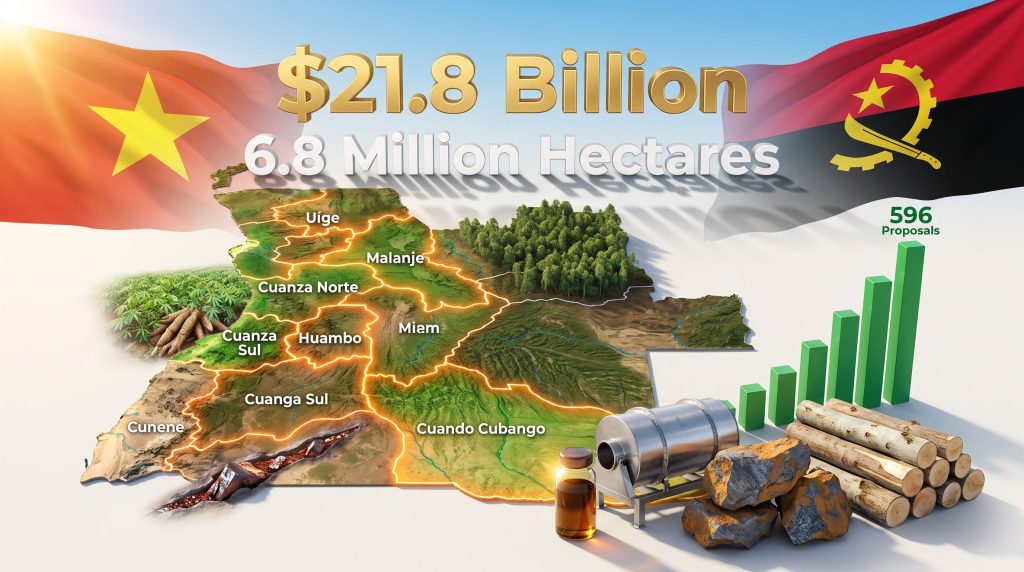
- Angola received 596 foreign investment proposals with a combined estimated value of $21.8 billion between approximately 2020 and 2025.
- Chinese investors account for roughly 80% of those proposals by volume.
- Notable Chinese-backed projects include a $900 million port terminal at Barra do Dande and $4.8 billion in financing sought by state oil company Sonangol from Chinese financial institutions to fund part of the $6.2 billion Lobito refinery.
- The UAE has committed nearly $6.5 billion across 44 agreements covering agriculture, energy, infrastructure, and port management.
- Vietnam remains a smaller capital contributor in absolute terms, but the scale and complexity of Xuan Thien's pipeline is changing that calculus rapidly.
Special economic zones have become a key structural incentive mechanism, offering large-scale investors preferential frameworks that reduce friction during the early phases of project development.
Who Is Xuan Thien Group and What Does Angola Mean to Its Global Strategy?
Xuan Thien Group is a privately held Vietnamese conglomerate chaired by Nguyen Van Thien. Its core business verticals span agro-industrial processing, mineral extraction, green energy, and hydrocarbons. What distinguishes the group from typical resource-focused investors is the degree to which its Angola operations are structurally integrated with its domestic Vietnamese industrial ambitions.
Angola has been designated internally as the group's primary international investment destination, with active project implementation beginning in 2023. The rationale is grounded in a combination of factors that, taken together, are difficult to replicate elsewhere in the developing world:
- Access to 6.8 million hectares of arable and forestry land suitable for large-scale agro-industrial development.
- Iron ore deposits described as containing hundreds of millions of tonnes, relevant to green steel manufacturing.
- Angola's geographic position as a logistics gateway into Southern and Central African consumer markets.
- A young labour force capable of supporting labour-intensive processing and manufacturing operations.
- A natural agricultural fit between Angola's cassava-growing conditions and Vietnam's established expertise in cassava starch processing.
The conceptual architecture here is worth pausing on. Xuan Thien is not building standalone projects in Angola. It is constructing upstream supply nodes that feed directly into Vietnam's domestic industrial decarbonisation strategy, most notably its Green Steel Complex, which is designed to produce zero-carbon steel using pig iron derived from Angolan iron ore and eucalyptus-derived charcoal from Angolan plantations. Furthermore, green iron production methods are becoming increasingly central to how industrial conglomerates across Asia plan their long-term manufacturing roadmaps.
This upstream-downstream integration model, where African land and resources serve as the raw material foundation for Asian industrial production, represents a qualitatively different form of foreign investment than the extraction-only models that have historically defined foreign engagement with African economies.
The Full Scale of the Angola Portfolio: A Multi-Sector Investment Map
The breadth of Xuan Thien's Angola commitments is best understood through a structured overview of its confirmed and projected project pipeline:
| Sector | Project | Projected Investment | Scale / Capacity | Location |
|---|---|---|---|---|
| Agro-forestry (Phase I) | Xixila Industrial Complex | $750 million | 500,000 ha; ~1.6M tonnes/year | Cuanza Sul, Malanje |
| Agro-forestry SEZ | Special Economic Zone (in progress) | $4.5 billion (projected) | 6.8 million hectares | Cuanza Sul, Malanje, Uíge |
| Oil and Gas | Etosha-Okavango Basin exploration | $200M to $300M (initial phase) | 200,000 km² exploration area | Cunene, Cuando Cubango |
| Mining and Green Steel | Iron ore extraction and eucalyptus plantations | Integrated into Green Steel Complex | 1 million hectares eucalyptus | Angola (multiple provinces) |
| Coffee and Agriculture | Cultivation and processing across six provinces | Undisclosed | ~50,000 families targeted | Uíge, Malanje, Huambo, Cuanza Norte, Cuando Cubango |
The Xixila Agroforestry Complex: Angola's Largest Private Agricultural Development in a Decade
The centrepiece of Xuan Thien's existing Angola footprint is the Xixila Agroforestry Complex, developed through Agrostars Angola, a joint venture between Xuan Thien Group and Equity Group. Phase I infrastructure encompasses:
- Cassava starch processing plant.
- Instant noodle manufacturing facility.
- Food-grade cassava flour mill.
- Organic fertiliser production facility.
- Large-scale cassava cultivation across more than 500,000 hectares.
At full development, the project is projected to generate up to 95,000 direct and indirect jobs, making it potentially one of the largest single employment generators from a foreign private investor in Angola's non-oil history. In addition, the group's green iron strategy aligns closely with its Angolan eucalyptus plantations, which are intended to supply the charcoal inputs required for low-emission pig iron manufacturing.
The Oil and Gas Frontier: Vietnam's First Conglomerate in Angola's Hydrocarbon Sector
On March 17, 2025, Xuan Thien formalised an exploration agreement with Angola's National Agency for Petroleum and Biofuels (ANPG) covering seismic studies across a 200,000 km² zone within the Etosha-Okavango Basin. The initial exploration commitment is estimated at between $200 million and $300 million, funded entirely by Xuan Thien with no disclosed Angolan state co-financing in this phase.
The significance of this milestone extends beyond its financial scale. It marks the first entry by a Vietnamese private conglomerate into Angola's upstream oil and gas sector, a space that has historically been dominated by Chinese state enterprises, Western majors, and Sonangol.
Breaking Down the Six-Province Expansion
The most recent development in Xuan Thien's Angola strategy involves a proposed multi-sector expansion across six provinces. Angola's Foreign Minister Téte António discussed these plans directly with Nguyen Van Thien during a meeting in Luanda, reflecting the high-level diplomatic engagement surrounding the initiative.
The Six Target Provinces and Their Strategic Logic
Each province in the expansion carries a distinct strategic rationale:
- Uíge: A historical coffee-growing region where Xuan Thien plans to establish plantations and an industrial processing facility capable of retaining value domestically rather than exporting raw beans.
- Malanje: Integrated into the broader agroforestry SEZ corridor, with cassava cultivation expansion planned alongside the existing Xixila operations.
- Cuando Cubango: Overlaps geographically with the Etosha-Okavango oil and gas exploration zone, giving this province dual-use potential across agricultural and energy sectors.
- Cuanza Norte: Positioned as an agricultural diversification corridor with proximity to existing Cuanza Sul operations.
- Huambo: Angola's highland agricultural heartland, known for its fertile soils and strong agro-processing potential.
- Cuanza Sul: The existing operational base where cassava cultivation and processing is already underway through Agrostars Angola.
What Has Been Confirmed Versus What Remains Projected
Investors and analysts tracking this story should distinguish carefully between confirmed operational activity and announced intentions:
| Status | Project Element |
|---|---|
| Operational | Cassava cultivation and processing, Cuanza Sul |
| Agreement Signed | Oil and gas exploration with ANPG (March 2025) |
| Joint Venture Active | Agrostars Angola, Xixila Complex Phase I |
| In Progress | Six-province agriculture, mining, and manufacturing expansion |
| Projected | $4.5 billion Special Economic Zone across 6.8 million hectares |
| Undisclosed | Confirmed investment value for the six-province expansion |
It is worth noting explicitly that no new investment figure for the six-province expansion has been publicly disclosed by either Angola's foreign ministry or Xuan Thien Group. The previously cited figures for the SEZ and Xixila Complex should not be applied to this new announcement without verification.
Angola Within the Broader Asian and Gulf Investment Landscape
The Xuan Thien Group investment in Angola does not exist in isolation. It is one data point within a much larger convergence of Asian and Gulf capital targeting the country's underutilised productive assets.
Vietnam-Angola Economic Relations: From Trade to Industrial Co-Development
Bilateral trade between Vietnam and Angola reached a peak of $227.1 million in 2023, reflecting both governments' active efforts to expand commercial ties. However, the gap between that trade figure and Xuan Thien's multi-billion-dollar investment pipeline illustrates a qualitative transformation in the relationship: it is moving from simple commodity exchange toward long-term industrial co-development.
Why Southeast Asian Industrial Capital Is Targeting Sub-Saharan Africa Now
Several structural forces are driving this shift beyond any single company's strategy. Consequently, understanding these dynamics is essential for analysts assessing the durability of this investment wave:
- Resource scarcity pressures in Southeast Asia are pushing outbound investment into land-rich African economies where arable land, water, and mineral endowments remain underutilised relative to their potential.
- Vietnam's industrial upgrading strategy requires secure upstream access to agricultural commodities, minerals, and energy inputs that cannot be sourced domestically at the required scale.
- Green economy transition dynamics are creating new alignment between African resource endowments and Asian manufacturing decarbonisation goals. The eucalyptus-to-pig-iron supply chain is a precise example of this alignment in action.
- Angola's regulatory reforms and the active role of AIPEX have lowered entry barriers for non-traditional investors who might previously have prioritised more familiar markets.
Furthermore, the surge in critical minerals demand globally is reinforcing the strategic logic of securing long-term access to mineral-rich territories across Sub-Saharan Africa before competition intensifies further.
The next major ASX story will hit our subscribers first
Projected Social and Economic Impacts Across Angola's Provinces
Employment and Income Generation
The human development dimension of Xuan Thien's Angola strategy is as significant as the capital figures. Across the six-province expansion, the group's activities are projected to create income opportunities for approximately 50,000 Angolan families. When combined with the Xixila Complex's potential to generate up to 95,000 direct and indirect jobs at full build-out, the aggregate social impact could rival that of some of Angola's major infrastructure programmes.
The coffee processing infrastructure merits specific attention. By building industrial processing capacity inside Angola rather than simply exporting unprocessed beans, Xuan Thien's model is designed to capture value-added revenue within the country. This is a structurally different outcome from the commodity export model that has historically dominated African agricultural sectors. Vietnamese industrialists active across Angola's provinces are increasingly framing their investments in exactly these terms.
Provincial Economic Development Beyond the Capital
The deliberate geographic spread of Xuan Thien's investments into interior provinces including Malanje, Uíge, Huambo, and Cuando Cubango represents a departure from the Luanda-centric investment patterns that have historically characterised foreign capital in Angola. This distribution model carries the potential to stimulate ancillary economic activity in transport, logistics, packaging, and local services across regions that have been structurally marginalised from the oil economy.
However, projects of this scale also carry risks that must be acknowledged:
- Large-scale land concessions require transparent community consultation and robust land rights frameworks to prevent displacement of local populations.
- The timeline gap between announced investment and confirmed capital deployment can be substantial, particularly for projects of this complexity.
- Environmental management of eucalyptus monocultures at million-hectare scale requires careful oversight given the species' known impacts on water tables in certain soil conditions.
Key Structural Signals for Investors and Analysts
Beyond the headline figures, several structural signals embedded in Xuan Thien's Angola strategy reveal broader trends in African investment:
- Vertical integration over extraction: The group is building processing infrastructure inside Angola rather than simply exporting raw commodities, a model that generates more durable economic linkages within the host country.
- Provincial depth over capital concentration: Targeting interior provinces signals a development model with broader social impact potential and reduced competition for assets compared to Luanda-centric investment.
- Green supply chain logic: The eucalyptus-to-green-steel pipeline directly connects Angolan land resources to Vietnam's industrial decarbonisation ambitions, a model that may attract replication by other Asian manufacturers facing similar supply chain pressures.
- Scale ambition with phased execution: A projected 6.8 million-hectare Special Economic Zone would represent one of the largest private agricultural land concessions in African history if fully realised. Phased delivery reduces execution risk but extends the timeline for full economic impact.
- Diplomatic facilitation at the highest level: Direct engagement between Angola's Foreign Minister and Xuan Thien's chairman signals meaningful state-level facilitation, which typically reduces sovereign risk for project implementation.
In addition, renewable energy in mining and agro-industrial contexts is increasingly embedded within the group's broader operational model, further distinguishing its approach from legacy extraction-focused investors.
Disclaimer: Investment figures cited for the Special Economic Zone ($4.5 billion) and the six-province expansion represent company projections and outcomes of government-level discussions. Announced intentions should be clearly distinguished from confirmed capital deployment when evaluating realistic economic impact timelines. This article does not constitute financial advice.
Frequently Asked Questions: Xuan Thien Group Investment in Angola
What is the total value of Xuan Thien Group's investment in Angola?
The group's confirmed and projected Angola portfolio exceeds $5 billion in aggregate, combining the $750 million Xixila Complex, the $4.5 billion Special Economic Zone projection, and the $200 to $300 million initial oil and gas exploration commitment. The investment value specific to the newly announced six-province expansion has not been publicly disclosed.
Which provinces is Xuan Thien Group targeting in Angola?
The six-province expansion covers Uíge, Malanje, Cuando Cubango, Cuanza Norte, and Huambo, building on the existing operational base in Cuanza Sul where cassava cultivation and processing is already underway.
What is the Agrostars Angola joint venture?
Agrostars Angola is a joint venture between Xuan Thien Group and Equity Group, established to develop the Xixila Industrial Complex in Cuanza Sul. The project encompasses cassava plantations, a starch processing plant, a flour mill, an instant noodle factory, and an organic fertiliser facility, with a Phase I valuation of approximately $750 million.
When did Xuan Thien Group enter Angola's oil sector?
The group signed an exploration agreement with Angola's National Agency for Petroleum and Biofuels (ANPG) on March 17, 2025, covering a 200,000 km² exploration zone in the Etosha-Okavango Basin. This was the first entry by a Vietnamese private conglomerate into Angola's upstream hydrocarbon sector.
What sectors is Xuan Thien Group focused on across Angola?
The Xuan Thien Group investment in Angola spans four primary sectors: agro-industrial processing covering cassava and coffee, mineral extraction including iron ore prospecting, oil and gas exploration in the Etosha-Okavango Basin, and the green economy encompassing eucalyptus plantations and renewable energy components supporting green pig iron production.
Want to Stay Ahead of the Next Major Mineral Discovery Driving These Global Supply Chains?
As Southeast Asian and Gulf capital reshapes Africa's resource landscape, Discovery Alert's proprietary Discovery IQ model delivers real-time alerts on significant ASX mineral discoveries, translating complex geological and commodity data into actionable insights for investors at every level — explore historic discoveries and their returns to understand the scale of opportunity, then begin your 14-day free trial at Discovery Alert to position yourself ahead of the market.