August 5, 2026
The Sovereign Bet That Defies Conventional Debt Logic
Across the history of sovereign debt crises, the standard recovery script follows a familiar pattern: austerity, structural adjustment, currency stabilisation, and a cautious return to markets only after years of fiscal restraint. Zambia is writing a different chapter entirely. Rather than retreating into prolonged belt-tightening, Lusaka is accelerating into a new borrowing cycle, one explicitly calibrated around the premise that copper will be worth far more to global industry in 2031 than the debt servicing it generates today.
This is not a reckless gamble dressed in optimistic language. It is a structurally distinct model of post-default recovery, one that uses the projected global scarcity of copper as the macroeconomic foundation for renewed creditworthiness, without formally pledging ore in the ground as collateral. Understanding why this distinction matters, and whether the wager will pay off, requires working through the mechanics of Zambia's debt restructuring and copper borrowing strategy from the ground up.
When big ASX news breaks, our subscribers know first
Understanding the Four-Year Economic Freeze That Preceded the Recovery
In November 2020, Zambia became the first African sovereign to default during the COVID-19 era, triggering a period of market exclusion that would last approximately four years. The default did not arrive suddenly. It was the culmination of a decade in which Chinese state-linked infrastructure loans accumulated faster than the productive capacity they were meant to unlock, copper prices remained structurally suppressed, and pandemic-era fiscal shocks removed the final buffer between debt service and insolvency.
The human cost of that period extended well beyond balance sheets. The Zambian kwacha lost more than 97% of its value against the US dollar between early 2020 and early 2026, according to figures compiled by the Ministry of Finance and National Planning. With 60.28% of the country's debt portfolio denominated in foreign currency, every kwacha depreciation cycle fed directly into a larger domestic-currency debt burden, compressing the fiscal space available for social expenditure and capital investment simultaneously.
| Consequence | Metric |
|---|---|
| Kwacha depreciation vs USD (2020-2026) | More than 97% loss |
| Default period duration | Approximately 4 years (2020-2024) |
| Foreign currency share of debt portfolio | 60.28% |
| Mining sector's GDP contribution (Q3 2024) | 13% |
| Copper share of total export revenue | 70-75% |
Mining contributed 13% of gross domestic product in the third quarter of 2024, and copper accounted for between 70% and 75% of total export revenues during the default period. Consequently, the commodity which most needed investment to grow was also the one whose price weakness had contributed most directly to the fiscal collapse in the first place.
How Zambia's Debt Restructuring Actually Worked
The G20 Common Framework: Architecture and Limitations
Zambia's restructuring was conducted under the G20 Common Framework, a multilateral coordination mechanism designed specifically to manage debt relief across creditor classes that previously operated under separate bilateral arrangements. The Framework was notable for bringing Chinese state lenders into a coordinated process alongside Paris Club members, a geopolitically significant development given that China held the largest single share of Zambia's bilateral obligations.
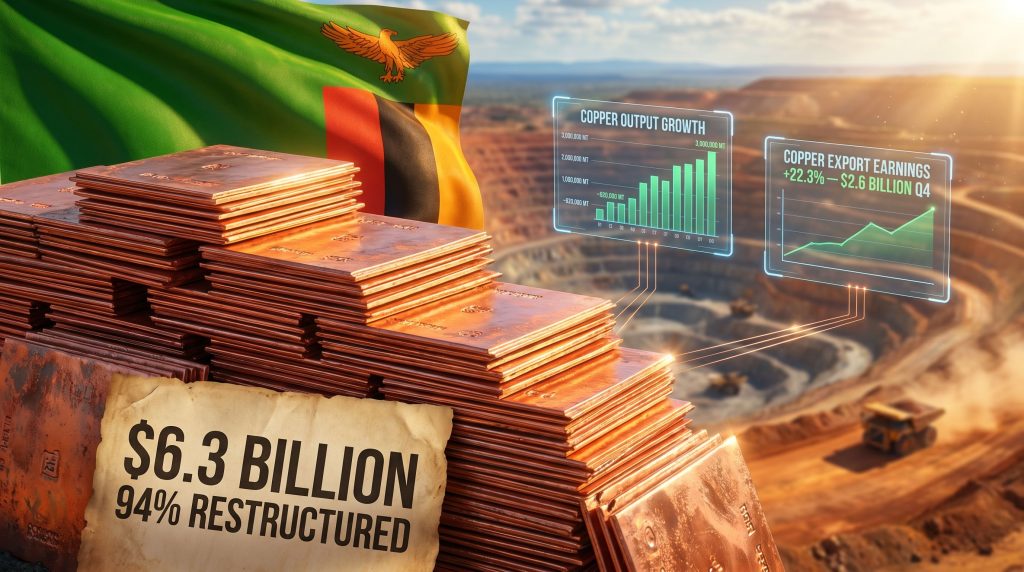
By June 2023, $6.3 billion in official bilateral debt had been restructured, with China co-chairing the creditor committee alongside France. Five separate bilateral creditor agreements had been finalised by the time the IMF completed its sixth programme review in January 2026, with India among the official creditors included in the process. For a thorough examination of how this process unfolded, Zambia's debt turnaround provides useful structural context on the creditor coordination dynamics involved.
The IMF Extended Credit Facility: Fiscal Architecture
The IMF's approval of a $1.7 billion Extended Credit Facility in 2022, subsequently expanded in 2024, provided the structural anchor around which all other creditor negotiations orbited. Without the Fund's endorsement of Zambia's fiscal trajectory, bilateral and commercial creditor agreements would have lacked the verification mechanism creditors required to commit to relief terms.
The ECF's conditionality structure demanded fiscal consolidation, revenue administration reform, and maintenance of social protection expenditure floors. Compliance with these benchmarks served as a credibility signal that enabled the broader restructuring process to advance.
Bondholder Agreements and Commercial Debt Progress
The bondholder component of the restructuring delivered approximately $840 million in claim reductions, with an estimated $2.5 billion in cashflow relief secured across the IMF programme period. By October 2025, roughly 94% of eligible external debt had been restructured, covering official bilateral creditors and international bondholders.
The critical unresolved element as of early 2026 remained approximately $3.3 billion in commercial creditor obligations, including loans from China Development Bank, which were still under active negotiation at the time of the IMF's sixth review (IMF Staff Report, January 2026).
Key Distinction: Zambia's restructuring differed from earlier African sovereign workouts primarily because it required coordinating between Paris Club creditors, Chinese state banks, and international bondholders simultaneously, rather than sequentially. This tripartite negotiation structure, managed under the Common Framework, was genuinely unprecedented in scope for a sub-Saharan African economy.
What Zambia's Copper Borrowing Strategy Actually Means
Export Revenue Thesis, Not Resource-Backed Collateral
A persistent mischaracterisation surrounds Zambia's post-default financing model. Critics and commentators frequently conflate it with resource-backed lending arrangements, in which future commodity output is directly pledged as collateral against loan repayments. Zambia's approach operates differently:
- Resource-backed loans contractually assign future commodity output to creditors, creating off-balance-sheet obligations tied to physical production
- Zambia's model uses the projected trajectory of copper export revenues as the macroeconomic basis for demonstrating debt sustainability to new lenders, without the ore itself constituting formal security
- The distinction is legally and fiscally significant: Zambia retains sovereign control over its mineral assets, but its borrowing capacity is nonetheless contingent on copper delivering the revenue projections underpinning fiscal sustainability analyses
Furthermore, the global copper supply gap lends additional macroeconomic credibility to this approach, as the projected scarcity of mined copper reinforces the long-term revenue thesis that underpins Zambia's renewed creditworthiness.
The 3 Million Metric Ton Target: Scale of Ambition
Current copper output stands at approximately 820,000 metric tons annually based on 2024 production figures compiled by the Zambia Institute for Policy Analysis and Research. The national target of 3 million metric tons per year by 2031 represents a nearly 266% increase within seven years, a scale of production growth that would require simultaneous expansion across mining capacity, energy infrastructure, processing facilities, and export logistics.
| Production Metric | Current (2024) | Target (2031) | Required Growth |
|---|---|---|---|
| Annual copper output | ~820,000 MT | 3,000,000 MT | ~266% increase |
| Share of export revenue | 70-75% | Projected higher | Expanding |
| GDP contribution (mining) | ~13-15% | Target above 20% | Expanding |
What makes this ambition credible to external investors rather than purely aspirational is the global demand context into which Zambia is seeking to expand output. Indeed, the Zambia copper production forecast for 2025 and beyond highlights why international capital continues to view these targets with measured optimism rather than scepticism.
Why the Global Copper Deficit Makes This Strategy Investable
The International Energy Agency projects a roughly 30% gap between mined copper supply and demand by 2035 under its stated-policies scenario, a shortfall driven by electrification infrastructure, electric vehicle battery supply chains, and grid-scale renewable energy deployment. This structural deficit creates a demand floor that extends across planning horizons relevant to mine development timelines.
Zambia holds one of the world's largest remaining undeveloped copper deposit concentrations, situated within the Central African Copperbelt, a geological formation that stretches across Zambia and the Democratic Republic of Congo. The Copperbelt's copper mineralisation is hosted primarily in sedimentary rock sequences, with ore grades in several undeveloped deposits ranging from 1.5% to 3.5% copper, materially above the global average open-pit grade of around 0.5% to 0.7%. Higher ore grades translate directly into lower processing costs per tonne of refined copper produced, a critical competitive advantage when global copper prices compress.
Geological Context: The Copperbelt's stratiform copper deposits, formed approximately 800 million years ago during the Neoproterozoic era, differ structurally from the porphyry copper systems dominant in Chile and Peru. Stratiform deposits typically exhibit more consistent grade distribution across the ore body, which can reduce grade variability risk in mine planning and production forecasting. This geological predictability is one reason the region continues to attract major mining capital despite infrastructure constraints.
In addition, the broader critical minerals demand picture reinforces why copper-rich nations like Zambia occupy a strategically privileged position within global energy transition supply chains. Zambia has also signed a memorandum of understanding with the DRC targeting electric vehicle battery value chain development, positioning the two countries to move beyond raw copper export toward downstream processing and materials supply, though the timeline and commercial terms of that arrangement remain under development.
The $2.2 Billion Investment Wave: Deal-by-Deal Analysis
Since December 2024, Zambia has signed or launched financing commitments exceeding $2.2 billion, the most concentrated sequence of external capital commitments since President Hakainde Hichilema assumed office in 2021.
| Project | Financier(s) | Value | Sector | Date |
|---|---|---|---|---|
| Lobito Atlantic Railway | U.S. DFC + DBSA | $553M + $200M | Transport/export corridor | December 2024 |
| 900 MW Energy Portfolio | CMEC / Sinomach | $1.5 billion | Power generation | April 2026 |
| Leopards Hill Solar + Storage | Globeleq (BII + Norfund) | €290 million | Renewable energy | April 2026 |
| Mingomba Copper Mine | KoBold Metals | $2.3 billion | Mining | May 2026 (groundbreaking) |
Sources: DFC press release (December 2024); Zambia Development Agency statement (April 2026); Ecofin Agency (May 2026)
Reading the Infrastructure Logic Behind the Capital
Each of these investments functions as an enabler of copper production at a different point in the value chain, rather than simply as isolated commercial transactions:
- The Lobito Atlantic Railway reduces the logistics cost and transit time for copper concentrate moving from the Copperbelt to Atlantic ports, addressing one of the primary competitive disadvantages Zambian producers face relative to Chilean and Peruvian peers with direct Pacific access
- The 900 MW energy portfolio targets chronic electricity deficits that have historically forced Zambian smelters to operate below nameplate capacity, a constraint that caps copper output irrespective of ore availability
- The Leopards Hill solar-plus-storage project contributes both grid stability and ESG compliance credentials that Western copper buyers increasingly demand as conditions of long-term offtake agreements
- KoBold Metals' Mingomba mine, which broke ground in May 2026 with a committed $2.3 billion investment, represents the single largest new mining development currently underway in Zambia
KoBold Metals, backed by prominent technology and resource investors and applying artificial intelligence-driven geological analysis to target identification, has positioned Mingomba as a high-grade deposit capable of materially shifting Zambia's production trajectory. The mine's ramp-up timeline will be one of the three most consequential variables determining whether Zambia's 3-million-tonne ambition remains credible through the late 2020s.
How Copper Revenues Are Already Reshaping Zambia's Budget
The fiscal dividend from copper is no longer theoretical. In the fourth quarter of the most recent reporting period, copper export earnings rose 22.3% to reach $2.6 billion, while corporate income tax receipts from mining companies exceeded their quarterly target by 115.3%, contributing to a primary budget surplus of 8.36 billion kwacha, according to the Ministry of Finance and National Planning bulletin.
Direct foreign-currency tax payments from miners totalled $344.6 million in the quarter, forming the bulk of foreign reserve accumulation for the period. This is structurally significant: it means Zambia's reserve position is being rebuilt not through multilateral disbursements or sovereign bond issuance, but through the operating cash flows of mining companies paying taxes in hard currency.
Why This Matters for Debt Sustainability: Reserve accumulation driven by mining tax receipts creates a self-reinforcing dynamic when copper prices are elevated: higher prices generate larger tax payments, larger payments rebuild reserves, and stronger reserves reduce pressure on the kwacha, which in turn lowers the domestic-currency cost of servicing foreign-denominated debt. The concern is that this loop operates just as powerfully in reverse during a commodity price downturn.
The next major ASX story will hit our subscribers first
Currency Innovation: The Yuan Settlement Arrangement
In October 2024, Chinese mining firms operating in Zambia began settling their tax obligations in Chinese yuan, in an arrangement confirmed by the Bank of Zambia and reported as the first such arrangement on the African continent. Talks on a formal bilateral currency swap agreement with the People's Bank of China were initiated in 2025.
The strategic logic behind this arrangement operates on two levels. First, it reduces Zambia's dependence on US dollar liquidity for day-to-day budget operations, providing a partial hedge against kwacha-dollar volatility. Second, it deepens financial integration with China at a moment when Beijing remains Zambia's largest bilateral creditor and holds approximately $3.3 billion in unresolved commercial claims.
A comparable arrangement in Kenya, where the government converted $5 billion in railway debt into yuan-denominated terms in 2025, was estimated to generate $215 million in annual savings, according to Bloomberg News. Whether Zambia's arrangement produces proportionally similar fiscal benefits will depend on the scale of yuan flows, the exchange rate stability of the yuan itself, and the final terms of any formal swap agreement.
The Remaining Debt Risks: What the Recovery Has Not Yet Resolved
Near-Term Maturity Concentration
The post-restructuring debt profile contains a structural vulnerability that the new borrowing cycle must navigate carefully. Approximately 41.95% of Zambia's public-sector debt stock matures within four years, while the average time to maturity across the entire portfolio has shortened to 8.78 years, according to the Ministry of Finance and National Planning. This maturity concentration means that Zambia must refinance a substantial portion of its debt obligations precisely as the new mining investments are still in capital expenditure phase, before copper production volumes and tax revenues have fully materialised.
The Unresolved Commercial Creditor Gap
The $3.3 billion in commercial creditor obligations still under negotiation as of early 2026, including China Development Bank exposure, represents the most material unresolved element of Zambia's debt restructuring and copper borrowing strategy. The IMF has indicated that discussions on a successor programme to the current ECF will resume following the August 2026 general election, meaning that political transition risk is structurally embedded in the debt sustainability timeline (IMF Staff Report, January 2026).
| Risk Factor | Probability | Fiscal Impact |
|---|---|---|
| Copper price decline exceeding 20% | Medium | High: direct revenue shortfall |
| Post-election policy reversal | Low to Medium | Medium: investor confidence effects |
| Electricity deficit constraining smelting | Medium | High: production bottleneck |
| Drought disrupting hydropower supply | Medium to High | Medium: energy cost escalation |
| Commercial creditor negotiations failing | Low | High: debt sustainability breach |
Geopolitical Dimensions: The US-China-Zambia Triangle
Critical Minerals Diplomacy and Sovereign Agency
Zambia's navigation of competing geopolitical interests over its copper reserves has become one of the most closely watched aspects of its post-default positioning. Foreign Minister Mulambo Haimbe publicly rejected a US proposal that sought to link $2 billion in health sector funding to preferential access for American firms over Zambia's critical mineral assets. Zambia's stated position was that no single strategic partner would receive preferential treatment over others (Al Jazeera, 2026). The rejection triggered a public diplomatic dispute, with the outgoing US Ambassador characterising the Zambian government's account of the negotiations as inaccurate (Associated Press, 2026).
The episode reflects a broader dynamic across resource-rich African nations, in which governments are increasingly asserting sovereign agency over the terms under which foreign capital accesses strategic mineral endowments, rather than accepting investment packages with embedded conditionalities.
Multi-Vector Engagement as Strategy
The simultaneous presence of US (DFC), Chinese (CMEC/Sinomach, China Development Bank), British (British International Investment via Globeleq), and Norwegian (Norfund) capital within Zambia's active investment pipeline illustrates the government's deliberate multi-vector engagement approach. This diversification reduces dependency on any single geopolitical bloc while introducing coordination complexity across projects with potentially competing strategic interests. However, it also positions Zambia to benefit from the copper supply crunch by ensuring multiple investor relationships are maintained simultaneously.
Policy Reforms That Made Zambia Investable Again
The Hichilema administration's reversal of investor-unfriendly fiscal policies after taking office in 2021 was a necessary precondition for the investment wave that followed. Key reforms included:
- Elimination of double taxation arrangements that had previously deterred foreign mining capital from committing to long-cycle investment decisions
- Stabilisation of royalty rate frameworks to provide cost predictability across mine development timelines
- Resolution of the Mopani Copper Mines ownership structure, culminating in International Resource Holdings' $1.1 billion stake acquisition
- Renewed investor engagement with Konkola Copper Mines, one of the world's deepest copper deposits, which had been in administration
These measures collectively restored the regulatory predictability that large-scale mining investments require, given that copper mine development cycles typically span 10 to 15 years from initial capital commitment to peak production. Consequently, those assessing copper investment strategies for 2025 and beyond are increasingly citing Zambia's policy reform trajectory as a key factor in the country's renewed investability.
Scenario Analysis: Can Zambia Reach 3 Million Tons by 2031?
Scenario 1: Base Case
Production grows steadily to between 1.5 and 2 million metric tons by 2028 as Mingomba ramps alongside existing operations. The IMF successor programme is agreed following the August 2026 election. Zambia gradually re-enters international capital markets by 2027 to 2028. The 3-million-tonne target slips to 2033 to 2034 but remains achievable.
Scenario 2: Upside Case
The IEA's projected copper supply-demand gap materialises ahead of schedule, driving prices above $12,000 per metric ton. Windfall revenues accelerate infrastructure investment. Zambia reaches 2.5 million metric tons by 2030, with the 3-million-tonne target achievable by 2031 to 2032.
Scenario 3: Downside Case
A global recession compresses copper demand and pushes prices below $7,500 per metric ton. The August 2026 election produces policy uncertainty that delays IMF successor programme negotiations. Commercial creditor negotiations stall. Production growth plateaus below 1.2 million metric tons by 2028, and kwacha depreciation accelerates the cost of servicing residual foreign-currency debt.
Frequently Asked Questions
What caused Zambia's sovereign debt default in 2020?
The default was the product of accumulated infrastructure-linked borrowing from Chinese state lenders, a prolonged period of structurally weak copper prices, and the fiscal shock of the COVID-19 pandemic, which simultaneously collapsed revenues and increased expenditure pressures. No single factor was determinative; the default reflected the compounding of all three simultaneously.
How does Zambia's copper strategy differ from resource-backed lending?
Zambia's approach uses projected copper export revenues as the macroeconomic rationale for new borrowing capacity. The copper itself is not formally pledged as collateral. Revenue from copper operations services existing debt, rather than future ore output being contractually assigned to specific creditors.
What is the G20 Common Framework and how did it apply to Zambia?
The G20 Common Framework is a multilateral mechanism for coordinating sovereign debt restructuring across creditor groups that previously operated under entirely separate bilateral processes, most critically bridging Paris Club and non-Paris Club lenders including China. Zambia used this mechanism to bring Chinese creditors and Western bilateral lenders into the same coordinated negotiation, with China co-chairing the official creditor committee. For those seeking a detailed analysis of this process, the Zambia case study on sovereign debt restructuring published by the Centre for Global Development provides a rigorous technical account.
Is the 3-million-tonne copper target realistic?
The target demands a nearly fourfold production increase within seven years, requiring sustained capital investment, energy infrastructure expansion, and stable commodity prices throughout the development period. Most analysts treat 2031 as an aspirational target under optimal conditions, with the mid-2030s representing a more probable baseline for sustained output at that level.
Why does yuan-denominated tax settlement matter for Zambia's fiscal position?
It reduces the government's reliance on US dollar liquidity for day-to-day budget operations, providing a partial hedge against kwacha-dollar volatility. It also deepens financial integration with China at a moment when Beijing holds the largest single share of Zambia's unresolved commercial creditor obligations, creating potential leverage in ongoing debt negotiations.
What Zambia's Model Means for African Sovereign Finance
Zambia's dual-track approach — restructuring legacy debt while simultaneously deploying new capital toward productive resource extraction — represents a structurally distinct model from conventional IMF-led austerity recoveries. Its replicability across other African resource economies depends on the availability of a commodity with a demand profile comparable to copper: globally supply-constrained, structurally embedded in energy transition supply chains, and attracting multi-polar geopolitical investment interest simultaneously.
The model's vulnerabilities are equally distinctive. The $3.3 billion unresolved commercial creditor gap, the 41.95% near-term debt maturity concentration, and the kwacha's structural fragility each represent constraints that copper revenues alone cannot address if commodity prices move adversely. The August 2026 election, the IMF successor programme negotiations, and KoBold's Mingomba production ramp form the three near-term inflection points that will determine whether Zambia's debt restructuring and copper borrowing strategy is validated or stress-tested in the years ahead. Furthermore, whether this model succeeds or stumbles, it will almost certainly shape how other resource-rich African sovereigns approach post-default recovery in an era of accelerating critical minerals demand.
Disclaimer: This article contains forward-looking statements, scenario projections, and analysis based on publicly available information as of May 2026. Figures drawn from the Ministry of Finance and National Planning bulletins, IMF Staff Reports, and Ecofin Agency reporting (May 7, 2026) are cited as sourced. Production targets, price projections, and fiscal scenarios involve uncertainty and should not be interpreted as investment advice. Readers are encouraged to consult primary source documentation before making financial or investment decisions.
Further context on Zambia's economic trajectory and African sovereign debt dynamics is available through ongoing coverage published by Ecofin Agency at ecofinagency.com.
Want to Track the Next Major Copper Discovery Before the Market Does?
Zambia's copper ambitions and the widening global supply deficit are creating significant opportunities in ASX-listed mineral exploration — and Discovery Alert's proprietary Discovery IQ model delivers real-time alerts the moment significant copper and critical mineral discoveries are announced on the ASX, turning complex data into actionable insights. Explore historic discoveries and their returns to understand what major finds can mean for investors, then begin your 14-day free trial at Discovery Alert to position yourself ahead of the market.