
July 10, 2026
Africa's Informal Gold Economy Is Reaching a Tipping Point
Across sub-Saharan Africa, a structural tension has been building for decades. Artisanal and small-scale gold mining (ASGM) generates an estimated 20% of global gold supply, yet the overwhelming majority of that production never touches a formal supply chain. It bypasses tax systems, evades environmental regulation, and feeds smuggling corridors that have become deeply entrenched across Central and Southern Africa. For governments watching record gold prices climb to record-breaking levels, the cost of continued inaction is no longer acceptable.
Zambia's response to this challenge represents one of the most structurally ambitious formalization efforts currently underway on the continent. Through a newly incorporated joint venture, the country is attempting to convert a chaotic artisanal rush into a regulated, mechanized, and vertically integrated gold operation. Understanding why the Zambia gold venture to formalize artisanal mining matters requires looking beyond the corporate announcement and into the mechanics of what formalization actually demands.
When big ASX news breaks, our subscribers know first
The True Cost of Unregulated Artisanal Mining
The word "formalization" is frequently used in African mining policy discussions but rarely understood in its full complexity. It is not simply a matter of issuing permits. Genuine formalization requires simultaneous action across at least four distinct dimensions: legal recognition, infrastructure access, financing pathways, and environmental compliance.
Past programs across the continent have failed because they addressed only one or two of these dimensions in isolation. Licensing schemes without financing support leave miners legally registered but economically unable to operate differently. Training programs without traceable supply chains create knowledge without commercial outlets. The lesson from Ghana's experience with its Community Mining Scheme is particularly instructive: government-issued equipment and training can rapidly increase formal sector participation, but inconsistent enforcement can unravel years of progress within a single electoral cycle.
The distinction between legalization and true formalization is one of the most consequential and least discussed gaps in African mining policy. Issuing a permit changes a miner's legal status. Building an ecosystem changes their economic reality.
In Zambia's North-Western Province, the scale of the challenge became visible in mid-2025 when thousands of independent miners converged on the Kikonge area in an unregulated gold rush. Security forces were eventually deployed to clear the site, a response that underscored both the governance stakes and the urgency of creating a legitimate alternative.
The United Nations has documented billions of dollars in gold being illicitly exported from the Democratic Republic of Congo annually. Zambia sits directly within this smuggling corridor, and the Kikonge rush demonstrated how quickly informal activity can escalate when elevated gold prices create extraction incentives that outpace regulatory capacity. Furthermore, understanding broader gold market dynamics helps contextualise why the pressure to formalise has intensified so rapidly.
The Kyalo Goldfields Joint Venture: Architecture and Intent
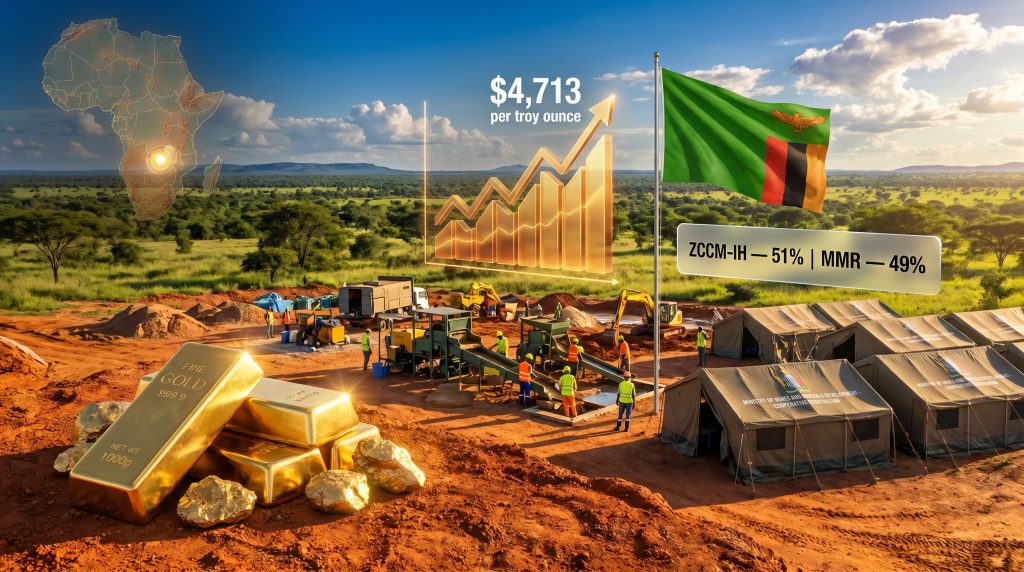
Zambia's answer to the Kikonge situation is the formation of Kyalo Goldfields Ltd., incorporated on May 6, 2026, as a joint venture between ZCCM Investments Holdings Plc (holding a 51% controlling stake) and Mining Mineral Resources Sprl (MMR) (holding the remaining 49%).
The ownership structure is deliberate. A simple majority state stake ensures Zambian sovereign primacy over operational direction and revenue flows, while stopping short of full nationalisation. This hybrid model is increasingly favoured across African resource economies seeking to maximise in-country value retention without deterring the private capital and technical expertise that large-scale processing infrastructure demands.
| Partner | Stake | Headquarters | Core Capabilities |
|---|---|---|---|
| ZCCM Investments Holdings Plc | 51% | Zambia | State investment, portfolio management, copper sector expertise |
| Mining Mineral Resources Sprl (MMR) | 49% | Democratic Republic of Congo | Gold, tin, tantalum, tungsten processing |
MMR's strategic value extends well beyond its equity contribution. An affiliated entity within the same conglomerate played a foundational role in launching the DRC's first state-backed gold refinery in March 2026, providing a directly applicable operational template for what Zambia is now attempting. The cross-border nature of this partnership also reflects a broader shift in Central and Southern African resource strategy, where neighbouring nations increasingly share processing infrastructure knowledge rather than competing for the same downstream value. This mirrors wider resource strategy trends across the continent.
For ZCCM-IH, Kyalo Goldfields represents a deliberate diversification away from its historically copper-centric portfolio. The state investment vehicle has separately signalled its intention to increase stakes in existing Zambian mining operations more broadly, suggesting that the Kyalo venture sits within a larger strategic reorientation toward maximising in-country mineral value retention.
Three Operational Mandates Driving the Kikonge Agenda
Kyalo Goldfields has been structured around three interconnected operational priorities, each addressing a different failure mode of previous formalization attempts.
Formalization Through Cooperative Empowerment
The Zambia Ministry of Mines and Minerals Development has already issued 90 letters of offer to mining cooperatives at Kikonge, establishing a legal framework for organised small-scale operations before Kyalo Goldfields even began operations. This sequencing is significant. Rather than waiting for a corporate structure to create legal pathways, Zambia pre-positioned the cooperative framework as the primary vehicle for formalization.
Kyalo Goldfields is expected to work alongside these cooperatives rather than displacing them. This cooperative-first approach attempts to solve a structural problem that has undermined formalization programs from Ghana to Tanzania: when industrial operators replace artisanal miners rather than integrating them, displacement creates political resistance and simply shifts informal activity to adjacent areas.
Mechanization as a Bridge Technology
Transitioning artisanal miners from manual extraction to semi-mechanised production is not a single event but a phased process requiring capital equipment investment, technical training, and site infrastructure development. The benefits, however, are compounding. Mechanisation increases yield consistency, reduces occupational safety risks, and generates auditable production volumes that are prerequisites for integration into internationally recognised responsible sourcing frameworks.
From an investor perspective, mechanisation also changes the economics of processing infrastructure investment. Consistent, measurable output volumes make downstream refining facilities commercially viable in ways that irregular artisanal production cannot support.
Processing Infrastructure as the Value Capture Imperative
Perhaps the most economically consequential mandate is the development of in-country processing capability. Currently, raw gold extracted across the Zambia-DRC corridor predominantly leaves the region in unrefined form, with value-adding refining stages captured by facilities in the UAE, Switzerland, and elsewhere. Building processing capacity at or near the Kikonge site would allow Zambia to retain a substantially larger share of the gold value chain.
With gold futures trading at approximately $4,713 per troy ounce as of May 2026, the spread between raw gold and refined product represents a meaningful economic opportunity. Elevated prices also improve the commercial viability of processing infrastructure investment by shortening payback periods and attracting private capital that might otherwise remain on the sidelines.
Mercury, Environment, and the Responsible Sourcing Premium
One of the least discussed but most commercially significant aspects of ASGM formalization is mercury reduction. Artisanal gold miners across sub-Saharan Africa predominantly use mercury amalgamation to separate gold from ore, a technique that is cheap, accessible, and highly toxic. Mercury use is not just an environmental and public health issue; it is increasingly a market access issue.
International responsible sourcing frameworks, including those applied by major refiners and jewellers in Europe, North America, and Japan, are progressively requiring mercury-free processing as a condition of supply chain inclusion. Miners who cannot demonstrate mercury-free or mercury-reduced production are effectively excluded from premium market channels regardless of the quality of their gold.
The planetGOLD Zambia initiative, launched in late 2024, directly addresses this barrier. The programme targets a reduction of 1.14 metric tonnes of mercury use over five years while supporting more than 11,000 miners through formalization assistance, access to finance, and mercury-free processing technologies. For Kyalo Goldfields, the existence of this parallel programme is operationally significant: it pre-conditions Kikonge area miners toward the environmental compliance standards that formal supply chain participation requires.
Zambia's National Policy Scaffolding
The Kikonge initiative does not exist in isolation. It operates within a broader national policy architecture that the Zambian government has been assembling over several years.
The third phase of the Ministry of Mines and Minerals Development's national artisanal miner training programme currently targets 400 mining cooperatives across eight provinces. This national rollout confirms that formalization is being pursued as a systemic policy objective rather than a localised experiment.
The Zambia ASM Blueprint, published in coordination with international development partners, maps the full spectrum of policy priorities required for sustainable formalization:
| Policy Priority | Core Objective |
|---|---|
| Simplified licensing | Lower barriers to legal registration for small-scale operators |
| Access to finance | Connect cooperatives with formal lending and investment instruments |
| Technology adoption | Introduce appropriate mechanisation and processing tools |
| Environmental compliance | Reduce mercury use and improve land rehabilitation standards |
| Supply chain traceability | Enable auditable, responsible gold sourcing for international markets |
| Geological mapping support | Help cooperatives identify viable, safe extraction zones |
The blueprint's emphasis on financial inclusion is particularly notable. Many artisanal miners lack access to formal banking, credit, or registered business structures. A formalization programme that ignores this reality simply creates a two-tier system where legally registered miners remain economically marginalised.
A novel financing instrument being piloted in Africa, described as a stakeholder prosperity bond, proposes to address this gap directly by linking investor returns to measurable social and environmental performance outcomes in artisanal mining supply chains. Zambia has been identified as the initial test jurisdiction for this instrument, with potential expansion to the DRC and Ghana if the model demonstrates viability.
The next major ASX story will hit our subscribers first
Risk Factors and Structural Challenges
No formalization initiative of this complexity operates without significant execution risk. Several structural challenges deserve careful monitoring.
- Entrenched smuggling networks in the DRC-Zambia corridor have operated for decades and generate substantial rents for well-connected intermediaries who have strong incentives to resist formalization
- Cooperative governance vulnerabilities, including internal disputes and elite capture of cooperative leadership, have undermined similar programmes in other African jurisdictions and represent a persistent operational risk
- Gold price volatility could affect the commercial viability of processing infrastructure investment if prices retreat sharply from current levels, potentially delaying the mechanisation timeline
- Behavioural change at scale is inherently difficult to achieve; mercury reduction targets require sustained adoption by thousands of individual miners, which enforcement alone cannot deliver without strong economic incentives
- Coordination complexity across the Ministry of Mines, ZCCM-IH, Kyalo Goldfields, mining cooperatives, and international development programmes creates multiple points of potential misalignment
A Continental Benchmark in the Making
The convergence of state investment through ZCCM-IH's majority stake, private sector technical expertise through MMR's processing knowledge, cooperative-based empowerment rather than displacement, environmental compliance through the planetGOLD programme, and novel financing mechanisms through the stakeholder prosperity bond framework is rare in African ASGM reform efforts. Most programmes have achieved one or two of these elements. Zambia is attempting all five simultaneously.
If the Zambia gold venture to formalize artisanal mining succeeds at Kikonge, the operational model becomes exportable. The DRC mineral wealth proposition, where MMR's affiliated entity is already building state-backed refining infrastructure, would be the most logical next application. Ghana, with its more mature but imperfect formalization history, could consequently draw lessons from Zambia's cooperative-first approach.
The countries that crack the ASGM formalization code will not only capture substantially more gold tax revenue. They will position themselves as preferred partners for the responsible sourcing frameworks that increasingly govern which gold reaches premium international markets.
However, ongoing progress in mining sustainability transformation across the continent suggests that the political will to pursue these goals is strengthening, not weakening. For investors and industry observers, the key metrics to watch are the pace of cooperative licensing completions at Kikonge, the timeline for processing infrastructure development, the measurable reduction in mercury use under the planetGOLD programme, and whether the stakeholder prosperity bond instrument successfully attracts institutional capital. Together, these indicators will determine whether Zambia's approach becomes a continental model or another well-designed programme that fell short of systemic change.
This article contains forward-looking statements and analysis based on publicly available information as of May 2026. Forecasts, projections, and assessments of policy outcomes involve inherent uncertainty and should not be construed as investment advice. Readers should conduct independent due diligence before making any investment or business decisions related to the companies, programmes, or instruments discussed.
Want to Stay Ahead of Significant Mineral Discoveries on the ASX?
Discovery Alert's proprietary Discovery IQ model delivers real-time alerts on major ASX mineral discoveries — including gold — instantly translating complex data into actionable investment insights for both short-term traders and long-term investors. Explore how historic discoveries have generated extraordinary returns on Discovery Alert's dedicated discoveries page, and begin your 14-day free trial today to secure a market-leading edge.