August 9, 2026
Why Credit Outlook Revisions Carry More Weight Than They Appear
In global capital markets, the language of credit rating agencies is deliberately precise. A single word carries enormous implications for how billions of dollars in debt are priced, how project financing negotiations unfold, and how institutional capital allocates across an industry. When S&P Global Ratings shifts a company's outlook from "stable" to "positive," it is not a minor administrative adjustment. It is a probabilistic declaration that a formal rating upgrade is on the horizon, provided specific operational benchmarks continue to be met.
This distinction matters profoundly in mining, where capital intensity is extreme and long-term debt servicing is as important as quarterly production results. The recent Zijin Mining outlook raised to positive by S&P represents exactly this kind of forward-looking signal, one that demands careful unpacking beyond the headline.
When big ASX news breaks, our subscribers know first
Understanding What S&P's Positive Outlook Actually Communicates
The Mechanics of an Outlook Revision
Credit rating agencies like S&P Global Ratings operate on a two-tier communication system: the rating itself, and the outlook attached to it. The rating reflects current creditworthiness. The outlook reflects expected direction of travel. A stable outlook means S&P expects the rating to remain unchanged over the next 12 to 24 months. A positive outlook signals that an upgrade is becoming a realistic possibility within that window if performance benchmarks hold.
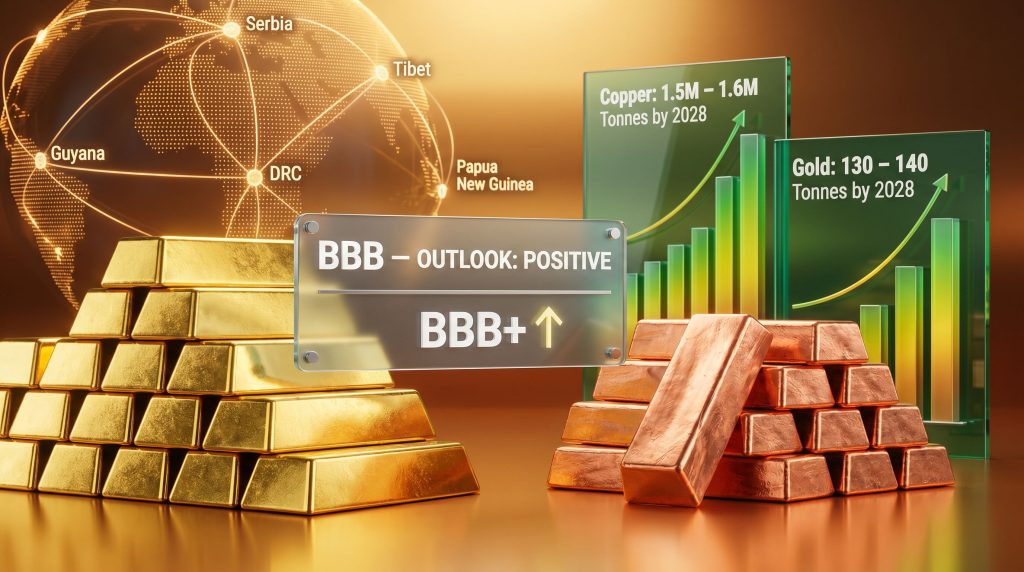
For Zijin Mining, S&P maintained its BBB long-term issuer credit rating while shifting the outlook from stable to positive as of May 26, 2026. In practical terms, this places Zijin on a formal upgrade pathway toward BBB+, the next rung on the investment-grade ladder. For a capital-intensive miner with global expansion ambitions, that distinction translates directly into cheaper debt financing, broader access to institutional bond markets, and enhanced credibility with project development partners across multiple jurisdictions.
A Two-Stage Credit Progression in Motion
This May 2026 development does not exist in isolation. It represents the second step in a visible progression. In October 2025, S&P upgraded Zijin from BBB- to BBB with a stable outlook, marking the company's ascent into the mainstream investment-grade tier. The May 2026 revision to a positive outlook is the natural continuation of that arc, reflecting sustained operational outperformance and growing confidence in Zijin's ability to execute against its ambitious 2028 production targets. Furthermore, the Zijin 2025 performance laid much of the groundwork for this credit progression.
Rating agencies assess a company's ability to service debt obligations across a defined horizon. This is fundamentally different from the question equity markets are asking, which is whether near-term earnings will surprise to the upside. The two can diverge significantly, particularly during periods of macro uncertainty affecting Chinese-listed equities.
This two-stage progression mirrors patterns seen in other resource-sector companies that have systematically closed the credit quality gap with established Western mining majors, using operational consistency as the primary currency of creditworthiness.
Zijin's Production Ambitions and Why S&P Believes Them
The 2028 Targets in Context
Zijin Mining has set production targets for 2028 that, if achieved, would fundamentally alter the company's standing in global commodity markets. The company is aiming for:
| Metal | 2028 Production Target | Strategic Implication |
|---|---|---|
| Copper | 1.5M to 1.6M tonnes | Projected top-three globally |
| Gold | 130 to 140 tonnes | Competitive with senior gold majors |
These are not modest aspirations. Achieving the copper target would place Zijin alongside Codelco and BHP at the very top of the global production hierarchy. The gold target, meanwhile, would position the company among the three largest gold producers on the planet, competing directly with Newmont, Barrick, and Agnico Eagle in volume terms.
What makes S&P's positive outlook particularly meaningful is that the agency has assessed these targets as credible, not merely aspirational. The rating agency specifically cited Zijin's robust project pipeline and solid execution record as the basis for its confidence that these benchmarks are achievable within the stated timeframe.
Where the Growth Is Actually Coming From
Zijin's production expansion strategy is geographically diversified across four continents, a structural feature that credit analysts treat as a meaningful risk-mitigation factor. The specific growth corridors cited by S&P are:
Copper expansion drivers:
- Upgrades and expansions at mines in Serbia
- Capacity increases at operations in the Democratic Republic of Congo
- Development of the Julong mine in Tibet, one of the largest undeveloped copper deposits in China
Gold growth drivers:
- Capacity increases in Guyana, where Zijin has established a significant presence
- Expansion at operations in Papua New Guinea
- Continued development of domestic Chinese assets
This geographic spread across politically and operationally diverse jurisdictions serves a dual purpose. It reduces the company's vulnerability to single-country disruptions while simultaneously demonstrating to credit analysts that management has developed the capability to operate complex, multi-jurisdictional projects simultaneously. The Zijin expansion strategy confirms this deliberate approach to geographic diversification as a core credit strength.
The Cost Management Dimension That Credit Agencies Prioritize
Why Output Volume Alone Does Not Win Rating Upgrades
A frequently misunderstood aspect of mining credit analysis is that production growth, on its own, is insufficient to drive credit quality improvements. What matters to rating agencies is the cost at which that production is achieved. A miner expanding output at rising marginal costs may actually see its credit metrics deteriorate even as its production volumes increase, because higher costs compress margins and reduce the free cash flow available for debt servicing.
S&P's positive outlook revision explicitly referenced Zijin's stronger cost management as a co-equal factor alongside its production expansion. This dual validation, covering both volume growth and cost discipline, is what distinguishes a credit-positive production expansion from one that merely adds scale without adding financial resilience.
In the credit analysis framework for mining companies, cost per unit of output functions as a proxy for operational quality. A miner growing cheaply is structurally more creditworthy than one expanding at high marginal cost, because cheap growth generates durable free cash flow rather than revenue that gets consumed by rising costs.
All-In Sustaining Costs as a Credit Variable
The all-in sustaining cost (AISC) metric has become the mining industry's standard measure of the true cost of maintaining production at existing operations. For credit analysis purposes, AISC matters because it determines how much of a decline in commodity prices a company can absorb before its ability to service debt is compromised.
Zijin's favourable cost positioning across its copper and gold operations reflects both the geological quality of its ore bodies and the operational efficiencies achieved through scale and technical optimisation. Higher-grade deposits naturally produce lower AISCs because more metal is extracted per tonne of ore processed, reducing the energy, labour, and consumable costs per unit of output. This geological advantage, combined with operational discipline, creates the kind of margin resilience that rating agencies require before advancing a company's credit outlook.
The Equity-Credit Divergence: Reading Two Different Signals
Share Price Weakness Does Not Contradict the Credit Story
One of the most intellectually interesting aspects of Zijin's current market position is the apparent contradiction between S&P's optimism and the company's equity performance. Zijin's Shanghai-listed A-shares have fallen 4.6% year-to-date as of May 26, 2026, while its Hong Kong-traded H-shares have declined a narrower 0.8% over the same period. On the surface, this might suggest the market is sceptical of the credit agency's positive assessment.
In reality, the divergence reflects the fundamentally different questions that credit markets and equity markets are trying to answer:
| Market | Primary Question | Time Horizon |
|---|---|---|
| Credit (Bond) Markets | Can this company service its debt? | 5 to 10+ years |
| Equity Markets | Will earnings beat expectations near-term? | 3 to 12 months |
| Credit Rating Agencies | Will operational metrics meet upgrade thresholds? | 12 to 24 months |
The A-share versus H-share divergence is itself revealing. The wider decline in Shanghai-listed shares compared to Hong Kong-listed shares likely reflects different investor bases responding differently to macro pressures affecting Chinese equities broadly. A-share investors tend to be more domestically oriented retail investors sensitive to short-term sentiment, while H-share markets attract more institutional international capital that may be applying a more fundamental lens to the company's long-term value.
What Macro Headwinds Are Weighing on Chinese Mining Equities
The broader context for Chinese mining equity performance in 2026 includes several macro variables that affect sentiment without necessarily altering long-term credit fundamentals. These include currency dynamics, domestic economic growth concerns, and broader geopolitical risk premiums attached to Chinese-listed companies by international investors. None of these factors directly impair Zijin's ability to service its debt obligations or execute its production expansion plan, which explains why S&P can simultaneously hold a positive credit outlook while equity markets apply a valuation discount.
Copper and Gold Market Fundamentals as Credit Tailwinds
The Structural Demand Case for Copper
Copper occupies an increasingly strategic position in the global energy transition, functioning as the essential conductor for virtually every form of electrification infrastructure. The copper market trends show demand underpinned by several converging structural forces:
- Electric vehicle adoption, where a single EV requires roughly three to four times more copper than a conventional internal combustion engine vehicle
- Grid infrastructure expansion, as governments invest heavily in upgrading transmission and distribution networks to accommodate renewable energy integration
- Data centre proliferation, driven by artificial intelligence infrastructure buildout requiring substantial copper for power distribution
- Renewable energy installation, with solar panels, wind turbines, and battery storage systems all requiring significant copper content
For Zijin specifically, this demand backdrop creates a favourable pricing environment that amplifies the financial impact of its production expansion. Every additional tonne of copper produced flows through to revenue at prices supported by structurally growing demand, providing the cash flow foundation that supports both debt servicing and further capital investment.
Gold's Dual Role in Zijin's Credit Profile
Gold functions differently from copper in Zijin's portfolio, serving as a counter-cyclical revenue stabiliser rather than a primary growth driver. When economic uncertainty increases or equity markets sell off, gold prices tend to rise as investors seek safe-haven assets. This inverse correlation with risk assets means that gold revenue acts as a natural hedge against the conditions that might otherwise stress Zijin's financial metrics. The broader gold market outlook reinforces why this asset class remains strategically important for miners like Zijin.
Central bank gold purchasing has remained elevated in recent years as reserve managers diversify away from US dollar exposure, providing a structural demand floor that supports gold prices independently of speculative investment flows. In addition, the relationship between gold and mining equities is particularly relevant here, as favourable gold pricing directly strengthens Zijin's revenue base and, consequently, its credit metrics. For credit analysis purposes, this dual demand foundation — covering both financial safe-haven buying and central bank accumulation — reduces the downside scenario for gold prices and therefore reduces the revenue volatility that credit agencies must account for when assessing a miner's debt serviceability.
The next major ASX story will hit our subscribers first
What Conditions Could Trigger a Formal Upgrade to BBB+
The Upgrade Pathway Is Conditional, Not Guaranteed
It is important to recognise that a positive outlook from S&P is a conditional signal, not a commitment. The agency has outlined an implicit set of benchmarks that Zijin must continue to meet for the outlook to culminate in a formal rating upgrade to BBB+. These conditions include:
- Sustained production execution across key growth projects, particularly at the DRC and Serbia copper operations
- Cost discipline maintenance as production scales, ensuring that rising output does not come with proportionally rising costs
- Debt management that keeps leverage ratios within acceptable investment-grade parameters despite significant capital expenditure requirements
- Project delivery timelines being met at flagship expansion sites, particularly those in politically complex jurisdictions
The positive outlook is best understood as a conditional probability statement. S&P is communicating that Zijin has earned the right to be considered for a higher rating, but that consideration is contingent on sustained performance delivery. The signal can be reversed if execution falters.
Execution Risk Across Multi-Jurisdiction Operations
The primary risk to Zijin's upgrade pathway lies in the operational complexity of managing simultaneous expansions across diverse geopolitical environments. The Democratic Republic of Congo, in particular, presents ongoing governance and logistical challenges that have affected numerous mining companies operating in the region. Delays at a single major project could slow the production ramp required to justify a formal rating upgrade, potentially stabilising the outlook rather than advancing it to a confirmed upgrade.
Similarly, Tibet's Julong mine, while representing one of China's largest undeveloped copper deposits, faces the inherent challenges of high-altitude operations and the logistical complexity of developing infrastructure in remote locations. Investors and credit analysts alike should treat these execution risks as material variables in assessing the probability that the positive outlook converts to a formal BBB+ upgrade within the stated timeframe.
Frequently Asked Questions: Zijin Mining's S&P Outlook Revision
What does a positive outlook from S&P mean for Zijin Mining?
A positive outlook indicates that S&P believes there is a meaningful probability of a credit rating upgrade from BBB to BBB+ within the next one to two years, provided Zijin continues to meet the operational and financial benchmarks that supported the outlook revision.
What is Zijin Mining's current S&P credit rating?
As of May 26, 2026, Zijin Mining holds a long-term issuer credit rating of BBB from S&P Global Ratings, with the outlook revised from stable to positive. The full rating details are available through S&P Global Ratings' official regulatory disclosures.
What production targets support the positive outlook?
Zijin is targeting copper output of 1.5 to 1.6 million tonnes and gold output of 130 to 140 tonnes by 2028, which S&P projects would place the company among the world's three largest producers in both metals.
Which mining regions are driving Zijin's production growth?
Copper expansion is anchored by operations in Serbia, the Democratic Republic of Congo, and Tibet's Julong mine, while gold growth is concentrated in Guyana, Papua New Guinea, and domestic Chinese assets.
Why is Zijin's share price falling if S&P is optimistic?
Credit ratings assess debt repayment capacity over a multi-year horizon, while equity valuations reflect short-term earnings expectations and market sentiment. The two metrics regularly diverge, particularly during periods of macro uncertainty affecting Chinese-listed equities.
How does the October 2025 upgrade relate to the May 2026 outlook revision?
In October 2025, S&P upgraded Zijin from BBB- to BBB with a stable outlook. The May 2026 revision to a positive outlook represents the next incremental step in a two-stage credit improvement trajectory, driven by continued operational execution against growth targets.
What Zijin's Credit Trajectory Signals About China's Mining Ambitions
The Zijin Mining outlook raised to positive by S&P is not merely a corporate finance milestone for a single Chinese company. It reflects a broader and deliberate strategic shift in which Chinese resource companies are systematically developing the operational scale, cost competitiveness, and geographic diversification required to challenge established Western mining majors for top-tier credit classification and global market leadership.
Zijin's dual-commodity focus on copper and gold positions it uniquely within this competitive landscape. Copper provides exposure to the structural demand growth driven by the global energy transition, while gold provides counter-cyclical revenue stability that smooths cash flows through commodity cycles. Together, these two metals create a financial profile that is arguably more resilient than single-commodity peers, a characteristic that credit agencies explicitly reward when assigning outlook revisions and formal rating upgrades.
For institutional debt investors monitoring the global mining credit landscape, Zijin's trajectory over the next 18 months provides a valuable case study in how operational execution translates into credit quality advancement. The key variables to watch include production delivery rates at the DRC and Serbia copper operations, AISC trends as output scales, and debt leverage management against the backdrop of substantial ongoing capital expenditure requirements.
The ultimate question is not whether S&P's positive outlook is warranted based on current performance, but whether Zijin's management can sustain the execution discipline required to convert a forward-looking credit signal into the concrete financial metrics that justify a formal BBB+ designation. Based on the two-stage progression observed since October 2025, the trajectory is clearly established. Whether it continues at the expected pace depends on the operational decisions made across four continents over the next two years.
This article contains forward-looking statements and financial analysis based on publicly available information including S&P Global Ratings announcements and company disclosures. Readers should not interpret any content herein as investment advice. Credit ratings and outlooks are subject to change based on evolving operational and financial conditions. Investors should conduct their own due diligence before making any investment decisions.
Want to Catch the Next Major ASX Mineral Discovery Before the Broader Market Does?
Discovery Alert's proprietary Discovery IQ model delivers real-time alerts on significant ASX mineral discoveries, translating complex geological and commodity data into clear, actionable insights for both short-term traders and long-term investors — explore the historic returns major discoveries have generated and begin your 14-day free trial today to position yourself ahead of the market.