
July 12, 2026
The Economics of Exclusion: Why African Nations Are Locking Foreign Capital Out of Artisanal Gold
Across the African continent, a quiet but consequential shift is reshaping how resource-rich nations think about foreign participation in their extractive industries. It is not the dramatic nationalisation campaigns of the 1970s or the sweeping expropriation policies that once defined African resource politics. Instead, what is emerging is something more surgically targeted: the reservation of specific mining tiers for domestic citizens only, while simultaneously welcoming foreign capital into the larger, more capital-intensive segments of the same sector.
Zimbabwe bars foreign operators from small-scale gold mining in what is the latest and perhaps most clearly defined expression of this trend. Understanding what it means for investors, for the structure of Zimbabwe's gold industry, and for the broader continental direction of artisanal mining policy requires looking beyond the headline and examining the underlying mechanics, motivations, and consequences. Furthermore, the geopolitical mining landscape across Africa continues to evolve rapidly, making this development all the more significant.
When big ASX news breaks, our subscribers know first
What the New Rules Actually Establish
Zimbabwe has formally classified small-scale gold mining as an activity exclusively reserved for its citizens. The regulatory boundaries are precise: any operation producing no more than 20 kilograms of gold per month and carrying a total capital investment below $15 million USD falls within the small-scale category and is now legally off-limits to foreign nationals and foreign-owned entities.
Mines Minister Polite Kambamura announced in Harare that all foreign investors and entities currently active within this segment must either scale their operations beyond these thresholds or exit the sector entirely by January 2027. The policy extends beyond direct ownership, targeting beneficial control arrangements as well, meaning that proxy structures where foreign nationals retain effective control through local fronts are explicitly within the enforcement scope.
The metrics at the centre of this policy deserve close attention:
| Metric | Figure |
|---|---|
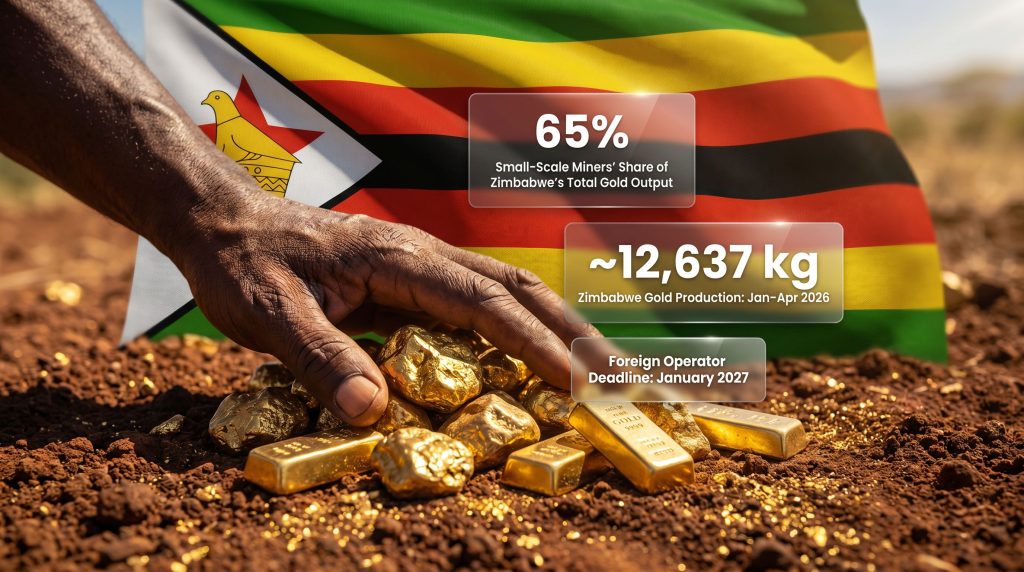
| Small-scale miners' share of Zimbabwe's total gold output | ~65% |
| Zimbabwe gold production (January to April 2026) | ~12,637 kg |
| Year-on-year production growth (January to April 2026) | +1.3% |
| Monthly output ceiling for small-scale classification | 20 kg |
| Capital investment ceiling for small-scale classification | $15 million USD |
| Foreign operator compliance deadline | January 2027 |
What makes these figures striking is the sheer weight of the small-scale segment within Zimbabwe's overall gold economy. A sector responsible for nearly two-thirds of national gold production is now being restructured around a citizen-only participation model.
The Structural Logic Behind Sector Reservation
To understand why Zimbabwe has drawn this particular line, it helps to consider what artisanal and small-scale gold mining actually represents at a grassroots economic level. Unlike large-scale industrial operations that generate revenue primarily through export royalties and corporate taxation, artisanal mining creates diffuse, household-level income across geographically dispersed communities. When foreign operators control these plots, the income generated does not necessarily circulate within local economies at the same rate.
The economic case for reserving this segment for citizens rests on three interconnected arguments:
-
Employment displacement: Foreign-operated small-scale plots can effectively price out or crowd out Zimbabwean operators who lack equivalent capital or equipment, reducing the sector's role as a domestic income generator.
-
Capital flight risk: Profits extracted by foreign-owned micro-operations are more likely to leave the domestic financial system entirely, rather than being reinvested locally or spent within Zimbabwean communities.
-
Regulatory efficiency: Monitoring beneficial ownership across thousands of small, geographically scattered operations is far more tractable when the eligible ownership pool is restricted to citizens, reducing the surface area for evasion.
The policy logic positions artisanal mining as a wealth-generation vehicle for Zimbabwean citizens, while directing foreign capital toward larger operations that generate infrastructure investment, formal employment, and broader economic multipliers at a scale commensurate with the risks involved.
Consequently, government intervention in mining of this nature reflects a broader global rethinking of how extractive industries should distribute economic benefits at the community level.
How Zimbabwe's Gold Sector Divides Under the New Framework
The policy creates an explicit bifurcation within Zimbabwe's gold industry. Far from being a blanket restriction on foreign investment, it carves the sector into two distinct tiers with very different rules of engagement.
| Dimension | Small-Scale Mining | Large-Scale Mining |
|---|---|---|
| Share of gold output | ~65% | ~35% |
| Foreign participation (post-ban) | Prohibited | Permitted and encouraged |
| Capital investment ceiling | Under $15 million | No ceiling |
| Monthly output ceiling | 20 kg | No ceiling |
| Ownership requirements | Zimbabwean citizens only | Open to foreign investors |
| Regulatory scrutiny on ownership | Intensifying | Established frameworks |
This structure signals that Zimbabwe is not attempting to isolate itself from international capital. Rather, it is attempting to channel that capital toward projects of sufficient scale to justify the economic trade-offs of foreign participation.
Compliance Pathways for Affected Foreign Operators
Foreign entities currently operating within the small-scale classification face a defined set of decisions before the January 2027 deadline. The process is not straightforward, and the options narrow quickly depending on the nature of each operation.
-
Classify existing operations accurately against the two defining thresholds: monthly output of 20 kg or less, and total capital investment below $15 million.
-
Assess whether scaling up is commercially viable, specifically whether increasing investment and production beyond the small-scale ceilings can be achieved within the compliance window.
-
Submit full beneficial ownership disclosures as required under Zimbabwe's transparency regime, covering all layers of the ownership structure to identify whether foreign nationals exercise control directly or indirectly.
-
Choose between large-scale licensing or exit, depending on whether the operation can credibly transition to the large-scale segment with appropriate documentation and investment commitments.
-
Engage proactively with the Ministry of Mines to clarify transition pathways, licensing requirements, and any interpretive guidance on the boundary between the two classifications.
Operators who attempt to maintain small-scale participation through proxy arrangements after the deadline face enforcement action under the beneficial ownership disclosure framework. The government has signalled that fronting arrangements, where a Zimbabwean citizen formally holds the title while a foreign national retains economic control, will be treated as a violation. In addition, strategic minerals policy developments in other regions demonstrate how rapidly ownership and control frameworks can shift when governments prioritise national economic interests.
A Continental Pattern, Not an Isolated Decision
Zimbabwe's move does not exist in a regulatory vacuum. Across sub-Saharan Africa, governments are tightening their grip on the artisanal and small-scale mining segment with increasing consistency. Mali, facing a different set of pressures including fatal accidents and security concerns, suspended foreign small-scale mining permits in a move that drew regional attention. The parallel is instructive even where the triggers differ.
| Country | Policy Action | Sector Affected | Primary Driver |
|---|---|---|---|
| Zimbabwe | Full ban on foreign participation in small-scale gold mining | Artisanal and small-scale gold | Economic sovereignty, local job protection |
| Mali | Suspension of foreign small-scale mining permits | Artisanal gold | Safety incidents, security environment |
| Multiple African states | Progressive indigenisation and local content requirements | Various minerals | Broader resource nationalism trend |
What the Zimbabwe and Mali cases share, despite their different contexts, is a common recognition that artisanal mining sits at the intersection of economic survival and national identity for large portions of their populations. Ceding control of this segment to foreign operators, even at a small individual scale, has become politically and economically difficult to justify.
Sector reservation policies of this kind occupy a distinct position on the resource nationalism spectrum. They stop well short of nationalisation or expropriation, yet they draw explicit, enforceable lines around economic participation in ways that meaningfully alter the calculus for foreign investors.
The next major ASX story will hit our subscribers first
What This Means for Investors and Market Participants
For foreign investors currently active in Zimbabwe's small-scale gold space, the risk is binary and time-bounded. There is no ambiguity about the direction of policy or the deadline. The January 2027 compliance horizon gives operators roughly eighteen months from the announcement to restructure or exit, which, in the context of mining operations, is a relatively compressed timeframe for material changes to production capacity or capital structure.
For investors evaluating Zimbabwe's large-scale gold opportunities, the policy arguably strengthens the investment case in a counterintuitive way. By directing foreign capital exclusively toward the upper tier of the market, the government is implicitly committing to protecting and supporting large-scale operations as the primary vehicle for international investment in the sector. The regulatory segmentation reduces the risk that large-scale project approvals will be complicated by the same citizen-reservation logic applied to small-scale operations.
However, gold investment trends suggest that broader macroeconomic conditions will also shape how foreign capital responds to Zimbabwe's restructured market access rules. A practical due diligence checklist for foreign mining investors in Zimbabwe should include:
-
Confirming whether existing or prospective operations fall within the 20 kg monthly output and $15 million capital thresholds.
-
Reviewing all layers of ownership structure for beneficial ownership compliance.
-
Assessing whether any current arrangements could be characterised as proxy or fronting structures under Zimbabwe's definitions.
-
Evaluating the commercial viability of scaling operations into the large-scale licensing regime.
-
Monitoring guidance from the Ministry of Mines as implementation details and enforcement mechanisms are formalised.
Output Trajectory and Enforcement Scenarios
Zimbabwe's gold production grew by 1.3% year-on-year in the first four months of 2026, reaching approximately 12,637 kilograms. Whether this trajectory is maintained through the policy transition depends significantly on how smoothly vacated foreign capacity is absorbed by citizen-owned operators. Furthermore, the gold market outlook for Zimbabwe will be closely tied to how effectively the domestic operator base can absorb any production gaps left by departing foreign interests.
Three broad scenarios frame the range of outcomes:
-
Optimistic trajectory: Foreign operators either exit cleanly or scale up into the large-scale tier. Zimbabwean citizens absorb vacated small-scale capacity without significant disruption. The existing production growth rate is maintained or modestly improved as the domestic operator base expands.
-
Neutral trajectory: Restructuring creates short-term operational gaps as some foreign operators delay compliance decisions. Output dips temporarily before recovering within twelve to eighteen months as the transition completes.
-
Downside trajectory: Enforcement gaps allow continued foreign participation through undisclosed proxy arrangements. Policy credibility erodes, creating uncertainty that affects both small-scale domestic operators and large-scale foreign investors evaluating the regulatory environment.
The third scenario is the one most worth watching. Beneficial ownership enforcement in a sector characterised by geographically dispersed, low-documentation operations is inherently difficult. The government's ability to operationalise its disclosure requirements at scale will be the primary indicator of whether this policy achieves its stated objectives or becomes another well-intentioned reform with limited practical effect. Notably, concerns have been raised that heavy-handed regulatory measures in Zimbabwe's gold sector risk driving activity underground rather than eliminating it entirely.
Frequently Asked Questions
What defines small-scale gold mining under Zimbabwe's new framework?
Operations producing no more than 20 kilograms of gold per month with total capital investment below $15 million USD. Both thresholds must be met for the small-scale classification to apply.
When must foreign operators comply?
Zimbabwe has set January 2027 as the deadline. Foreign operators must either transition to large-scale operations with appropriate licensing or cease small-scale activities before this date.
Is Zimbabwe closed to foreign mining investment?
No. The restriction applies specifically to the small-scale tier. Large-scale gold mining operations remain open to foreign participation and continue to operate under established licensing frameworks.
How dominant is small-scale mining within Zimbabwe's gold economy?
Small-scale miners account for approximately 65% of Zimbabwe's total gold production, making the sector far more central to national output than its per-operation scale might suggest.
What enforcement tools does Zimbabwe have?
The beneficial ownership disclosure regime is the primary enforcement mechanism, designed to surface proxy ownership arrangements where foreign nationals maintain effective control through citizen-registered fronts.
Is Zimbabwe alone in this approach?
No. Mali has taken similar steps restricting foreign small-scale mining permits, and broader indigenisation trends are visible across the continent, reflecting a consistent direction in African resource governance even where the specific triggers and mechanisms differ.
The Broader Signal for Resource-Rich Economies
Zimbabwe bars foreign operators from small-scale gold mining in a move that ultimately represents a recalibration of the terms on which foreign capital is welcome in resource-extractive sectors. The citizen-economy model being applied to artisanal gold mining reflects a maturing regulatory sophistication: rather than rejecting foreign investment wholesale or accepting it without conditions, governments are segmenting their resource sectors and applying different rules to different tiers based on economic function, scale, and distributional impact.
Whether this model delivers its intended outcomes depends on enforcement quality, the depth of Zimbabwe's domestic operator base, and whether the removal of foreign capital from the small-scale segment creates a vacuum or an opportunity for citizen miners to expand. The policy logic is sound. The implementation challenge is substantial. And for investors watching the continent, Zimbabwe's approach to this question is likely to be studied and, in some form, replicated elsewhere.
This article is intended for informational purposes only and does not constitute financial, legal, or investment advice. Readers should conduct their own due diligence before making any investment decisions based on the regulatory developments described above.
Want to Stay Ahead of Significant ASX Mineral Discoveries as They Happen?
Discovery Alert's proprietary Discovery IQ model delivers real-time alerts on significant ASX mineral discoveries, translating complex mineral data into clear, actionable insights for investors at every experience level — begin your 14-day free trial today and position yourself ahead of the broader market. To understand how historic mineral discoveries have generated substantial returns, explore Discovery Alert's dedicated discoveries page and see what early identification of major finds can mean for a portfolio.