July 22, 2026
The Structural Fault Line Running Through Africa's Battery Minerals Ambitions
Every mining jurisdiction on earth faces a logistics equation. But for landlocked producers, that equation is weighted heavily against them from the start. Coastal lithium exporters in Chile or Australia can move concentrate to port within hours. For Zimbabwe, the arithmetic has historically been far more punishing: high-grade spodumene deposits sitting deep inside a landlocked nation, connected to global markets by deteriorating roads, ageing rail infrastructure, and a series of border crossings that add cost, delay, and uncertainty to every single tonne dispatched.
That structural disadvantage has quietly undermined Zimbabwe's lithium competitiveness for years, even as Chinese capital poured billions of dollars into mine development across the country's geology-rich southern corridor. Now, with the launch of a newly operational Zimbabwe lithium rail route to the Port of Maputo, that calculus is beginning to shift in ways that matter not just for individual producers, but for the broader architecture of Southern Africa's battery minerals supply chain.
When big ASX news breaks, our subscribers know first
How Road Dependency Became a Hidden Tax on Zimbabwe's Lithium Sector
The consequences of road-reliant mineral export systems are well understood in freight economics, but rarely quantified from the perspective of a producer nation trying to compete in a globally cost-sensitive commodity market. For Zimbabwe's lithium industry, road dependency created a compounding cost structure that operated as an invisible tax on every export. Furthermore, the lithium market downturn has made these structural inefficiencies increasingly difficult to absorb.
Heavy haul trucks transporting lithium concentrate face several interacting cost pressures that rail simply does not carry at the same magnitude:
- Diesel price exposure, which fluctuates with global oil markets and amplifies cost unpredictability for mining operations already exposed to commodity price cycles
- Border procedure delays, which accumulate at multiple crossing points when cargo moves through Zimbabwe, across into Mozambique, and then onward to port
- Road degradation liability, because overloaded mineral haulage accelerates damage to public road infrastructure, creating both legal exposure and logistical friction for operators
- Insurance cost inflation, driven by the elevated risk profile of long-distance bulk cargo movements on roads subject to congestion and weather disruption
Against this backdrop, Zimbabwe's rail infrastructure offered a theoretical escape route that had, for decades, been structurally unavailable. The National Railways of Zimbabwe (NRZ) once processed approximately 12 million tonnes of freight annually during its 1990s peak. By 2025, that figure had collapsed to roughly 2 million tonnes per annum, representing an erosion of more than 83% of throughput capacity over three decades. Chronic underinvestment, deferred maintenance, rolling stock deterioration, and foreign currency shortages that prevented equipment procurement all contributed to a network that could no longer serve as a viable alternative to road.
The degradation of Zimbabwe's rail network did not merely create an inconvenience for the logistics sector. It structurally inflated the cost base of an entire export industry at the precise historical moment when global lithium demand was entering its steepest growth phase.
The New Rail Corridor: Architecture, Operators, and the First Consignment
A Three-Segment, Cross-Border Freight Chain
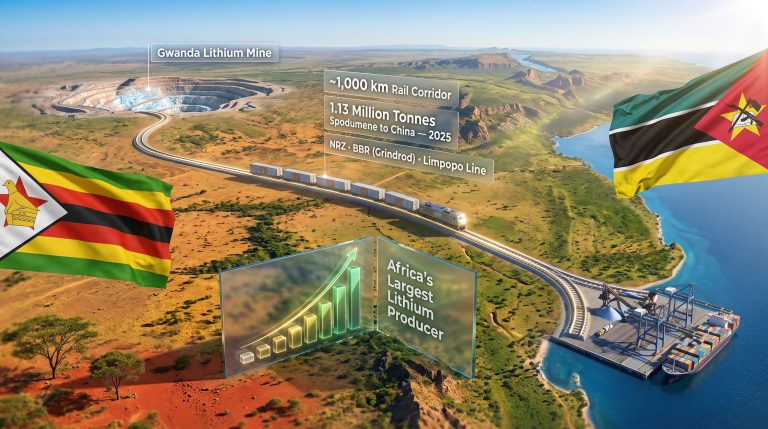
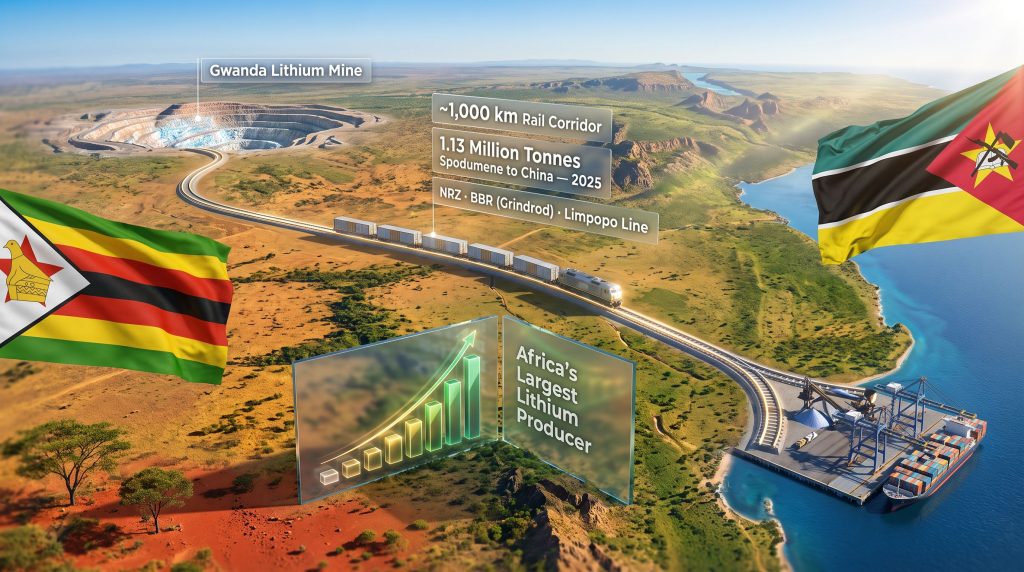
The newly operational Zimbabwe lithium rail route to the Port of Maputo is best understood not as a single railway line, but as a coordinated multi-operator freight corridor spanning approximately 1,000 kilometres across two countries. Each segment is operated by a distinct entity, creating a public-private partnership model that distributes both operational responsibility and commercial risk.
| Segment | Operator | Approx. Distance | Route |
|---|---|---|---|
| Segment 1 | Beitbridge Bulawayo Railway (BBR) | ~180 km | Gwanda Mine to Beitbridge |
| Segment 2 | National Railways of Zimbabwe (NRZ) | ~300 km | Beitbridge to Chicualacuala |
| Segment 3 | Limpopo Line (Mozambique) | ~522 km | Chicualacuala to Port of Maputo |
| Total | Multi-operator | ~1,000 km | Gwanda to Port of Maputo |
The inaugural shipment comprised 1,000 metric tonnes of lithium concentrate originating from Tsingshan Holding Group's Gwanda Lithium Mine, located in Zimbabwe's southern mineral corridor. Three operators share responsibility for the corridor: NRZ provides the state-owned Zimbabwean rail backbone, Beitbridge Bulawayo Railway (BBR), a subsidiary of South Africa's Grindrod, covers the critical southern link from the mining region to the border, and Silvergill, a Zimbabwean private logistics firm, manages coordination and cargo handling across the chain.
Why Maputo and Not Beira or Durban?
The choice of the Port of Maputo as the terminal destination reflects both geographic logic and investment trajectory. Maputo sits on the Indian Ocean in a position that naturally aligns with west-to-east freight flows from Zimbabwe's southern mining regions. Its sustained infrastructure development in recent years has elevated it into one of Southern Africa's most capable deep-water export gateways, particularly for bulk mineral cargoes destined for Asian markets.
By contrast, the Port of Beira, historically the lowest-cost Mozambican export outlet for Zimbabwean cargo, carries capacity and infrastructure limitations that constrain scalability for large-volume mineral shipments. South African alternatives such as Durban and Richards Bay impose longer overland distances and compete with substantial volumes of domestic South African freight, creating bottlenecks that reduce reliability for time-sensitive offtake obligations.
The Economics of Modal Shift: What Rail Means for Lithium Competitiveness
Freight Cost Modelling: Rail Versus Road
While exact freight rate agreements between NRZ, BBR, and Silvergill have not been publicly disclosed, well-established industry benchmarks provide a working framework for understanding the order-of-magnitude cost implications.
| Cost Dimension | Road Transport | Rail Transport |
|---|---|---|
| Fuel cost exposure | High, diesel price-linked | Materially lower per tonne-km |
| Border processing | Frequent, unpredictable delays | Consolidated at fewer crossing points |
| Road damage liability | Significant for heavy haul loads | Eliminated |
| Schedule reliability | Weather and congestion dependent | Higher predictability |
| Volume scalability | Limited by available fleet size | Scalable with demand |
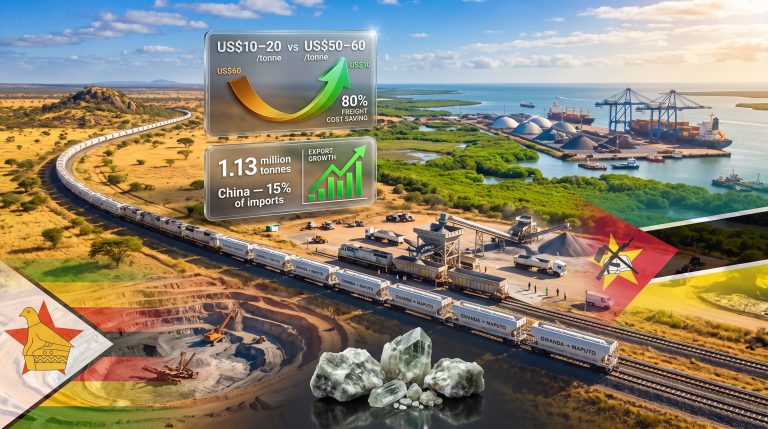
Industry consensus across bulk mineral freight literature consistently positions rail at 20 to 40 percent lower cost per tonne-kilometre than heavy road transport for movements exceeding 500 kilometres. Applied to Zimbabwe's roughly 1,000 kilometre export corridor, these savings compound meaningfully at scale, particularly as export volumes continue growing.
Margin Compression and the New Competitive Arithmetic
The timing of this corridor's activation matters enormously. Lithium carbonate and spodumene concentrate prices fell sharply from their extraordinary 2022 peak levels, compressing producer margins across every lithium-producing jurisdiction worldwide. In that environment, operational efficiency has displaced volume growth as the primary lever for maintaining export viability. Consequently, developments across the battery raw materials market have made logistics optimisation a first-order priority for producers.
In a commodity market where price tailwinds can no longer absorb operational waste, logistics optimisation has graduated from a secondary consideration to a first-order competitive variable. For Zimbabwe's producers, the Maputo corridor may prove as consequential as the discovery of a new deposit.
Crucially, improved export reliability also benefits offtake contract performance. Chinese battery manufacturers sourcing Zimbabwean spodumene operate on tightly scheduled production cycles. Fewer shipment delays mean fewer contract performance risks, which in turn strengthens the commercial relationships that underpin Zimbabwe's entire export market.
Zimbabwe's Rise to African Lithium Dominance: A Four-Year Transformation
The Chinese Investment Architecture
Zimbabwe's emergence as Africa's largest lithium producer was not gradual. It was the product of an unusually concentrated wave of Chinese capital deployed between 2021 and 2025. An estimated $2 billion in investment flowed into the country during this period, funding both asset acquisition and downstream processing infrastructure.
| Company | Origin | Primary Role in Zimbabwe |
|---|---|---|
| Tsingshan Holding Group | China | Gwanda Lithium Mine operator |
| Zhejiang Huayou Cobalt | China | Lithium asset investment and processing |
| Sinomine Resource Group | China | Mine acquisition and development |
| Sichuan Yahua Industrial Group | China | Lithium chemical processing |
| Chengxin Lithium | China | Spodumene concentrate production |
This investment wave transformed Zimbabwe's mineral export profile within approximately four years, a pace of industrial transformation that few African resource economies have matched in recent decades. In addition, advances in lithium extraction technologies have further supported Zimbabwe's ability to scale production rapidly.
Export Scale: The Numbers That Define Zimbabwe's Position
The production and trade metrics that have accumulated from this investment period are striking:
- Zimbabwe exported 1.13 million tonnes of spodumene concentrate to China in 2025, based on Chinese customs data
- This volume represented approximately 15% of China's total lithium concentrate imports for that year
- Zimbabwe achieved a historic first by shipping Africa's inaugural battery-grade lithium sulphate, produced at the Arcadia lithium project near Harare
That final milestone deserves particular attention. Battery-grade lithium sulphate is an intermediate chemical product that sits meaningfully further up the value chain than raw spodumene concentrate. Achieving this milestone demonstrated that Zimbabwe's processing capability was not merely theoretical, but operational.
Beneficiation Strategy: From Mineral Exporter to Battery Chemicals Producer
A Progressive Tightening of Export Requirements
Zimbabwe's government has pursued a deliberate, staged policy of capturing more value from its lithium resources rather than simply maximising raw export volumes. The sequencing of this policy has followed a clear escalation:
- 2022: Prohibition on exports of unprocessed raw lithium ore, forcing miners to process concentrate domestically before shipment
- Progressive tightening: Ongoing increases in beneficiation requirements, pushing producers toward higher-value output categories including lithium sulphate and battery-grade chemicals
- February 25, 2026: Extension of the export ban to include lithium concentrate, escalating the mandate further up the processing value chain. Transitional provisions may accommodate companies with in-transit shipments who can demonstrate measurable progress toward domestic processing targets
This approach mirrors strategies employed by other resource-rich nations, including Indonesia's nickel export restrictions, which successfully attracted substantial downstream processing investment by creating regulatory pressure that made in-country value addition economically necessary.
The 2030 Lithium Sulphate Ambition
Industry projections suggest Zimbabwe could reach annual lithium sulphate export capacity of up to 344,000 tonnes by 2030. Given that lithium sulphate commands substantially higher per-tonne revenue than raw spodumene, this trajectory would meaningfully amplify Zimbabwe's foreign exchange earnings per unit of mineral extracted.
The circular logic connecting the Maputo rail corridor to this processing ambition is worth making explicit:
- Lower and more reliable transport costs improve project-level economics for processing facility developers
- Better project economics attract the capital required to build lithium sulphate and battery-grade chemical plants inside Zimbabwe
- Higher-value exports generate greater fiscal revenue for the Zimbabwean government
- Greater fiscal revenue creates capacity for further infrastructure investment, including rail network rehabilitation
Each element of this chain reinforces the others. The rail corridor is not simply a logistics solution. It is a foundational enabler of Zimbabwe's industrial policy ambitions.
The next major ASX story will hit our subscribers first
The Broader Infrastructure Landscape: Active Routes and Future Ambitions
Zimbabwe's Current and Planned Export Corridors
| Route | Status | Distance | Key Port | Primary Use |
|---|---|---|---|---|
| Road to Port of Beira | Active (historical primary) | Variable | Beira, Mozambique | General cargo and minerals |
| Road to Durban or Richards Bay | Active | Long overland | South Africa | Multi-commodity |
| Rail to Port of Maputo (NRZ/BBR/Limpopo) | Newly operational (2026) | ~1,000 km | Maputo, Mozambique | Lithium concentrate |
| Ponta Techobanine Railway Project | Planned | TBC | New deep-sea port | Future bulk minerals |
The Ponta Techobanine Project: Zimbabwe's Long-Horizon Infrastructure Bet
Beyond the newly operational Maputo corridor, Zimbabwe has a longer-term infrastructure ambition centred on the proposed US$6.5 billion Ponta Techobanine Railway Project. This would connect Zimbabwe to a planned new deep-sea port located south of Maputo in Mozambique, purpose-built for high-volume bulk mineral exports.
The project remains in planning and feasibility stages, with alignment not yet finalised and financing complexity presenting a substantial challenge for a landlocked developing economy. However, its strategic logic is clear: a dedicated deep-sea port with exclusive rail access would insulate Zimbabwe's mineral exports from the shared capacity constraints that affect Maputo and Beira when multiple regional users compete for throughput.
Mozambique's Elevated Role in Southern Africa's Mineral Economy
From Transit Nation to Strategic Gateway
The increasing flow of Zimbabwean lithium through the Port of Maputo is reshaping Mozambique's own strategic position within the regional minerals economy. Mozambique is no longer simply a geographic transit route. It is becoming an active participant in the battery minerals supply chain, with revenue streams, employment multipliers, and infrastructure investment all linked to the growth of lithium freight through its port system.
Chinese capital flows into Mozambican port infrastructure broadly align with this trajectory, reflecting the integrated nature of Chinese investment across the full Zimbabwe lithium value chain: from mine ownership through to export logistics and end-market consumption by Chinese battery manufacturers. The global lithium market dynamics further reinforce why controlling each node of this supply chain matters so profoundly to Chinese strategic planners.
The China-Zimbabwe-Mozambique Supply Triangle
The commodity flow that the new corridor formalises is revealing in its coherence. Chinese-owned or Chinese-financed mines in Zimbabwe produce spodumene concentrate, which moves via Chinese-influenced rail and port infrastructure in Mozambique to Chinese battery manufacturers. This integrated supply chain architecture gives China substantial control over each node of the system, a dynamic that has significant implications for Western battery supply chain diversification strategies.
Despite growing political and commercial interest from Western governments and companies in securing alternative lithium sources, Zimbabwe's export volumes remain overwhelmingly directed toward Chinese end-markets. The Maputo corridor, in its current form, reinforces rather than diversifies that orientation. Moreover, the broader critical minerals demand outlook suggests this dynamic will only intensify as the energy transition accelerates.
Frequently Asked Questions: Zimbabwe Lithium Rail Route to Port of Maputo
What is the Zimbabwe lithium rail route to the Port of Maputo?
It is a newly operational multi-operator freight rail corridor spanning approximately 1,000 kilometres from Zimbabwe's Gwanda Lithium Mine in the south of the country to the Port of Maputo on Mozambique's Indian Ocean coastline. The corridor involves three operators: NRZ, BBR (a Grindrod subsidiary), and Silvergill.
How far is the rail journey from Gwanda to the Port of Maputo?
Approximately 1,000 kilometres, traversing three distinct rail segments across Zimbabwe and Mozambique with operational handovers at key border crossing points. For further context on the Limpopo railway segment that forms a critical part of this corridor, additional historical and technical background is available.
Why is rail considered superior to road for lithium exports at this scale?
Road transport exposes producers to diesel price volatility, unpredictable border delays, road damage liability, and limited scalability. Rail eliminates most of these structural disadvantages and typically delivers 20 to 40 percent lower cost per tonne-kilometre for bulk mineral movements over distances exceeding 500 kilometres.
How much lithium does Zimbabwe export to China annually?
Based on Chinese customs data, Zimbabwe exported 1.13 million tonnes of spodumene concentrate to China in 2025, representing approximately 15% of China's total lithium concentrate imports that year.
What is Zimbabwe's current lithium export ban policy?
Zimbabwe banned raw lithium ore exports in 2022 as part of a national beneficiation mandate requiring in-country processing before export. This was escalated in February 2026 to include lithium concentrate, with transitional provisions potentially applying where producers can demonstrate progress toward domestic processing targets.
Is Zimbabwe the largest lithium producer in Africa?
Yes. Zimbabwe holds this position, a status built primarily through approximately $2 billion in Chinese investment deployed since 2021 across mine acquisition, development, and processing infrastructure.
Five Strategic Implications of the Maputo Rail Corridor
-
Cost competitiveness in a margin-compressed market: With lithium prices still well below their 2022 peaks, logistics efficiency gains now function as a primary lever for maintaining export viability across Zimbabwe's producer base.
-
Infrastructure revival as industrial policy: The NRZ partnership model with BBR and Silvergill demonstrates that stranded rail capacity can be unlocked through targeted private-sector collaboration without requiring full state recapitalisation of a deteriorated network.
-
Processing investment enablement: Lower and more reliable export costs reduce one of the key risk factors that historically deterred processing facility investment in landlocked African economies, strengthening the economic case for lithium chemical plants inside Zimbabwe.
-
Mozambique's elevated strategic relevance: The Port of Maputo is consolidating its position as Southern Africa's preferred Indian Ocean gateway for battery mineral exports to Asian markets, with freight volume growth generating meaningful economic spillovers for Mozambique.
-
China's integrated supply chain architecture: The corridor reinforces Chinese influence across the full Zimbabwe lithium value chain, from underground ore through to battery cell manufacturing, a dynamic that shapes the competitive landscape for any alternative supply chain development.
For Zimbabwe, the Zimbabwe lithium rail route to the Port of Maputo represents more than a logistics upgrade. It is a foundational piece of export infrastructure that will determine whether Africa's largest lithium producer can successfully transition from raw mineral exporter to battery chemicals manufacturer over the next decade. The economics of that transition depend heavily on whether the country can move ore, concentrate, and chemical products to market efficiently enough to justify the processing investment the government is actively trying to attract. On that measure, the new rail corridor is not the end of the story. It is the beginning of a more consequential chapter.
Readers seeking additional context on Zimbabwe's evolving role in the battery minerals supply chain may find relevant reporting through Mining Weekly's coverage of the corridor's launch and its broader regional implications.
Want to Capitalise on the Next Major Battery Minerals Discovery Before the Broader Market?
Discovery Alert's proprietary Discovery IQ model delivers real-time alerts on significant ASX mineral discoveries — including battery metals like lithium — instantly translating complex exploration data into actionable investment insights for both short-term traders and long-term investors. Explore how historic mineral discoveries have generated substantial returns and begin your 14-day free trial today to position yourself ahead of the market.