
June 18, 2026
The Capital Allocation Logic Behind PGM Mine Life Extensions
Every major capital decision in platinum group metals mining ultimately comes down to one unresolvable question: how long will the internal combustion engine survive? That question has paralysed billions of dollars in project approvals across the PGM sector since 2022, sent producers into defensive cost-cutting cycles, and reshaped how joint ventures approach discretionary spending. The Zimbabwe Mimosa platinum project revival offers a rare and instructive case study in how that question is now being answered differently, as real-world EV adoption data forces a wholesale recalibration of long-term demand destruction forecasts.
When big ASX news breaks, our subscribers know first
Why the Great Dyke Is Reclaiming Strategic Relevance
Zimbabwe's Great Dyke is one of the most geologically distinctive platinum-bearing formations on Earth. Stretching approximately 550 kilometres from north to south through the country's interior, it hosts one of the highest-grade PGM ore bodies outside South Africa's Bushveld Complex. The ore occurs within a narrow but laterally continuous chromitite layer, making it amenable to shallow, mechanised extraction methods that carry a fundamentally different cost profile than the deep-level, labour-intensive operations that characterise much of South Africa's platinum belt.
This geological distinction matters enormously in the current market environment. South Africa accounts for roughly 70% of global platinum output, but production from that dominant region faces persistent structural headwinds, including ageing shaft infrastructure, escalating electricity costs, and deepening ore bodies that push extraction costs higher with every passing year. Against that backdrop, Zimbabwe's shallower, more mechanisable deposits along the Great Dyke represent a genuinely differentiated supply source rather than simply a secondary option.
Mimosa operates within this formation near Zvishavane, producing approximately 250,000 ounces of PGM concentrates annually. It sits as Zimbabwe's second-largest platinum producer, behind Zimplats, with Unki representing a third operational presence along the same geological corridor. Together, these operations form a critical secondary supply axis for global autocatalyst manufacturing that has historically been underweighted in supply-side analysis relative to its actual contribution. Furthermore, understanding the platinum and palladium dynamics underpinning this sector helps contextualise why Great Dyke operations are attracting renewed strategic attention.
The Great Dyke's shallow, mechanised mining potential gives Zimbabwean platinum operations a structural cost advantage over South Africa's deepening legacy mines, a distinction that becomes more commercially significant as South African production constraints tighten available global supply.
Understanding the North Hill Life-Extension Architecture
The Zimbabwe Mimosa platinum project revival centres on the North Hill development, which is fundamentally a mine replacement strategy rather than a production expansion. This distinction carries significant analytical weight. The South Hill ore body, which has sustained Mimosa's operations for decades, is depleting progressively and becoming more expensive to extract as the deposit's economics worsen with depth. Without a capital intervention, the mine's operational horizon effectively terminates at 2034 based on current reserve projections reported by Sibanye-Stillwater as of December 2024.
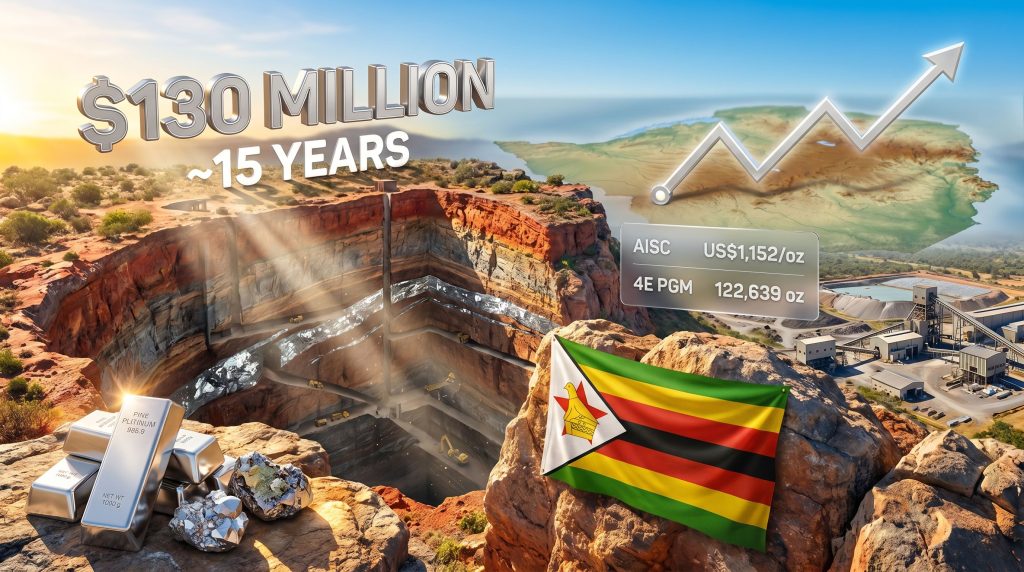
North Hill addresses this directly. The project would require a capital commitment of approximately US$130 million and has the potential to extend Mimosa's operational life by roughly 15 years beyond the current South Hill reserve base. That is not simply an extension of status quo production; it represents a complete replacement of the mine's productive core with a new ore body that sustains the existing processing infrastructure, workforce, and surface assets.
The Mtshingwe shaft development operates as a complementary mechanism within this framework. Shaft development must be sequenced carefully before full North Hill capital deployment can begin, meaning the infrastructure groundwork needs to precede the larger capital commitment. This sequencing logic is characteristic of underground mine life-extension projects, where access development timelines constrain the overall schedule regardless of how quickly capital approval is achieved.
| Metric | Current Status |
|---|---|
| Annual PGM Concentrate Output | ~250,000 oz |
| 4E PGM Production (2024) | 122,639 oz |
| All-In Sustaining Cost (2024) | US$1,152/oz |
| Current Life of Mine | 2034 (as of Dec 2024) |
| North Hill Capital Requirement | ~US$130 million |
| Potential Life Extension | ~15 years |
| Ownership Structure | 50/50 Impala Platinum / Sibanye-Stillwater |
The 2024 Suspension: Three Forces That Converged
The North Hill project's original suspension in 2024 was not the result of a single adverse event but rather three reinforcing pressures that compounded simultaneously to make a $130 million discretionary capital commitment economically indefensible at that moment.
-
Autocatalyst supply chain destocking reduced immediate demand for PGMs as manufacturers drew down existing inventory rather than purchasing at spot market prices, compressing near-term metal demand signals.
-
Weakening automotive manufacturing output across key markets reduced the volume of new vehicles requiring catalytic converters, directly affecting the primary demand driver for platinum and palladium.
-
Elevated EV adoption expectations prompted investors and analysts to price in an accelerated timeline for internal combustion engine displacement, reducing the perceived economic viability window for autocatalyst-dependent mining operations.
The combined effect pushed PGM prices below the hurdle rates required to justify large-scale capital investment, and Mimosa's joint venture partners made the commercially rational decision to suspend the project. Across South Africa's platinum belt, the same dynamic played out at scale, with major producers implementing job reductions, cancelling expansion plans, and retreating to sustaining capital only.
What Changed: The Recalibration That Triggered Revival
The conditions enabling the Zimbabwe Mimosa platinum project revival reflect a meaningful shift in the underlying assumptions that drove the 2024 suspension. PGM prices have recovered from their cycle lows, supported by tightening supply from South Africa's constrained production base. More significantly, electric vehicle adoption rates have tracked materially below the consensus forecasts that informed 2022 and 2023 capital planning models.
When EV penetration curves shift rightward in time, the economic justification window for autocatalyst-dependent mine life extensions widens in direct proportion. A 15-year life extension that appeared marginal under aggressive EV adoption assumptions can become highly compelling when those timelines extend by five to seven years.
This recalibration is not speculative. Global EV market share data through 2025 shows penetration rates consistently below the trajectories embedded in earlier demand destruction models, particularly in North America and emerging markets where the ICE vehicle base remains deeply entrenched. The practical implication for PGM mining companies is that autocatalyst demand is likely to remain the dominant market driver for platinum and palladium well beyond 2035, extending the viable economic window for operations like Mimosa. In addition, the broader critical minerals demand narrative reinforces why securing long-life PGM supply sources has become a strategic priority.
There is also a longer-horizon consideration that adds complexity to the demand outlook. Platinum's role in hydrogen fuel cell technology represents a potential secondary demand pillar that was largely absent from the original economic models built for operations like Mimosa. As hydrogen mobility infrastructure develops across Europe and Asia, platinum consumption in proton exchange membrane fuel cells could partially offset any eventual reduction in autocatalyst demand, providing an additional floor beneath long-run price assumptions. This potential is further amplified by the ongoing battery technology shift reshaping energy storage assumptions across the transport sector.
Navigating a 50/50 Joint Venture Capital Decision
One of the less commonly examined dimensions of the North Hill revival is the governance complexity inherent in a 50/50 joint venture between Impala Platinum and Sibanye-Stillwater. Equal ownership structures require full alignment between partners before capital of this magnitude can be committed, and each company brings a materially different financial position and strategic posture to that conversation.
Impala Platinum has articulated a consistent strategic preference for life-extension projects over greenfield mine development, recognising that sustaining existing infrastructure offers better capital efficiency and lower execution risk in an environment of commodity price uncertainty. North Hill aligns directly with this philosophy. Consequently, the way these mining joint ventures structure their capital decision-making becomes central to the project's ultimate trajectory.
Sibanye-Stillwater's balance sheet position represents a more dynamic variable. The company has navigated a challenging period across its PGM portfolio and its capacity to commit joint venture capital will influence the timeline for a formal investment decision. Securing alignment between two partners with potentially different near-term capital allocation priorities in a 50/50 structure typically requires more time than a wholly-owned project approval, which is one reason the current characterisation of the project as being under active internal consideration is significant without yet being a confirmed final investment decision.
The next major ASX story will hit our subscribers first
Three Scenarios for the $130 Million Decision
| Scenario | Capital Timeline | Life Extension Outcome | Key Risk |
|---|---|---|---|
| Accelerated Approval | 12-18 months to FID | Full 15-year extension | PGM price reversal |
| Phased Deployment | 2-3 years staged | Partial extension secured | Sequencing delays |
| Extended Deferral | 3+ years or indefinite | Post-2034 gap risk | Operational continuity |
Scenario 1: Accelerated Approval assumes sustained PGM price recovery above project hurdle rates and joint venture capital alignment achieved within 12 to 18 months. This represents the base case if current price dynamics hold and both partners can align their internal approval processes. The primary risk is a renewed price correction driven by demand-side weakness or a sudden acceleration in EV adoption.
Scenario 2: Phased Capital Deployment involves staging the investment, beginning with Mtshingwe shaft development as a separately funded phase before committing the full North Hill capital envelope. This approach reduces initial risk exposure while preserving strategic optionality, but it extends the timeline for full production contribution and may not fully protect the 2034 life-of-mine horizon if phasing delays become significant.
Scenario 3: Extended Deferral represents the downside case, triggered by renewed PGM price weakness, a resurgence of aggressive EV adoption expectations, or joint venture capital constraints at either partner level. Extended deferral creates genuine operational continuity risk beyond 2034 and carries workforce and community implications that make it commercially and reputationally costly to sustain indefinitely.
Zimbabwe's Regulatory and Operating Environment
The Zimbabwe Mimosa platinum project revival occurs within a regulatory framework that has evolved considerably over the past decade. Zimbabwe's indigenisation policy, which historically required significant local ownership stakes in mining operations, has been substantially reformed, and the current framework is generally considered more accommodating for foreign joint ventures operating in the platinum sector than it was during the peak indigenisation period.
Currency and royalty frameworks remain relevant variables in the project economics. Zimbabwe's fiscal take, including royalties applied to platinum group metal production, directly affects the net revenue available to service capital invested in North Hill. At an all-in sustaining cost of US$1,152 per ounce for 2024, the project's economics are sensitive to both metal prices and the in-country cost structure, including royalty obligations.
Brownfield expansion approvals in Zimbabwe typically carry a lower regulatory burden than new project applications, which represents a structural advantage for North Hill as a mine replacement initiative rather than a greenfield development. The Zimbabwean government has a structural interest in seeing Mimosa's operational life extended, given the mine's contribution to formal employment, foreign exchange earnings, and community economic activity in the Zvishavane region. Indeed, government support for the project has been publicly affirmed even amid a significant revenue decline, underscoring the operation's strategic importance to the national economy.
What North Hill Signals for the Broader PGM Investment Cycle
The Zimbabwe Mimosa platinum project revival is not an isolated corporate event. It functions as a leading indicator of shifting sentiment across the entire PGM capital cycle. The industry's willingness to recommit discretionary capital to mine life extensions signals that the deepest pessimism of the 2023–2024 period is being systematically revised as supply-side realities and demand-side recalibrations converge.
For investors monitoring the PGM sector, several indicators deserve close attention over the next 12 to 24 months:
- Formal feasibility study announcements or final investment decision disclosures from the Mimosa joint venture — a completed definitive feasibility study would represent a significant milestone in the project's progression
- PGM spot price trajectory and its relationship to disclosed project hurdle rates across South African and Zimbabwean producers
- Sibanye-Stillwater's balance sheet developments and any guidance on joint venture capital commitments
- Zimbabwe regulatory developments affecting brownfield expansion approvals and royalty frameworks
- EV adoption rate data from major automotive markets, particularly North America, Europe, and China
The broader template being established here, preferring shorter-payback life extensions over long-duration greenfield capital, is becoming the dominant investment model across PGM operations globally. At US$130 million over a potential 15-year production extension, North Hill's capital intensity per ounce of future production compares favourably to the cost of building comparable productive capacity from scratch, which in the current environment would likely require multiples of that figure and carry substantially higher execution risk.
Disclaimer: This article contains forward-looking analysis, scenario projections, and references to commodity price trends. It is intended for informational purposes only and does not constitute financial or investment advice. Readers should conduct independent research and consult qualified advisors before making investment decisions. All financial metrics and production figures referenced are based on publicly reported data available at the time of writing.
Want to Stay Ahead of the Next Major Mineral Discovery on the ASX?
Discovery Alert's proprietary Discovery IQ model delivers real-time alerts on significant ASX mineral discoveries — including opportunities across the PGM and critical minerals sectors — turning complex data into actionable insights for both short-term traders and long-term investors. Explore how historic mineral discoveries have generated substantial returns and begin your 14-day free trial today to position yourself ahead of the broader market.