June 17, 2026
Africa's Gold Processing Revolution and the Infrastructure Gap Nobody Talks About
Across sub-Saharan Africa, a quiet but consequential transformation is underway. The continent's gold producers are no longer content to simply extract ore and ship it offshore for processing. From Ghana to Tanzania, nations with significant precious metals endowments are investing in downstream infrastructure to capture more value domestically before gold ever reaches an international trading hub. Zimbabwe is the latest country to make this pivot, and its approach is revealing something important about how frontier gold economies evolve once production crosses a critical threshold.
The economics are straightforward: every tonne of gold refined domestically rather than exported unprocessed generates additional fiscal revenue, supports local employment, and strengthens foreign currency reserves. However, building refinery infrastructure at scale requires capital, technical expertise, and institutional confidence that many emerging producers have historically lacked. Zimbabwe's decision to license a Zimbabwe second gold refinery marks a structural turning point, not just for the country's mining sector, but for how African nations are beginning to think about mineral sovereignty.
When big ASX news breaks, our subscribers know first
Why Output Growth Eventually Breaks the Single-Refinery Model
There is a predictable tension in fast-growing resource economies between extraction capacity and processing infrastructure. Mining operations can be expanded relatively quickly through additional drilling, workforce scaling, and capital equipment deployment. Refinery construction, by contrast, is a multi-year, capital-intensive undertaking that requires regulatory licensing, civil engineering, metallurgical equipment procurement, and grid-quality power supply.
This asymmetry creates windows where production growth outpaces processing capacity, forcing governments to make a choice: throttle output growth to match existing infrastructure, or license new processing capacity to keep pace with the extraction side of the equation.
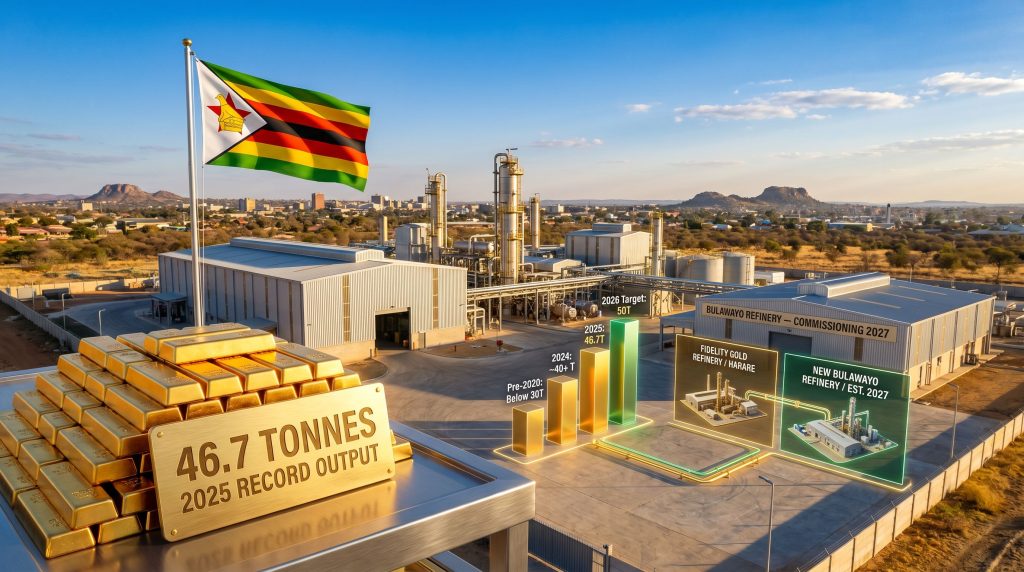
Zimbabwe has reached exactly this inflection point. The country recorded a historic 46.7 tonnes of gold production in 2025, and is targeting 50 tonnes in 2026, representing a new national benchmark. Furthermore, over a five-year window, Zimbabwe's gold output has grown by an estimated 55 to 60%, driven by a combination of formalisation programmes targeting artisanal and small-scale miners, increased investment from mid-tier producers, and improvements in ore recovery methodology. For a broader perspective on global gold production trends, Zimbabwe's trajectory sits within a wider continental surge in output.
Zimbabwe's Gold Production Trajectory
| Year | Estimated Output | Key Development |
|---|---|---|
| Pre-2020 | Below 30 tonnes | Artisanal sector largely informal |
| 2024 | ~40+ tonnes | Formalisation programmes gain traction |
| 2025 | 46.7 tonnes (record) | Single-refinery model under strain |
| 2026 (target) | 50 tonnes | Second refinery licensing activated |
The data tells a clear story. A refining architecture designed for a lower-output era is simply no longer fit for purpose. Fidelity Gold Refinery, Zimbabwe's state-linked sole official processing and purchasing channel, has served the country effectively for decades, but government officials have now acknowledged it will not be capable of absorbing projected national output beyond 2026.
The New Bulawayo Facility: Location, Timeline, and What Remains Unknown
The licensed Zimbabwe second gold refinery is designated for Bulawayo, the country's second-largest city and historical industrial centre. The commissioning timeline, according to government officials who requested anonymity due to the confidential nature of the project, is 2027.
Bulawayo's selection is not arbitrary. The city carries significant industrial heritage from Zimbabwe's manufacturing era, retains metallurgical infrastructure from earlier industrial activity, and sits within logistics corridors that connect the southwestern region of the country to export-oriented transport networks. From an operational perspective, Bulawayo also offers geographic diversification away from Harare, reducing single-point-of-failure risk in Zimbabwe's gold processing pipeline.
Industry observers have noted that Betterbrands Gold Refinery appears to be preparing for operations in Bulawayo, with timing and location alignment that warrants monitoring. No official confirmation has linked Betterbrands directly to the newly issued licence, but the overlap is significant enough that sector analysts are watching the entity closely.
What is explicitly confirmed is that the investors behind the new facility have not been publicly identified. Government sources have indicated ownership disclosure will occur at the point of commissioning, a deliberate deferral that carries its own implications for transparency and international market access, explored in more detail below.
Fidelity Gold Refinery: The Incumbent and Its Evolving Role
Understanding why the Zimbabwe second gold refinery matters requires appreciating the structural role Fidelity Gold Refinery has played in Zimbabwe's gold economy. The institution functions simultaneously as a commercial buyer, a refining operation, and a quasi-regulatory mechanism for formalising gold flows through official channels.
Its state-linked structure has enabled the government to monitor export volumes, capture royalties, and apply export levies at the point of processing, making it a central tool in Zimbabwe's broader effort to reduce informal gold trading and the associated revenue leakage.
However, this model also creates concentration risk. A single processing node means any operational disruption, power failure, capacity constraint, or compliance challenge affects the entire gold export pipeline simultaneously.
Fidelity vs. the New Bulawayo Refinery: A Structural Comparison
| Feature | Fidelity Gold Refinery | New Bulawayo Refinery |
|---|---|---|
| Ownership | State-linked | Undisclosed private investors |
| Location | Harare | Bulawayo |
| Operational Status | Active | Commissioning ~2027 |
| Market Role | Sole official buyer/exporter | Supplementary processing capacity |
| Capacity Status | At or near ceiling | Designed for expanded output |
| Investor Transparency | Public | To be disclosed at commissioning |
The emergence of a privately backed facility alongside the state-linked Fidelity structure introduces what analysts are calling a dual-track processing model for Zimbabwe's gold sector. This is a meaningful architectural shift, one that distributes risk, invites competition, and opens the door to different governance standards depending on which facility processes a given parcel of gold.
The Fidelity Restructuring: Reading the Privatisation Signal
Running parallel to the new refinery licence is a separate but interconnected development: Zimbabwean authorities have moved to divest a 60% stake in a gold refinery business connected to Fidelity Gold Refinery, with that stake valued at $49 million.
This transaction deserves close analytical attention. At face value, it could be read as a straightforward capital-raising exercise for a state entity that lacks the balance sheet to self-fund infrastructure expansion. Consequently, the timing suggests something more structural is happening.
Licensing a new private refinery while simultaneously offering a majority stake in the existing state-linked facility signals that Zimbabwe is pursuing a hybrid ownership model for its gold processing sector, retaining sovereign oversight while inviting private capital to fund the expansion the government cannot finance alone.
This pattern has precedent across African resource economies. In Ghana, South Africa, and more recently Tanzania, governments have navigated the tension between sovereign control over strategic commodity infrastructure and the private capital requirements needed to scale that infrastructure. Zimbabwe appears to be following a similar trajectory, albeit at its own pace and with its own regulatory constraints.
The $49 million valuation for the 60% Fidelity-linked stake also provides a useful benchmark for investors thinking about the capital intensity of refinery-scale precious metals processing in the southern African context. It implies a total enterprise value of approximately $81.7 million for the business, reflecting both the scale of Zimbabwe's current operations and the discount applied by investors for country-specific risk.
Zimbabwe's Competitive Position Among African Gold Producers
To contextualise what the Zimbabwe second gold refinery means for the country's regional standing, it helps to map Zimbabwe's output against its continental peers. In addition, understanding the broader gold market outlook provides useful context for why downstream processing infrastructure is increasingly prioritised across emerging producer nations.
African Gold Production and Processing Comparison
| Country | Estimated Annual Output | Refining Infrastructure |
|---|---|---|
| South Africa | ~90-100 tonnes | Mature multi-facility ecosystem |
| Ghana | ~80-90 tonnes | Multiple refineries and export hubs |
| Mali | ~60-70 tonnes | Primarily export-oriented unrefined |
| Tanzania | ~45-50 tonnes | Growing domestic processing capacity |
| Zimbabwe | 46.7 tonnes (2025) | Transitioning to dual-refinery model |
Zimbabwe's output now sits in the same tier as Tanzania, yet its processing infrastructure has historically lagged behind. The second refinery licence begins to close this structural gap. More significantly, it positions Zimbabwe to move up the value chain by certifying and exporting refined gold rather than semi-processed material, a distinction that carries meaningful price differentials in international precious metals markets.
Gold exported in fully refined form, meeting London Bullion Market Association (LBMA) good delivery standards, commands materially better pricing than unrefined or semi-processed gold sold to intermediaries. Building the domestic infrastructure to achieve LBMA-standard certification at scale is therefore not just a capacity story — it is a margin story.
The next major ASX story will hit our subscribers first
The UAE Trade Dimension and Why Refining Redundancy Matters Geopolitically
Zimbabwe's gold export relationships have a well-documented Gulf dimension, with significant volumes historically flowing through UAE-based trading hubs. This creates a geopolitical exposure that domestic refining redundancy directly addresses.
When Middle East trade routes come under pressure, as they have during periods of regional instability, Zimbabwe's gold export flows are affected. A more robust domestic refining ecosystem reduces the country's dependence on exporting lower-grade or semi-processed material, allowing it to engage with a wider range of international buyers on better terms.
Furthermore, the logic extends further: a country with two certified refineries operating to international standards is a more credible counterparty for sovereign wealth funds, central bank gold reserves, and institutional buyers than a country with a single, capacity-constrained state entity. The second refinery, if commissioned successfully and to appropriate standards, materially improves Zimbabwe's gold trading flexibility.
Key Risks That Could Delay or Derail the 2027 Commissioning Target
Investors and industry observers should approach the 2027 commissioning timeline with appropriate scepticism. Several structural risks could delay or complicate the facility's path to operation.
Investor Opacity and LBMA Compliance Risk
The deliberate non-disclosure of investor identities until commissioning creates a transparency deficit that matters in the context of international gold trade. The LBMA's Responsible Gold Guidance and the OECD Due Diligence Guidance for Responsible Mineral Supply Chains both require clear beneficial ownership disclosure for refineries seeking global market access.
If the undisclosed investors include entities subject to international sanctions, operating through complex ownership structures, or with governance profiles that conflict with responsible sourcing standards, the new refinery could face significant barriers to accessing LBMA-accredited markets, regardless of its physical processing capability.
This is not a theoretical concern. Zimbabwe's gold sector has previously attracted scrutiny over informal trading flows, beneficial ownership opacity, and off-market transactions that bypassed official channels. A new refinery that replicates these characteristics would undermine rather than advance Zimbabwe's formal sector credibility.
Infrastructure and Power Supply Constraints
Gold refining is energy-intensive. The electrolytic refining processes used to achieve high-purity gold output, including the Wohlwill process for achieving 99.99% purity, require consistent, high-quality electrical supply. Zimbabwe's national grid has faced chronic reliability challenges, creating material operational risk for any energy-intensive industrial facility.
Refinery developers in Zimbabwe would likely need to incorporate dedicated power generation or co-generation capacity into their facility design, adding capital cost and construction complexity that could push the 2027 target further out.
Regulatory and Licensing Continuity
Zimbabwe's mining regulatory environment has evolved significantly over recent years, with changes to export levy structures, royalty frameworks, and formal sector participation requirements affecting the economics of gold processing. The new refinery's operating terms — including its purchasing rights relative to Fidelity, its relationship with the Zimbabwe Miners Federation, and its export licensing conditions — will determine how competitive and sustainable its business model actually is.
The key risks to monitor include:
- Ambiguity in how gold purchasing rights are divided between Fidelity and the new facility
- Potential regulatory changes that affect refinery margins or export pricing
- Foreign exchange repatriation rules that could affect investor returns
- Environmental and social governance requirements that may differ from international standards
- Grid power availability and reliability at the Bulawayo site
What the Dual-Refinery Model Means for Informal Sector Dynamics
One underappreciated dimension of Zimbabwe's refinery expansion is its potential impact on artisanal and small-scale mining (ASM) formalisation. Zimbabwe's gold production growth has been substantially driven by formalisation programmes that brought previously informal ASM operators into official purchasing channels.
When a single refinery operates at capacity, it creates practical bottlenecks that can push smaller producers back toward informal channels, particularly during peak production periods. A second licensed buyer and processor creates competitive tension in the purchasing market, theoretically improving prices offered to small-scale producers and reducing incentives to sell outside official channels.
This dynamic has been observed in other African gold economies where multiple licensed buyers compete for artisanal production. The net effect is typically improved formalisation rates, higher official production figures, and reduced revenue leakage. Notably, this also reinforces safe-haven gold demand at a sovereign level, as higher safe-haven gold demand globally encourages governments to tighten and expand their domestic processing pipelines — all of which benefit the sovereign.
Key Takeaways: Zimbabwe's Gold Processing Architecture in Transition
- Record output: Zimbabwe produced 46.7 tonnes of gold in 2025, a national record, with a 50-tonne target set for 2026
- Capacity driver: Fidelity Gold Refinery is approaching its processing ceiling, directly triggering the second refinery licence
- New facility location: Bulawayo, with commissioning targeted for 2027
- Ownership opacity: Investor identities remain undisclosed, creating LBMA compliance risk worth monitoring
- Parallel restructuring: A 60% stake in a Fidelity-linked refinery business is being offered at a $49 million valuation
- Strategic model: Zimbabwe is moving toward a hybrid state-private gold processing architecture
- Value chain ambition: Domestic refining expansion positions Zimbabwe to export certified refined gold rather than semi-processed material, improving margin capture
- Regional context: Zimbabwe's output now rivals Tanzania's, but its processing infrastructure has historically lagged continental peers. Furthermore, central bank gold programs globally are increasingly favouring nations with verified, certified refining capacity — an important dimension of Zimbabwe's long-term positioning in central bank gold programs
This article is intended for informational purposes only and does not constitute financial or investment advice. Production figures, valuation estimates, and commissioning timelines referenced herein are based on publicly available reporting and should be independently verified. All forward-looking statements involve inherent uncertainty.
Want to Capitalise on the Next Major Mineral Discovery Before the Broader Market?
Discovery Alert's proprietary Discovery IQ model delivers real-time alerts on significant ASX mineral discoveries, instantly translating complex mineral data into actionable investment insights for both short-term traders and long-term investors. Explore historic examples of exceptional discovery returns and begin your 14-day free trial today to position yourself ahead of the market.