
June 12, 2026
Africa's Industrial Gold Shift: Understanding the Forces Reshaping Sub-Saharan Production
For decades, sub-Saharan Africa's gold output has been shaped by a fragmented mix of large-scale corporate miners and sprawling artisanal sectors. That dynamic is beginning to shift. Across several African jurisdictions, state-directed capital is flowing into industrial-scale projects specifically designed to consolidate production, formalise supply chains, and capture a greater share of export value. Zimbabwe is among the clearest examples of this structural transition, and the Zimbabwe state gold miner output expansion over the next four years will test whether sovereign-led models can deliver on their considerable ambitions.
Understanding this shift requires looking beyond headline tonnage figures. The real story lies in how production is organised, who controls the capital, and what the financing architecture behind major projects reveals about execution risk.
When big ASX news breaks, our subscribers know first
Zimbabwe's Gold Sector by the Numbers: What the Data Actually Reveals
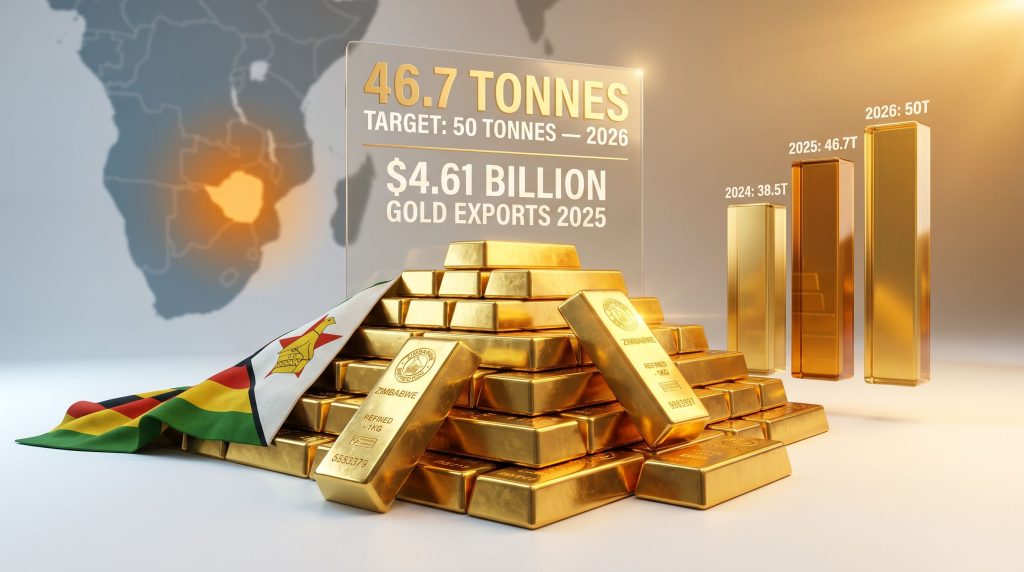
Zimbabwe's national gold output climbed to a record 46.7 metric tonnes in 2025, up from 38.5 metric tonnes in 2024, and the country has set a target of 50 metric tonnes for 2026. These figures alone would be notable, but the export revenue data is what makes the growth trajectory truly striking.
| Metric | Figure |
|---|---|
| Zimbabwe national gold output (2024) | 38.5 metric tonnes |
| Zimbabwe national gold output (2025, record) | 46.7 metric tonnes |
| National production target (2026) | 50 metric tonnes |
| Gold export revenue (Q1 2026) | $1.19 billion |
| Gold export revenue (Q1 2025 comparison) | $579 million |
| Total gold export earnings (full year 2025) | $4.61 billion |
| Total national exports (2025) | $9.7 billion |
| Gold's share of total national exports (2025) | ~47.5% |
The year-on-year comparison for Q1 export revenue is particularly revealing. Gold sales of $1.19 billion in the first quarter of 2026 against $579 million in Q1 2025 represents a 105% increase, driven by a combination of higher production volumes and elevated international gold prices. Furthermore, while price tailwinds have clearly contributed, the structural expansion in output volume is the more durable driver to watch. The current environment of record gold prices has amplified revenue gains beyond what volume growth alone would suggest.
Gold as Zimbabwe's Primary Foreign Currency Engine
When a single commodity accounts for approximately half of a country's total export revenue, the implications extend well beyond the mining sector. Gold's $4.61 billion contribution to Zimbabwe's $9.7 billion in total 2025 exports makes it the country's dominant source of hard currency. This concentration creates both a powerful incentive to grow production and a meaningful vulnerability to gold price cycles, operational disruptions, or grade deterioration at key mines.
For context, Zimbabwe's gold export dependency is among the most pronounced of any African economy with a diversified resource base. Countries such as Mali and Burkina Faso derive similarly high proportions of export earnings from gold, though their respective security and governance environments carry different risk profiles. Zimbabwe's institutional framework, while historically challenging for foreign investors, is being actively repositioned through state-directed vehicles like its sovereign wealth fund.
Mutapa Gold Resources: Sovereign Ownership and the Strategic Production Mandate
Mutapa Gold Resources, owned by Zimbabwe's sovereign wealth fund, sits at the centre of the country's gold expansion ambitions. As the country's largest state-owned gold producer, Mutapa carries both an operational mandate and a broader economic function: generating foreign currency, anchoring mine employment, and demonstrating that state-directed capital allocation can compete with private sector efficiency.
The company's most recent financial year results, covering the period to 31 March 2025, recorded output of 104,626 ounces, a 10% decline from the prior year. Critically, this decline was attributed to lower ore grades rather than operational failures such as equipment breakdowns, labour disputes, or processing bottlenecks. This distinction matters enormously for how investors and analysts should interpret the expansion roadmap.
Grade decline in an operating mine is a geological reality, not an operational crisis. It signals that the ore body being processed is yielding less gold per tonne of rock moved, which requires either accessing higher-grade zones through new development or processing significantly more material to maintain output levels. Capital investment, rather than operational optimisation alone, is the appropriate response.
This is precisely the context in which Mutapa's expansion pipeline must be understood. The company is not fixing a broken operation; it is funding new capacity to compensate for geological depletion at existing workings while simultaneously targeting a near-doubling of total output. Consequently, the gold price impact on miners of this scale is substantial, with elevated prices improving project economics and strengthening the investment case for new capital commitments.
The Shamva Hill Project: Open-Pit Economics and the $150 Million Capital Question
The flagship driver of Mutapa's Zimbabwe state gold miner output expansion strategy is the Shamva Hill open-pit project, located approximately 100 kilometres northwest of Harare. The project is designed to transform Shamva from a relatively modest operation producing around 24,000 ounces per year into a materially larger contributor of nearly 80,000 ounces annually, representing a greater than 230% increase in output from a single mine.
Open-pit mining at Shamva Hill offers several structural advantages over underground methods. Strip ratios in open-pit operations tend to allow for higher throughput volumes, and the capital cost per recovered ounce can be significantly lower where ore bodies are sufficiently shallow and laterally continuous. However, open-pit economics are highly sensitive to ore grade, fuel costs for haulage equipment, and the availability of adequate processing infrastructure.
Capital Structure: Secured Funding and the Remaining Gap
The total capital requirement for Shamva Hill is approximately $150 million, structured as follows:
| Funding Component | Amount | Source |
|---|---|---|
| Secured domestic funding | $75 million | Zimbabwean banks |
| Remaining capital requirement | ~$75 million | Foreign lender negotiations |
| Total project capital requirement | ~$150 million | Mixed domestic/international |
Mutapa has confirmed that the $75 million domestic tranche has been secured from Zimbabwean banks, with construction scheduled to begin in August 2026. The remaining $75 million is currently being negotiated with international lenders. This funding gap is the single most important variable in assessing whether the Shamva timeline holds.
Foreign lenders evaluating Zimbabwean mining projects typically apply rigorous due diligence around currency risk, sovereign creditworthiness, and offtake security. Zimbabwe's monetary history, including past episodes of hyperinflation and currency redenomination, means international capital providers demand strong structural protections before committing. The willingness of foreign lenders to close on the remaining tranche will serve as an important external validation of the project's bankability.
A definitive feasibility study of this calibre is typically a prerequisite for securing international financing, and Shamva Hill's progress through this process will be closely monitored by prospective lenders assessing project credibility.
Construction Timeline and Delivery Risk
An August 2026 construction start gives Shamva Hill a realistic path to contributing meaningfully to Mutapa's production profile by late 2027 or 2028, depending on civil works duration, equipment procurement lead times, and commissioning schedules. Open-pit mine builds of this scale in African jurisdictions have historically encountered delays of six to eighteen months related to equipment importation, grid connection, and wet-season construction constraints.
Beyond Shamva: The Multi-Asset Growth Architecture
Shamva Hill is the headline project, but Mutapa's path to 220,000 ounces by 2029 draws from multiple production sources.
| Production Source | Current Contribution | Target Contribution |
|---|---|---|
| Shamva Hill (post-expansion) | ~24,000 oz/yr | ~80,000 oz/yr |
| Jena Mine (post-expansion) | TBC | Material uplift |
| Freda Rebecca Mine | Ongoing | Improved efficiency |
| Artisanal integration | Minimal | Supplementary |
| Total Target | ~104,626 oz (FY to Mar 2025) | 220,000 oz by 2029 |
Jena Mine Capacity Expansion
Construction at the Jena mine is expected to commence in the final quarter of 2026, meaning its production contribution will likely materialise in 2028 at the earliest. Jena's expansion adds a second major capital project to Mutapa's execution pipeline, raising the complexity of managing two simultaneous builds while maintaining output continuity at existing operations.
Freda Rebecca Mine: Operational Improvement as an Output Lever
Freda Rebecca, one of Zimbabwe's better-known gold operations, offers near-term production upside through process optimisation rather than major new capital investment. Improving recovery rates, throughput efficiency, and mining selectivity at an existing operation typically carries lower execution risk than greenfield or significant brownfield development, making Freda Rebecca's contribution more predictable than Shamva or Jena.
Artisanal Miner Integration: Structural Strategy or Tactical Supplement?
The incorporation of material from artisanal miners is a recurring feature of African state mining strategies. In Zimbabwe's context, formalising artisanal gold through licensed buying channels or toll-treatment arrangements can add incremental ounces to the national count without requiring direct capital expenditure on new mines. However, as detailed in reporting on Zimbabwe's artisanal mining sector, artisanal contributions remain inherently variable and difficult to forecast with precision, meaning they are best treated as supplementary rather than foundational to the 220,000-ounce target.
Is Doubling Output in Four Years Operationally Credible?
Achieving 220,000 ounces from a 2025 base of approximately 104,626 ounces requires Mutapa to add roughly 115,000 ounces of annual production in under four years. This is not unprecedented in African gold mining, particularly where open-pit development is the mechanism, but it demands near-flawless execution across three simultaneous project workstreams while managing the geological grade challenges already evident at existing operations.
Comparable African expansions, including those by state-aligned entities in West Africa, have demonstrated that 50%+ output uplifts are achievable within four-to-six year windows when financing is fully secured and project management capacity is adequate. The critical qualifier is fully secured financing, which Mutapa has not yet achieved for the complete Shamva capital stack.
Capital Financing Risks: The Variables That Could Reshape the Timeline
The most material risk to Mutapa's expansion roadmap is not geological or operational. It is financial. Three specific financing dynamics warrant close attention.
1. Domestic bank concentration risk. The $75 million already secured from Zimbabwean banks represents a significant exposure for a domestic banking system operating in a single-currency economy with constrained capital markets. Should economic conditions in Zimbabwe deteriorate, the terms or availability of this funding could be revisited.
2. Foreign lender appetite. International capital providers assessing the remaining $75 million requirement will evaluate Zimbabwe's currency regime, the strength of Mutapa's sovereign wealth fund ownership structure as a credit enhancement, and the projected gold price environment over the project's repayment horizon.
3. Currency risk. Zimbabwe's monetary environment remains one of the most complex in Africa. Gold is priced and exported in US dollars, which provides a natural hedge for revenue, but domestic input costs, labour, and contractor payments introduce local currency exposure that financing structures must carefully manage.
| Scenario | Probability Assessment | Impact on 2029 Target |
|---|---|---|
| Full $150M secured by mid-2026 | Moderate | On-track for 220,000 oz |
| Partial funding secured (domestic only) | Moderate-High | Shamva delayed; partial uplift |
| Funding gap persists beyond 2026 | Lower | Output growth limited to Freda Rebecca/Jena gains |
The next major ASX story will hit our subscribers first
State-Led vs. Private Sector Expansion: Comparing African Models
State-owned mining entities across Africa have pursued large-scale expansion with mixed results. The advantages of sovereign ownership include alignment with national policy objectives, preferential access to land and water rights, and the ability to leverage government relationships in project permitting. These factors can meaningfully accelerate early-stage development.
The risks, however, are equally well-documented. State miners have historically struggled with capital efficiency, particularly where procurement decisions are influenced by political considerations rather than pure commercial logic. In addition, gold M&A activity across the broader sector demonstrates that private operators frequently pursue consolidation as an efficiency mechanism that state-owned entities rarely replicate at comparable speed.
Mutapa's sovereign wealth fund ownership places it in an interesting intermediate position. Unlike a purely government ministry-controlled entity, a sovereign wealth fund structure implies a degree of commercial mandate and financial discipline that can improve credibility with international capital markets. Furthermore, broader mining industry consolidation trends suggest that state-aligned producers increasingly need to demonstrate private-sector-equivalent discipline to attract international financing partners.
Zimbabwe's 2026 National Target: What Closing the Gap Requires
Reaching the 50 metric tonne national target for 2026 from the 2025 record of 46.7 metric tonnes requires an incremental gain of approximately 3.3 metric tonnes, or roughly 106,000 additional ounces nationally. This gap is within reach if existing operations maintain performance and artisanal output remains at elevated levels, but it offers little margin for weather disruptions, equipment failures, or processing interruptions at major mines.
The country's strategy for achieving this target draws on a combination of:
- Continued investment in formalised large-scale mining operations
- Incentive structures designed to channel artisanal production through licensed buying centres
- Processing capacity improvements at established mines including Freda Rebecca
- Regulatory frameworks intended to reduce illegal gold exports and improve official production capture
Macroeconomic Implications: When Gold Represents Half of National Exports
Gold's ~47.5% share of Zimbabwe's total export revenue is both a sign of the sector's vitality and a structural concentration risk. When international gold prices are elevated, as they have been through 2024 and into 2025-2026, this concentration generates substantial foreign currency inflows that support fiscal balances, reserve accumulation, and sovereign fund reinvestment.
However, commodity concentration at this scale means that a sustained gold price correction could create significant fiscal stress. The country's ability to fund infrastructure, service external obligations, and maintain the Zimbabwean dollar's relative stability would all be affected by a material decline in gold export revenue.
The 105% year-on-year increase in Q1 2026 export revenue is partly a function of gold prices near multi-year highs. Analysts tracking Zimbabwe's fiscal trajectory should therefore distinguish between the volume-driven and price-driven components of export revenue growth to accurately assess structural versus cyclical strength. For instance, a fresh investment cycle in Zimbabwe's gold mining sector highlights how both forces are converging to reshape the country's economic outlook.
Frequently Asked Questions: Zimbabwe State Gold Miner Output Expansion
What is Mutapa Gold Resources' current annual gold output?
In the financial year ending 31 March 2025, Mutapa produced approximately 104,626 ounces of gold, representing a 10% decline from the prior year, primarily attributed to lower ore grades rather than operational disruptions.
What is Mutapa's gold production target by 2029?
Mutapa has set a target of 220,000 ounces per year by 2029, representing a near-doubling of current output, contingent on the successful completion of expansion projects at Shamva Hill, Jena, and Freda Rebecca.
How much capital is required for the Shamva Hill expansion?
The Shamva Hill open-pit project requires approximately $150 million in total capital. Mutapa has secured $75 million from domestic Zimbabwean banks, with the remaining balance under negotiation with international lenders.
When is construction at Shamva Hill expected to begin?
Construction is scheduled to commence in August 2026, at a site located approximately 100 kilometres northwest of Harare.
What is Zimbabwe's national gold production target for 2026?
Zimbabwe is targeting 50 metric tonnes of national gold output in 2026, building on a record 46.7 metric tonnes produced in 2025.
How significant is gold to Zimbabwe's overall economy?
Gold is Zimbabwe's leading foreign currency earner. In 2025, gold exports generated $4.61 billion, representing approximately 47.5% of the country's total export revenue of $9.7 billion. In Q1 2026 alone, gold export sales reached $1.19 billion, more than double the $579 million recorded in Q1 2025.
Who owns Mutapa Gold Resources?
Mutapa Gold Resources is owned by Zimbabwe's sovereign wealth fund, positioning it as a state-directed vehicle for achieving national gold production objectives.
Key Takeaways: Evaluating Zimbabwe's Gold Expansion in Strategic Context
Four structural pillars underpin Mutapa's growth case:
- Sovereign ownership providing policy alignment and access to domestic capital markets
- Open-pit development at Shamva Hill offering a proven, high-volume production methodology
- Multi-asset diversification across Shamva, Jena, and Freda Rebecca reducing single-project dependence
- National production momentum with Zimbabwe already at record output levels heading into the expansion cycle
Execution risk is concentrated in three areas: closing the Shamva financing gap, managing simultaneous project builds across two major sites, and navigating Zimbabwe's currency environment without disrupting project economics.
If Mutapa successfully secures the remaining $75 million and delivers Shamva Hill on schedule, Zimbabwe's trajectory toward becoming a genuine Tier-2 African gold producer becomes materially more credible. The conditions for that outcome are not guaranteed, but the architecture to achieve it is now more clearly defined than at any point in the country's recent mining history. The Zimbabwe state gold miner output expansion, consequently, represents one of the most closely watched sovereign mining programmes on the continent today.
This article contains forward-looking statements and production forecasts based on publicly available information. Actual outcomes may differ materially from projections due to financing delays, commodity price movements, geological variability, and operational factors. This content is for informational purposes only and does not constitute financial or investment advice. Readers seeking additional context on Zimbabwe's broader mining sector can explore related coverage available through Mining Weekly (miningweekly.com).
Want To Position Yourself Ahead of the Next Major Mineral Discovery?
Discovery Alert's proprietary Discovery IQ model delivers real-time alerts on significant ASX mineral discoveries, transforming complex geological and market data into actionable investment insights for both short-term traders and long-term investors — explore the historic returns major discoveries have generated and begin your 14-day free trial at Discovery Alert to secure your market-leading advantage.