July 21, 2026
The Hidden Cost Equation Reshaping Mining in Central Africa
Across the extractive industries of Sub-Saharan Africa, a quiet but consequential reckoning is underway. For decades, remote mine sites have operated as energy islands, burning through diesel at extraordinary cost and generating emissions that increasingly conflict with the expectations of global commodity markets. The arithmetic of diesel dependency has always been unfavourable. At remote locations across the Democratic Republic of Congo, where fuel must be transported across deteriorating road networks spanning hundreds of kilometres, that arithmetic becomes punishing.
What is changing now is not simply the availability of cheaper solar technology. It is the convergence of multiple forces, including collapsing renewable energy costs, intensifying ESG scrutiny from downstream buyers, and the structural impossibility of grid connection for most interior DRC mining operations, that is making hybrid solar-plus-storage the rational choice rather than the aspirational one. A zinc mine in DR Congo seeking to add solar and battery storage is the latest and increasingly typical expression of this shift.
When big ASX news breaks, our subscribers know first
Why Energy Poverty Creates Operational Risk at DRC Mine Sites
The Democratic Republic of Congo occupies a paradoxical position in the global energy landscape. It holds the second-largest tropical rainforest on Earth, sits astride the Congo River, which carries the largest hydroelectric potential of any river system in the world, and receives some of the highest levels of solar irradiance recorded across the African continent. Furthermore, the natural resources in the DRC are vast, yet fewer than 20% of its population have access to reliable electricity, and large-scale transmission infrastructure connecting interior mining regions to centralised power supply remains absent in most cases.
For industrial operations in the DRC's mineral-rich interior, this means energy must be self-generated. The historical default has been diesel generation, which carries a cost structure that compounds across multiple dimensions:
- Fuel procurement at international commodity prices, with no ability to hedge against oil price volatility
- Logistics costs associated with transporting large diesel volumes across the DRC's interior road network
- Generator maintenance, spare parts procurement, and downtime risk in remote locations
- Carbon intensity that increasingly conflicts with downstream ESG compliance frameworks
- Fuel security risk, where supply disruptions translate directly into production stoppages
In Sub-Saharan African mining contexts, diesel fuel has been estimated to account for between 20% and 40% of total operational expenditure at fully off-grid sites, making renewable energy integration a financial imperative rather than a peripheral sustainability initiative.
The DRC's energy deficit is structurally distinct from other nations in the region. Unlike South Africa, where grid instability is a matter of maintenance and governance, or Kenya, where geothermal and growing renewable capacity are progressively improving supply reliability, the DRC's challenge is fundamentally one of transmission geography. Vast hydroelectric potential exists but remains largely untapped at the industrial scale needed to serve remote mine sites. This structural reality is precisely what makes on-site solar-plus-storage such a compelling alternative.
The Economics That Are Making Solar-BESS Unavoidable
Levelised Cost Comparisons Across Energy Sources
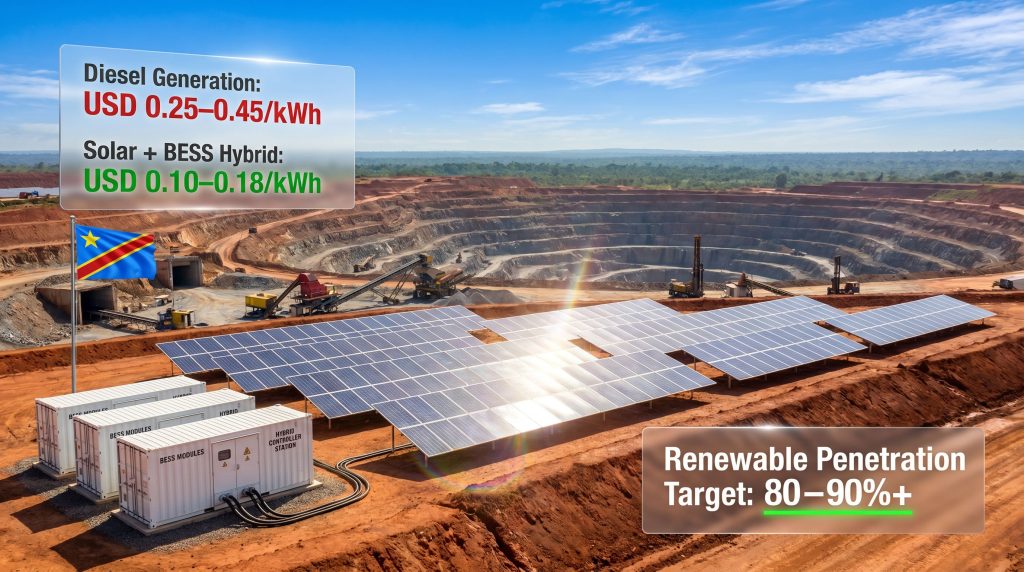
The financial case for transitioning away from diesel at DRC zinc mining operations has strengthened dramatically over the past decade. The levelised cost of utility-scale solar photovoltaic generation has fallen below USD 0.04 per kilowatt-hour in high-irradiance environments globally, while diesel generation at remote African mine sites typically costs between USD 0.25 and USD 0.45 per kWh when all logistics and maintenance costs are factored in.
| Energy Source | Estimated LCOE (Remote Africa) | Reliability Factor | Carbon Intensity |
|---|---|---|---|
| Diesel Generation | USD 0.25–0.45/kWh | High (fuel supply dependent) | Very High |
| Solar PV Only | USD 0.04–0.08/kWh | Intermittent | Near Zero |
| Solar + BESS Hybrid | USD 0.10–0.18/kWh | High (dispatchable) | Very Low |
| Grid Connection (DRC) | Variable / Unreliable | Low in remote areas | Mixed |
Even accounting for the additional capital cost of battery energy storage systems, a well-structured solar-BESS hybrid delivers energy at a fraction of the cost of full diesel dependency. For mining operations consuming between 10 MW and 50 MW of continuous power across zinc crushing, milling, flotation, and processing circuits, this cost differential is transformative at the operating margin level. Hybrid solar-BESS implementations at comparable African mine sites have demonstrated energy cost reductions of 30% to 60% over an operation's lifetime, with capital payback periods typically falling in the 5 to 8 year range for well-structured projects.
Zinc's Dual Role in the Clean Energy Economy
There is a structural irony embedded in the story of a zinc mine in DR Congo pursuing solar and storage that is worth examining carefully. Zinc is not simply a commodity whose production happens to consume energy. It is a foundational input for the clean energy infrastructure being built at global scale. According to the IEA's analysis of critical minerals in clean energy transitions, the demand trajectory for these materials is set to accelerate significantly as decarbonisation targets intensify.
Galvanised steel, in which zinc coating provides corrosion resistance, is the primary structural material for wind turbine towers, solar panel mounting systems, and transmission infrastructure. As the global energy transition accelerates, demand for galvanised structural steel grows in direct proportion. The International Zinc Association has noted that a single onshore wind turbine can require several tonnes of zinc in its tower and foundation components alone.
This creates a compelling lifecycle sustainability narrative. Zinc produced at mine sites powered predominantly by renewable energy carries measurably lower Scope 1 and Scope 2 emissions than zinc produced using diesel. As global manufacturers and infrastructure developers face growing pressure to account for Scope 3 emissions across their supply chains, the provenance of raw materials is becoming a commercial differentiator. Zinc producers that can demonstrate low-carbon extraction credentials will hold an increasingly meaningful advantage in securing long-term offtake agreements with ESG-conscious buyers.
How Solar-Plus-Storage Systems Actually Function at Industrial Mine Sites
System Architecture and Load Profiling
Deploying solar and battery storage at a zinc mining operation is considerably more technically complex than a utility-scale solar park connected to a national grid. The mine site operates as an islanded microgrid, meaning the hybrid energy system must replicate all the functions that a transmission grid normally provides, including voltage regulation, frequency stabilisation, and spinning reserve capacity.
The process begins with detailed load profiling. Zinc mining has a characteristically high and relatively stable baseload demand, driven by continuous grinding mills, flotation circuits, and ventilation systems. Superimposed on this baseload are periodic high-demand spikes from hoist motors, crusher startups, and processing equipment. Understanding the full 24-hour demand curve is essential to correctly sizing both the solar array and the BESS.
Solar arrays for mid-size mining operations are typically sized at 1.2 to 1.5 times the average load to account for generation variability, cloud cover, and soiling losses. In equatorial DRC, average global horizontal irradiance exceeds 5.0 kWh per square metre per day across most mineral-bearing regions, providing an excellent resource base. However, that irradiance advantage must be managed against real operational challenges including dust accumulation, which can impose soiling losses of 5% to 15% on generation performance without regular panel cleaning programmes.
Phase-by-Phase Deployment
Successful hybrid energy implementations at mine sites in the DRC and broader Sub-Saharan Africa follow a phased commissioning structure. The role of renewable energy in mining has consequently evolved from a niche consideration to a core operational strategy:
- Feasibility and demand mapping — Establishing precise 24-hour energy demand curves, identifying peak loads, and modelling diesel displacement scenarios across different solar-BESS sizing configurations
- Solar farm commissioning — Establishing generation capacity ahead of storage integration, allowing the operation to begin benefiting from renewable energy while BESS procurement and installation proceeds
- BESS integration — Adding dispatchable storage capacity to extend effective solar hours beyond daylight, provide overnight supply, and eliminate or dramatically reduce diesel generator runtime
- Performance optimisation — Monitoring renewable penetration rates using AI-driven energy management software, adjusting dispatch logic, and targeting renewable supply fractions above 80% to 90%
*Mining operations across Sub-Saharan Africa that have completed solar-BESS integration have reported renewable penetration rates rising from initial levels of around 60% to 80% toward sustained achievement of 85% to 90%+, with corresponding diesel consumption reductions of 30% to 50% depending on system sizing.*
Battery Chemistry and Technology Selection
For mine-site applications in equatorial Africa, lithium iron phosphate (LFP) chemistry has become the dominant technology choice for battery energy storage. Its selection is driven by several properties that align with the operational environment:
- Superior thermal stability at high ambient temperatures compared to nickel manganese cobalt (NMC) alternatives
- Cycle life of 3,000 to 6,000 full charge-discharge cycles, providing economic durability over a mine's operating life
- Lower intrinsic fire and thermal runaway risk, which is critical in remote locations where emergency response capability is limited
- A declining cost trajectory that continues to improve project economics
BESS units at remote DRC mine sites are typically deployed in containerised configurations, enabling modular capacity expansion and simplified logistics for transport to interior locations. BESS capacity is commonly sized to provide 4 to 8 hours of storage at average load, sufficient to bridge overnight periods and low-irradiance intervals during cloud cover events.
The DRC Renewables Transition: Precedents Already Established
A Pattern Emerging Across Multiple Commodity Types
The move by a zinc mine in DR Congo toward solar and storage does not occur in isolation. A recognisable pattern has already established itself across multiple commodity categories operating in the DRC and the broader Central African mining landscape. In addition, the DRC cobalt export ban has further reinforced investor attention on the strategic dimensions of mineral supply from this region, adding urgency to the conversation around operational resilience.
Gold mining operations in the DRC have already commissioned solar PV arrays paired with BESS, with at least one project targeting a step-change in renewable electricity supply from approximately 81% toward 90%, representing a meaningful reduction in residual diesel dependency. Lithium mining projects in the DRC have completed Phase I solar farm commissioning, with BESS integration proceeding in subsequent phases. Cobalt and copper operations are following similar trajectories.
| Project Type | Country | Capacity | Renewable Target | Status |
|---|---|---|---|---|
| Gold Mine Solar + BESS | DRC | ~16 MW solar | ~90% renewable | Operational (2025) |
| Lithium Mine Solar (Phase I) | DRC | Undisclosed | Ongoing | Commissioned |
| Solar Park (Utility-Scale) | South Africa | 120 MWp | Grid-connected | Commissioned (2026) |
| Solar-Storage Acquisition | Southern Africa | Large-scale | Undisclosed | Transaction (2026) |
The Role of Development Finance in Accelerating Mine-Site Renewables
Capital availability has historically been a constraint on renewable energy deployment at DRC mine sites, given the combination of high upfront costs, political risk premiums, and relatively thin operating margins in base metal mining. Development finance institutions are playing an increasingly active role in de-risking these investments. The Congo cobalt market impacts have also prompted financiers to look more broadly at how operational sustainability can be improved across the region's mineral sector.
The African Development Bank and Nordic development finance institutions have formally committed to co-financing renewable mini-grid expansion across Sub-Saharan Africa, including projects serving industrial off-takers such as mine sites. Blended finance structures, which combine concessional capital from development institutions with commercial project finance, reduce the effective cost of capital for mine-site renewable projects and enable financing structures that would not be achievable on purely commercial terms in high-risk jurisdictions like the DRC.
Emerging project finance models such as build-own-operate-transfer (BOOT) arrangements and energy-as-a-service (EaaS) structures are also gaining traction, enabling mine operators to access renewable energy without committing the full capital requirement upfront. Under these models, an independent power producer funds, builds, and operates the solar-BESS system, selling energy to the mine at a contracted tariff that typically undercuts the mine's diesel generation cost from day one.
Key Challenges That Cannot Be Overlooked
Logistics, Workforce, and Technical Risk
The case for solar-plus-storage at DRC zinc mines is compelling, but it would be analytically incomplete without acknowledging the genuine barriers that make deployment more complex and costly than comparable projects in more accessible markets. As highlighted by research on green conflict minerals, the intersection of mineral extraction and responsible energy sourcing in the DRC carries additional social and political dimensions that investors cannot afford to ignore.
Road infrastructure quality across the DRC's mineral-bearing interior remains among the most challenging on the African continent. Transporting containerised BESS units, large-format solar panels, and associated electrical infrastructure to remote mine sites involves extended lead times, elevated freight costs, and meaningful risk of equipment damage or delays. Project commissioning timelines at DRC mine sites routinely run longer than equivalent projects in more accessible jurisdictions.
Local workforce capacity for the construction, operation, and maintenance of sophisticated solar-BESS hybrid systems is also a constraint. Effective project execution requires investment in training programmes that build the technical competency needed to maintain these systems over a multi-decade mine life. Reliance on expatriate technical staff for energy system maintenance introduces both cost and availability risks.
Additional technical risks specific to equatorial deployments include:
- Thermal management demands for BESS containers in high-ambient-temperature environments, requiring active cooling systems that themselves consume energy and require maintenance
- Dust soiling on solar panels in dry season conditions, necessitating structured cleaning programmes to prevent generation losses reaching the upper end of the 5% to 15% soiling loss range
- Cybersecurity considerations for remotely monitored and AI-managed energy systems in locations where physical security and network infrastructure may be less robust
The next major ASX story will hit our subscribers first
Frequently Asked Questions: Solar and Storage at Zinc Mines in the DRC
Why are zinc mines in the DRC investing in solar and battery storage?
The primary driver is the reduction of diesel fuel costs that consume a disproportionate share of operational budgets at remote sites. Secondary drivers include growing ESG compliance requirements from commodity buyers and financiers who are increasingly scrutinising Scope 3 emissions across industrial supply chains. Energy security represents a third dimension, with solar-BESS hybrid systems providing operational continuity independent of the fuel supply chains and unreliable grid connections that have historically constrained DRC mining operations. Furthermore, the broader role of critical minerals and energy security in global policy frameworks is reinforcing the commercial logic of transitioning to lower-emission mining operations.
What capacity of solar and storage does a zinc mining operation typically need?
Mid-size zinc operations generally require continuous power supply in the range of 10 MW to 50 MW, depending on the scale of processing infrastructure. Solar arrays are typically sized at 1.2 to 1.5 times average load to account for generation variability, while BESS capacity is designed to provide 4 to 8 hours of storage at average load to bridge overnight periods and low-irradiance intervals.
Is the DRC a viable environment for renewable energy infrastructure?
From a solar resource perspective, the DRC's equatorial location provides average global horizontal irradiance exceeding 5.0 kWh per square metre per day across most mining regions, placing it among the highest-irradiance mining jurisdictions globally. While political, logistical, and regulatory factors introduce genuine complexity, multiple completed projects across gold, lithium, and other commodity categories have demonstrated that technical and commercial viability is achievable with appropriate structuring and risk management. The World Bank's analysis of DRC mineral policy further underscores the strategic importance of sustainable investment frameworks in the region.
What does this transition signal for investors watching the DRC mining sector?
Mine-site renewable projects of this type function as proof-of-concept investments that lower the perceived risk of subsequent deployments. As each solar-BESS project at a DRC mine site delivers on its operational and financial projections, it strengthens the investment case for the next project and expands the universe of financing structures available to operators. The longer-term scenario of DRC mine sites powered predominantly by renewables, supplying minerals that build the global clean energy economy, represents a closed-loop sustainability narrative with genuine commercial logic behind it.
Disclaimer: This article contains forward-looking statements and projections based on publicly available information and industry benchmarks. These statements involve inherent uncertainties and should not be construed as financial or investment advice. Readers should conduct independent due diligence before making investment decisions. Cost estimates, renewable penetration rates, and payback periods referenced are illustrative industry benchmarks and will vary by project.
Readers seeking further coverage of renewable energy developments across Sub-Saharan Africa's mining sector can explore ongoing reporting at Renewables Now, which tracks solar, storage, and energy transition projects across the Democratic Republic of Congo and the broader African region.
Want To Identify The Next Major Mineral Discovery Before The Broader Market Does?
Discovery Alert's proprietary Discovery IQ model delivers real-time alerts on significant ASX mineral discoveries — instantly transforming complex mineral data into actionable investment insights for both short-term traders and long-term investors. Explore Discovery Alert's discoveries page to understand how historic finds have generated substantial returns, and begin your 14-day free trial today to secure a meaningful market advantage.