July 16, 2026
The Hidden Cost of Corrosion: Why Africa's Infrastructure Future Depends on What You Can't See
Across Sub-Saharan Africa, billions of dollars in public and private infrastructure investment are quietly being eroded — not by mismanagement or poor planning, but by a force so fundamental it often escapes procurement conversations altogether: corrosion. The World Corrosion Organization estimates that corrosion costs the global economy roughly 3.4% of GDP annually, with developing economies frequently bearing a disproportionate share of that burden due to deferred maintenance cycles and procurement frameworks that prioritise upfront capital cost over long-term asset performance.
It is within this context that the IZA Africa zinc use in Southern Africa story becomes far more than an industry milestone. It represents a structural argument about how the continent builds, maintains, and ultimately finances its infrastructure over decades. Furthermore, understanding this argument is essential for engineers, specifiers, and policymakers who are shaping the region's built environment for generations to come.
When big ASX news breaks, our subscribers know first
Seven Years of Technical Advocacy: What IZA Africa Has Actually Built
The International Zinc Association's Africa Desk has spent the period from 2019 to 2026 doing something that rarely generates headlines but quietly reshapes industries: educating the people who write specifications. Engineers, contractors, university graduates, and government procurement officers are the gatekeepers of material selection decisions. If those decision-makers do not understand the lifecycle economics of zinc-based corrosion protection, the cheapest option on a bill of materials will win every time.
Over seven years, IZA Africa has delivered its technical mandate through a deliberate mix of:
- Engineering seminars and industry webinars targeting practising professionals
- Technical publications and white papers on corrosion science and zinc application standards
- Specialist training programmes covering hot-dip galvanizing, zinc-rich coating systems, zinc thermal spray, and lifecycle corrosion modelling
- Active engagement with tertiary institutions to embed corrosion science into civil and structural engineering curricula
- Relationship development with consulting engineers, galvanizing contractors, industry bodies, and government specifiers
The geographic reach of this effort extends beyond South Africa's dominant market to include Egypt, Morocco, Kenya, Nigeria, and Ethiopia — each at different stages of industrial development but all facing accelerating demand for durable infrastructure solutions. In addition, these resource export challenges facing commodities-dependent economies globally make the case for domestic zinc utilisation all the more compelling.
"Technical education is frequently undervalued as an industry investment, yet it functions as a demand-side multiplier. When specifiers understand lifecycle costing, they make fundamentally different procurement decisions — and those decisions compound over the lifespan of entire asset portfolios."
The Numbers Behind South Africa's Zinc Consumption Story
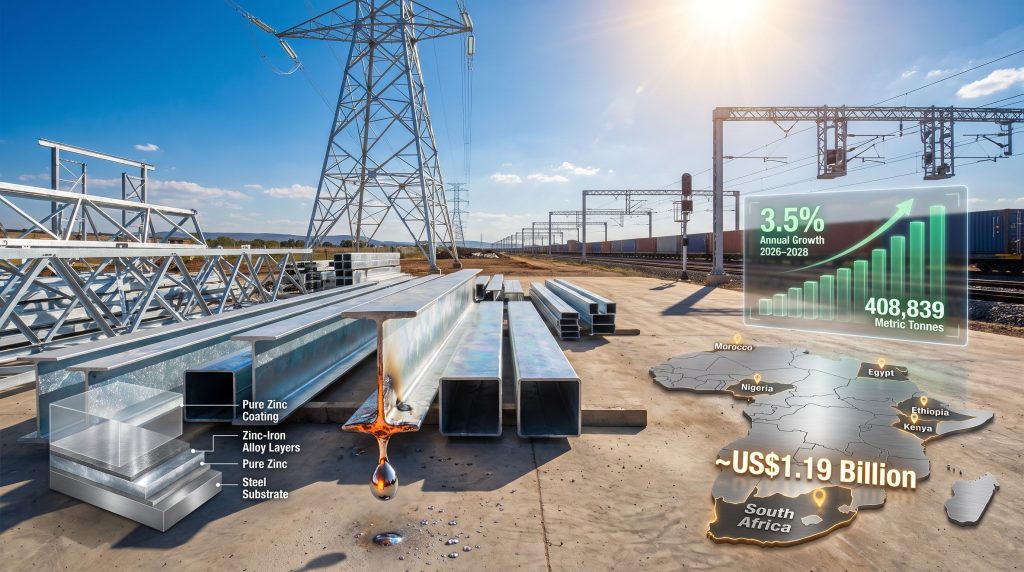
Between 2019 and 2025, South Africa consumed 408,839 metric tonnes of refined zinc, a volume valued at approximately US$1.19 billion (roughly R19.67 billion at prevailing exchange rates). On an annualised basis, this implies consumption of approximately 58,000 to 60,000 metric tonnes per year — a figure that tells only part of the story.
The more revealing data point is what that number used to be. Before 2011, South Africa's annual refined zinc consumption approached 129,000 metric tonnes per year — more than double current levels. The structural cause of this contraction is traceable to a single event: the closure of Exxaro's Zincor refinery in Springs, Johannesburg. Its closure in 2011 removed virtually the entire domestic refining supply base in one move, shifting South Africa from near self-sufficiency to near-total import dependency. Consequently, zinc production trends globally have had an outsized effect on South Africa's import costs and supply security.
| Metric | Value |
|---|---|
| Total refined zinc consumed (2019–2025) | 408,839 metric tonnes |
| Estimated value (USD) | ~US$1.19 billion |
| Estimated value (ZAR) | ~R19.67 billion |
| Implied average annual consumption | ~58,400 metric tonnes/year |
| Pre-2011 peak annual consumption | ~129,000 metric tonnes/year |
| Zincor refinery annual output (pre-closure) | ~117,000 metric tonnes/year |
The consumption decline is not simply a supply-side artefact. It also reflects a structural bias in procurement culture toward lowest-cost initial specification — a pattern that systematically undervalues the maintenance cost implications of inadequate corrosion protection. This dynamic is particularly acute in public infrastructure spending, where budget cycles rarely account for the compounding costs of premature asset degradation.
How Hot-Dip Galvanizing Actually Works — and Why It Matters in African Conditions
For non-specialists, understanding why zinc is so effective as a corrosion protection system requires a brief detour into materials science. Hot-dip galvanizing is not simply a surface coating; it creates a metallurgical bond between zinc and the steel substrate that cannot be replicated by paint or organic coating systems alone.
The Hot-Dip Galvanizing Process Step by Step
- Steel fabrication is completed to the required specification and dimensional tolerances
- Surface preparation begins with degreasing to remove oils and organic contaminants
- Acid pickling removes mill scale and rust from the steel surface
- Fluxing applies a zinc ammonium chloride layer to prevent re-oxidation before immersion
- The steel is immersed in a molten zinc bath held at approximately 450 degrees Celsius
- During withdrawal, zinc reacts with the steel surface to form a series of zinc-iron alloy layers, topped by a layer of pure zinc
- The coating is inspected against standards such as ISO 1461 for thickness and adhesion
What makes this process particularly suited to Africa's operating environments is the sacrificial anode mechanism. The zinc coating corrodes preferentially before the underlying steel, meaning that even where the coating is physically damaged, the surrounding zinc continues to protect exposed steel electrochemically. No paint system offers this self-healing characteristic.
| Zinc Coating System | Primary Application | Typical Service Life |
|---|---|---|
| Hot-dip galvanizing | Structural steel, transmission towers, rail fasteners | 50–100+ years in moderate environments |
| Zinc-rich primers | Maintenance painting, complex geometries | 15–30 years with topcoat |
| Zinc thermal spray | Heavy industrial, offshore, deep mining structures | 20–40+ years |
| Duplex systems (galvanizing + organic topcoat) | Marine, chloride-aggressive environments | Exceeds individual system life |
Southern Africa's corrosion environment is genuinely demanding. Coastal cities including Durban, Cape Town, and Port Elizabeth face chloride-laden marine atmospheres that accelerate steel corrosion rates significantly. The IZA Africa's technical resources provide detailed guidance on selecting the appropriate zinc protection system for each of these challenging environments.
Zinc's Multi-Sector Role: More Than a Corrosion Barrier
One of the less commonly understood aspects of zinc's strategic value in Southern Africa is that corrosion protection, while the dominant application by volume, is not the only dimension of the metal's industrial and social relevance. IZA Africa has actively promoted zinc's role across three distinct verticals.
| Application Domain | Zinc Function | Strategic Relevance |
|---|---|---|
| Structural steel protection | Hot-dip galvanizing and zinc-rich coatings | Extends asset life across mining, rail, and coastal infrastructure |
| Agricultural productivity | Soil and foliar fertiliser micronutrient | Addresses zinc deficiency in maize, wheat, and sorghum crops |
| Public health | Immune function and childhood illness prevention | Supports health resilience in underserved communities |
| Industrial corrosion control | Thermal spray and zinc-rich primer systems | Protects power transmission and heavy industrial assets |
Zinc deficiency in Southern African soils is a well-documented agronomic challenge with measurable impacts on crop yields. In zinc-deficient soils, both foliar application and soil amendment strategies can significantly improve grain yields, directly contributing to food security outcomes in a region where subsistence and smallholder agriculture remain economically significant.
Which Sectors Drive Zinc Demand Across the Region
Mining Infrastructure: The Largest Single Consumer
South Africa's deep mining sector represents the largest single application domain for zinc-based corrosion protection on the continent, with an estimated 50,000 tonnes of Special High Grade (SHG) zinc consumed annually in galvanizing applications across the sector. The applications are extensive:
- Headgear structures and winder housings at shaft collars
- Underground steelwork including bunton sets in vertical shafts
- Conveyor gantries and transfer structures at surface processing facilities
- Ventilation infrastructure exposed to aggressive airborne moisture
- Coastal mineral processing facilities in proximity to marine chloride exposure
The risk calculus in mining is distinct from surface infrastructure. Corrosion-induced structural failure in a deep mining environment carries both direct financial consequences and serious safety implications, elevating the engineering argument for zinc protection beyond pure lifecycle economics. The mining sustainability transformation underway across the region further reinforces the case for durable, low-maintenance materials like galvanized steel.
Rail and Power Transmission: The Infrastructure Multiplier
Rail and power transmission infrastructure represent one of the highest-value applications for hot-dip galvanizing because the assets involved are both difficult to access for maintenance and designed for multi-decade operational lives. A galvanized overhead transmission tower can realistically require zero maintenance coating intervention for 50 or more years in moderate inland environments, compared to a painted steel structure that may require recoating every 10 to 15 years.
IZA Africa has specifically highlighted rail expansion projects in Egypt and Kenya as important demand catalysts, including Egypt's major new rail corridor development, as well as South Africa's ongoing freight rail rehabilitation programme. These projects collectively represent significant new demand for galvanized structural steel, fasteners, signal gantries, and bridge elements. For context, the metals supply chains serving these markets are evolving rapidly to meet growing regional infrastructure demand.
Construction: The Projected Growth Frontier
Despite significant volatility in regional construction markets through the COVID-19 period and subsequent supply chain disruptions, the sector is projected to grow at approximately 3.5% annually from 2026 to 2028, creating renewed and expanding demand for galvanized structural steel products across roofing, structural framing, and reinforcement applications.
There is also an emerging alignment between zinc-based corrosion protection and green building frameworks. The decarbonisation benefits associated with extending asset operational life are increasingly recognised in sustainability reporting. Steel structures protected by hot-dip galvanizing require substantially fewer maintenance interventions, reducing embodied carbon associated with periodic recoating and extending the functional lifespan of structures before replacement is required.
The next major ASX story will hit our subscribers first
The Supply Chain Problem South Africa Has Not Solved
The closure of the Zincor refinery in 2011 created a structural supply gap that has never been adequately addressed through domestic industrial policy. South Africa now imports the overwhelming majority of its refined zinc requirements, exposing galvanizers and industrial consumers to currency volatility, international freight costs, and global supply chain disruptions of the kind experienced acutely between 2020 and 2022.
"The absence of domestic zinc refining capacity is not merely a supply chain inconvenience. It represents a strategic vulnerability for a country that hosts significant zinc mining operations — notably at Vedanta's Black Mountain Mine and Glencore's Gamsberg operation in the Northern Cape — yet lacks the downstream refining infrastructure to convert that ore into finished metal domestically."
According to calls for new refining investment, the economic logic for reinvestment in South African zinc refining is compelling: domestic ore supply, existing industrial infrastructure, a large captive consumer base, and the foreign exchange savings from import substitution. However, whether that argument translates into investable projects remains an open question, dependent on metal price cycles, capital availability, and long-term demand visibility.
Continental Growth Markets: Where Zinc Demand Is Heading Through 2030
| Country/Region | Primary Growth Driver | Zinc Demand Implication |
|---|---|---|
| South Africa | Freight rail rehabilitation, energy infrastructure | Structural galvanizing demand recovery |
| Egypt | New rail corridors, power grid expansion | High-volume hot-dip galvanizing requirements |
| Kenya | Urban rail investment, port infrastructure | Growing galvanizing market |
| Nigeria | Industrial construction, energy sector development | Emerging demand for zinc coating systems |
| Ethiopia | Infrastructure buildout, agricultural zinc fertiliser | Dual-stream demand across sectors |
The pattern across these markets reflects a consistent underlying dynamic: as economies industrialise and urbanise, the demand for durable, low-maintenance structural steel naturally increases. Zinc-based protection systems, furthermore, offer the most cost-effective pathway to achieving that durability at scale.
The Lifecycle Economics Case That Procurement Culture Is Ignoring
Perhaps the most consequential challenge facing IZA Africa zinc use in Southern Africa is not a supply issue, a technical limitation, or a price problem. It is a procurement culture systematically biased toward minimising initial capital expenditure at the expense of total lifecycle cost.
When a government infrastructure agency selects painted structural steel over hot-dip galvanized steel because the upfront cost is lower, the decision appears financially rational within the confines of a single budget cycle. Across the asset's full operational life of 30 to 50 years, however, the cost arithmetic frequently reverses. Recoating costs, scaffolding, traffic management for bridge structures, production shutdowns for mining or industrial facilities, and ultimately premature asset replacement all compound into a maintenance liability that dwarfs the initial specification saving.
IZA Africa's technical education work is, at its core, an effort to shift this calculation. When engineers and specifiers understand total cost of ownership modelling, they are better equipped to advocate for lifecycle-optimised specifications even within procurement frameworks that prioritise capital budget constraints. Building that capacity across an entire professional generation is slow work, but it is the most durable lever available for expanding zinc adoption at continental scale.
Simon Norton, Director of IZA Africa, has consistently articulated this principle: investing in knowledge is itself a form of infrastructure development, because the decisions engineers make today will determine the durability and maintenance cost trajectories of assets that will still be in service in 2060 and beyond.
Frequently Asked Questions: Zinc Use in Southern Africa
What is IZA Africa and what does it do?
IZA Africa is the regional desk of the International Zinc Association, focused on promoting technically informed zinc use across Southern Africa and the broader African continent. Its activities encompass engineering education, industry body engagement, university partnerships, and technical publication. The goal is to increase specification of zinc-based corrosion protection systems across infrastructure, mining, rail, and construction applications.
How much zinc does South Africa consume annually?
Current annual refined zinc consumption in South Africa is estimated at approximately 58,000 to 60,000 metric tonnes per year, representing a significant structural decline from a pre-2011 peak of roughly 129,000 tonnes annually. The primary driver of that decline was the closure of the Zincor refinery, which removed the country's domestic refining capacity.
Why is hot-dip galvanizing preferred over paint systems for African infrastructure?
Hot-dip galvanizing creates a metallurgical zinc-iron alloy bond with the steel substrate rather than a surface coating. This provides electrochemical sacrificial protection even at damaged areas, requires zero ongoing maintenance in many environments, and can deliver service lives exceeding 50 years in moderate conditions. For infrastructure in remote or difficult-to-access locations, the maintenance-free performance characteristic is particularly valuable.
Which African countries consume the most refined zinc?
South Africa remains by a considerable margin the continent's largest refined zinc consumer. Egypt, Morocco, Kenya, Nigeria, and Ethiopia represent the next tier of significant and growing consumption markets, driven by power infrastructure expansion, urban rail development, and industrial construction activity.
How does zinc contribute to agricultural productivity in Southern Africa?
Zinc deficiency is prevalent across many Southern African soils, reducing yields in staple grain crops including maize, wheat, and sorghum. Application of zinc-containing fertilisers — both as soil amendments and foliar sprays — can meaningfully improve crop performance in deficient growing zones. Consequently, this connects industrial zinc supply chains directly to food security outcomes across the region.
Disclaimer: Consumption figures, market valuations, and sector demand projections referenced in this article are drawn from IZA Africa's published data and industry estimates. Forward-looking projections regarding construction sector growth and demand trajectories involve inherent uncertainty and should not be interpreted as financial or investment advice. Readers should conduct independent research before making any investment or procurement decisions.
Ready to Identify the Next Major ASX Mineral Discovery Before the Market Does?
Discovery Alert's proprietary Discovery IQ model scans ASX announcements in real time, instantly converting complex mineral data across 30+ commodities into clear, actionable opportunities — just as it has for historic discoveries like De Grey Mining and WA1 Resources. Start your 14-day free trial today, or explore the Discovery Alert discoveries page to understand how major mineral finds have generated exceptional returns for well-positioned investors.