June 6, 2026
The rapid price escalation of China's 314 Ah storage cell prices increase has fundamentally disrupted global energy storage economics. This unprecedented combination of raw material volatility, policy-driven demand acceleration, and structural supply constraints has created market conditions not seen since the early days of lithium-ion commercialization, forcing stakeholders across the value chain to reassess deployment strategies and investment frameworks.
Understanding the 314 Ah Cell Market Structure and Its Economic Significance
China's 314 Ah lithium iron phosphate (LFP) storage cells represent the technical backbone of utility-scale energy storage deployment worldwide. These large-format cells have emerged as the industry standard for grid-scale applications, optimising energy density while maintaining the thermal stability critical for utility operations.
Market Positioning and Industrial Scale
The 314 Ah format delivers approximately 1,000 watt-hours per cell, positioning these units as the preferred choice for multi-megawatt storage installations. Manufacturing has concentrated among China's tier-one battery producers, with production facilities achieving economies of scale that traditionally kept pricing competitive.
Current market dynamics reveal significant pricing dispersion across suppliers. As of April 2026, 314 Ah cell prices range from CNY 0.335 to 0.395 per watt-hour, reflecting varying supplier strategies and capacity constraints. This price spread of CNY 0.060/Wh represents approximately 17% variation between low and high-end suppliers.
The standardisation around 314 Ah configurations has created network effects throughout the supply chain. Balance-of-system components, thermal management systems, and integration platforms have optimised around this cell format, creating switching costs that reinforce market positioning.
Price Discovery Mechanisms in Chinese Battery Markets
Chinese storage cell pricing operates through multiple channels, each responding differently to supply-demand imbalances. Framework procurement contracts typically establish baseline pricing for large-scale deployments, while spot market transactions reflect immediate supply availability.
Framework procurement quotes exceeded CNY 0.40/Wh by late January 2026, according to InfoLink Consulting market analysis. These contracts, designed to provide price stability for multi-gigawatt-hour projects, have become premium-priced relative to historical norms.
Furthermore, the emergence of price-linkage clauses in medium and long-term contracts has created additional complexity. These mechanisms tie cell pricing to upstream commodity costs, particularly lithium carbonate, creating automatic adjustment mechanisms that transfer raw material volatility to end users.
Regional pricing variations have also emerged across China's manufacturing hubs. Coastal production centres, with better access to import/export logistics, command different pricing dynamics compared to inland facilities focused on domestic deployment.
When big ASX news breaks, our subscribers know first
How Raw Material Inflation Cascaded Through the Storage Cell Supply Chain
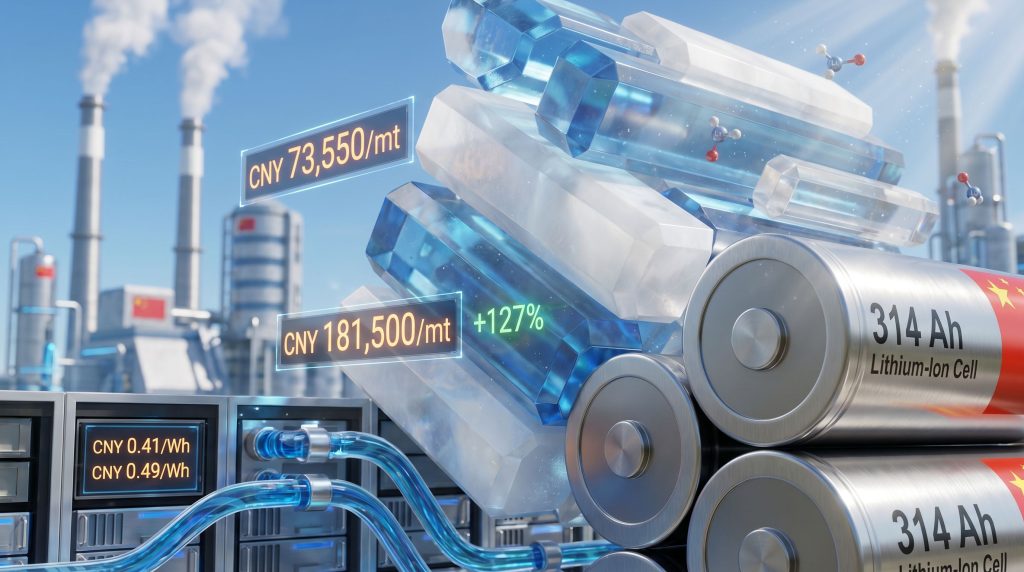
The lithium carbonate price explosion that began in October 2025 created cascading effects throughout China's battery manufacturing ecosystem. Battery-grade lithium carbonate surged from CNY 73,550 per metric ton in October 2025 to CNY 181,500 per metric ton by January 26, 2026, representing a 147% increase over just three months. This volatility has intensified despite a battery recycling breakthrough that was expected to ease supply pressures.
Lithium Carbonate Price Volatility Analysis
| Time Period | Price (CNY/mt) | Month-over-Month Change | Source |
|---|---|---|---|
| October 2025 | CNY 73,550 | Baseline | SMM |
| January 26, 2026 | CNY 181,500 | +147% | SMM |
| April 20, 2026 | CNY 167,000 | -8% from peak | InfoLink |
The Shanghai Metal Market (SMM) analysis revealed that this price movement was driven by multiple simultaneous factors: tighter supply conditions, policy interventions targeting "irrational competition," and production disruptions at key facilities. In addition, the global battery metals investment landscape has shifted significantly, affecting pricing dynamics.
The suspension of CATL's Jianxiawo mine in Yichun, Jiangxi province emerged as a critical supply shock. This facility's temporary closure removed significant lithium production capacity from China's domestic supply chain precisely as demand was accelerating.
By April 2026, lithium carbonate prices had moderated to CNY 167,000 per metric ton, but this 8% decline from peak levels still represented a 127% increase from October 2025 baselines. This price persistence suggests structural rather than speculative factors continue driving the lithium market.
Upstream Cost Transmission Mechanisms
The relationship between lithium carbonate prices and battery cell costs operates through multiple transmission channels. For every CNY 10,000 increase in lithium pricing, LFP cathode materials experience cost pressure of approximately RMB 2,300-2,500 per metric ton.
This cost transmission reflects the chemical composition of lithium iron phosphate cathodes, where lithium represents a significant portion of raw material inputs. Manufacturing processes cannot easily substitute alternative materials without compromising performance characteristics critical for utility applications.
Processing fees throughout the supply chain have amplified raw material cost impacts. Lithium refiners, cathode material manufacturers, and cell assemblers have all implemented surcharges during supply shortage periods, creating multiplicative effects on final cell pricing.
The geographic concentration of lithium processing in Jiangxi province has created additional vulnerability. When regional production disruptions occur, the entire downstream manufacturing network experiences synchronised cost shocks.
Comparative Analysis: 314 Ah vs. 280 Ah Cell Price Movements
Parallel analysis of different cell formats reveals broad-based pricing pressure across utility-scale segments. 280 Ah cells increased from CNY 0.298/Wh to CNY 0.370/Wh, representing a 24% increase compared to the 22% rise experienced by 314 Ah products.
This near-identical price movement across cell formats indicates that raw material costs, rather than format-specific demand or supply constraints, drove the majority of price increases. The slight premium experienced by 280 Ah cells may reflect different supply chain optimisation levels between the two formats.
Why Did Demand Surge Coincide with Supply Constraints?
The timing of China's 314 Ah storage cell prices increase reflects an unusual convergence of demand acceleration and supply limitations. Leading storage cell manufacturers operated with capacity utilisation exceeding 65% through the first quarter of 2026, according to InfoLink Consulting analysis.
Policy-Driven Demand Acceleration
China's introduction of a national capacity-pricing mechanism for grid-side storage fundamentally altered project economics for utility-scale deployments. This policy framework established revenue floors for storage capacity services, reducing investment risk and accelerating project development timelines.
The capacity pricing mechanism ties compensation to coal plant benchmark pricing, providing predictable revenue streams for storage project developers. This structural improvement in project economics converted previously marginal developments into financially viable investments.
Export tax rebate reductions created additional demand front-loading effects. Reuters analysis indicated that manufacturers and developers accelerated procurement ahead of reduced battery export tax rebates, concentrating demand into a compressed timeframe.
The combination of improved domestic project economics and time-sensitive export incentives created an artificial demand surge that coincided with supply chain vulnerabilities.
Industrial Utilisation Patterns and Capacity Constraints
High capacity utilisation at leading manufacturers has created delivery schedule tightening throughout the industry. Standard lead times for 314 Ah cells have extended from 90-120 days to 120-180 days, strengthening supplier bargaining power and enabling price increases.
This utilisation pattern reflects both demand strength and the capital-intensive nature of battery manufacturing expansion. New production lines require 12-18 months for full commissioning, creating temporary supply inelasticity during demand surges.
Consequently, second and third-tier manufacturers have gained market positioning during this tight supply period. Previously price-focused suppliers have been able to command premium pricing as tier-one manufacturers reach capacity constraints.
Export Market Dynamics
International demand for Chinese storage cells has intensified alongside domestic consumption growth. Front-loaded exports ahead of reduced tax rebates created additional pressure on available manufacturing capacity.
Global competitiveness of Chinese cell manufacturers has remained strong despite price increases. The 22% price rise for 314 Ah cells still maintains significant cost advantages compared to international alternatives, supporting continued export demand.
Trade policy implications extend beyond immediate pricing effects. Reduced export tax rebates signal Chinese government priorities toward domestic storage deployment rather than export market development.
What Do System-Level Price Increases Signal About Market Maturation?
The transmission of cell price increases into complete system pricing reveals important dynamics about value chain margin distribution and market power. DC-side liquid-cooled energy storage systems increased from CNY 0.41/Wh to CNY 0.49/Wh, representing a 19.5% system-level price increase.
DC-Side Liquid-Cooled ESS Pricing Evolution
| Configuration | October 2025 | April 2026 | Percentage Change |
|---|---|---|---|
| 2-hour DC-side liquid-cooled ESS | CNY 0.41/Wh | CNY 0.49/Wh | +19.5% |
This system pricing evolution demonstrates several important market characteristics:
Cells represent approximately 60-75% of total system value in liquid-cooled configurations. The 22% cell price increase translating to 19.5% system price increases suggests balance-of-system components are absorbing some volatility.
Integration costs have remained relatively stable despite supply chain pressures. Thermal management systems, power conversion equipment, and control systems have not experienced the same cost inflation as battery cells.
System integrators maintain limited pricing power compared to cell manufacturers. The close correlation between cell and system pricing indicates integrators operate with compressed margins and cannot fully buffer cost increases.
Value Chain Margin Distribution
The relationship between cell and system pricing reveals margin pressure throughout the storage value chain. Balance-of-system suppliers, including thermal management and power electronics manufacturers, have absorbed cost increases to maintain competitiveness.
This margin compression at the system level suggests that cell manufacturers currently hold the strongest pricing power within the energy storage ecosystem. Supply constraints at the cell level create bottlenecks that cannot be easily substituted through alternative sourcing.
System-level pricing persistence despite slight lithium price moderation indicates that delivery schedules and capacity allocation have become more important than short-term commodity price movements for determining final pricing.
How Will Market Structure Evolution Affect Long-Term Pricing?
Future pricing trajectories for China's 314 Ah storage cell prices increase depend critically on capacity expansion timelines and competitive dynamics evolution. Additional capacity ramp-ups could ease pricing trends later this year, according to InfoLink Consulting's market outlook.
Capacity Expansion Plans and Timeline Analysis
Major battery manufacturers have announced significant capacity expansion programmes, but commissioning schedules extend well into 2027. New production facilities require 12-24 months from groundbreaking to full production, creating extended periods of supply constraint.
Technology migration toward 500+ Ah cell formats may complicate capacity planning. Some manufacturers are allocating new production lines to next-generation cell formats rather than expanding current 314 Ah capacity.
Capital expenditure cycles in battery manufacturing are intensifying, with leading manufacturers committing multi-billion yuan investments in production expansion. However, these investments primarily target 2027-2028 production capacity rather than near-term supply relief.
Competitive Dynamics and Market Consolidation
The current supply-constrained environment is accelerating market consolidation dynamics. Tier-one manufacturers with existing capacity are gaining market share at the expense of smaller players who cannot secure raw material supplies.
Vertical integration strategies are becoming more prevalent throughout the supply chain. Battery manufacturers are investing in upstream lithium processing and downstream system integration to capture additional value and reduce supply chain vulnerabilities.
Innovation cycles continue despite supply constraints, with manufacturers investing in improved energy density, cycle life, and safety characteristics. These technological improvements may support premium pricing even as capacity constraints ease.
Demand Forecasting and Supply-Demand Balance
Grid-scale storage deployment projections for 2026-2027 indicate continued strong demand growth across multiple end-use sectors. Renewable energy integration requirements, grid stability services, and commercial storage applications all support sustained demand growth.
Industrial and commercial storage markets are expanding rapidly, creating additional demand streams beyond traditional utility-scale applications. These smaller-scale deployments often accept premium pricing for faster delivery schedules.
Supply-demand balance analysis suggests that current tight conditions may persist through the remainder of 2026, with potential easing in early 2027 as new capacity comes online.
What Are the Broader Economic Implications for Energy Storage Deployment?
The 22% increase in China's 314 Ah storage cell prices carries significant implications for global energy storage deployment economics and investment decision frameworks. This situation contrasts sharply with the lithium market downturn that many analysts had predicted would continue throughout 2025.
Project Economics and Investment Decision Frameworks
Storage project internal rates of return (IRR) are experiencing downward pressure as capital costs increase without corresponding revenue improvements. Projects previously achieving 12-15% IRR targets may require restructured financing or improved revenue mechanisms.
Financing cost implications extend beyond immediate capital requirements. Lenders are reassessing storage project risk profiles as equipment cost volatility increases, potentially requiring higher risk premiums or additional security mechanisms.
Long-term procurement strategies are shifting toward contract structures that provide price stability. Framework agreements with price-linkage clauses are becoming more common as developers seek to transfer commodity price risk to suppliers.
Global Competitive Positioning
Chinese storage cell pricing advantages remain substantial despite recent increases. The CNY 0.365/Wh average for 314 Ah cells still provides significant cost advantages compared to international alternatives, supporting continued export competitiveness.
Technology leadership in large-format cell manufacturing has reinforced China's market position. Technical performance characteristics, manufacturing quality, and supply chain reliability continue supporting market share despite price increases.
Market share implications in key export markets may become more significant if pricing continues rising. Alternative suppliers in South Korea, Japan, and emerging manufacturing regions may gain competitive positioning in price-sensitive markets.
Strategic Scenario Analysis for Q2-Q4 2026
Base case scenario: Continued tight supply conditions through Q3 2026, with gradual easing in Q4 as new capacity begins commissioning. Cell pricing likely remains elevated above CNY 0.35/Wh through year-end.
Upside scenario: Accelerated capacity additions and lithium price moderation could drive cell pricing back toward CNY 0.30-0.32/Wh by late 2026. This scenario requires both supply capacity increases and demand moderation.
Downside scenario: Further supply disruptions or additional lithium price increases could drive cell pricing above CNY 0.40/Wh, potentially impacting storage deployment growth rates globally.
Market participants should monitor delivery schedule indicators, new capacity commissioning announcements, and lithium supply chain developments as leading indicators for future pricing direction. For instance, developments in lithium brine market insights from Argentina could provide additional supply relief.
The next major ASX story will hit our subscribers first
Frequently Asked Questions About China's Storage Cell Market Dynamics
Why Are 314 Ah Cells Specifically Experiencing These Price Increases?
The 314 Ah format has become the dominant standard for utility-scale storage applications due to optimal energy density and manufacturing economies of scale. This market concentration means demand surges and supply constraints affect 314 Ah cells more dramatically than other formats.
Technical advantages in utility-scale applications include improved energy density per unit volume, optimised thermal management compatibility, and standardised integration with existing balance-of-system architectures. These characteristics have created strong preference among large-scale storage developers.
Manufacturing standardisation around 314 Ah formats has created supply chain network effects, where component suppliers, thermal management systems, and integration platforms have optimised specifically for this cell format. This specialisation creates switching costs that reinforce market positioning.
How Do These Price Changes Compare to Historical Battery Market Cycles?
Previous commodity super-cycles in battery materials have typically lasted 12-18 months, with price increases of 50-100% followed by gradual normalisation. The current cycle's 127% lithium price increase and 22% cell price rise align with historical volatility patterns.
Duration and magnitude of past price corrections suggest current elevated pricing may persist for 6-12 months before supply capacity expansions provide relief. However, the increasing scale of the storage market may create different dynamics compared to previous cycles.
Leading indicators for future price movements include lithium mine production announcements, battery manufacturing capacity commissioning schedules, and global storage deployment growth rates. Historical patterns suggest supply response typically lags demand surges by 12-24 months.
What Should Storage Developers and Investors Monitor Going Forward?
Key supply chain metrics to track include lithium carbonate pricing trends, battery manufacturer capacity utilisation rates, and delivery schedule changes. These indicators typically provide 3-6 month advance warning of pricing direction changes.
Policy developments affecting demand patterns, particularly China's grid-scale storage deployment policies and international trade regulations, significantly influence market dynamics. Changes in capacity pricing mechanisms or export tax policies can create rapid demand shifts.
Technology roadmap implications for cell format evolution may affect 314 Ah market positioning. Migration toward 500+ Ah formats could reduce demand for current-generation products, but timeline uncertainty creates investment complexity. Additionally, developments in battery-grade lithium refinery capacity in India could affect global supply chains.
However, industry observers note that battery cell price increases approaching $0.4 RMB/Wh represent a significant shift in market dynamics that may persist longer than initially anticipated.
Important Notice: This analysis contains forward-looking statements and market projections that involve uncertainty and risk. Battery cell pricing, raw material costs, and supply chain dynamics are subject to rapid change based on factors including but not limited to policy changes, technological developments, and global economic conditions. Readers should conduct independent research and consult qualified professionals before making investment decisions based on this information.
Ready to Invest in the Next Major Mineral Discovery?
Discovery Alert instantly alerts investors to significant ASX mineral discoveries using its proprietary Discovery IQ model, turning complex mineral data into actionable insights. Understand why historic discoveries can generate substantial returns by visiting Discovery Alert's dedicated discoveries page, and begin your 14-day free trial today to position yourself ahead of the market.