June 5, 2026
The Battery Storage Boom Is Rewriting What Lithium Is Actually For
There is a quiet but profound restructuring happening beneath the surface of critical mineral markets. For most of the past decade, investors and analysts treated lithium as a one-variable equation: track EV adoption rates, adjust for manufacturing ramp-ups, and you had your demand model. That framework has not simply been updated. It has been replaced.
The battery storage boom and lithium demand are now inseparable from a much wider set of infrastructure forces, ones that operate on entirely different procurement cycles, investment horizons, and policy frameworks than consumer vehicle markets. Understanding this shift is not just academically interesting. For investors, supply chain planners, and policymakers, it changes the risk profile, the opportunity set, and the timeline for nearly every lithium-related decision.
When big ASX news breaks, our subscribers know first
Three Demand Pillars, Not One
The old model was simple. Consumers buy EVs, automakers order battery cells, cell manufacturers buy lithium. Demand moved with car sales.
The new model is structurally different. Lithium consumption is now being driven by three simultaneous and largely independent forces:
- Electric vehicles, which continue to grow but are subject to consumer sentiment, subsidy cycles, and model-year purchasing patterns
- Grid-scale battery energy storage systems (BESS), which are procured by utilities and energy operators through multi-year capital programmes tied to national infrastructure plans
- Data centre and AI computing infrastructure, where hyperscale technology operators deploy large battery systems for behind-the-meter power resilience, entirely independent of either transportation or energy policy
What makes this structure strategically significant is that a slowdown in any one of these sectors does not collapse the others. A consumer confidence shock that dampens EV purchases does nothing to halt a utility's ten-year storage procurement plan. A shift in EV subsidy policy does not affect a hyperscale data centre operator's need for uninterruptible power.
Furthermore, the battery raw materials market has had to adapt rapidly to accommodate this multi-sector demand reality, creating new pressures across the entire supply chain.
"When demand is underpinned by three structurally distinct sectors operating on independent investment cycles, the commodity at the centre transitions from a cyclical material to a foundational industrial input."
The Scale of the Battery Storage Boom: Numbers That Reframe the Conversation
The pace of BESS deployment has consistently surprised even well-resourced forecasting teams. The numbers now available for 2024 and 2025 make the scale of this shift concrete.
| Metric | Figure | Source |
|---|---|---|
| Global BESS installations (2024) | ~205 GWh | Benchmark Mineral Intelligence |
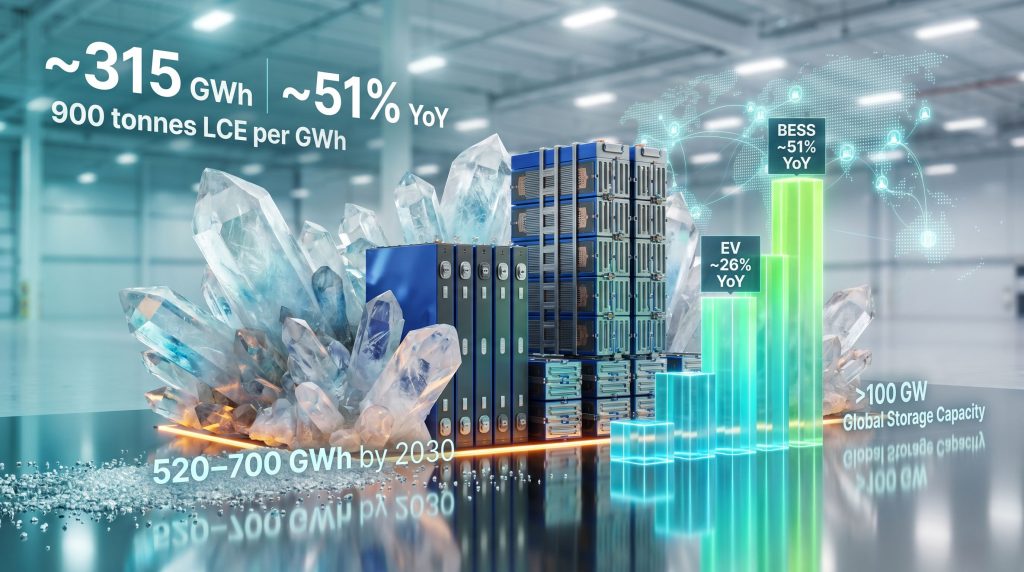
| Global BESS installations (2025) | ~315 GWh | Benchmark Mineral Intelligence |
| Year-over-year BESS growth (2025) | ~51% | Industry analysis |
| EV demand growth rate (2025, comparative) | ~26% YoY | Industry analysis |
| Overall lithium demand growth (2024) | ~30% | Industry analysis |
| Projected BESS installations (2030, range) | 520-700 GWh | Market forecasts |
| Lithium required per GWh of storage | ~900 tonnes LCE | Industry data |
| Global battery manufacturing capacity (2024) | >3 TWh/year | International Energy Agency |
| Projected global manufacturing capacity | ~10 TWh/year | IEA |
| US BESS capacity growth projected (2025-2030) | ~400% | Benchmark Mineral Intelligence / SEIA |
| Global energy storage capacity (2025 est.) | >100 GW | BloombergNEF |
| Projected global storage capacity (2035) | ~200 GW | BloombergNEF |
The headline figure is this: grid-scale battery storage grew at roughly twice the pace of EV battery demand in 2025. This is the first period in which battery storage expansion has clearly outpaced transportation as a growth driver for lithium consumption. It is not a temporary anomaly produced by a single large procurement. It reflects structural forces that analysts expect to persist through the decade.
What Is Actually Driving Storage Growth: Four Interconnected Forces
Renewable Energy Integration
Wind and solar generation cannot be scheduled. Their output depends on weather, not grid operator needs. As the share of intermittent renewables in electricity systems climbs toward 30%, 40%, and eventually higher percentages across major markets, grid operators face an increasingly complex balancing problem.
Battery storage is the most operationally flexible solution available. It can absorb excess generation during periods of high wind or solar output and discharge that energy during evening demand peaks or periods of low generation. Utilities are no longer treating storage as an optional add-on. It is being written into baseline grid architecture in the United States, European Union, China, and Australia as a non-negotiable component of reliable energy delivery.
AI Infrastructure and Behind-the-Meter Power Resilience
This is the demand driver that most commodity models have been slowest to incorporate. The rapid scaling of artificial intelligence computing infrastructure has created a new category of electricity consumer with unusually demanding reliability requirements.
Hyperscale technology operators including major cloud computing providers are deploying battery systems directly at data centre facilities. These systems serve multiple simultaneous functions:
- Instantaneous backup power during grid interruptions, replacing or supplementing diesel generators
- Peak demand management, reducing the cost of energy procurement at high-tariff periods
- Grid services participation in some markets, allowing data centre batteries to generate revenue while providing grid stability
As AI model complexity and inference workload intensity continue to increase, the power density and backup requirements per facility are scaling upward. This creates a demand source for lithium that is highly predictable, growing consistently, and entirely disconnected from consumer behaviour.
The Cost Collapse in Utility-Scale Storage
One of the least-publicised drivers of the storage boom is the extraordinary cost reduction achieved in battery systems over the past decade. Utility-scale storage costs have fallen sharply, driven by manufacturing scale particularly in China, improvements in cell chemistry, and supply chain maturation that has reduced component procurement costs.
Lower costs have fundamentally changed the economics of storage deployment. Projects that were marginal at previous cost levels are now clearly viable. Geographic markets that were too cost-sensitive to deploy storage at scale are now active procurement regions. This cost dynamic is pulling deployment timelines forward rather than pushing them back. According to S&P Global, this cost trajectory is expected to continue driving demand well into the next decade.
Policy and Grid Modernisation Programmes
Government policy functions as a demand amplifier in this market. Across multiple major economies, storage deployment is embedded in energy transition legislation and grid modernisation frameworks:
- In the United States, domestic storage capacity is projected to expand by approximately 400% between 2025 and 2030, supported by grid modernisation investment programmes
- The European Union has embedded storage procurement within its clean energy transition targets
- China has incorporated state-directed energy storage targets into national grid planning documents
- Australia faces specific firming capacity requirements as coal generation retires, creating substantial storage procurement opportunities
The Material Reality: How BESS Growth Translates Into Lithium Demand
The bridge between installation statistics and mineral demand runs through a single, crucial figure: each gigawatt-hour of grid-scale storage capacity requires approximately 900 tonnes of lithium carbonate equivalent (LCE). This material intensity ratio converts deployment forecasts into procurement realities.
Applying that ratio to current and projected BESS installations produces the following demand picture:
| Deployment Scenario | BESS Volume | Implied Lithium Demand |
|---|---|---|
| 2024 baseline | ~205 GWh | ~184,500 tonnes LCE |
| 2025 actual | ~315 GWh | ~283,500 tonnes LCE |
| 2030 low estimate | ~520 GWh | ~468,000 tonnes LCE |
| 2030 high estimate | ~700 GWh | ~630,000 tonnes LCE |
These figures are illustrative estimates applying the 900 tonnes LCE per GWh ratio to deployment projections. Actual demand will vary based on technology mix, cell chemistry, and system configuration.
One widely cited projection suggests that battery energy storage could account for approximately 10% of total global lithium demand by 2030, compared to a much smaller share just a few years earlier. That may sound modest relative to EV demand, but the growth trajectory matters as much as the absolute share. Storage is the fastest-expanding segment in the market, and its procurement cycles are anchored in infrastructure planning rather than consumer decisions.
However, it is worth noting that lithium oversupply risks remain a genuine concern even as demand expands, particularly if new mining projects come online faster than storage deployment can absorb additional supply.
Sodium-Ion Batteries: Real Competitor or Marginal Challenger?
Any honest analysis of the battery storage boom and lithium demand must address the sodium-ion question directly. Sodium-ion technology has attracted genuine commercial interest, and several Chinese manufacturers have moved sodium-ion cells into production. The case for and against meaningful displacement of lithium deserves clear examination.
Where sodium-ion has genuine advantages:
- Sodium is abundant and geographically distributed, reducing supply chain concentration risk
- Sodium-ion cells are increasingly cost-competitive for short-duration storage applications (typically one to two hours of discharge)
- The absence of lithium, cobalt, and nickel from the cathode chemistry simplifies supply chain management
Where lithium-ion retains structural advantages:
- Energy density advantages remain relevant for applications requiring longer discharge durations
- Established manufacturing infrastructure, installation expertise, and supply chains create significant switching costs
- Long-duration storage requirements of four to twelve or more hours still favour lithium-ion chemistry
- The overall scale of BESS deployment growth is large enough that both chemistries can gain volume simultaneously
"The more accurate framing is not substitution but market segmentation. Sodium-ion is likely to capture cost-sensitive short-duration applications. Lithium-ion retains the advantage in longer-duration, higher-performance, and space-constrained deployments. Both markets are growing."
A less commonly discussed dynamic is the chemistry split within lithium-ion itself. Lithium iron phosphate (LFP) chemistry has become the dominant choice for stationary storage applications due to its cycle life, thermal stability, and cost profile, even though it carries lower energy density than nickel-manganese-cobalt (NMC) formulations. Understanding this distinction matters for lithium demand analysis: LFP chemistry is less lithium-intensive per unit of energy than NMC, which affects the precise material intensity calculations used in demand modelling.
In addition, innovations in direct lithium extraction technology are beginning to influence how quickly new lithium supply can be brought online, which has meaningful implications for the balance between supply and storage-driven demand.
The next major ASX story will hit our subscribers first
How Storage Demand Reaches the Lithium Mine: The Supply Chain Sequence
One underappreciated feature of storage-driven lithium demand is the lag between a utility's procurement decision and the demand signal reaching upstream miners. The sequence operates as follows:
- A grid operator or utility identifies a storage need and issues a procurement tender for BESS capacity
- A battery system integrator wins the contract and places a cell manufacturing order
- The cell manufacturer schedules production and triggers cathode material procurement
- Cathode material demand flows back to lithium chemical producers as purchase orders
- Lithium chemical producers adjust their offtake requirements from mining operations
- Mining projects allocate output to contracted supply chains accordingly
This multi-stage chain means demand signals from utility storage contracts reach lithium producers with a six to eighteen month lag depending on inventory positions at each link. However, once a utility-scale storage project is embedded in a grid operator's capital programme, the demand it represents is highly durable. It does not evaporate because of a shift in consumer confidence or a change in government subsidy levels.
The Manufacturing Capacity Gap: An Underweighted Risk
The International Energy Agency has reported that global battery manufacturing capacity already exceeded 3 TWh per year in 2024, with projections suggesting this figure could approach 10 TWh annually. This manufacturing ambition is proceeding substantially faster than upstream lithium mining and processing capacity is being developed.
"A scenario in which battery manufacturing capacity significantly outpaces lithium mining output could create acute supply bottlenecks, particularly if BESS deployment continues to accelerate alongside sustained EV demand growth. The risk is not theoretical. It reflects a structural misalignment that is visible in current investment data."
The implication for supply strategy is significant. Long-lived lithium projects with high annual output, consistent product quality, and domestic positioning in key markets are increasingly valued not just as commodity producers but as infrastructure-grade supply assets. Utilities and technology companies seeking supply security are beginning to approach offtake structuring the way they approach other long-term infrastructure procurement: with multi-decade horizons and premium pricing for reliability.
The global lithium market is consequently attracting renewed strategic interest from sovereign investors and industrial partners seeking to lock in long-term access to this foundational material.
What the Multi-Driver Model Means for Investors
The diversification of lithium demand has changed the risk calculus in ways that markets have been slow to fully price. Under the old single-driver model, a slowdown in EV demand translated directly into a lithium demand downgrade. Under the current three-pillar structure, the correlation between any single end market and overall lithium demand has weakened considerably.
Key investor considerations in this new landscape:
- Demand floor resilience: Infrastructure-driven demand from utilities and data centres provides a demand floor that is not sensitive to consumer cycles, reducing the downside severity of EV market corrections
- Offtake contract evolution: Utilities and technology companies are increasingly seeking long-term supply agreements, creating the potential for contracted revenue streams with lower price volatility than spot market exposure
- Domestic supply premiums: In the US, EU, and Australia, policy-driven preferences for locally sourced critical minerals are creating pricing and contracting advantages for domestic producers that may persist for years
- Project duration matters more: When demand is driven by infrastructure with 20–40 year asset lifecycles, lithium projects with long mine lives and stable production profiles command structurally higher strategic value than shorter-lived operations
Furthermore, utility dive analysis has highlighted how low lithium prices are paradoxically accelerating storage deployment by making battery systems more affordable, creating a self-reinforcing dynamic that strengthens the long-term demand outlook even as near-term prices remain under pressure.
Disclaimer: This article is informational only and does not constitute financial or investment advice. Readers should conduct their own research and seek independent advice before making any investment decisions. Lithium market forecasts involve material uncertainty and actual outcomes may differ significantly from projections.
Key Metrics at a Glance
| Indicator | Figure |
|---|---|
| Global BESS growth rate (2025) | ~51% YoY |
| EV demand growth rate (2025) | ~26% YoY |
| Global BESS installations (2025) | ~315 GWh |
| Projected BESS installations (2030, range) | 520-700 GWh |
| Lithium demand growth (2024) | ~30% |
| Storage share of lithium demand (2030 est.) | ~10% |
| Lithium required per GWh of storage | ~900 tonnes LCE |
| Global battery manufacturing capacity (2024) | >3 TWh/year |
| US BESS capacity growth (2025-2030) | ~400% projected |
| Global energy storage capacity (2025 est.) | >100 GW |
Frequently Asked Questions
How much did global BESS installations grow in 2025?
Global battery energy storage system installations reached approximately 315 GWh in 2025, representing growth of around 51% compared to 2024 levels of approximately 205 GWh, according to Benchmark Mineral Intelligence.
Why is battery storage growing faster than EV demand?
Grid storage growth is being driven by utility infrastructure investment cycles, renewable energy integration requirements, and data centre power resilience needs, all of which operate on procurement timelines less sensitive to consumer sentiment than EV purchasing. Sharp cost declines in battery systems have also expanded the addressable market considerably.
How much lithium does one GWh of battery storage require?
Approximately 900 tonnes of lithium carbonate equivalent is required per GWh of grid-scale storage capacity installed, based on industry data. This figure varies depending on the specific chemistry and system configuration used.
Will sodium-ion batteries replace lithium in storage applications?
Sodium-ion batteries are gaining commercial traction in short-duration storage markets but are unlikely to displace lithium-ion across the full range of grid storage applications in the near term. The overall scale of deployment growth is large enough that both chemistries are expected to gain volume simultaneously rather than one displacing the other.
What share of lithium demand will storage represent by 2030?
Industry projections suggest battery energy storage could account for approximately 10% of total global lithium demand by 2030, up from a smaller share in 2024 and 2025, with the segment representing the fastest-growing component of total lithium consumption. The battery storage boom and lithium demand dynamics reinforcing this trend show no signs of abating as grid modernisation programmes accelerate globally.
Want to Track the Next Major Mineral Discovery Before the Market Does?
Discovery Alert's proprietary Discovery IQ model delivers real-time alerts on significant ASX mineral discoveries — including lithium and battery materials — turning complex data across 30-plus commodities into clear, actionable insights the moment they hit the exchange. Explore historic discoveries and their returns to understand the opportunity, then begin your 14-day free trial to position yourself ahead of the market.