June 13, 2026
The ultra-hard materials manufacturing sector stands at a critical juncture where traditional production methods face mounting pressure from economic and sustainability concerns. Cemented carbides, particularly tungsten carbide-cobalt composites, represent some of the most challenging materials to manufacture efficiently using conventional approaches. The intersection of extreme material properties and costly raw material inputs creates a compelling case for revolutionary manufacturing technologies that can minimise waste while maintaining performance standards, particularly through 3D printing tungsten carbide innovations that address these fundamental challenges.
Understanding Tungsten Carbide's Manufacturing Evolution
Traditional powder metallurgy has dominated tungsten carbide production for decades, yet this established approach carries significant drawbacks that manufacturers increasingly struggle to accept. The conventional process involves pressing tungsten carbide powder mixed with cobalt binder into desired shapes, followed by high-temperature sintering at 1200-1450°C. This methodology creates finished components that resist subsequent modification due to their extreme hardness, requiring expensive grinding or electrical discharge machining for any geometric adjustments.
Material waste represents a critical economic challenge in traditional manufacturing routes. Industry studies indicate that conventional tungsten carbide manufacturing can result in 30-50% material waste during production cycles, with some machining operations discarding 60-80% of raw materials when creating complex geometries from solid blanks. Given tungsten's price volatility and China's control over approximately 80% of global tungsten processing, this waste translates directly into substantial cost burdens for manufacturers.
Furthermore, these industry innovation trends demonstrate that the economic imperative for additive manufacturing adoption stems from the expensive nature of primary raw materials. Research from Hiroshima University demonstrates that cemented carbides utilise costly tungsten and cobalt inputs, making material usage reduction highly desirable across industrial applications. By enabling targeted material deposition only where functionally necessary, additive manufacturing addresses the fundamental inefficiency of subtractive processes.
Complex geometry limitations further constrain powder metallurgy approaches. The pressing and sintering constraints inherently limit manufacturers to relatively simple shapes, preventing the creation of internal cooling channels, variable hardness zones, or intricate cutting edge profiles that could optimise tool performance. These geometric restrictions force designers to compromise on functionality or accept multiple-component assemblies where single-piece solutions would prove superior.
When big ASX news breaks, our subscribers know first
What Makes Tungsten Carbide So Difficult to 3D Print?
Material Properties That Challenge Conventional 3D Printing
Tungsten carbide's exceptional hardness, exceeding 1400 Vickers Hardness (HV), creates unique challenges for additive manufacturing technologies. This hardness level positions the material just below superhard substances like sapphire and diamond, making it invaluable for cutting applications but extraordinarily difficult to process using standard 3D printing approaches that rely on complete material melting.
Thermal sensitivity during processing represents perhaps the most critical constraint facing 3D printing tungsten carbide applications. The material exhibits two distinct failure mechanisms that occur at specific temperature thresholds:
Critical Temperature Boundaries:
- Cobalt melting point: 1495°C (operational minimum)
- Tungsten carbide decomposition point: Above 1600°C (critical maximum)
- Operational window: Approximately 105°C range
Research conducted at Hiroshima University revealed that tungsten carbide begins decomposing above 1600°C, releasing tungsten and carbon elements that degrade both material structure and hardness properties. This decomposition mechanism represents a fundamental constraint not encountered in materials with higher breakdown thresholds, requiring precise thermal control throughout the manufacturing process.
Traditional Manufacturing Constraints
Conventional manufacturing methods face inherent limitations when addressing tungsten carbide's unique properties. Powder metallurgy waste ratios create significant cost implications, particularly given tungsten's strategic importance and limited global supply diversity. The pressing and sintering approach also restricts geometric complexity, preventing manufacturers from creating optimised designs that could enhance tool performance or reduce material usage.
Material utilisation inefficiencies in subtractive processes compound these challenges. When manufacturers machine tungsten carbide components from solid blanks, the removed material cannot be easily recycled due to contamination and structural changes during cutting operations. This creates a cascading economic impact where expensive raw materials are essentially discarded during production.
Which 3D Printing Technologies Work Best for Tungsten Carbide?
Hot-Wire Laser Irradiation: The Breakthrough Method
Process Mechanics and Temperature Control
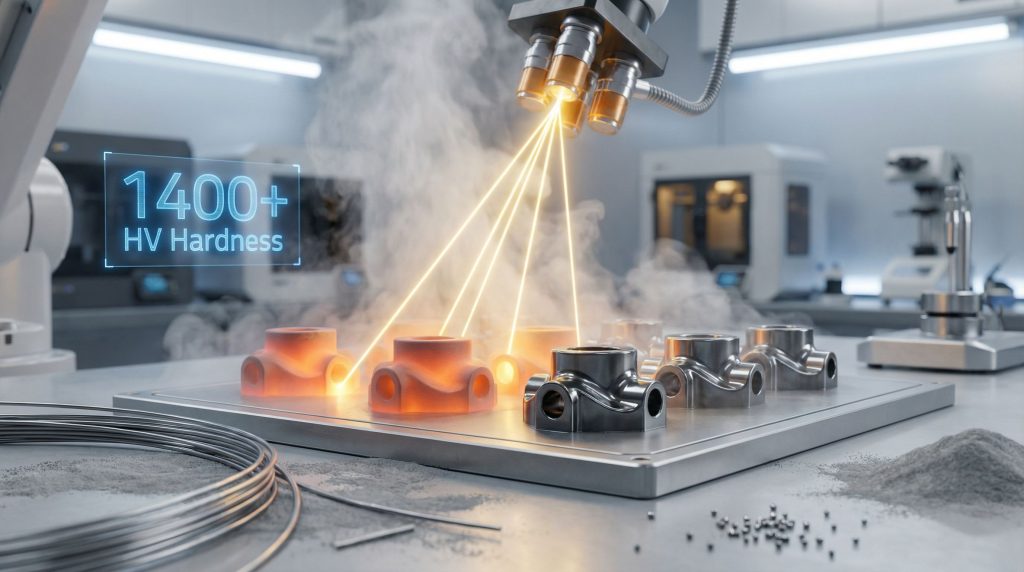
Hot-wire laser irradiation represents the most promising approach for 3D printing tungsten carbide applications, based on recent breakthrough research from Japanese institutions. This method fundamentally differs from conventional additive manufacturing by employing a softening approach rather than complete material melting, preserving the hardness properties essential for industrial applications.
The process combines laser heating with pre-heated filler wire to deposit material efficiently while maintaining structural integrity. Critical to this approach is maintaining precise temperature windows that allow cobalt binder melting without triggering tungsten carbide decomposition. The narrow operational range requires sophisticated real-time monitoring and automated feedback systems to prevent material degradation.
| Processing Parameter | Optimal Range | Impact on Quality |
|---|---|---|
| Laser Power | 800-1200W | Controls melting depth and thermal penetration |
| Feed Rate | 2-5 mm/s | Affects layer adhesion and build quality |
| Interlayer Material | Nickel-based alloy | Prevents cracking and enhances bonding |
| Base Temperature | 400-600°C | Maintains carbide structure integrity |
Dual Laser Positioning Strategies
Research teams identified two distinct laser positioning configurations with dramatically different outcomes. The laser-leading method positions the laser ahead of the tungsten carbide rod, heating the deposition zone between the rod's lower end and the iron base material. This configuration allows controlled material feeding into the pre-heated zone while reducing thermal shock through substrate preparation.
Conversely, the rod-leading method aims the laser directly at the rod's top surface during forward feeding. This approach resulted in decomposition of tungsten carbide in upper layers, proving incompatible with hardness preservation requirements. The laser-leading configuration emerged as the primary success method, achieving hardness levels exceeding 1400 HV while maintaining structural integrity.
Nickel Alloy Interlayer Integration
The introduction of nickel-based alloy intermediate layers proved critical for successful tungsten carbide deposition. These interlayers serve multiple functions including thermal gradient moderation, chemical barrier prevention of direct carbide-iron interaction, and bonding enhancement between dissimilar materials. The specific selection of nickel alloy suggests its thermal properties and phase compatibility with both tungsten carbide and iron substrates were determining factors.
Temperature control strategy focuses on maintaining conditions hot enough to melt cobalt binder while preventing tungsten carbide decomposition. This precise thermal management enables the material to be shaped while controlling heat distribution and reducing defect formation throughout the build process.
Defect Prevention Strategies
Successful tungsten carbide additive manufacturing requires comprehensive defect prevention approaches addressing multiple failure modes. Decomposition avoidance involves maintaining temperatures below critical breakdown thresholds through continuous monitoring and rapid response systems. Crack mitigation employs thermal gradient management through controlled cooling rates that prevent thermal shock while avoiding unwanted phase transformations.
Layer adhesion optimisation balances heat input with structural preservation, ensuring sufficient bonding between layers without compromising the material's fundamental hardness properties. The research demonstrates that achieving over 1400 HV hardness requires careful coordination of all process parameters within narrow tolerance ranges.
Alternative Additive Manufacturing Approaches
Electron Beam Powder Bed Fusion (EB-PBF)
Electron beam powder bed fusion offers theoretical advantages for tungsten carbide applications through its vacuum environment operation, which eliminates oxidation risks during processing. The vacuum chamber prevents atmospheric contamination that could degrade material properties, while the electron beam provides precise energy control for selective powder melting.
This approach theoretically enables complex geometry capabilities that exceed conventional powder metallurgy limitations. However, the fundamental challenge remains whether EB-PBF can successfully maintain tungsten carbide's hardness properties while achieving full material melting. The vacuum operation adds significant cost complexity compared to atmospheric laser methods, requiring careful economic analysis for commercial viability.
Selective Laser Melting (SLM) Adaptations
Selective laser melting requires significant modifications for carbide material applications, as the standard approach relies on complete powder melting that conflicts with hardness preservation requirements. The layer-by-layer building strategy must accommodate tungsten carbide's unique thermal constraints while achieving sufficient bonding between successive layers.
Post-processing requirements for optimal hardness recovery after SLM represent a critical consideration, as the full-melting approach may necessitate additional heat treatment cycles to restore material properties. This additional processing increases production costs and potentially negates some efficiency advantages of additive manufacturing.
What Are the Key Technical Challenges in Tungsten Carbide 3D Printing?
Thermal Management Complexities
Critical Temperature Windows
Thermal management represents the most complex challenge in 3D printing tungsten carbide, requiring unprecedented precision in temperature control throughout the manufacturing process. The operational window between cobalt melting at 1495°C and tungsten carbide decomposition above 1600°C provides only approximately 105°C of working range, demanding real-time monitoring and rapid response capabilities.
Research observations demonstrate that even brief temperature excursions above decomposition thresholds cause irreversible material degradation. When using rod-leading laser configurations, tungsten carbide decomposition occurred in upper build portions, creating defects that rendered final products unsuitable for industrial applications. This sensitivity necessitates sophisticated thermal feedback systems capable of maintaining temperature precision within narrow tolerances.
Heat Distribution Optimisation
Achieving uniform heat distribution across the build area requires advanced laser beam focusing strategies and multi-pass welding techniques for thick sections. The challenge involves maintaining sufficient energy density for cobalt melting while preventing localised overheating that triggers decomposition reactions. Thermal barrier integration provides additional process control, helping maintain consistent temperatures throughout complex geometries.
Cobalt Phase Transition Significance:
Cobalt serves as the binder metal in WC-Co cemented carbides, typically comprising 5-12% cobalt by volume. The 1495°C melting point represents the threshold where cobalt transforms from solid to liquid phase, enabling mechanical interlocking during cooling and final hardness development. Liquid cobalt presence facilitates bonding between tungsten carbide particles, making this phase transition essential for achieving target material properties.
Material Quality Assurance
Hardness Preservation Metrics
Achieving consistent 1400+ HV hardness across printed parts requires comprehensive quality control protocols addressing multiple variables throughout the manufacturing process. The research successfully demonstrated hardness levels matching conventionally manufactured cemented carbides without introducing defects or decomposition, establishing a benchmark for industrial viability.
Quality control testing protocols must accommodate the unique challenges of additive manufacturing, including layer-to-layer consistency, thermal history effects, and potential residual stress concentrations. Vickers hardness testing across component surfaces provides quantitative verification of material properties, while standardised wear resistance evaluation confirms performance under operational conditions.
Microstructure Integrity
Maintaining tungsten carbide microstructure integrity during additive manufacturing requires careful control of grain size formation and carbide particle distribution uniformity. The softening approach preserves microstructural characteristics that contribute to hardness, while conventional melting approaches risk altering these fundamental properties.
Decomposition Mechanism Understanding:
Above 1600°C, tungsten carbide decomposes into constituent tungsten and carbon elements, which segregate and form less desirable phases. This breakdown process is irreversible and immediately compromises both hardness and wear resistance properties essential for cutting tool applications.
How Do Manufacturing Costs Compare Across Different Methods?
Material Utilisation Efficiency Analysis
Cost comparison across tungsten carbide manufacturing methods reveals significant variations in material efficiency, setup requirements, and production capabilities. Traditional approaches demonstrate substantial material waste, while emerging additive technologies offer improved utilisation at higher initial investment costs.
| Manufacturing Method | Material Waste % | Setup Cost | Production Speed | Geometric Complexity |
|---|---|---|---|---|
| Traditional Powder Metallurgy | 30-50% | Low | Medium | Limited |
| Hot-Wire Laser 3D Printing | 5-15% | High | Low-Medium | High |
| Machining from Blanks | 60-80% | Medium | High | Medium |
| Electron Beam Fusion | 10-20% | Very High | Low | Very High |
Raw Material Cost Considerations
Tungsten pricing volatility significantly impacts manufacturing cost calculations, with global prices fluctuating based on supply chain disruptions and geopolitical factors. China's control over approximately 80% of tungsten processing creates strategic supply risks that manufacturers must consider when evaluating production methods. Cobalt supply chain factors add additional complexity, with mining operations concentrated in politically sensitive regions.
Powder vs. Wire Feedstock Economics:
Hot-wire laser approaches utilise wire feedstock rather than powder materials, potentially offering cost advantages through reduced material preparation requirements. Wire production typically generates less waste during manufacturing compared to powder atomisation processes, while offering improved material handling and storage characteristics.
Production Economics for Complex Geometries
Break-even analysis for low-volume, high-complexity tungsten carbide parts strongly favours additive manufacturing approaches despite higher setup costs. Traditional manufacturing methods become increasingly expensive as geometric complexity increases, requiring specialised tooling and multiple machining operations that additive processes can eliminate entirely.
Tooling Elimination Benefits:
Additive manufacturing eliminates tooling requirements that represent significant fixed costs in conventional production. For specialised cutting tools or custom geometries, this advantage becomes particularly pronounced, enabling economic production of single units or small batches that would be prohibitively expensive using traditional methods.
Lead time reductions provide additional economic benefits, particularly for prototype development and custom applications where speed to market creates competitive advantages. Traditional powder metallurgy often requires weeks for tooling design and fabrication, while additive approaches can begin production directly from digital designs.
What Industrial Applications Benefit Most from 3D Printed Tungsten Carbide?
Cutting Tool Manufacturing Revolution
Custom Geometry Capabilities
3D printing tungsten carbide enables cutting tool designs previously impossible with conventional manufacturing methods. Internal cooling channels can be integrated directly into tool bodies, providing superior heat management during high-speed machining operations. These channels follow optimal thermal pathways rather than the straight-line limitations of drilled holes, dramatically improving cooling efficiency and tool life.
Variable hardness zones within single components allow designers to optimise material properties for specific applications. Tool edges can maintain maximum hardness for cutting performance while body sections utilise modified compositions for enhanced toughness and crack resistance. This gradient approach maximises performance while minimising material costs.
Complex cutting edge profiles optimised for specific machining operations become economically viable through additive manufacturing. Traditional grinding operations limit edge geometries to relatively simple forms, while 3D printing enables intricate shapes that reduce cutting forces and improve surface finishes in specialised applications.
Tool Life Extension Strategies
Additive manufacturing enables repair and rebuilding applications for expensive tungsten carbide tooling, extending service life beyond conventional replacement cycles. Worn cutting edges can be rebuilt with fresh material while preserving the original tool body, reducing costs and material consumption. This repair capability proves particularly valuable for large or complex tools where replacement costs are substantial.
Just-in-time manufacturing for specialised cutting applications eliminates inventory costs while ensuring optimal tool availability. Custom tools can be produced on demand rather than requiring extensive stock maintenance, reducing working capital requirements and improving cash flow for manufacturers.
Aerospace and Defence Applications
High-Temperature Component Design
Rocket nozzle manufacturing benefits significantly from tungsten carbide's thermal properties combined with additive manufacturing's geometric freedom. Integrated cooling features and optimised flow channels can be manufactured as single components, eliminating joints and potential failure points while improving thermal management efficiency.
Turbine blade edge reinforcement applications utilise tungsten carbide's wear resistance to protect leading edges from erosion damage. The ability to create functionally graded materials allows smooth transitions between tungsten carbide reinforcement and base turbine materials, optimising both performance and manufacturability.
Ballistic protection components leverage both hardness properties and geometric optimisation for enhanced protection efficiency. Complex lattice structures can be designed to absorb impact energy while maintaining minimal weight, creating protective systems previously impossible with conventional manufacturing approaches.
Weight Reduction Through Design Freedom
Lattice structures for strength-to-weight optimisation enable substantial weight reductions while maintaining structural performance. These internal architectures can be tuned for specific loading conditions, providing maximum strength where needed while minimising material usage in low-stress regions.
Hollow component manufacturing previously impossible with powder metallurgy becomes achievable through additive approaches. Internal cavities can house electronic components, cooling systems, or structural reinforcements while maintaining external geometric requirements.
Multi-material integration enables specialised performance characteristics by combining tungsten carbide with other materials in single components. Interface optimisation through additive manufacturing ensures proper bonding while enabling property gradients tailored to specific applications.
Medical and Nuclear Industry Uses
Radiation Shielding Components
Custom-fit collimators for medical imaging equipment benefit from tungsten carbide's high density and additive manufacturing's geometric precision. Patient-specific shielding can be manufactured to minimise radiation exposure while maintaining optimal imaging quality, improving both safety and diagnostic capabilities.
Nuclear reactor components utilise tungsten carbide's radiation resistance combined with complex geometries for enhanced performance. Heat exchangers with optimised flow patterns and integrated structural features can be manufactured as single units, reducing assembly complexity and potential leak paths.
Surgical Instrument Applications
Ultra-sharp cutting edges with extended durability enable surgical instruments that maintain performance throughout lengthy procedures. The ability to create complex edge geometries optimises cutting efficiency while reducing tissue trauma, improving patient outcomes and reducing procedure times.
Biocompatible surface treatments can be integrated during the additive manufacturing process, eliminating secondary processing steps while ensuring proper surface characteristics for medical applications. This integration reduces manufacturing costs while improving quality control consistency.
Miniaturised components for minimally invasive procedures become economically viable through additive manufacturing's elimination of tooling constraints. Specialised instruments for specific procedures can be manufactured in small quantities without prohibitive setup costs.
The next major ASX story will hit our subscribers first
What Quality Control Measures Ensure Reliable 3D Printed Parts?
In-Process Monitoring Technologies
Real-Time Temperature Tracking
Infrared thermography systems provide continuous thermal profile monitoring throughout the 3D printing tungsten carbide process, enabling immediate detection of temperature excursions that could trigger decomposition. These systems typically offer temperature resolution of ±5°C with response times under 100 milliseconds, sufficient for maintaining the critical thermal windows required for successful processing.
Pyrometer integration enables precise point temperature measurement at the laser interaction zone, providing feedback for automatic parameter adjustment. Multiple pyrometer arrays can monitor different regions of the build area simultaneously, ensuring uniform thermal conditions across complex geometries.
Additionally, these AI-driven process advancements demonstrate how feedback loop systems automatically adjust laser power, feed rates, and cooling parameters based on real-time temperature measurements. Machine learning algorithms can predict thermal behaviour and preemptively modify process parameters to maintain optimal conditions, reducing defect rates and improving consistency.
Layer Quality Assessment
Optical scanning systems detect surface defects including porosity, cracks, and dimensional deviations at each layer completion. High-resolution cameras combined with structured light projection can identify defects as small as 10 micrometers, enabling immediate correction before subsequent layers are deposited.
Ultrasonic testing identifies internal voids and bonding defects that optical methods cannot detect. Portable ultrasonic devices can scan completed sections during build pauses, providing verification of internal quality without compromising the manufacturing process.
Dimensional accuracy verification ensures each layer meets geometric specifications before proceeding. Laser measurement systems provide real-time feedback on layer thickness and surface profile, enabling automatic correction of deposition parameters to maintain dimensional tolerances.
Post-Processing Quality Assurance
Mechanical Property Testing
Hardness mapping across component surfaces confirms uniform material properties and identifies potential weak areas. Vickers testing protocols specifically designed for tungsten carbide applications verify that hardness levels consistently exceed 1400 HV throughout the finished part.
Wear resistance evaluation employs standardised abrasion testing to confirm performance under operational conditions. Pin-on-disk tests and abrasive wear assessments provide quantitative data on material durability compared to conventionally manufactured benchmarks.
Fracture toughness assessment proves critical for tool applications where sudden failure could cause safety hazards or expensive damage. Controlled crack propagation tests verify that additive manufacturing maintains the crack resistance characteristics essential for tungsten carbide applications.
Microstructural Analysis Requirements
X-ray diffraction analysis verifies phase composition and confirms absence of decomposition products that could compromise performance. This testing identifies unwanted phase formations that might occur during processing, ensuring material integrity throughout the component.
Electron microscopy evaluation provides detailed grain structure analysis and carbide particle distribution assessment. Scanning electron microscopy reveals microstructural features that affect hardness and wear resistance, enabling process optimisation for enhanced properties.
Chemical composition verification confirms material consistency and absence of contamination from processing environments. Spectroscopic analysis ensures that tungsten and cobalt ratios remain within specification throughout the manufactured part.
How Is the Technology Expected to Evolve?
Near-Term Development Priorities
Process Parameter Optimisation
Machine learning integration represents the next frontier for 3D printing tungsten carbide process control, with artificial intelligence systems capable of automatically adjusting parameters based on real-time feedback from multiple sensors. These systems can predict optimal settings for new geometries by analysing historical data from successful builds, reducing trial-and-error optimisation time and improving first-part success rates.
Multi-laser systems promise improved processing speeds through parallel processing capabilities, enabling larger components or multiple parts to be manufactured simultaneously. Synchronised laser control systems must maintain precise thermal coordination to prevent interference between heating zones while maximising productivity gains.
Furthermore, these data-driven operations demonstrate how advanced cooling strategies focus on preventing crack formation through controlled thermal gradients rather than simple ambient cooling. Active cooling systems using directed gas flows or liquid cooling can provide precise temperature control during critical cooling phases, reducing residual stresses and improving dimensional accuracy.
Material System Expansion
Alternative binder metal exploration beyond cobalt aims to reduce supply chain risks while potentially improving material properties. Nickel-based binders show promise for specific applications, while iron-based systems might offer cost advantages for less demanding uses. Each binder system requires complete process parameter development and performance verification.
Nano-carbide integration could enhance material properties through grain refinement and improved dispersion throughout the matrix. Nano-scale tungsten carbide particles might provide superior hardness and wear resistance compared to conventional particle sizes, though processing challenges increase with smaller particle dimensions.
Functionally graded material development enables smooth property transitions within single components, optimising performance while minimising material costs. Gradient compositions can provide maximum hardness at cutting edges while offering enhanced toughness in structural regions, creating superior tools compared to homogeneous alternatives.
Long-Term Industry Transformation
Manufacturing Paradigm Shifts
Distributed production models could revolutionise tungsten carbide tool manufacturing by enabling local production of specialised tools rather than centralised mass production. Regional manufacturing centres equipped with additive systems could serve local markets more efficiently while reducing shipping costs and lead times for custom applications.
Mass customisation capabilities make economic production of unique geometries viable for individual customers, enabling tool designs optimised for specific applications rather than general-purpose compromise solutions. This customisation extends beyond geometry to include material property variations tailored to particular operating conditions.
Circular economy integration through recycling and remanufacturing applications could dramatically reduce tungsten consumption by enabling multiple use cycles for expensive materials. Worn tools could be reprocessed into feedstock for new production, closing material loops and reducing dependence on primary mining operations.
Technology Convergence Opportunities
Moreover, sustainability transformation initiatives drive hybrid manufacturing systems combining additive and subtractive processes in single machines offer optimal efficiency by depositing material near final dimensions then finishing with precision machining. This approach leverages additive manufacturing's geometric freedom while achieving surface finishes and tolerances that exceed current additive capabilities.
AI-driven design optimisation specifically addresses 3D printing constraints and opportunities, automatically generating designs that minimise material usage while maximising performance. These systems can consider thermal constraints, support requirements, and post-processing needs during the design phase rather than as afterthoughts.
Industry 4.0 integration connects tungsten carbide additive manufacturing systems with broader smart manufacturing networks, enabling predictive maintenance, automatic quality control, and seamless integration with downstream processing equipment. Digital twins of manufacturing processes can optimise parameters and predict outcomes before physical production begins.
What Investment and Market Opportunities Exist?
Market Size and Growth Projections
Global Tungsten Carbide 3D Printing Market
Current market analysis indicates the 3D printing tungsten carbide sector represents a nascent but rapidly expanding niche within the broader additive manufacturing landscape. While precise market valuations remain difficult to establish due to the technology's emerging nature, industry projections suggest significant growth potential driven by increasing adoption in specialised tool manufacturing and aerospace applications.
Regional adoption patterns show particular strength in advanced manufacturing economies including Germany, Japan, and the United States, where high-precision tooling demands justify the initial technology investments. Asian markets, particularly those with strong automotive and electronics manufacturing bases, represent substantial growth opportunities as the technology matures and costs decrease.
Technology adoption curves typically follow the established pattern for advanced manufacturing technologies, with aerospace and defence applications providing initial market entry, followed by broader industrial adoption as costs decline and capabilities improve. The current stage resembles early commercialisation phases, suggesting substantial growth potential over the next decade.
Key Market Drivers
Consequently, 3D modelling innovations highlight how sustainability mandates increasingly influence manufacturing decisions as regulatory pressure for waste reduction intensifies globally. European Union directives targeting material efficiency and circular economy principles favour technologies that minimise waste, providing regulatory support for additive manufacturing adoption in tungsten carbide applications.
Supply chain resilience requirements drive local production capability development, particularly given China's dominance in tungsten processing. Companies seeking supply chain diversification view additive manufacturing as enabling domestic production of critical components previously requiring international sourcing.
Performance requirements continue increasing across industries, demanding complex geometries and material properties that conventional manufacturing cannot achieve economically. The convergence of performance demands and geometric complexity creates favourable conditions for additive manufacturing adoption despite higher initial costs.
Strategic Investment Considerations
Technology Development Investments
Equipment manufacturer partnerships offer strategic opportunities for companies seeking market entry without complete technology development. Collaborative relationships with laser system manufacturers, powder processing companies, and automation specialists can accelerate market access while sharing development risks and costs.
Research and development funding priorities should focus on process optimisation, material system expansion, and quality control improvement rather than fundamental feasibility demonstration. The Hiroshima University research establishes technical viability, enabling investment focus on commercialisation and scaling challenges.
Intellectual property landscape analysis reveals substantial opportunities for process improvements and application-specific optimisations. While basic additive manufacturing patents may be well-established, tungsten carbide-specific innovations offer strong patent protection potential for companies developing proprietary approaches.
Market Entry Strategies
Service bureau business models provide lower-risk market entry by offering tungsten carbide additive manufacturing services without requiring customer equipment investments. This approach enables market development while building process expertise and customer relationships before potential technology licensing or equipment sales.
Vertical integration opportunities for established tool manufacturers include incorporating additive capabilities to expand product offerings and improve margins. Companies with existing tungsten carbide expertise can leverage manufacturing knowledge while adding geometric capabilities that differentiate their products.
Partnership strategies with traditional carbide producers enable technology access while leveraging established distribution channels and customer relationships. These partnerships can accelerate market penetration by combining additive capabilities with proven commercial infrastructure.
Scientists have recently achieved a remarkable breakthrough in 3D printing tungsten-based materials, demonstrating successful production of components with unprecedented hardness levels. This achievement builds upon earlier research into tungsten carbide additive manufacturing that established the fundamental feasibility of the process.
Disclaimer: The tungsten carbide 3D printing market remains in early development stages with limited historical data for precise forecasting. Investment decisions should consider technology risks, market uncertainty, and evolving competitive landscapes. Forward-looking statements regarding market growth and adoption rates represent current analysis based on available information and may not reflect actual future performance.
Want to Capitalise on Advanced Materials Manufacturing Opportunities?
Discovery Alert's proprietary Discovery IQ model delivers real-time alerts on significant mineral discoveries across tungsten, cobalt, and other strategic materials essential for advanced manufacturing applications. Position yourself ahead of the market by accessing actionable insights on companies developing critical supply chains for emerging technologies like 3D printing applications. Begin your 14-day free trial today to secure your investment advantage in the rapidly evolving materials sector.